Logistics and supply chain leaders no longer compete on price alone; they compete on speed, visibility, and reliability. A late shipment, a stockout, or a manual data-entry error can ripple across the entire network and erode customer trust. Yet many logistics companies still run on a patchwork of disconnected spreadsheets, legacy tools, and standalone applications that never quite talk to each other.
This is exactly where Odoo, and more specifically Odoo customization, changes the equation. Out of the box, Odoo is a powerful open-source ERP with modules for Inventory, Purchase, Manufacturing, Sales, and more. But logistics and supply chain operations are rarely “standard.” Multi-warehouse routing, carrier integrations, custom picking strategies, and industry-specific compliance rules all demand a system shaped around your workflows and not the other way around.
In this guide, we’ll break down how Odoo ERP customization helps logistics and supply chain businesses automate operations, gain real-time visibility, and scale without adding headcount. We’ll also cover the modules that matter most, common customization use cases, and how to choose the right Odoo customization partner in the USA.
Ready to see what a tailored Odoo build looks like for your supply chain? Talk to our Odoo experts for a free consultation.
Why Standard ERP Falls Short for Logistics
Generic ERP platforms are built to serve the widest possible market, which means they optimize for the “average” business. Logistics companies are anything but average, which is why Odoo ERP customization tailored to your industry matters. Consider a typical mid-sized 3PL or distribution operation:
- Multiple warehouses across regions, each with different storage rules and cutoff times
- Dozens of shipping carriers with unique rate cards, labels, and tracking APIs
- Customers who demand branded portals, EDI feeds, or custom SLAs
- Seasonal demand swings that require dynamic replenishment logic
A vanilla ERP forces teams to bend their processes to fit the software. Employees end up exporting data to spreadsheets, running manual reconciliations, and building workarounds that quietly introduce risk. Odoo customization services flip this dynamic: instead of adapting your business to the tool, expert developers adapt the tool to your business, while keeping the core system upgradeable and stable.
According to Odoo’s official documentation, the platform’s modular architecture and open-source codebase are specifically designed to be extended, making it one of the most customization-friendly ERPs available today.
Core Odoo Modules for Logistics and Supply Chain
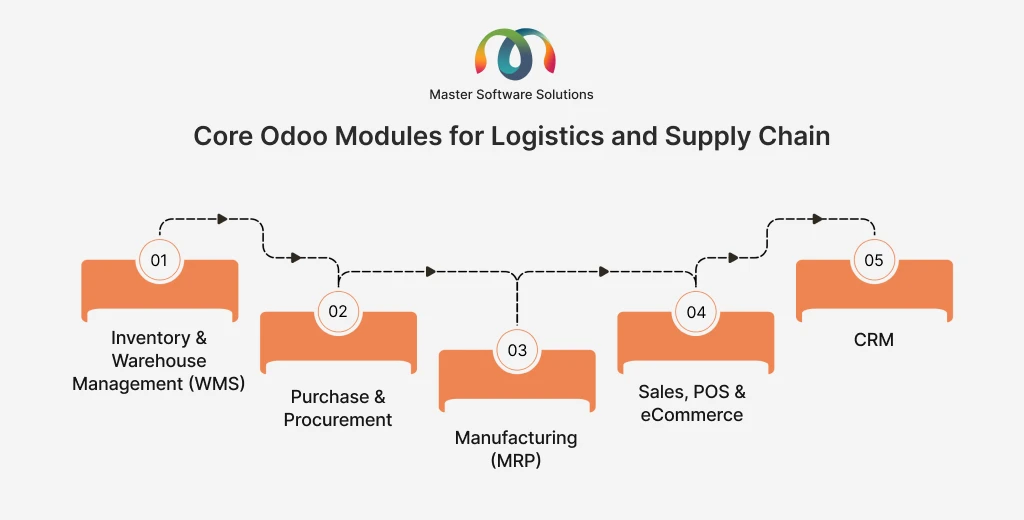
Before diving into customization, it helps to understand the foundation. These are the Odoo modules that power most logistics and supply chain builds:
Inventory & Warehouse Management (WMS)
Odoo Inventory unifies your entire supply chain, including purchasing, warehousing, and delivery, with real-time stock synchronization. Recent Odoo releases add AI-driven demand forecasting, automated replenishment, barcode scanning, and advanced picking strategies such as wave and batch picking. These features alone can dramatically cut order-processing times.
Purchase & Procurement
Automated purchase orders, vendor price lists, and reordering rules keep inventory at optimal levels. Customization here often involves multi-vendor comparison logic, approval workflows, and procurement rules tied to lead times.
Manufacturing (MRP)
Odoo MRP links work orders, inventory, and bills of materials into a single flow for companies that assemble or kit products. This is crucial for precise available-to-promise computations.
Sales, POS & eCommerce
Odoo synchronizes stock across POS, eCommerce, and warehouse channels in real time, preventing overselling. This is where Odoo website customization comes into play for customer-facing tracking portals and self-service ordering.
CRM
Managing shippers, consignees, and long-term contracts requires more than a generic pipeline. Odoo CRM customization tailors lead stages, quote automation, and account management to logistics sales cycles.
Not sure which modules your operation needs? Request a module assessment and we’ll map Odoo to your existing workflows.
High-Impact Odoo Customizations for Supply Chain Operations
This is where the real value of a specialized Odoo customization services providing company shows up. Below are the most requested and highest-ROI customizations for logistics and supply chain clients.
Multi-Warehouse and Multi-Location Routing
Standard Odoo supports multiple warehouses, but complex networks need custom routing rules, automatically assigning orders to the nearest warehouse with stock, splitting shipments across facilities, and honoring regional cutoff times. Custom push/pull routes and location strategies ensure goods move through the network with minimal manual intervention.
Carrier and Shipping Integrations
Few things frustrate logistics teams more than switching between carrier portals. Through Odoo ERP customization, developers integrate carriers (FedEx, UPS, DHL, regional couriers, and freight brokers) directly into Odoo, automatically generating labels, pulling live rates, and syncing tracking numbers back to customer records.
Barcode and RFID-Driven Warehouse Operations
Custom barcode workflows speed up receiving, put-away, picking, and cycle counting. Customization can extend Odoo’s barcode app to support device-specific scanners, custom validation rules, and mobile-first screens for warehouse staff.
Real-Time Tracking Portals and Dashboards
Customers increasingly expect Amazon-level visibility. A customized, branded tracking portal, often built through Odoo website customization, lets clients view shipment status, delivery ETAs, and documentation without calling support. Internally, custom KPI dashboards surface on-time delivery rates, dock-to-stock times, and carrier performance.
Demand Forecasting and Automated Replenishment
By tailoring reordering rules, safety-stock formulas, and forecasting inputs to your historical data, customization turns Odoo’s replenishment engine into a proactive planning tool rather than a reactive one.
EDI and Third-Party System Integrations
Large retail and logistics partners often mandate EDI. Custom connectors allow data to flow without rekeying between Odoo and marketplaces, accounting systems, TMS platforms, and EDI providers.
Custom Reporting and Compliance
From dangerous-goods documentation to customs paperwork and audit trails, custom reports and automated document generation keep operations compliant across jurisdictions.
Every customization above starts with a discovery call. Book a free Odoo strategy session with Master Software Solutions.
Odoo Website and CRM Customization for Logistics Businesses
Logistics doesn’t end at the warehouse door; the customer experience matters just as much. Two areas deserve special attention.
Odoo website customization transforms the standard Odoo site builder into a purpose-built logistics platform, featuring customer login portals, real-time shipment-tracking widgets, online quote requests, freight calculators, and self-service document downloads. Because the website is native to Odoo, every action, including a quote request, a booking, and a tracking query, flows straight into your ERP with no integration overhead.
Odoo CRM customization aligns your sales process with how logistics deals actually close. That means custom lead scoring for shippers, automated follow-ups tied to contract renewals, territory and account routing, and quote templates that pull live rates. The result is a shorter sales cycle and a single source of truth from first contact through recurring shipments.
The Odoo Customization Process: What to Expect
A reliable Odoo customization services providing company follows a structured, low-risk methodology. At Master Software Solutions, the typical engagement looks like this:
- Discovery and process mapping. We document your current workflows, pain points, and goals before writing a single line of code.
- Solution design. We define the modules, custom features, and integrations required, and just as importantly, what should stay standard to protect upgradeability.
- Development in a staging environment. Customizations are built as separate modules, keeping the Odoo core clean.
- Testing and UAT. Your team validates real-world scenarios before go-live.
- Deployment and data migration. We migrate historical data and launch with minimal disruption.
- Training and ongoing support. Adoption is where ROI is won or lost, so we train your team and provide continued Odoo ERP customization services as your needs evolve.
This disciplined approach is what separates sustainable, upgrade-safe builds from the “custom code sprawl” that traps many businesses on outdated versions.
How to Choose an Odoo Customization Partner in the USA
Selecting the right Odoo customization partner in the USA is as important as the software itself. Here’s what to evaluate:
- Odoo expertise and certifications. Look for a certified partner with a track record of complex, logistics-focused implementations and not just plug-and-play setups.
- Domain knowledge. The supply chain has its own vocabulary and constraints. A partner who understands 3PL, distribution, and freight will design smarter solutions from day one.
- Upgrade-safe development practices. Ask how they structure custom code. Well-built modules should survive version upgrades; poorly built ones lock you in place.
- Full-lifecycle support. Customization is ongoing. Choose a partner offering Odoo ERP customization services, support, and enhancements, and not just a one-time project.
- Transparent communication. Time zones, response times, and clear reporting matter, especially for U.S. businesses that need dependable collaboration.
Master Software Solutions checks every one of these boxes as an experienced Odoo customization services provider serving logistics and supply chain clients across the USA and beyond.
Real-World Benefits: What Customization Delivers
When Odoo is properly tailored to a logistics operation, the results compound:
- Fewer errors from eliminated manual data entry and automated validations
- Faster fulfillment through optimized picking, routing, and carrier integration
- Real-time visibility across inventory, shipments, and KPIs
- Lower operating costs by reducing overtime, stockouts, and excess inventory
- Happier customers thanks to accurate ETAs and self-service portals
- Scalability to add warehouses, channels, or product lines without re-platforming
For a deeper look at broader supply-chain technology trends shaping these outcomes, the Council of Supply Chain Management Professionals (CSCMP) publishes respected industry research and benchmarks.
Conclusion
Logistics and supply chain success hinges on visibility, speed, and control, and no off-the-shelf ERP delivers all three without tailoring. Odoo ERP customization turns a flexible open-source platform into a purpose-built command center for your warehouses, shipments, and customers. From multi-warehouse routing and carrier integrations to branded tracking portals and demand forecasting, the right customizations pay for themselves in efficiency, accuracy, and customer loyalty.
The key is choosing an experienced partner who builds smart, upgrade-safe solutions around your actual workflows. As a specialized Odoo customization services provider and Odoo customization partner in the USA, Master Software Solutions helps logistics and supply chain businesses do exactly that.
Take the next step. Whether you need Odoo CRM customization, Odoo website customization, or a full supply chain build, our team is ready. Contact Master Software Solutions today for a free consultation and see how tailored Odoo can transform your operations.