Every growing business hits the same wall with Odoo. The core ERP runs beautifully, but your data lives everywhere else too, including in QuickBooks, Shopify, on your POS terminals, and inside your payment gateway. Until those systems talk to each other, your team is stuck copying numbers between tabs and hoping nobody fat-fingers an invoice.
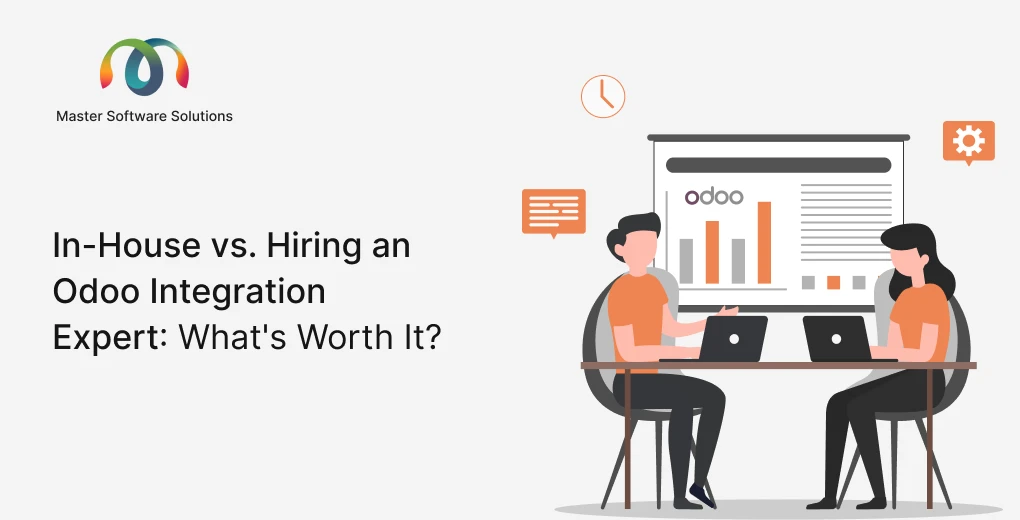
So you face a decision that costs real money either way: build the integration with your own people, or bring in an Odoo integration expert to do it. Get it right, and you save months and a small fortune. Get it wrong, and you pay twice, once for the failed attempt and again to fix it.
This guide breaks down the honest trade-offs so you can decide what’s actually worth it for your business, not just what looks cheaper on a spreadsheet.
Short on time? If you already know integration isn’t your team’s core strength, skip ahead and talk to our Odoo integration specialists. We’ll scope it for free.
What “Odoo Integration” Actually Means
Before comparing who should do the work, it helps to be clear about what the work is. Odoo integration is the process of connecting Odoo to other software your business depends on so data flows automatically between them without manual re-entry.
In practice, most companies need one or more of these:
- Odoo-QuickBooks integration: syncing invoices, payments, and chart-of-accounts data so your books stay accurate.
- Odoo Shopify integration and Odoo WooCommerce integration: pushing orders, inventory, and customers between your storefront and ERP in near real time.
- Odoo ecommerce integration more broadly: connecting any online sales channel to fulfillment and stock.
- Odoo POS integration: unifying in-store sales with online and back-office inventory.
- Odoo payment gateway integration: routing Stripe, PayPal, Razorpay, or Authorize.Net transactions straight into Odoo.
- Odoo accounting integration: closing the loop between sales, payments, and financial reporting.
- Odoo API integration: the underlying technical layer (Odoo’s XML-RPC and JSON-RPC APIs, plus REST middleware) that makes all of the above possible.
This is the world of professional Odoo integration services: a specialized discipline that sits between ERP configuration and software engineering. Whoever does the work, your team or an outside expert, needs to understand both Odoo’s data model and the quirks of every external system it connects to.
The Case for Building Odoo Integrations In-House
Doing it yourself isn’t always the wrong call. Here’s when in-house genuinely makes sense.
You already have real Odoo and API talent
If someone on your team already knows Python, Odoo’s ORM, and how to authenticate against a REST or Odoo API integration endpoint, a simple connector might be well within reach. A one-way sync of orders from a single Shopify store into Odoo is a very different beast from a bidirectional, multi-warehouse, multi-currency Odoo ERP integration.
The integration is small, stable, and low-risk
Some integrations barely change once they’re live. If you’re pushing daily sales totals into an accounting module and the data rarely breaks, an in-house script may run happily for years. Low complexity plus low change frequency is the sweet spot for building it yourself.
You want maximum institutional knowledge
When your own engineers build the integration, the knowledge stays in-house. Nobody has to reverse-engineer a departed contractor’s code. For businesses that view software as a core competency, this can be worth the extra effort.
The honest costs of in-house
That said, the “free because we already pay them” logic hides real expenses:
- Opportunity cost. Every week your developer spends wrestling with Odoo’s API is a week they’re not building your actual product or serving customers.
- The learning curve is steep. Odoo’s version-to-version changes, undocumented edge cases, and webhook reliability issues eat time that experienced specialists have already paid for.
- Maintenance never ends. APIs change. Shopify updates its order schema. QuickBooks rotates authentication, and Odoo releases a new version. Someone has to own that forever.
- Key-person risk. If the one person who understood the integration leaves, you inherit a black box.
Not sure your team has the bandwidth? A short conversation can save you a bad quarter. Get a free integration readiness assessment.
The Case for Hiring an Odoo Integration Expert
An Odoo integration expert is a specialist, often part of a certified Odoo partner team, who does these connections for a living. Here’s what you’re really paying for.
Speed to value
A specialist has built Odoo-QuickBooks integration and Odoo-Shopify integration dozens of times. What might take your team three months of trial and error, they’ve done before and can deliver in weeks. In a fast-moving business, that time gap is often the entire ROI argument.
They’ve already hit the edge cases
Real integration pain lives in the details: tax mapping between systems, partial refunds, multi-currency rounding, and inventory conflicts when two channels sell the last unit at the same second. An experienced provider of Odoo ecommerce integration has already been burned by these and built guardrails against them.
Reliability and support
Professional Odoo integration services usually come with monitoring, error handling, and a support agreement. When a sync fails at 2 a.m. during a flash sale, there’s a defined process to fix it, not a frantic Slack message to whoever’s awake.
Scalability built in
A good expert designs your Odoo API integration to grow. Adding a second sales channel, a new Odoo payment gateway integration, or an Odoo WooCommerce integration later becomes an extension of existing work rather than a fresh project from zero.
The honest costs of hiring out
Fairness cuts both ways:
- Higher upfront cost. You’ll pay more on day one than an internal “we’ll just build it” estimate, though that internal estimate is almost always optimistic.
- Vendor dependency. You need a partner who documents their work and won’t hold you hostage. (Ask about code ownership and handover before you sign.)
- Communication overhead. An external team needs clear requirements and access, which takes coordination.
By being open, meticulous in their documentation, and frequently costing less over the entire lifecycle than an in-house build that stalls midway, the right expert offsets all three.
In-House vs. Odoo Integration Expert
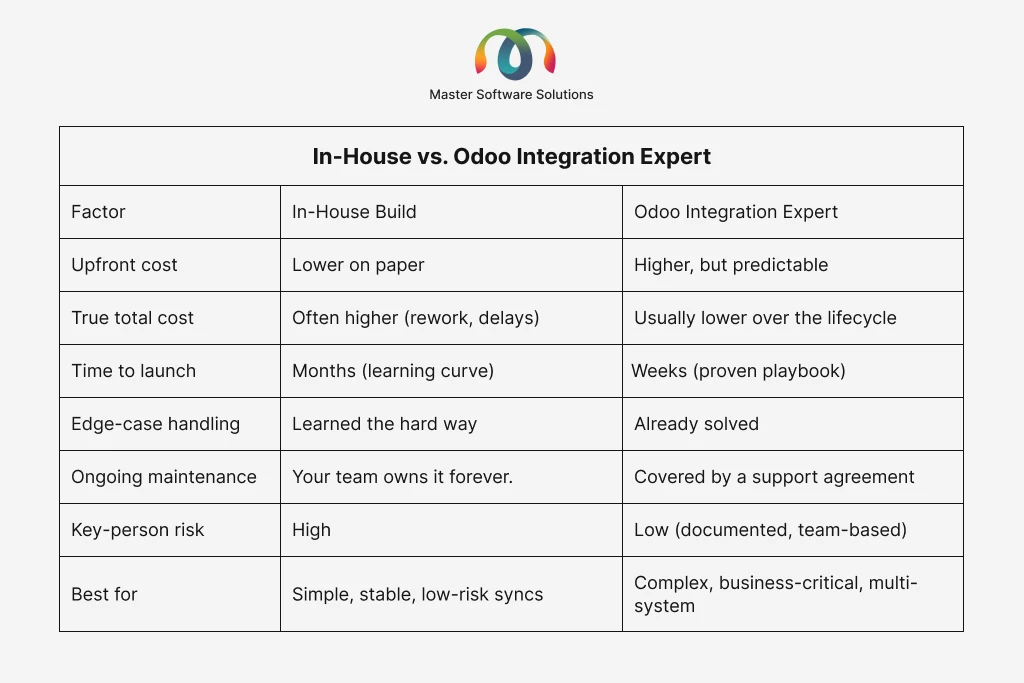
How to Decide: A Simple Framework
Instead of a gut call, run your project through four questions.
Q1. How business-critical is this integration?
If a broken sync stops orders, stops payments, or corrupts your books, the cost of downtime dwarfs the cost of hiring a specialist. Business-critical work, including most Odoo accounting integration and Odoo payment gateway integration projects, falls here and leans strongly toward an expert.
Q2. How complex is the data flow?
One-directional, one system, rarely changing? In-house is defensible. Bidirectional, multiple channels, real-time inventory, and tax and currency logic? That’s expert territory.
Q3. What’s the real opportunity cost of your team?
Multiply your developer’s fully loaded weekly cost by the number of weeks. Compare that to a fixed-scope quote. The comparison surprises most owners.
Q4. Who maintains it in year two?
Integrations aren’t “done” at launch. If you don’t have a clear, funded plan to maintain it internally, an expert with a support agreement is the safer economic choice.
If you answered “critical,” “complex,” “expensive,” or “unclear” to any of these, a specialist is almost certainly worth it.
The Hybrid Approach Most Growing Businesses Land On
The smartest answer is often not either/or. Many companies:
- Hire an expert to build the foundation: the hard, high-risk Odoo ERP integration work, done right the first time.
- Keep light maintenance in-house: small config tweaks and monitoring, handled by internal staff once the system is documented.
- Re-engage the specialist for major changes: new channels, a fresh Odoo POS integration, or a version migration.
This gives you the reliability of expert work and the responsiveness of an internal team, without paying for either at full scale. If you’re weighing whether to grow your own capability, our guide to when to hire dedicated Odoo developers walks through the staffing side of the same decision.
Real-World Scenarios
A retailer with Shopify + physical stores
They need Odoo Shopify integration, Odoo POS integration, and unified inventory across both. This is high-complexity, business-critical, real-time work.
Verdict: hire an expert.
A B2B firm syncing daily invoices to QuickBooks
One direction, one system, stable schema, nightly batch.
Verdict: in-house is reasonable if the skills exist.
A DTC brand on WooCommerce adding Stripe
They need Odoo WooCommerce integration plus Odoo payment gateway integration, with refund and reconciliation logic. Getting money movement wrong is expensive.
Verdict: hire an expert, keep monitoring in-house.
The Bottom Line: What’s Worth It?
Building Odoo integration in-house makes sense when the work is simple, stable, and low-risk, and you already have genuine Odoo and API talent to spare. For anything business-critical, complex, or money-related, QuickBooks, Shopify, WooCommerce, POS, payment gateways, and an Odoo integration expert almost always win on total cost, speed, and peace of mind.
The most common regret isn’t hiring an expert. It’s spending three months on an in-house build, watching it stall, and then paying a specialist to rescue it anyway.
If you’d rather get it right the first time, Master Software Solutions delivers end-to-end Odoo integration services, from Odoo Shopify integration and Odoo QuickBooks integration to custom Odoo API integration and Odoo payment gateway integration.
Let’s figure out what’s worth it for your business. Request your free integration consultation today