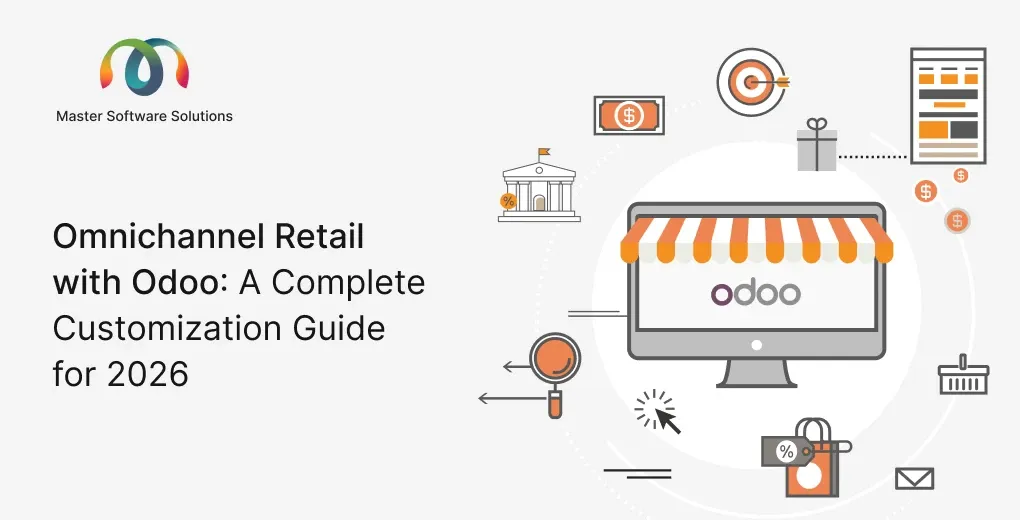
Retail no longer happens in one place. A shopper discovers a product on Instagram, checks the price on your website, walks into your store to see it in person, then completes the purchase on their phone in the parking lot, expecting the same price, the same loyalty points, and the same availability at every step. That is omnichannel retail, and it only works when every system behind the scenes speaks the same language.
Odoo has become one of the most popular platforms for building this connected experience, largely because it is modular and open. But out of the box, Odoo is a general-purpose ERP. To turn it into a retail engine that unifies online, in-store, and back-office operations, businesses invest in Odoo customization.
This guide explains exactly how retailers customize Odoo for omnichannel, what they change, why it matters, and how to get it right.
Why Omnichannel Retail Needs Odoo Customization
Standard Odoo gives you the building blocks: Point of Sale, eCommerce, Inventory, CRM, Accounting, and Marketing. The gap appears when those blocks need to behave like a single, retail-specific system.
A clothing brand selling on its website, in three physical stores, on Amazon, and through a WhatsApp catalog has dozens of edge cases that no default configuration anticipates: how to reserve stock for online orders without disappointing walk-in customers, how to apply a store-specific promotion online, how to let a customer return an online purchase in-store, or how to merge two customer records that represent the same person. Solving these requires industry-specific Odoo ERP customization, adjusting workflows, data models, and integrations to fit how the business actually sells.
This is why most retailers work with an Odoo customization services providing company rather than doing it in-house. According to Odoo’s official documentation, the platform is designed to be extended through custom modules, and doing that well takes deep knowledge of Odoo’s ORM, security model, and upgrade path.
The Core Pillars of an Omnichannel Odoo Setup
Before diving into specific customizations, it helps to understand the four pillars every omnichannel retail deployment rests on. Nearly all Odoo customization services map back to one of these.
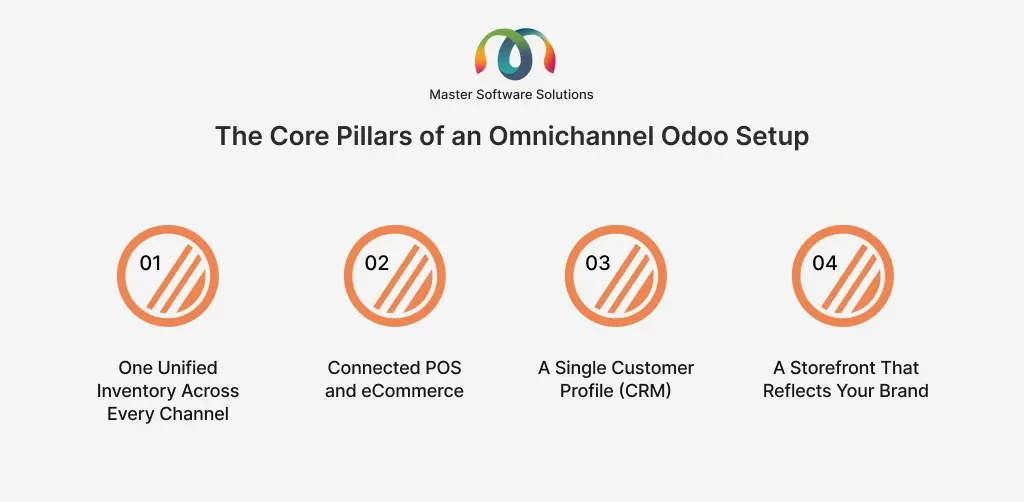
One Unified Inventory Across Every Channel
The single most important promise of omnichannel is that stock is accurate everywhere at once. When a customer buys the last unit in-store, the website should reflect that within seconds so no one online orders a product that no longer exists.
Odoo’s Inventory module supports real-time stock synchronization across warehouses, stores, and sales channels. Retailers can drastically reduce overselling and stockouts by customizing it.
Typical customizations include:
- Multi-warehouse and multi-location logic so each store, dark store, and fulfillment center is tracked separately but rolls up into a single view.
- Stock reservation rules that decide whether online or in-store demand takes priority.
- Automated replenishment triggers tuned to each location’s velocity rather than one global rule.
- Buy-online-pickup-in-store (BOPIS) and ship-from-store routing that require custom stock moves.
Connected POS and eCommerce
Odoo’s Point of Sale and eCommerce modules can share the same product catalog, pricing, and inventory. The value of Odoo ERP customization services here is making the two channels behave consistently even when the business logic differs.
Common work includes syncing loyalty points earned online with in-store redemption, unifying gift-card balances, letting the POS pull up a customer’s online order history, and enabling cross-channel returns and exchanges. Custom logic ensures that the POS’s real-time updates to all sales channels result in the appropriate accounting entries and inventory movements.
A Single Customer Profile (CRM)
Omnichannel falls apart if the same shopper looks like three different people to your systems. Odoo CRM customization stitches together data from the website, POS, marketplaces, and support desk into one unified customer profile.
Customized Odoo CRM lets retailers see a customer’s complete purchase history regardless of channel, segment audiences for targeted campaigns, personalize offers based on behavior, and give store associates the context they need to deliver clienteling-level service. This unified view is the foundation for loyalty programs and retention marketing.
A Storefront That Reflects Your Brand
Your website is often the first and most frequent touchpoint. Odoo website customization goes beyond swapping a logo; it means building a storefront that matches your brand, loads fast, converts well, and integrates with the rest of the stack.
This includes custom themes and page layouts, product configurators, dynamic pricing displays, custom checkout flows, and integrations with payment gateways and shipping carriers relevant to your region.
Ready to unify your channels? Explore our Odoo customization services to see how we tailor each of these pillars to your retail model
How Retailers Actually Customize Odoo for Omnichannel: Step by Step
Understanding the pillars is one thing; executing is another. Here is the practical sequence experienced teams follow.
Step 1: Map Every Channel and Touchpoint
Before writing a line of code, a good Odoo customization partner in the USA will audit how you sell. Which channels are live? Where does data live today? Where do customers drop off? This map serves as a guide for what must be connected and keeps you from creating unnecessary integrations.
Step 2: Configure Before You Customize
The most cost-effective omnichannel setups exhaust Odoo’s native configuration first. A large share of what businesses assume requires custom development can be achieved with pricelists, inventory routes, POS settings, and website blocks. Real Odoo ERP customization begins only where configuration ends; this keeps your system easier to maintain and upgrade.
Step 3: Build Custom Modules for Retail-Specific Logic
When native features aren’t enough, developers build custom Odoo modules. Typical examples in omnichannel retail:
- Custom loyalty and rewards engines that work identically online and offline.
- Order orchestration logic for ship-from-store, BOPIS, and split shipments.
- Region-specific tax, invoicing, and compliance rules.
- Custom dashboards that consolidate KPIs across every channel in one screen.
Step 4: Integrate Third-Party Platforms
Few retailers live entirely inside Odoo. Most need to connect marketplaces and tools like Shopify, WooCommerce, Magento, Amazon, payment processors, shipping aggregators, and accounting or tax software. Odoo customization services here focus on reliable, two-way data sync so inventory and orders never fall out of alignment.
Step 5: Customize the Website and Checkout
With the back end connected, teams turn to the storefront. Odoo website customization at this stage means optimizing for conversion and speed: mobile-first design, streamlined checkout, personalized product recommendations pulled from CRM data, and SEO-friendly page structures.
Step 6: Test, Train, and Iterate
Omnichannel touches many teams, so rollout includes thorough testing of edge cases (returns, partial refunds, out-of-stock handling) and staff training. The best deployments use real transaction data to refine rules, treating launch as the start.
Not sure where to start? Request a free Odoo audit, and we’ll tell you what to configure versus customize.
Real Business Benefits of a Customized Omnichannel Odoo Setup
Investing in Odoo ERP customization services pays off in measurable ways:
- Fewer stockouts and less overselling thanks to real-time inventory sync across channels.
- Faster fulfillment by routing orders to the nearest or best-stocked location.
- Higher average order value from personalized, CRM-driven recommendations.
- Stronger loyalty because points, offers, and history follow the customer everywhere.
- Better decisions from unified dashboards that consolidate online, in-store, and marketplace performance in one place.
- Lower operating costs by replacing a patchwork of disconnected tools with one system.
Retail is competitive, and the difference between a frustrating shopping experience and a seamless one increasingly comes down to how well the systems behind the counter are connected. That connection is precisely what thoughtful Odoo customization delivers.
Common Mistakes to Avoid
Even strong teams stumble. Watch for these:
Over-customizing too early
Every custom module is code you must maintain and test on each Odoo upgrade. Configure first; customize only where it creates real value.
Ignoring data quality
A unified customer profile is only as good as the data feeding it. You must clean and deduplicate records before you merge channels.
Skipping the upgrade path
Poorly written customizations can trap you on an old Odoo version. Work with an Odoo customization services providing company that follows Odoo’s development standards so you can upgrade smoothly.
Treating the website as an afterthought
Your storefront is where most first impressions happen. Invest in Odoo website customization with the same seriousness as your back-office logic.
Why Choose Master Software Solutions as Your Odoo Customization Partner in the USA
Building omnichannel retail on Odoo is not a plug-and-play project—it rewards experience. As an established Odoo customization partner in the USA, Master Software Solutions helps retailers move from disconnected channels to one unified system without over-engineering the build.
Our team covers the full spectrum of Odoo customization services: ERP configuration, custom module development, Odoo CRM customization, Odoo website customization, third-party integrations, and ongoing support. We start by understanding how you sell, recommend what to configure versus build, and deliver a setup that scales as you grow. Beyond retail, we also deliver Odoo ERP customization tailored to your industry, from manufacturing to distribution.” Only use this if the target page covers those industries.
Let’s build your omnichannel advantage. Get in touch with Master Software Solutions for a tailored Odoo roadmap — no obligation, just a clear plan.