If you’re running a growing business in 2026, you’ve probably felt the friction: your online store is on Shopify, your inventory lives in a spreadsheet, your accounting is in QuickBooks, and your customer data sits in a separate CRM. Every week, your team wastes hours reconciling systems that were never designed to talk to each other.
That’s exactly why thousands of businesses are switching to Odoo eCommerce and why the numbers keep climbing. Odoo reported a 40% increase in new implementations in 2025 alone, with that growth accelerating well into 2026.
This isn’t a coincidence. It’s the result of a platform that has matured into a genuine all-in-one solution for scaling businesses. Here’s why the switch is happening and why it might be the right move for you, too.
The All-in-One Advantage
The most common pain point for growing businesses isn’t a lack of tools; it’s having too many tools that don’t work together.
Odoo eCommerce is built as a native module within the broader Odoo ERP ecosystem. That means your online store is directly connected to:
- Inventory & Warehouse Management: real-time stock levels across all channels
- Accounting & Invoicing: automated order-to-cash workflows
- CRM & Sales: every customer interaction captured in one place
- Shipping & Fulfillment: integrated with major carriers
- Email Marketing: segment and target customers from the same platform
When a customer places an order on your Odoo store, the inventory adjusts instantly, an invoice generates automatically, and your CRM updates in real time. There are no sync delays and no human error from manual data entry — the failure mode that cost one wholesale manufacturer hours a week in duplicate-SKU cleanup before we consolidated it.
For a business processing hundreds or thousands of orders a month, this is transformative.
Ready to eliminate tool sprawl? Talk to our Odoo implementation team and get a free consultation tailored to your business.
Odoo vs. Shopify, WooCommerce & Magento in 2026
Shopify, WooCommerce, and Magento each have their strengths, but they share a common weakness: they are storefronts, not business operating systems.
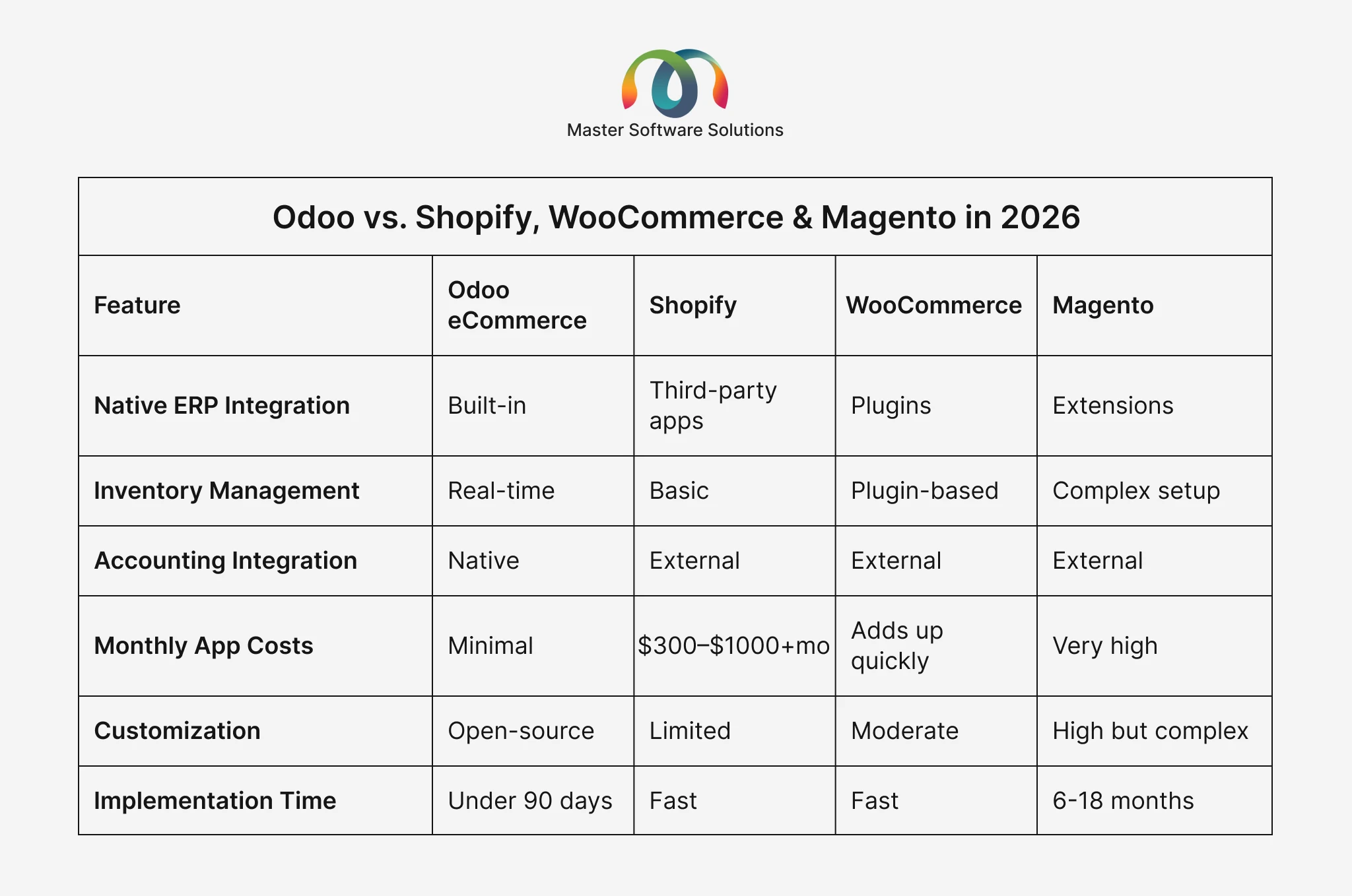
As your business scales, Shopify’s transaction fees and mandatory app subscriptions can quietly eat into your margins. WooCommerce becomes a maintenance burden. Magento demands significant developer resources.
Odoo’s modular pricing model means you pay for what you use, not per transaction. Are you considering a migration? Our team specializes in seamless Odoo integration and migration services from Shopify, WooCommerce, and Magento.
Odoo 19 eCommerce Features
Odoo 19, released in late 2025, brought the platform to parity with, and in many areas beyond, the leading standalone eCommerce platforms. If you want the full module-by-module breakdown, our detailed review of Odoo eCommerce features and benefits covers all 12 core capabilities, pricing tiers, and where the platform falls short. Here’s what’s turning heads:
Drag-and-Drop Website Builder with Business Logic Built In
Odoo’s website builder isn’t just visual; every block you drop has business functionality baked in. Product carousels pull live inventory. Promotional banners apply discount rules. Customer portals show live order status. You do not need a developer for the day-to-day.
Advanced Product Configuration
Configurable products with variants, attributes, and pricing rules are fully supported. Whether you’re selling custom apparel, B2B equipment bundles, or subscription boxes, Odoo handles complex product catalogs elegantly.
Mobile-First by Default
All Odoo eCommerce stores are mobile-responsive out of the box. With mobile commerce accounting for over 70% of eCommerce traffic in 2026, this isn’t optional; it’s essential.
Cart Abandonment Recovery
Odoo 19 introduced native cart abandonment email workflows, allowing you to automatically follow up with customers who didn’t complete their purchase without a third-party tool.
B2B eCommerce Portal
Odoo’s B2B capabilities are a standout feature. Customer-specific pricing, quote request workflows, punchout catalog support, and a self-service portal make it the platform of choice for wholesale and B2B-heavy businesses.
AI-Powered Product Recommendations
Personalised upsell and cross-sell suggestions powered by Odoo’s built-in AI engine drive higher average order values without manual configuration.
Real Cost Savings
Let’s talk numbers. A mid-sized business running Shopify Plus with standard integrations typically looks like this:
- Shopify Plus subscription: $2,300/month
- Inventory management app: $300/month
- Email marketing tool: $200/month
- Accounting sync app: $150/month
- CRM integration: $200/month
- Transaction fees (0.15% on $500K/year): $750/month
Total: ~$3,900/month or $46,800/year
A comparable Odoo setup, including eCommerce, Inventory, Accounting, CRM, and Email Marketing, typically costs a fraction of that, with no per-transaction fees and one unified support contract.
Over three years, the savings for a scaling business often exceed six figures. Want a cost comparison for your specific setup? Contact Master Software Solutions for a detailed ROI analysis.
SEO & Digital Marketing: Odoo’s Built-In Growth Engine
A beautiful store that no one can find is worthless. Odoo eCommerce comes with a robust set of SEO and marketing tools built natively into the platform:
- SEO-friendly URLs: clean, customizable URLs for every product, category, and page
- Meta tag management: title and description fields on every page, manageable without a developer
- Sitemap auto-generation: always up-to-date, submitted automatically to search engines
- Structured data / Schema markup: product rich snippets for Google Search
- Blog module: content marketing built directly into your store
- Google Analytics & Search Console integration: one-click setup
- A/B testing: test landing pages and product pages to maximize conversion
In 2026, with AI search engines like Google’s AI Overviews and Perplexity increasingly directing commerce traffic, structured data and fast-loading pages matter more than ever. Odoo’s performance-optimized architecture is built for this reality.
Odoo eCommerce for B2B Businesses
If you operate in the B2B space, Odoo eCommerce deserves special attention. Most e-commerce platforms are designed primarily for B2C, and B2B is an afterthought.
Odoo flips this. Its B2B eCommerce capabilities include the following:
- Customer-specific pricing: different price lists for different customers or tiers
- Purchase order workflows: customers can submit POs directly through the portal
- Credit limit management: control payment terms per account
- Sales rep assignment: each B2B account is connected to a dedicated rep in CRM
- Quote-to-order online: customers view quotes, negotiate, and confirm online
For distributors, manufacturers, and wholesalers managing complex account relationships, this is functionality that would require expensive custom development on any other platform.
Running a B2B operation? Learn how Odoo customization services from Master Software Solutions can tailor the B2B portal to your exact workflows.
Implementation Timeline: How Fast Can You Go Live?
One of the biggest concerns businesses have when considering an ERP-backed eCommerce platform is implementation time. The reputation of “ERP projects taking years” is well-earned for legacy systems.
Odoo is different. Most businesses go live in under 90 days with the right implementation partner. A typical timeline looks like:
- Week 1-2: Discovery, requirements mapping, environment setup
- Weeks 3-5: Store configuration, product catalog migration, theme setup
- Weeks 6-8: ERP modules setup (Inventory, Accounting, CRM)
- Weeks 9-10: Integrations, payment gateway setup, testing
- Weeks 11-12: Training, UAT, and go-live
The key is choosing a certified Odoo partner who has done this before. Master Software Solutions has delivered 200+ Odoo implementations across retail, wholesale, manufacturing, and services — and we’ve refined this process to minimize disruption to your business.
Planning your switch? Explore our Odoo implementation services and see how we structure a risk-free migration.
Ongoing Support and Scalability: Built to Grow With You
Switching platforms is a big decision. What happens after go-live matters just as much as the migration itself.
Odoo’s open-source architecture means you’re never locked into a vendor’s roadmap. You can customize, extend, and adapt the platform as your business evolves without waiting for a SaaS provider to add the feature you need.
For ongoing peace of mind, Master Software Solutions offers dedicated Odoo support and maintenance services, including:
- Proactive system monitoring
- Regular version updates and security patches
- Bug fixes and performance optimization
- Feature enhancements and new module rollouts
As Odoo continues to release updates, with Odoo 20 expected in late 2026, having a dedicated support partner ensures your store stays current and competitive.
The Bottom Line
Growing businesses in 2026 are switching to Odoo eCommerce because they have outgrown simple platforms and require more scalability.
The combination of a fully integrated ERP backbone, a mature and capable storefront, competitive pricing, and rapid implementation timelines makes Odoo the most compelling eCommerce platform for businesses with ambitions beyond the basics.
The question isn’t whether Odoo can handle your business. It’s whether your current platform can keep up with where your business is going.
Ready to Make the Switch? Master Software Solutions is a certified Odoo Partner with 13+ years of experience and 90+ Odoo-certified professionals. We’ve helped 200+ businesses across the US, Canada, and India go live on Odoo on time and within budget. Get Your Free Odoo eCommerce Consultation.