A roastery owner asks three different Odoo partners for a quote on a similar project that includes the same basic need to connect sales, inventory & accounting. One company quoted at $16,000, another at $70,000 & a software company came up with $110,000 with batch costing & traceability as per their business objective. The question is: which number is real, the cheapest one or the most expensive one?
This confusion is normal for businesses because ERP implementation cost is not a single number, it’s basically a sum of specific decisions like how many users, how much customization is required, batch costing, rental billing & many more. This article breaks down exactly where coffee ERP implementation costs come from & what the real surprises are after the contract is signed.
Why There’s No Single Price Tag for a Coffee ERP Implementation
Coffee ERP implementation is a running project & projects scale with scope. There are a few factors that actually drive the final number.
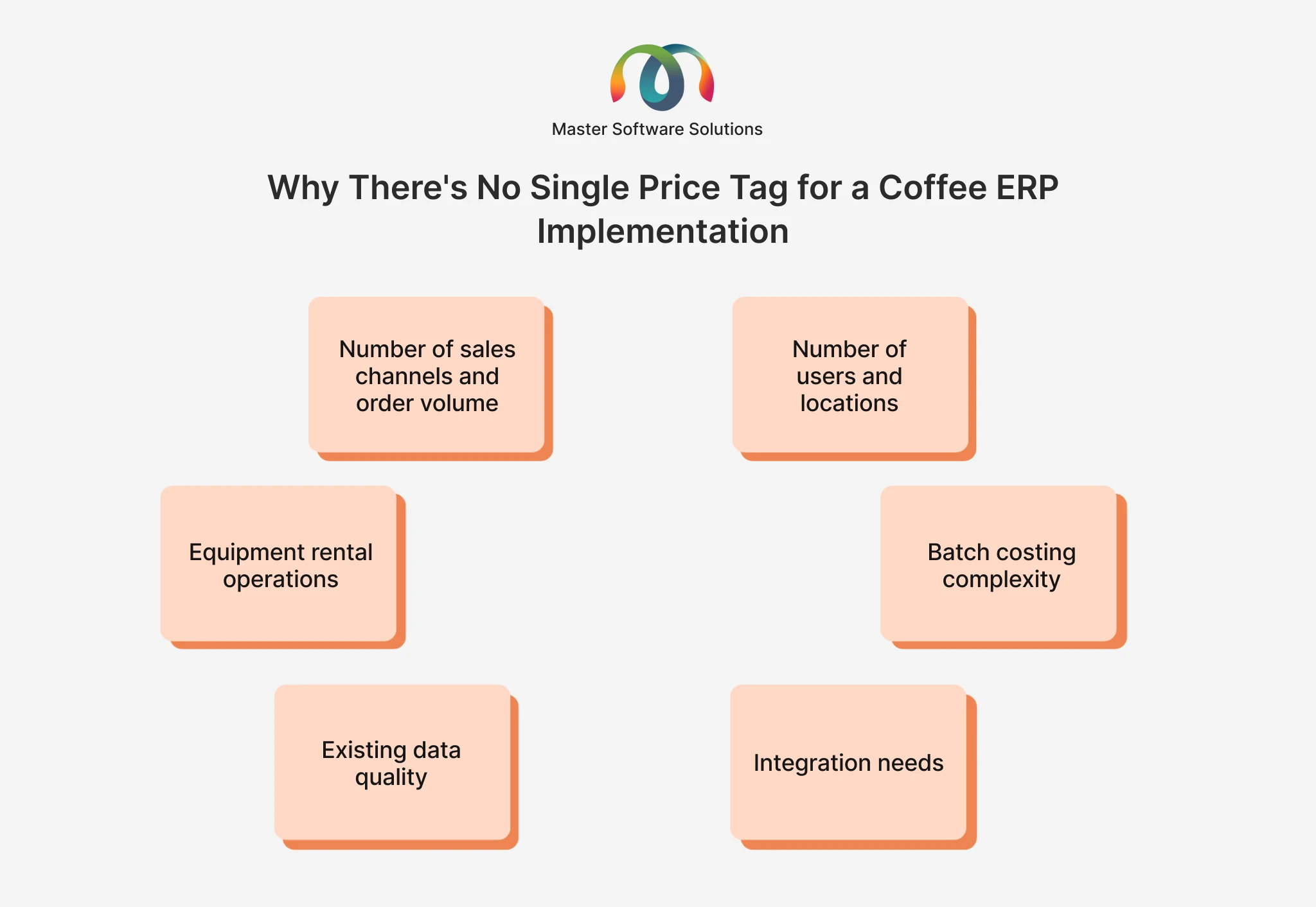
Number of sales channels and order volume
A roastery running wholesale orders via one channel needs less configuration than one managing wholesale, retail, and subscription orders.
Number of users and locations
A single-site operation with more users is fundamentally smaller than a business coordinating multiple roasting locations or warehouses.
Equipment rental operations
Coffee businesses leasing espresso machines and roasters to wholesale accounts need recurring billing, deposit tracking, and maintenance workflows built in; none of this is included in the standard setup.
Batch costing complexity
Tracking cost per batch across multiple product lines, including roast shrinkage and consuming more labor time, takes more configuration than a single-product operation.
Existing data quality
A coffee business that migrates well-organized records moves faster and cheaper than one that contains years of inconsistent spreadsheets and disconnected systems.
Integration needs
Connecting the coffee ERP software to the existing e-commerce platforms, payment processors, or accounting tools takes more development time than a self-contained setup.
Core Cost Components of an Odoo Coffee ERP Implementation
Every ERP implementation, whether it’s small or large, has some common cost components that need to be figured out.
- Licensing: Odoo Enterprise runs approximately $173 per user per month when billed annually, with Odoo.sh cloud hosting, external APIs & Agentic AI. The rough estimate is around $70 to $100 per month, depending on the customization needed. Whereas Odoo Community is free but needs hands-on expertise to extend further.
- Implementation services: This is usually the major point of concern and includes configuration, workflow setup, and testing. U.S.-based developers typically charge $100 to $200 per hour, while certified offshore partners with U.S. project oversight run closer to $35 to $75 per hour.
- Customization: Anything beyond Odoo’s out-of-the-box functionality, whether it is a custom rental billing workflow or batch costing report, Odoo customization adds development time on top of the standard configuration.
- Data migration: Data is a major concern coffee businesses care about. Moving existing customer records, pricing history, and inventory data into the new system, and clearing up in the process, is consistently underestimated in time and cost.
- Training and change management: Hiring an experienced employee or trainee: they need to be comfortable using the new system in its project phase, rather than going through training & sessions.
- Ongoing support: Post-launch, a managed support retainer typically runs approximately $1,000 to $5,000 per month, and a major version upgrade costs approximately $5,000 to $20,000 depending on how customized it is required.
Putting the complete cost components together, the breakdown of Odoo implementation cost in the USA enables small & mid-size businesses to get a clear idea of the pricing structure & what the market actually needs.
What Makes a Coffee Business’s Implementation Cost Higher
Coffee is a commodity whose prices vary with time, and a coffee roaster is not a generic retail or service business. It entirely depends upon lot traceability, batch costing, and catch weight billing for packaged coffee sold at slightly variable weights.
Other than that, equipment rental workflows to monthly sales are not something that standard ERP configuration handles automatically. Each of these either needs custom development or a partner who already builds similar logic for another coffee client.
Both of the above paths cost more than a sales & inventory setup. That’s exactly the gap most generic ERP quotes don’t care about.
The Hidden Costs Nobody Quotes You Upfront
The number on the initial proposal is rarely the number on the final invoice. This broader analysis flags data migration and extended testing for regulated or compliance-sensitive processes, as well as underestimating internal staff time.
This is not a rare outcome either. Panorama’s 2026 ERP Report found that more than a quarter of organizations went over their original ERP implementation budget, which is a clear sign of the hidden costs of ERP implementations. The key focus is not on assuming the lowest number; it’s specifically what’s included in that number & what will be added later.
How to Avoid Paying More Than You Should
The businesses that signed closest to their original budget should follow a handful of things, including:
- Define actual business requirements and document existing processes before requesting quotes.
- Consider data cleanup as its own project phase with dedicated time and cost.
- Hire an implementation partner based on relevant industry experience and transparent pricing, not just their written knowledge.
- For businesses that already have Odoo & need coffee-specific workflows built on top, understand what’s involved in Odoo customization before requesting it.
Conclusion
Coffee ERP implementation costs vary based on customizations & integrations. The roastery owner who stands at three widely different quotes is not choosing between the right price; they are choosing between three different scopes & the real job is to figure out which scope actually matches your business. A quote that looks cheaper on paper but skips batch costing or rental billing is not considered a better deal. The right comparison was never quote-to-quote; it’s matching each proposal against what your roastery actually runs. Get in detail on Odoo ERP implementation to fulfill your coffee business needs.
Master Software Solutions provides end-to-end ERP solutions to streamline & optimize your entire supply chain & coffee vending machine rentals. Get our reliable Coffee ERP implementation services tailored to your coffee needs.