If you’re evaluating Odoo for your business, the first question on your mind is almost certainly, “What’s this going to cost me?” The honest answer depends. But “it depends” isn’t actionable, so this guide breaks down every cost component, from licensing to post-go-live support, so you can build a realistic budget before you talk to a single vendor.
At Master Software Solutions, we’ve delivered Odoo implementations for businesses across manufacturing, retail, logistics, e-commerce, and more. This guide reflects real-world numbers, not marketing estimates.
What Is Odoo and Why Are Businesses in the USA Choosing It?
Odoo is an open-source, modular ERP platform that covers CRM, accounting, inventory, manufacturing, HR, e-commerce, project management, and dozens of other functions under one roof. Unlike legacy ERP systems, Odoo scales from a 10-person startup to a 5,000-employee enterprise, and its pricing model reflects that flexibility.
U.S. businesses are increasingly choosing Odoo over SAP, Oracle NetSuite, and Microsoft Dynamics because of its:
- Lower total cost of ownership compared to enterprise ERPs
- Modular architecture, meaning pay only for what you use
- Active open-source community and regular version releases
- Strong partner ecosystem for local implementation support
Read more: Top Benefits of Odoo Implementation for Growing Businesses
Odoo Licensing Cost: Community vs. Enterprise
Before implementation costs come into play, you need to choose an Odoo edition. For a full breakdown of what’s changed across releases, see our Odoo Versions Explained: Complete Guide from V14 to V19.
Odoo Community (Free)
The Community edition is open-source and free to download. You get core modules, including CRM, sales, purchase, inventory, accounting basics, and manufacturing, with no per-user licensing fee. However, Community lacks several features that most mid-size U.S. businesses require: advanced reporting, Studio (low-code customizer), IoT integration, eSign, and dedicated Odoo support.
Odoo Enterprise
Enterprise is the commercial edition, hosted either on Odoo’s cloud (Odoo.sh or odoo.com) or on your own servers (on-premise). You can verify the latest rates on Odoo’s official pricing page.
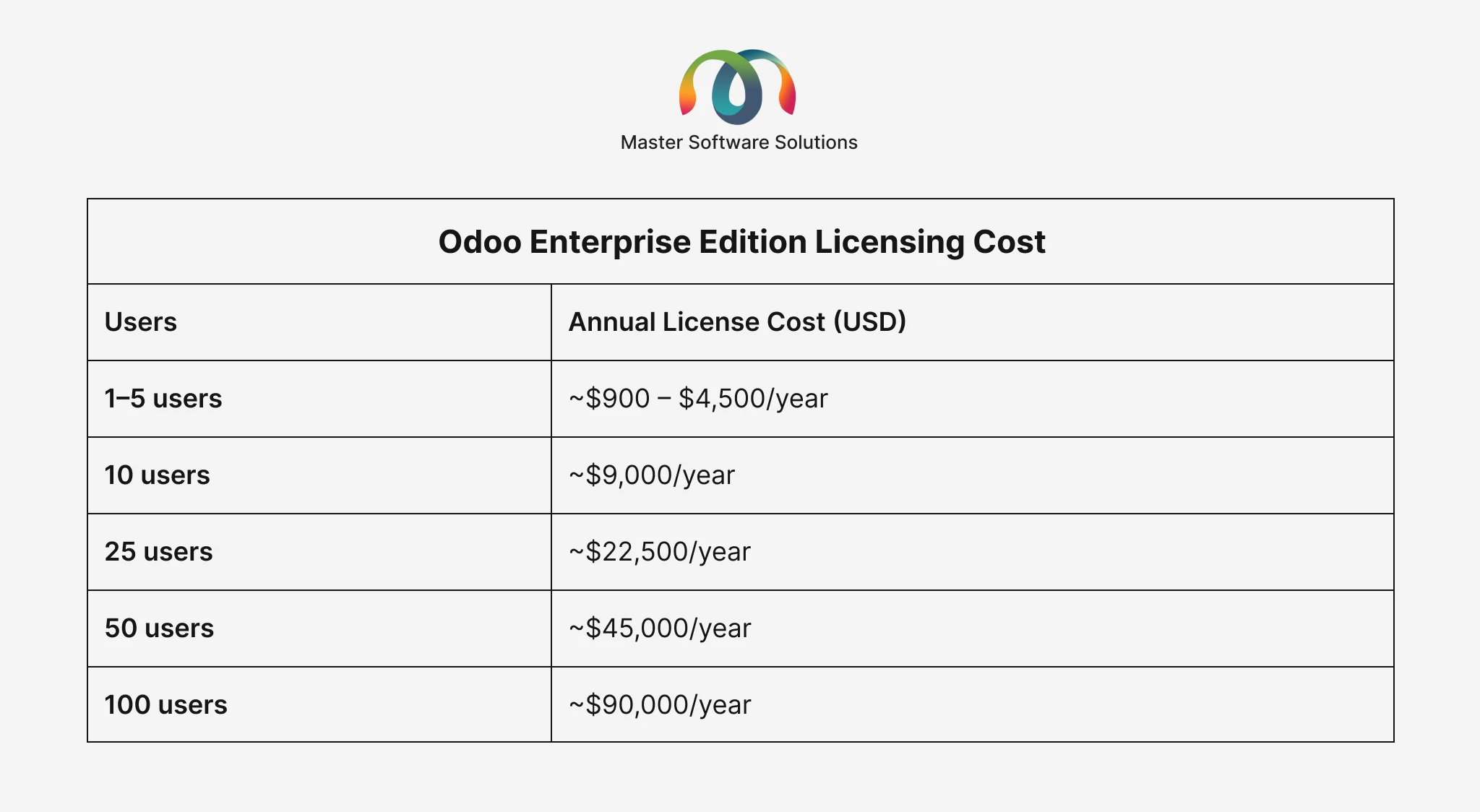
Note: Odoo pricing as of 2026 is approximately $24.90 per user/month for Enterprise (billed annually). Multi-app bundles and annual commitments often carry discounts negotiated through certified partners.
Odoo.sh (cloud hosting) adds a hosting fee on top of the license, starting from around $100–$250/month, depending on the number of production branches and staging environments you need.
Odoo Implementation Cost Breakdown in the USA
Licensing is just one line item. Here’s a complete breakdown of what a real implementation costs.
Discovery & Requirements Analysis
Before a single line of code is written, a qualified partner should conduct a detailed business process analysis, mapping your current workflows, identifying gaps, and defining what Odoo needs to do to replace or integrate with your existing tools. Skipping this phase is the single most common reason implementations go over budget. Our guide on prerequisites to Odoo implementation walks you through exactly what to prepare.
Project Management
Every implementation needs a dedicated project manager to coordinate timelines, track milestones, manage stakeholders, and keep scope creep in check. The cost scales with project size and duration.
Configuration & Setup
“Configuration” means setting up Odoo out of the box using its built-in settings, chart of accounts, tax rules, warehouse locations, user roles, approval workflows, email templates, and so on. This is distinct from customization (writing code). Most SMB implementations are 60–80% configuration. Following best practices during Odoo ERP implementation at this stage significantly reduces rework later.
Customization & Module Development
When standard Odoo doesn’t match your processes, you need custom development. Common customizations include:
- Custom reports and dashboards
- Industry-specific workflows (e.g., lot/serial traceability for food & beverage)
- Custom approval hierarchies
- Modifications to the manufacturing or MRP modules – See our guide on Odoo ERP for manufacturing
- Bespoke UI/UX changes
Development rates for U.S.-based Odoo developers run $100–$200/hour; offshore-certified partners (with U.S. oversight) typically bill $35–$75/hour.
Data Migration
Moving clean, validated data from your legacy system (QuickBooks, SAP B1, spreadsheets, or a custom system) into Odoo is one of the most underestimated costs in any ERP project. The price depends on data volume, data quality, and the number of source systems.
Third-Party Integrations
Odoo rarely lives in isolation. Common integrations in U.S. implementations include:
- E-commerce: Shopify, WooCommerce, Amazon, Magento
- Payments: Stripe, PayPal, Authorize.net
- Shipping & logistics: FedEx, UPS, ShipStation, EasyPost
- Accounting: QuickBooks (for transition periods)
- CRM/Marketing: HubSpot, Salesforce, Mailchimp
- EDI: For retail and distribution chains with compliance requirements
Pre-built connectors cost less; custom API integrations cost more.
Training
User adoption is what separates a successful ERP go-live from an expensive shelf-ware situation. Training costs cover end-user sessions, admin/power-user training, and training documentation. Remote training reduces costs; on-site training at your U.S. facility adds travel expenses.
Testing & Quality Assurance
UAT (User Acceptance Testing), regression testing, and performance testing before go-live. Often bundled into project management fees for smaller projects.
Go-Live Support
Hypercare in the first 2-4 weeks post-launch, having consultants on standby to resolve issues quickly before they affect operations.
Post-Go-Live Support & Maintenance
Ongoing support contracts (bug fixes, minor enhancements, version upgrades) are strongly recommended. Most U.S. businesses budget for a retainer with their implementation partner.
Total Odoo Implementation Cost by Business Size
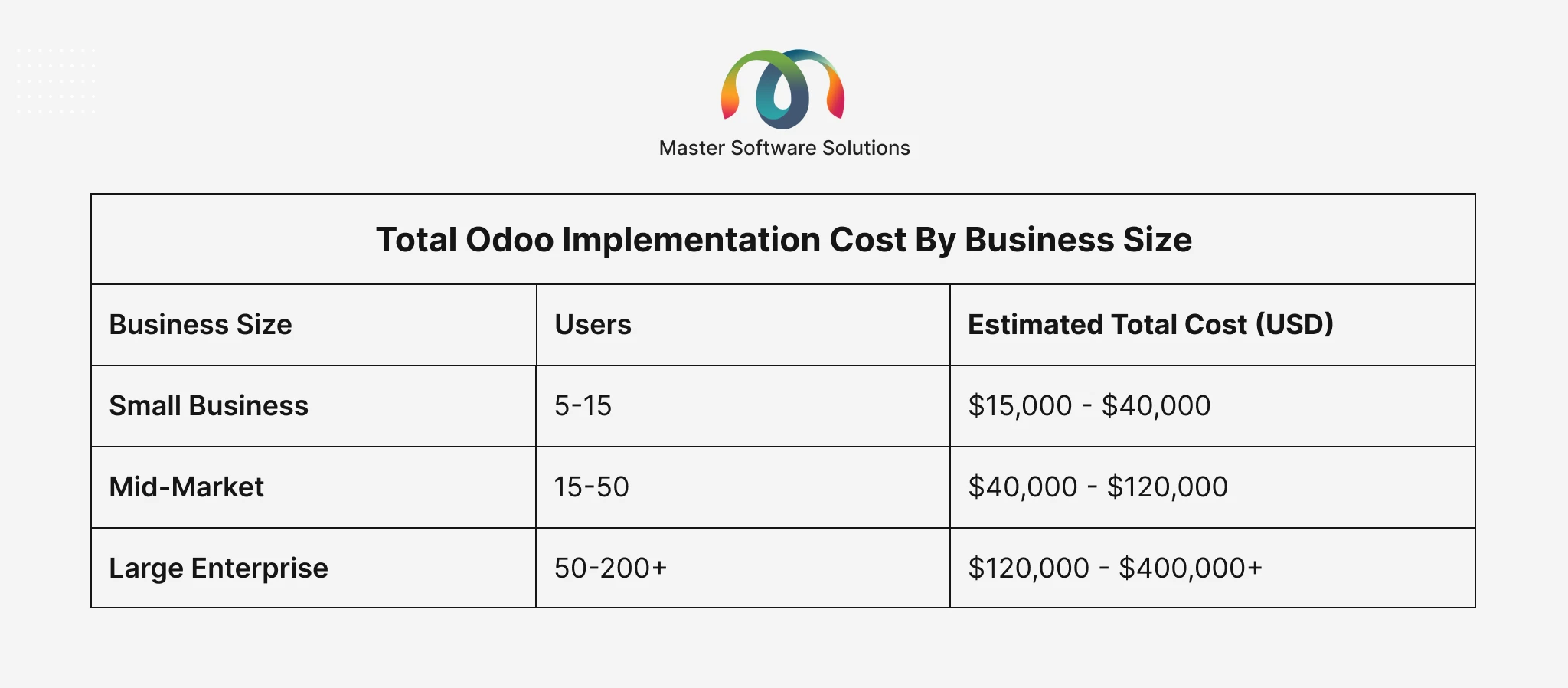
These are all-in estimates covering license, implementation, customization, migration, training, and first-year support. Simple, out-of-the-box deployments land at the lower end; multi-site, heavily integrated, or highly customized projects land higher.
Factors That Significantly Impact Your Odoo Implementation Cost
Understanding what drives your bill up or down helps you make smarter decisions during scoping.
Number of Modules Deployed
Each Odoo module (Sales, Inventory, Manufacturing, Accounting, HR, Payroll, etc.) adds implementation effort. A CRM-only deployment is vastly simpler than a full ERP rollout across Sales + Inventory + Manufacturing + Accounting + HR.
Level of Customization Required
Sticking closely to standard Odoo functionality dramatically reduces cost and risk. Heavy customization not only increases development cost, but it also increases upgrade costs with every new Odoo version.
Number of Users and Locations
More users mean more licenses, more training, and more complexity. Multi-site deployments (multiple warehouses, offices, or countries) add configuration and testing overhead.
Data Quality and Volume
If your data is clean and well-structured, migration is fast. If you’re migrating from multiple legacy systems with inconsistent formats, expect significant data cleansing effort.
Choice of Hosting Model
- Odoo Online (SaaS): Lowest upfront cost; limited customization.
- Odoo.sh: Flexible cloud hosting; moderate cost; supports custom modules.
- On-Premise: Highest control and customization potential; highest infrastructure and maintenance cost.
Partner Location and Rates
A U.S.-based Odoo partner with local consultants costs more per hour than an offshore-certified partner but may offer faster communication, cultural alignment, and on-site availability. The best approach for many U.S. companies is a certified global partner with U.S.-based project management, exactly what Master Software Solutions provides.
Odoo Community vs. Enterprise: Which Is Right for Your Business?
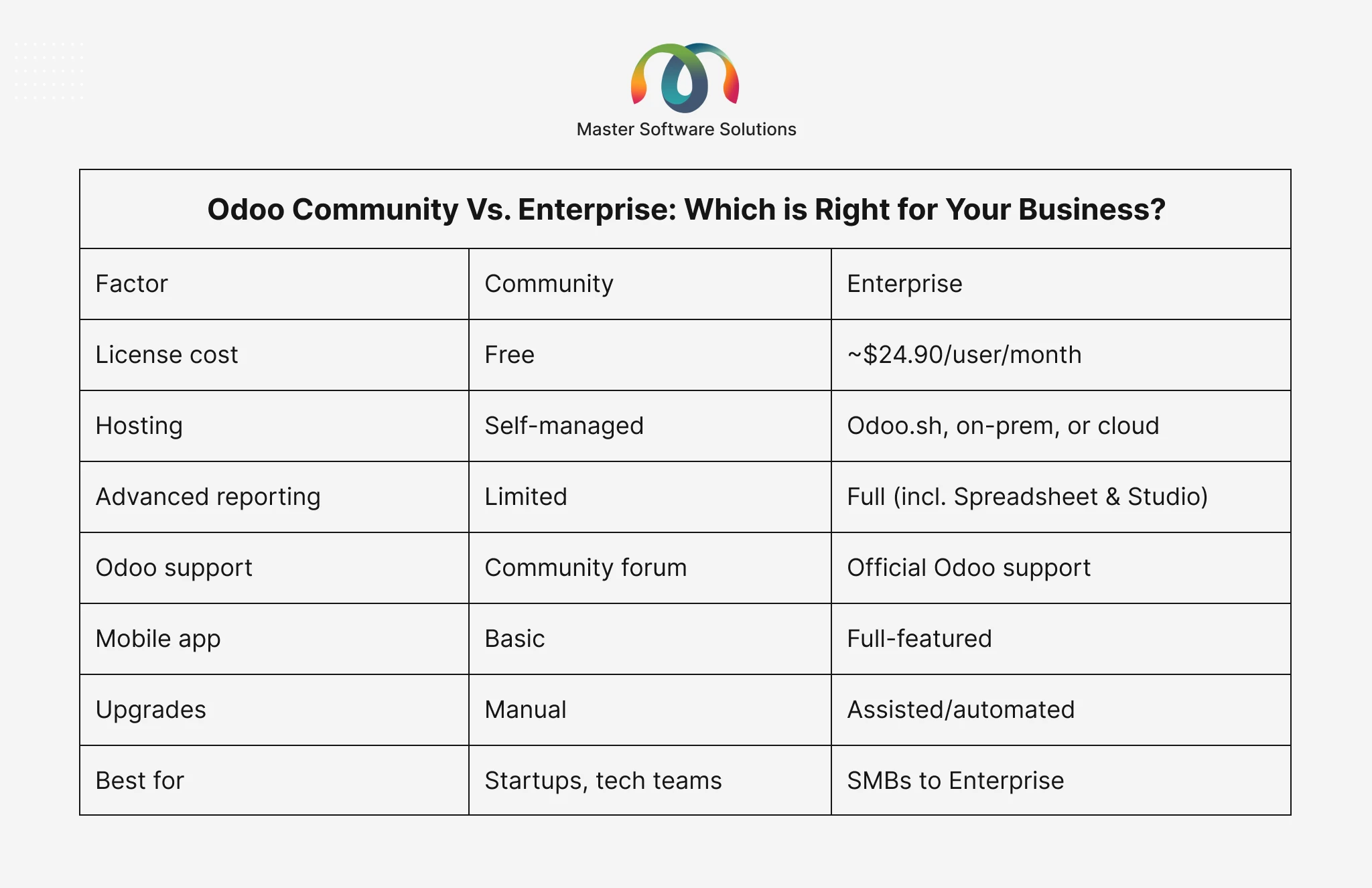
For most growing U.S. businesses, Enterprise pays for itself through reduced customization effort, official support, and lower total cost of ownership over three years.
Hidden Costs of Odoo Implementation to Watch For
Even well-planned implementations can surprise you. Watch out for these often-overlooked expenses:
Scope creep
It is the biggest hidden cost in ERP projects. A change request in month 3 that seemed small (“Can we add one more field to the sales order?”) adds up quickly if it requires development, testing, and retraining.
Version upgrades
Odoo releases a new major version annually. If you’re on Enterprise, Odoo provides upgrade scripts, but partner assistance is often still needed. Budget $5,000–$20,000 per major upgrade depending on your level of customization.
Infrastructure costs for on-premise deployments: servers, backups, SSL certificates, IT administration, and disaster recovery.
Change management
Resistance from staff, inadequate training follow-through, and poor internal project ownership are silent killers of ERP ROI.
How to Reduce Odoo Implementation Costs Without Cutting Corners
Start with a phased rollout. Deploy the core modules first (sales, inventory, accounting), prove ROI; then expand to HR, manufacturing, and other areas. This spreads cost and risk.
Minimize customization
Challenge every customization request with “Can we change the business process instead?” Standard Odoo is the result of millions of hours of best-practice design.
Invest in discovery
A thorough requirements analysis upfront prevents expensive rework mid-project. Every dollar spent in discovery typically saves three in development.
Choose the right partner
The lowest-cost quote is rarely the best value. Look for a partner with verifiable Odoo certifications, industry experience, and U.S. client references.
Train your internal champion
A well-trained internal Odoo admin reduces your reliance on the partner for routine tasks and minor changes post-go-live.
Ready to Get a Precise Cost Estimate for Your Business?
Every Odoo implementation is different. Master Software Solutions offers a free, no-obligation scoping consultation where our certified Odoo consultants will assess your requirements, recommend the right modules and hosting model, and give you a transparent, itemized cost estimate. Schedule Your Free Consultation
Odoo Implementation ROI: Is It Worth the Investment?
The relevant question isn’t just “what does Odoo cost?” It’s “What does Odoo save?”
Businesses that implement Odoo successfully typically report:
- 30-50% reduction in time spent on manual data entry and reporting
- 20-35% improvement in inventory accuracy
- 15-25% faster order-to-cash cycle times
- Significant reduction in software licensing costs (replacing multiple point solutions with one platform)
- Better decision-making through unified, real-time data visibility
A mid-size manufacturing company replacing separate systems for accounting, inventory, production planning, and sales CRM can often recover its full implementation investment within 12-24 months.
Why Choose Master Software Solutions for Your Odoo Implementation?
Master Software Solutions is a certified Odoo partner serving businesses across the USA in industries including manufacturing, retail, logistics, distribution, e-commerce, food & beverage, and professional services.
What sets us apart:
- Certified Odoo consultants with deep module expertise
- End-to-end service: consulting → implementation → customization → integration → training → support
- Industry-specific accelerators that reduce implementation time and cost
- Transparent, fixed-scope engagements
- Proven track record with U.S.-based clients across SMB to enterprise
Our Odoo services include Odoo Consulting, Odoo Implementation, Odoo Customization, Odoo Integration, Odoo Migration, and Odoo Support & Maintenance.
Start Your Odoo Journey the Right Way. Don’t let cost uncertainty stall your ERP decision. Our team will help you scope your project, select the right edition and hosting model, and build a phased roadmap that fits your budget. Talk to an Odoo expert today.