A wholesale cafe ordered a coffee blend every week after week, & in one week, the order didn’t come in. The salesperson is busy with active deals, so the system has nothing to show. After a few weeks, that cafe placed the standing order with another roaster, who checked it at the right moment. No relationship was affected, no mistakes; but the account quietly froze, being a customer, and the item was found a month later, when the numbers looked a little softer than usual.
This is a major difference between managing customer relationships & the next prediction on behalf of the orders. To fix this, a coffee roasting CRM playbook for wholesalers turns order history into real-time foresight, always available before an account is already gone.
Why “Managing Relationships” Isn’t Enough Anymore
Wholesale coffee relationships have always run on familiarity. That familiarity serves the real value, but it doesn’t scale past accounts, and it completely breaks down during slow weeks or fewer check-in calls.
The number gap is greater than assumed, and speed is another competitive factor in B2B buying. As reported in McKinsey’s B2B Pulse survey, nearly 4,000 B2B decision-makers found that 51% would look elsewhere if they weren’t tracked consistently across channels, and another 51% would switch suppliers if they weren’t connected to the right person. A wholesale coffee account rarely shows up as a shopping account; it directly starts the conversation with a competitor. And all the data, whether it’s a call, text, or email, stays under a single person’s observation. A CRM built for this is not considered an organizational tool; it creates the difference between the first call & finding out later that you do not exist.
From Reactive to Predictive: What a Coffee CRM Playbook Actually Tracks
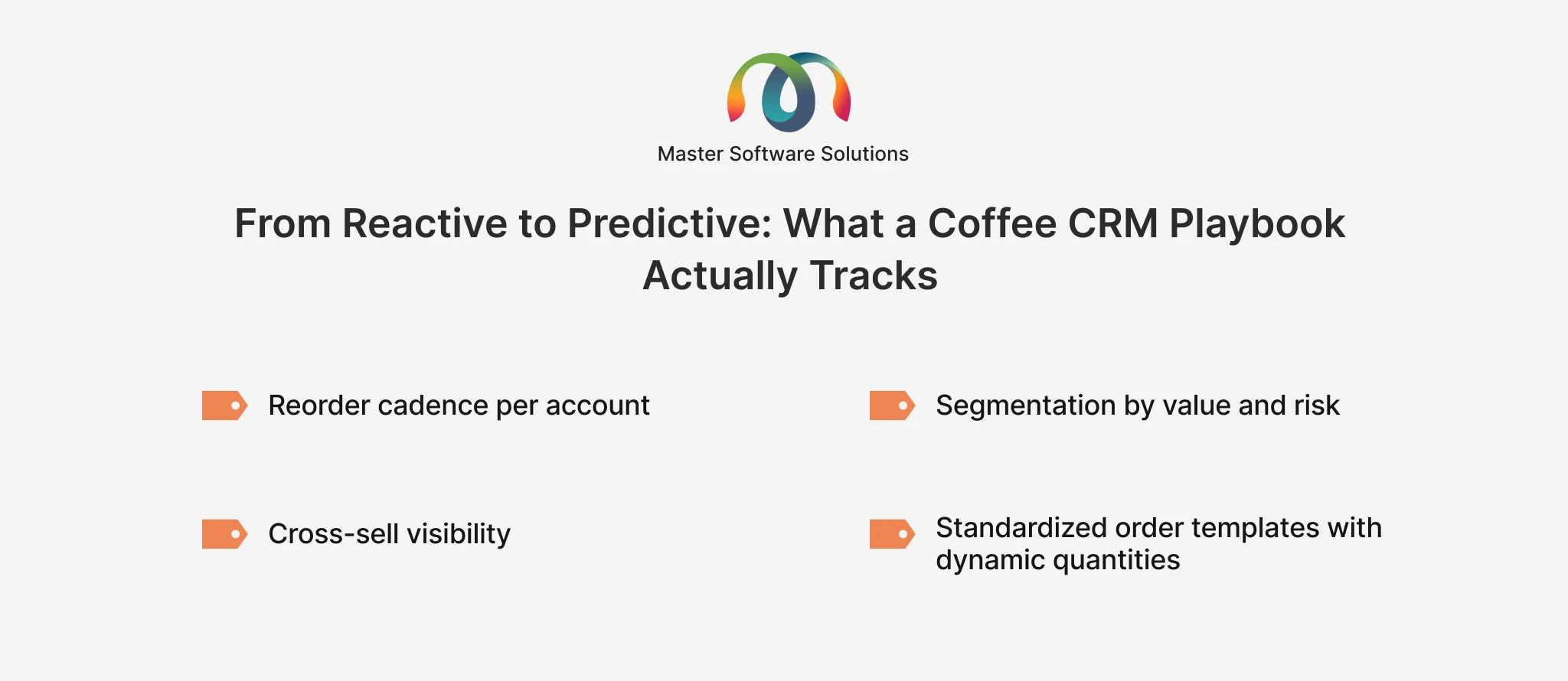
Coffee CRM playbook means the system surfaces what needs attention before the team looks for it, as it holds a few specific capabilities that include:
Reorder cadence per account
Every wholesale customer churn prediction works as per a strategy, i. e., weekly, biweekly, or monthly. An Odoo CRM flags a missing recurring order as an alert, the same as an overdue payment does. The automated process checks each account’s ordering pattern & notifies the salesperson as soon as the expected order arrives.
Segmentation by value and risk
Grouping accounts according to frequency and order value makes it possible to see which customers are growing and quietly slipping away before the revenue drop.
Cross-sell visibility
The purchase-history tracking can surface products that a loyal account has never actually tried, including decaf as well as seasonal origin. This turns an existing relationship into incremental revenue instead of treating every account in a fixed order.
Standardized order templates with dynamic quantities
The team starts working from a consistent order template, pre-filled with a customer’s typical products and adjustable quantities. This will consume less time reconstructing an order from memory & fulfill timely orders without any error or dispute.
The Multi-Channel Chaos Most Roasteries Are Actually Operating In
The concern is not that reorder patterns get missed, but that wholesale orders rarely arrive via one channel. The text message, phone call, email thread & a delivery note are all visited in pieces, with no interconnection. So, finally, the rep is the only person who holds the information, which leads to juggling between many accounts & details falling through. This is not because the team is careless; there is no single channel that holds the full picture. An Odoo wholesale CRM for wholesale distributors consolidates these channels into one account for faster tracking & segmentation in one place. As per HubSpot’s State of Customer Service research survey, it’s found that 76% lack full-funnel visibility into their customers’ experience, and 74% say tools initiated across disconnected systems actively slow their teams down. An Odoo wholesale CRM for wholesale distributors consolidates all the channels into one account for faster tracking & segmentation.
Turning the Odoo CRM Playbook Into Practice
Replacing the sales team is never the goal; it’s actually connecting the system in a unified platform that remembers the data and maintains the consistency of records.
- Build a full account profile for every wholesale customer, including order history, preferred products, and communication channel, in a unified platform.
- Set reorder-window alerts so that a missed order triggers a check-in call automatically, before checking the account manually.
- Segments should be reviewed regularly, not a one-time exercise. This gives slipping accounts attention while there’s still time to save them.
- Create standardized order templates across the sales team for quoting and reordering so that the team does not depend on which representative to ask.
- Connect CRM to inventory and accounting data to trigger a real-time reordering with no separate spreadsheet.
How Coffee ERP Software Powers the Playbook
CRM lives apart from inventory, production, and accounting provides data on whether the account is overdue for a reorder, but it does not have the actual number. Coffee roaster CRM software is built specifically to fill this gap, pairing CRM with real-time inventory & finance visibility for generating reorder alerts, rather than managing two separate systems manually. It is worth pairing with the operational gains outlined in Benefits of Implementing an Odoo ERP Solution in the Coffee Business for a full picture of what changes are made in sales, inventory & accounting.
Conclusion
A CRM playbook built around reorder prediction, account segmentation, and cross-sell visibility turns that kind of loss from routine and invisible into something a sales team can actually see coming and act on. For a wholesale coffee business, that’s not a minor operational upgrade; it’s the difference between managing relationships and keeping them for longer.
Master Software Solutions Odoo ERP for coffee manufacturing enables wholesalers to pair CRM data with real-time inventory & finance visibility to streamline the process of order fulfillment, instead of reconciling manually.
Ready to Stop Losing Accounts You Never Saw Leaving? Our team of experts provides the best CRM capabilities for increased efficiency & ROI.