It is one of the most important questions you can ask an ERP implementation partner. And it is also one of the questions that makes some partners uncomfortable.
Ask it anyway.
When you invest in an ERP implementation, particularly one that involves custom-built features, integrations, or industry-specific modules, you are not just buying software. You are making decisions that will affect your operational flexibility, your future costs, and your ability to switch partners or systems years down the line.
Yet many businesses sign contracts without ever clarifying who owns what. They discover the answer too late: when they try to change partners, request their data, or understand why a module they paid to build is a recurring license fee.
This article breaks down the three categories of code in an ERP implementation, why data ownership matters, and how Master Software Solutions handles all of it openly, clearly, and before you ever sign a contract.
Why Code and Data Ownership Is a Question Most Partners Avoid
ERP implementations are complex. There are layers of software involved, such as the platform itself, standard modules, partner-built customizations, and third-party integrations. Within that complexity, it is easy for ownership questions to get buried in technical jargon or pushed to the fine print.
Some partners prefer it that way.
The reality is that IP and data ownership terms have significant commercial implications:
Switching costs: If a partner owns the custom code they built for you, you may have to rebuild everything from scratch when you move on.
License dependencies: If you are using proprietary modules without realising it, you may face ongoing fees you did not budget for.
Data portability: If your data is stored in a way that makes it difficult to extract, your ability to leave a platform or partner is dramatically reduced.
Exit scenarios: What happens to your system, your customizations, and your data if the implementation relationship ends?
These are not niche concerns. They are fundamental business risks, and they should be resolved in the contract, not in a dispute two years from now.
The Three Categories of Code in Any Odoo ERP Implementation
When it comes to code in an Odoo ERP implementation, there are three distinct categories. Each has different ownership terms and implications for your business. Here is how to understand them:
Odoo Core
The Odoo platform itself, its core modules, framework, and base functionality, is owned by Odoo S.A. This is standard and expected. When you use Odoo, you are operating under Odoo’s own licensing terms, which govern how the platform can be used, modified, and distributed.
This is not a grey area, and any reputable implementation partner will explain it plainly. What matters here is that you understand what you are licensing from Odoo versus what is being built on top of it.
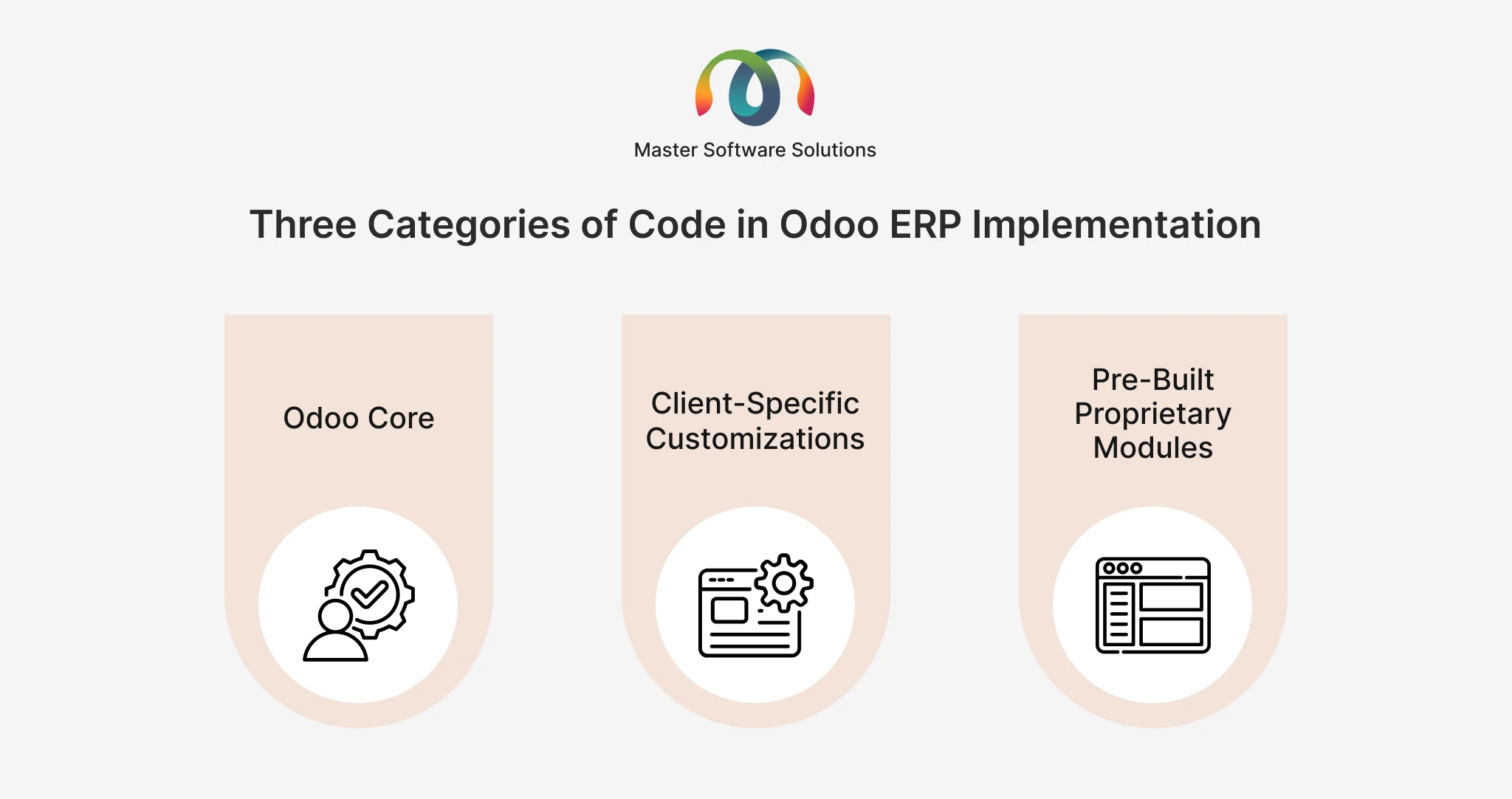
Client-Specific Customizations
This is where ownership questions become critically important.
When an implementation partner builds a custom module or feature specifically for your business, funded by your project budget, who owns the resulting code?
The answer varies by partner. Some partners retain ownership of all custom code they write, even when you have paid for it. Others transfer IP to the client. Many leave it ambiguous.
At Master Software Solutions, we make this explicit. For every client-specific customisation, any module or feature built specifically for your business using your budget, we discuss and formally document intellectual property ownership during the contracting phase. Nothing is left unclear. You will know, before work begins, what you own and what you are licensing.
Pre-Built Proprietary Modules
This is the category that surprises businesses most often.
Many implementation partners have built their own libraries of ready-made modules, developed over time to serve common industry needs. These modules are not built specifically for you; they are developed once and then deployed across multiple clients.
There is nothing wrong with this model. Pre-built modules can be excellent solutions that save time and cost. But you need to know when using one.
At Master Software Solutions, we have developed a suite of proprietary modules for specific industry needs, including delivery management, collection centre tracking, and procurement workflows. These modules are licensed to clients, not sold outright. This means you are using them under a license arrangement, not owning the underlying code.
What matters is that you know this clearly upfront, including what the module does, that it is a licensed product, what the licensing terms are, and what your options are if the relationship changes.
On Data Ownership: Your Data Is Always Yours
Beyond code, there is a second, and arguably more important, question: who owns your business data?
Your ERP system will hold years of transactional history, customer records, supplier data, financial information, inventory movements, and operational insights. This is not the partner’s data. It is not the platform’s data. It is yours.
Yet businesses sometimes discover that, when trying to leave a platform or partner, extracting their data is harder than expected. Data may be stored in proprietary formats, locked behind export restrictions, or simply not made available in a usable structure.
At Master Software Solutions, your data is always yours. Full stop. Regardless of what happens to the implementation relationship, your business data remains your asset. We document data portability in every contract, what you can take with you, in what format, and what the process looks like in every exit scenario.
This is not a clause buried in the back of an agreement. It is a conversation we proactively have at the contracting stage, because we believe you should know your options before you ever need them.
The Questions Every Business Should Ask Before Signing
If you are evaluating ERP implementation partners, here are the questions that will quickly reveal how transparent they are about ownership:
- Who owns the custom modules or features you build for me using my budget? The answer should be unambiguous and in writing.
- Do you use any pre-built proprietary modules in your implementations? If yes, what are the licensing terms, and what happens to my access if I change partners?
- What format will my data be in, and how do I get it out if I decide to leave? A responsible partner will have a clear answer.
- If I switch to a different Odoo partner in three years, what exactly will I be able to take with me? Ask for a concrete answer, not a vague reassurance.
- Is IP and data ownership documented in the contract? If a partner is hesitant to put it in writing, that tells you something.
A partner who welcomes these questions has nothing to hide.
How Master Software Solutions Handles Ownership With Transparency
We do not wait for clients to ask about IP and data ownership. We raise it proactively as part of our standard contracting process, because we believe clarity at the beginning of a relationship prevents problems at the end. Here is exactly how we approach it:
We document everything in three clear categories.
Every contract with Master Software Solutions distinguishes between Odoo core (governed by Odoo’s licensing), client-specific customizations (IP ownership explicitly agreed and recorded), and pre-built licensed modules (clearly identified with full licensing terms disclosed).
We never leave IP ownership ambiguous.
If a feature is built specifically for your business and funded by your budget, we have an explicit conversation about who owns the resulting code. That decision is recorded in the contract before work begins.
We disclose all proprietary modules upfront.
If your implementation uses any of our pre-built modules, you will know precisely which ones, what the license terms are, and what your options are going forward.
Your data portability is documented in every exit scenario.
Whether you outgrow the platform, decide to change partners, or simply want to move to a different system in the future, you will know exactly what you can take with you and how.
This conversation is not a negotiation we reluctantly enter when pushed. It is a standard part of how we do business.
Why This Matters More Than You Think
It might be tempting to sign a contract quickly and trust that everything will work out. Most of the time, implementations go well, and these questions never become critical. But “most of the time” is not good enough when you are entrusting your core business systems to a partner.
Consider these scenarios:
- Your partner closes down or is acquired. What happens to your custom modules and your data?
- You want to expand your system and bring in a second technical partner. Can they work with the code your first partner built?
- Your business evolves, and you need to switch ERP platforms entirely. Can you extract your data cleanly?
- You discover a proprietary module you rely on has its license fee tripled. Do you have any leverage or alternatives?
These are not hypotheticals. They happen to businesses that did not ask the hard questions early enough.
IP and data ownership terms are not bureaucratic details. They are the foundation of your long-term relationship with your ERP system and with the partner who built it.
Start Your ERP Journey the Right Way
You deserve to work with an ERP implementation partner who answers the hard questions clearly, not with vague reassurances but with documented terms you can hold them to.
Master Software Solutions brings full transparency to every implementation we deliver. We tell you exactly what you own, what you are licensing, and what you can take with you. And we put it all in writing before the work begins.
Book a Free Implementation Consultation. Talk to our team about your ERP needs. We will walk you through exactly how we structure ownership, licensing, and data portability for your implementation.
About Master Software Solutions
Master Software Solutions is a specialist ERP implementation and migration partner helping businesses build powerful, scalable systems on terms they fully understand and control.
We work primarily with Odoo ERP, delivering implementations that are transparent from day one: clear ownership terms, documented data portability, and no surprises buried in the fine print. Our team combines deep technical expertise with a genuine commitment to long-term client success.
What we do:
- Odoo ERP implementation and configuration
- Custom module development and integration
- ERP data migration and system upgrades
- Business process mapping and optimisation
- Ongoing ERP support, maintenance, and training
We believe the best implementation partnerships are built on honesty, and that starts with being clear about who owns what before the project begins.
Start a conversation with our team to find out why businesses trust Master Software Solutions to build their ERP systems the right way.
Frequently Asked Questions
Q1. Who owns custom Odoo modules built specifically for my business?
A1. Ownership of client-specific customizations depends entirely on the terms agreed with your implementation partner. At Master Software Solutions, we explicitly discuss and document intellectual property ownership during the contracting phase for every piece of custom development funded by your project budget. Nothing is left ambiguous; you will know your ownership position before work begins.
Q2. What is the difference between a client-specific customisation and a proprietary module?
A2. A client-specific customisation is code built exclusively for your business using your budget. A proprietary module is a pre-built solution developed by the implementation partner and licensed to multiple clients. Both can be valuable, but they have very different ownership and cost implications. Master Software Solutions clearly identifies which category every piece of code falls into.
Q3. Do I own my business data if I use an Odoo ERP system?
A3. Yes. Your business data is always yours, regardless of the platform or the implementation partner. At Master Software Solutions, we document data portability in every contract, including the format your data will be in and how you can extract it in any exit scenario.
Q4. What happens to my custom modules if I change ERP partners?
A4. This depends on the IP ownership terms in your contract. If you own the custom code, you can take it with you and have any qualified Odoo partner support it. If the partner owns it, you may need to rebuild or re-license. This is exactly why ownership terms must be clarified before you sign, not after you decide to leave.
Q5. Are Master Software Solutions’ pre-built modules available after the implementation ends?
A5. Our pre-built proprietary modules are licensed to clients. We are fully transparent about which modules fall into this category, what the licensing terms are, and what your options look like in various scenarios, including if the implementation relationship ends. This is always documented in the contract.
Q6. Can I see what code has been built for me during the implementation?
A6. Yes. At Master Software Solutions, we maintain clear documentation of all development work carried out for your implementation. Client-specific customizations are your investment, and you have full visibility into what has been built and why.