The food and beverage industry runs on razor-thin margins, complex regulatory requirements, and supply chains that never sleep. Choosing the right ERP (Enterprise Resource Planning) system can be the difference between scaling confidently and drowning in spreadsheets, compliance gaps, and costly recalls.
In 2026, food and beverage manufacturers face mounting pressures: tighter FDA and FSMA traceability mandates, rising ingredient costs, shifting consumer demand for transparency, and global supply chain volatility. Your ERP needs to handle it, from batch production and lot traceability to recipe management, allergen controls, and real-time inventory visibility.
This guide ranks the top 10 ERP systems for food and beverage companies in 2026, covering what each does best, who it’s built for, and what to consider before buying.
Why Food & Beverage Businesses Need an Industry-Specific ERP
Generic ERP platforms were built for a broad market. Food and beverage operations are anything but generic.
An industry-specific ERP addresses the unique challenges your business faces daily:
- Lot and batch traceability: Forward and backward trace from raw ingredient to finished product, essential for audits and recalls
- Catch weight and variable yield management: Accurately price and account for products sold by weight
- Shelf life and expiry date tracking: FEFO (First Expired, First Out) inventory management reduces waste and prevents spoilage
- Recipe and formula management: Version control for formulations, scaling for production runs, and cost roll-ups
- Regulatory compliance: FDA, FSMA, HACCP, GMP, SQF, BRC, and global food safety standards
- Allergen management: Track allergens at the ingredient level and prevent cross-contamination across production runs
- Quality control and testing: Integrated lab results, certificate of analysis (COA) generation, and vendor scorecards
Without these capabilities, food and beverage companies either rely on disconnected bolt-on tools or spend excessive manual effort stitching data together, neither of which is sustainable.
Ready to find the right ERP for your food or beverage business? Talk to a specialist at Master Software Solutions today.
The Top 10 ERP Systems for Food & Beverage in 2026
SAP S/4HANA: Best for Large-Scale Global Food & Beverage Enterprises
Overview
SAP S/4HANA is the world’s most widely deployed ERP platform, and its food and beverage capabilities are among the deepest available for global enterprise operations. Running on SAP’s in-memory HANA database, it offers real-time analytics, complex supply chain orchestration, and unmatched global compliance coverage.
Key Features
- SAP Recipe Development for formula and specification management
- Global Available-to-Promise (gATP) for dynamic inventory allocation
- Integrated Environment, Health & Safety (EHS) management
- SAP Ariba integration for supplier collaboration and procurement
- Advanced production planning with finite scheduling
- Comprehensive audit trail for global regulatory compliance
- Real-time financial consolidation across multiple entities and currencies
Best For
Large global food and beverage enterprises with complex, multi-site, multi-country operations requiring world-class supply chain management and financial consolidation.
Considerations
SAP S/4HANA carries the highest total cost of ownership among options on this list. Implementation complexity demands experienced SAP partners. Not recommended for SMBs without significant IT and financial investment.
Microsoft Dynamics 365: Best for Microsoft-Centric Organizations Seeking Flexibility
Overview
Microsoft Dynamics 365 is a modular cloud ERP and CRM platform that, when paired with industry-specific add-ons and ISV (independent software vendor) solutions, becomes a capable platform for food and beverage operations. Its deep integration with Microsoft 365, Teams, Power BI, and Azure gives it a major advantage in organizations already invested in the Microsoft ecosystem.
Key Features
- Modular deployment (Finance, Supply Chain, Manufacturing, Commerce)
- Native integration with Power BI for production analytics and reporting
- Microsoft Teams integration for operational collaboration
- Robust third-party ISV marketplace with food-specific add-ons
- AI-powered demand forecasting via Azure Machine Learning
- Global compliance and multi-entity financial management
Best For
Mid-size to enterprise food and beverage companies with strong Microsoft environments and the IT resources to configure and customize the platform for food-specific requirements.
Considerations
Out-of-the-box food and beverage functionality is less mature than purpose-built alternatives. Requires careful ISV selection and implementation expertise, and a partner like Master Software Solutions ensures the right configuration for your operation.
Master Software Solutions: Best for End-to-End Food & Beverage ERP Consulting & Implementation
Overview
Master Software Solutions is a leading ERP consulting and implementation partner supporting food and beverage manufacturers, distributors, and processors in selecting, deploying, and optimize the right ERP platform for their business. Rather than locking clients into a single product, Master Software Solutions takes a consultative approach, understanding your production environment, compliance requirements, and growth goals before recommending and implementing the ideal ERP solution.
With deep expertise across the food and beverage vertical, Master Software Solutions bridges the gap between complex ERP platforms and real-world production floors. Their team works alongside your operations, quality, finance, and IT teams to ensure the ERP delivers measurable ROI from day one.
Key Strengths
- Industry-Specific Expertise: Decades of hands-on experience in food and beverage ERP implementations, from small craft producers to large-scale manufacturerVendor-Agnostic
- Recommendations: Master Software Solutions evaluates leading platforms objectively, ensuring you get the best fit, not just the most popular name
- End-to-End Implementation: Project scoping, data migration, system configuration, staff training, go-live support, and post-implementation optimization
- Compliance Readiness: Guidance on configuring ERP for FSMA, FDA 204 traceability requirements, HACCP, SQF, and BRC certification support
- Ongoing Support: Managed support, system upgrades, and continuous improvement services that grow with your business
Best For
Food and beverage companies at any stage, from selecting their first ERP to replacing a legacy system or expanding into new markets, who want a trusted partner with proven industry experience to ensure a successful implementation.
Get a Free ERP Consultation. Whether you’re evaluating ERP for the first time or looking to upgrade, Master Software Solutions helps you make the right decision. Schedule your consultation
Infor CloudSuite Food & Beverage: Best Purpose-Built Cloud ERP for Large F&B Enterprises
Overview
Infor CloudSuite Food & Beverage is widely regarded as one of the most complete, purpose-built ERP platforms for the food and beverage industry. Built on Infor’s multi-tenant cloud architecture and pre-loaded with industry-specific functionality, it eliminates much of the custom configuration required by generic ERP systems.
Key Features
- Pre-built food and beverage process templates and workflows
- Lot genealogy and full traceability from farm to fork
- Catch weight management and dual units of measure support
- Demand-driven MRP with seasonality modeling
- Integrated quality management with COA generation
- Nutritional content and label management
- Built-in compliance for FDA, FSMA, and GFSI standards
Best For
Mid-market to enterprise food and beverage manufacturers seeking a cloud-first, industry-native ERP with minimal customization. Particularly strong for processors, co-manufacturers, and beverage producers.
Considerations
Implementation timelines can be lengthy for complex operations. Total cost of ownership should be carefully evaluated against the breadth of included functionality.
Deacom ERP: Best for Batch Process Manufacturers and Formulators
Overview
Deacom ERP (now part of SYSPRO) is built from the ground up for batch process manufacturers, making it a natural fit for food, beverage, nutraceutical, and specialty chemical producers. Unlike many ERPs that treat batch manufacturing as an afterthought, Deacom’s architecture centers on formula-based production.
Key Features
- True single-system architecture, no modules, no bolt-ons
- Formula and recipe management with version control
- Integrated lot traceability and genealogy reporting
- Co-product and by-product costing
- Regulatory compliance for FDA, TTB (alcohol), and food safety mandates
- Built-in quality management and non-conformance tracking
- Customer portal for order management and documentation
Best For
Small to mid-size food and beverage manufacturers, specialty processors, and co-packers who need deep batch production functionality without enterprise-level complexity or cost.
Considerations
Limited global capabilities compared to SAP or Oracle. Best suited to North American operations.
Oracle NetSuite: Best Cloud ERP for Fast-Growing F&B Brands
Overview
Oracle NetSuite is the world’s leading cloud-native ERP platform, trusted by thousands of fast-growing businesses globally. While not exclusively built for food and beverage, NetSuite’s combination of strong financials, inventory management, eCommerce integration, and scalability makes it a popular choice for emerging and mid-market food and beverage brands.
Key Features
- Real-time financial visibility with multi-subsidiary consolidation
- Demand planning and inventory optimization
- Lot and serial number tracking with full traceability
- Native eCommerce and omnichannel order management
- Quality management and vendor certification tracking
- SuiteSuccess: pre-built configurations for food and beverage companies
- Extensive third-party integration ecosystem
Best For
High-growth food and beverage brands, DTC producers, and omnichannel food businesses that prioritize financial agility and scalability over deep manufacturing-specific functionality.
Considerations
Advanced manufacturing features (catch weight, process orders, and advanced formula management) may require third-party add-ons. Works best for lighter manufacturing or distribution-focused operations.
BatchMaster ERP: Best Specialized ERP for Small-to-Mid Batch Producers
Overview
BatchMaster is a specialized ERP designed exclusively for batch-process industries, including food, beverage, nutraceuticals, and cannabis. Available as a standalone system or as an add-on to SAP Business One and QuickBooks, BatchMaster fills critical functionality gaps for small producers who have outgrown entry-level accounting tools but aren’t ready for a full enterprise ERP.
Key Features
- Formula and recipe management with scaling
- Batch production orders with yield tracking
- Lot traceability and recall management
- Quality control with specification management
- Allergen tracking and label generation
- Integration with SAP Business One and QuickBooks
- Regulatory compliance reporting for FDA and GMP
Best For
Small- to mid-size food and beverage manufacturers, craft producers, and specialty processors looking for deep batch functionality at a lower price point, especially those already using SAP Business One or QuickBooks.
Considerations
Less suitable for operations requiring advanced financials, multi-site management, or global capabilities. Growth beyond mid-market may require migration to a more comprehensive platform.
Aptean Food & Beverage ERP: Best for Process Manufacturers Across the F&B Value Chain
Overview
Aptean Food & Beverage ERP (built on Microsoft Dynamics technology) is a purpose-built ERP targeting the full food and beverage value chain, from primary processors and manufacturers to distributors and foodservice operators. Aptean has made significant investments in food- and beverage-specific functionality, making it a compelling alternative to generic Microsoft Dynamics deployments.
Key Features
- Meat and produce-specific modules, including catch weight and yield management
- Forward and backward lot traceability with one-click recall simulations
- Nutritional analysis and label management
- Production scheduling with resource and capacity planning
- Quality management across production and procurement
- Cold chain and temperature monitoring integration
- Farm-to-fork traceability for fresh produce and meat processors
Best For
Mid-market food and beverage companies, particularly meat processors, fresh produce operations, dairy producers, and bakeries, need deep industry-specific functionality on a Microsoft technology foundation.
Considerations
May carry a premium over standard Dynamics deployments. Evaluate support and implementation resources in your region.
Plex Smart Manufacturing Platform (Cloud Manufacturing ERP): Best for Production-Floor-Driven F&B Operations
Overview
Plex Systems (now part of Rockwell Automation) brings together ERP, MES (Manufacturing Execution System), and quality management in a single cloud platform. Plex’s unique strength lies in its deep shop-floor connectivity, bridging the gap between enterprise planning and real-time production execution in a way few traditional ERPs can match.
Key Features
- Unified ERP + MES in a single cloud platform
- Real-time production monitoring and OEE (Overall Equipment Effectiveness) tracking
- Lot and serial traceability from raw material to finished goods
- Statistical Process Control (SPC) for quality management
- Integrated supplier quality and incoming inspection
- IoT connectivity for machine data capture
- Demand-driven production scheduling
Best For
Mid-market to enterprise food and beverage manufacturers with complex production environments who need tight integration between the shop floor and ERP, particularly beverage, dairy, and packaged food producers.
Considerations
Strong in manufacturing execution; financial management depth may require supplementation for complex multi-entity organizations.
SYSPRO ERP: Best for Mid-Market Food Manufacturers Seeking Simplicity and Value
Overview
SYSPRO is a global mid-market ERP vendor with a dedicated focus on the food and beverage industry. Known for its straightforward implementation, clear pricing, and strong customer support, SYSPRO is a reliable choice for mid-size food manufacturers who want an ERP that works without the complexity and cost of enterprise platforms.
Key Features
- Lot traceability and expiry date management
- Formula and bill of materials management
- Quality inspection and non-conformance tracking
- Procurement and supplier management
- Production scheduling and work order management
- Financial management with multi-currency support
- Strong reporting and analytics with built-in dashboards
Best For
Mid-size food and beverage manufacturers in distribution, light processing, or packaged goods who need a reliable, proven ERP without enterprise-level complexity.
Considerations
Deep batch manufacturing functionality (catch-weight and complex yield management) is less mature than purpose-built alternatives, such as Infor or Deacom.
How to Choose the Right ERP for Your Food & Beverage Business
With so many strong options available, the right ERP comes down to your specific operation, growth stage, and strategic priorities. Use these criteria to guide your evaluation:
Define Your Must-Have Features
List the capabilities that are non-negotiable for your operation, including lot traceability, catch weight, allergen management, regulatory compliance reporting, and specific integrations. Use this list to filter platforms.
Match the Platform to Your Scale
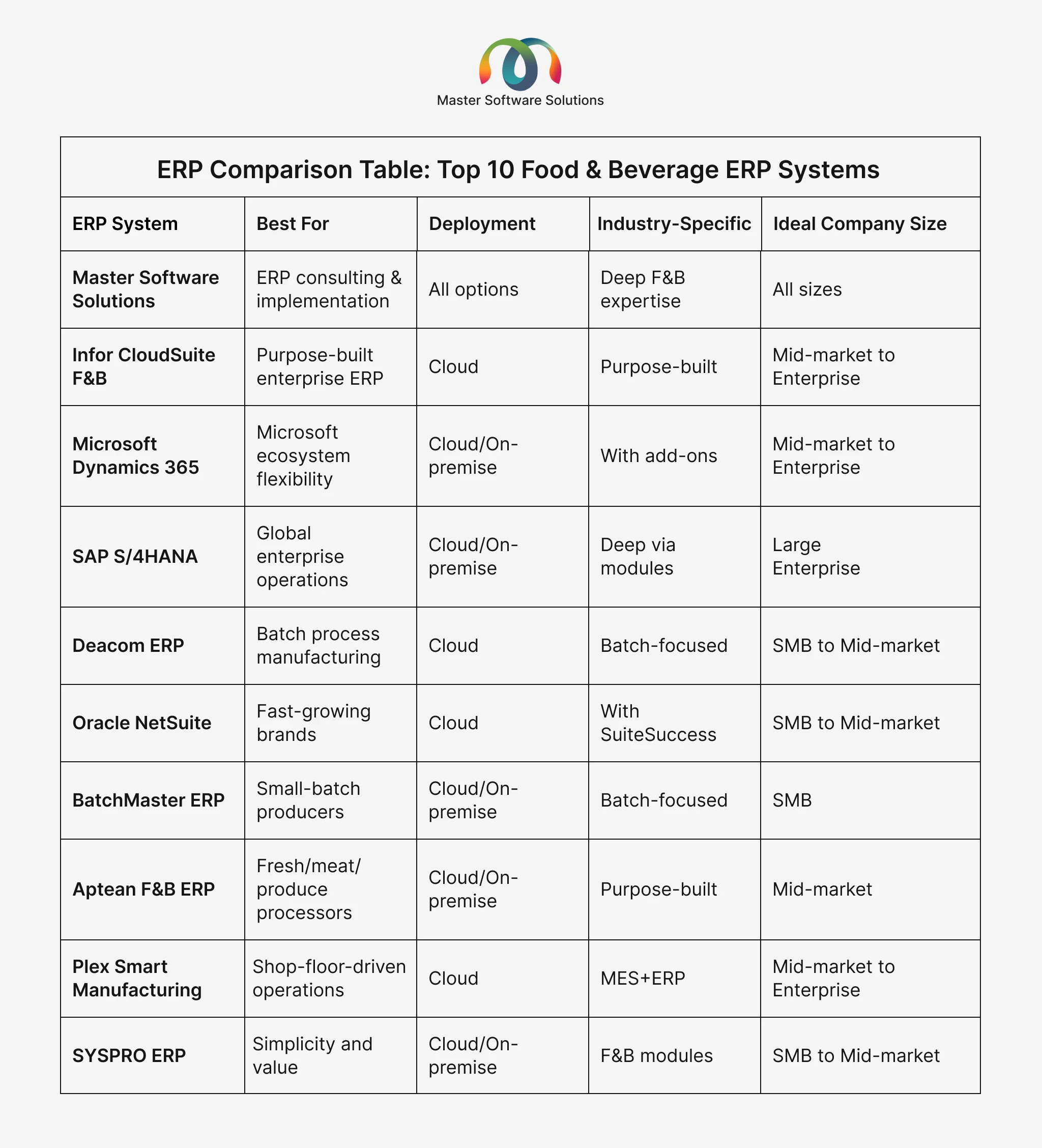
ERP platforms are generally tiered by business size and complexity. SAP S/4HANA and Infor CloudSuite are built for enterprises. Oracle NetSuite and Aptean serve the mid-market well. BatchMaster and SYSPRO cater to smaller operations. Choosing a platform designed for your size prevents both under-serving and over-investing.
Evaluate Total Cost of Ownership (TCO)
License fees are only part of the picture. Factor in implementation costs, customization, training, ongoing support, and upgrade costs. An ERP with a lower license fee but high implementation and support costs may be more expensive over five years than a premium platform with comprehensive support.
Assess Vendor and Partner Ecosystem
An ERP is a long-term investment. Evaluate the vendor’s financial stability, product roadmap, customer support reputation, and the strength of their implementation partner network. Working with an experienced implementation partner like Master Software Solutions significantly reduces risk and time-to-value.
Plan for Compliance and Future Regulations
With FDA Rule 204 traceability requirements now in effect and global food safety regulations continuing to tighten, your ERP must support current and future compliance mandates, not just what’s required today.
Not sure where to start your ERP evaluation? Master Software Solutions provides objective, expert guidance to help food and beverage companies evaluate, select, and implement the right ERP. Request a free ERP assessment.
Key ERP Features Every Food & Beverage Company Should Prioritize in 2026
FDA Rule 204 Traceability Compliance
The FDA’s Food Safety Modernization Act (FSMA) Rule 204 requires detailed traceability for foods on the Food Traceability List (FTL). Your ERP must capture Key Data Elements (KDEs) at Critical Tracking Events (CTEs), including growing, receiving, transforming, creating, and shipping processes. Any ERP investment in 2026 must explicitly address this requirement.
AI-Powered Demand Forecasting
Leading ERP platforms now integrate AI and machine learning for demand planning — analyzing seasonal patterns, promotional lift, weather impacts, and consumer trends to improve forecast accuracy and reduce overstock and stockout.
Real-Time Supply Chain Visibility
Post-pandemic supply chain disruptions have made real-time supplier and inventory visibility a board-level priority. Modern ERPs provide live dashboards, automated alerts, and multi-tier supplier tracking to reduce surprises and accelerate response times.
Sustainability and ESG Reporting
Retailers, investors, and consumers increasingly demand transparency around carbon footprint, water usage, packaging waste, and ethical sourcing. Food and beverage ERPs in 2026 will increasingly support sustainability data capture and ESG reporting as a native feature.
Mobile and Shop-Floor Connectivity
Production teams need access to work orders, quality inspections, and lot information directly from the production floor on tablets, handheld scanners, and mobile devices. Modern ERPs provide responsive mobile interfaces and IoT connectivity, eliminating paper-based processes.
ERP Comparison Table: Top 10 Food & Beverage ERP Systems
Conclusion: The Right ERP Is a Competitive Advantage
The food and beverage industry is more demanding than ever. Rising input costs, tightening regulations, shifting consumer expectations, and fragile supply chains mean that operational visibility and efficiency are no longer optional — they’re existential.
The right ERP doesn’t just manage your operations. It accelerates them. It gives your team real-time visibility from the production floor to the boardroom, ensures you’re always audit-ready, reduces waste through smarter planning, and provides the data foundation to grow.
Whether you’re a craft beverage producer evaluating your first ERP, a mid-size processor replacing a legacy system, or a multi-site enterprise standardizing operations globally, 2026 is the year to make the ERP decision that sets your business up for the next decade.
Let Master Software Solutions guide your ERP journey. With deep expertise in food and beverage ERP selection and implementation, Master Software Solutions helps companies like yours find the right system, deploy it successfully, and maximize ROI from day one. Schedule your free ERP strategy.
Frequently Asked Questions (FAQs)
Q1. What is an ERP system in the food and beverage industry?
A1. An ERP (Enterprise Resource Planning) system in the food and beverage industry is an integrated software platform that manages all core business processes, including production planning, inventory and warehouse management, procurement, quality control, lot traceability, financial management, and regulatory compliance, in a single unified system. Food and beverage ERPs are either purpose-built for the industry or configured with industry-specific modules to address unique requirements, such as catch-weight management, recipe/formula control, allergen tracking, and food safety compliance.
Q2. How much does a food and beverage ERP system cost?
A2. ERP costs vary widely based on company size, deployment model, and platform. Small-business ERPs (BatchMaster and SYSPRO) may start from $20,000–$50,000 for implementation. Mid-market platforms like Oracle NetSuite and Aptean typically range from $75,000 to $300,000 for full implementations. Enterprise platforms like SAP S/4HANA and Infor CloudSuite can exceed $500,000–$2M+, depending on scope. Total cost of ownership over five years, including licenses, implementation, training, support, and upgrades, should always be evaluated rather than headline license fees alone.
Q3. What ERP features are required for FDA FSMA Rule 204 compliance?
A3. FDA FSMA Rule 204 requires food companies handling products on the Food Traceability List (FTL) to capture and maintain Key Data Elements (KDEs) at each Critical Tracking Event (CTE): growing, receiving, transforming, creating, and shipping. Your ERP must support lot-level traceability with timestamps, location data, supplier information, and quantity at each CTE. It must also generate traceability records in a format the FDA can review within 24 hours upon request. Always verify Rule 204 compliance capability with your ERP vendor and implementation partner.
Q4. How long does it take to implement a food and beverage ERP?
A4. Implementation timelines depend heavily on company size, system complexity, data migration requirements, and organizational readiness. Small to mid-size implementations typically take 3–9 months. Complex enterprise rollouts can take 12–24 months or more. Partnering with an experienced food and beverage ERP implementation specialist, such as Master Software Solutions, significantly reduces implementation risk and time-to-value through proven methodologies and industry expertise.
Q5. What is the difference between a cloud ERP and an on-premises ERP for the food and beverage industry?
A5. A cloud ERP is hosted by the vendor on shared infrastructure and accessed via a browser or app. It typically offers lower upfront costs, automatic updates, and remote access, making it well-suited for businesses without large IT teams. An on-premise ERP is installed on the company’s own servers and managed internally, offering greater control over data and customization but requiring significant IT investment. Most modern food and beverage ERP platforms now offer cloud-first or hybrid deployment options. The right choice depends on your data security requirements, IT capabilities, and long-term cost preferences.
Q6. Can small food and beverage businesses afford an ERP system?
A6. Yes. Platforms like BatchMaster, SYSPRO, and Oracle NetSuite offer scalable pricing tiers accessible to smaller businesses. Many vendors now offer subscription-based cloud pricing that reduces upfront capital investment. The key is matching the platform to your current scale and growth trajectory. A good ERP partner will help you find the most cost-effective solution that meets your operational requirements today while providing a clear path for growth.
Q7. How do I choose between Infor, SAP, and Microsoft Dynamics for my food company?
A7. The choice typically comes down to three factors: scale and complexity (SAP for large global enterprises, Infor for mid-to-large purpose-built needs, and Dynamics for Microsoft-ecosystem flexibility); industry-specific depth (Infor CloudSuite F&B and Aptean offer the most pre-built food functionality), and total cost of ownership (SAP carries the highest TCO; Dynamics can be cost-effective with the right ISV add-ons). Engaging an independent ERP consultant like Master Software Solutions ensures you get an objective recommendation based on your specific needs, not vendor sales incentives.