Choosing the right ERP can make or break your business operations. With dozens of platforms on the market, two open-source contenders consistently rise to the top for small and mid-sized businesses: Odoo and ERPNext.
Both promise to centralize your operations, eliminate data silos, and automate repetitive work. But they are built for different types of businesses, have very different pricing models, and significantly diverge in customization depth, ecosystem maturity, and implementation support.
This guide breaks down every dimension you need to evaluate before committing, from core modules and UI experience to total cost of ownership and long-term scalability.
What Is Odoo?
Odoo is a comprehensive, modular ERP platform originally founded in Belgium in 2005 (then called TinyERP). Today, it serves over 12 million users across 100+ countries and offers more than 30 official business apps, from CRM, accounting, and inventory to e-commerce, HR, and manufacturing.
Odoo is available in two editions:
- Odoo Community: free, open-source, self-hosted
- Odoo Enterprise: subscription-based, includes additional apps, cloud hosting, and official support
Its app marketplace (Odoo Apps Store) hosts over 40,000 third-party modules, providing businesses with an extensive library of plug-and-play extensions.
What Is ERPNext?
ERPNext is a fully open-source ERP platform built on the Frappe framework, launched in 2008. It’s particularly popular in South Asia, the Middle East, and Africa, as well as among businesses that want a completely free, self-hosted ERP without per-user licensing costs.
ERPNext covers core business functions including accounting, inventory, HR, manufacturing, CRM, and project management. An active open-source community governs it and is also available as a managed cloud service via Frappe Cloud.
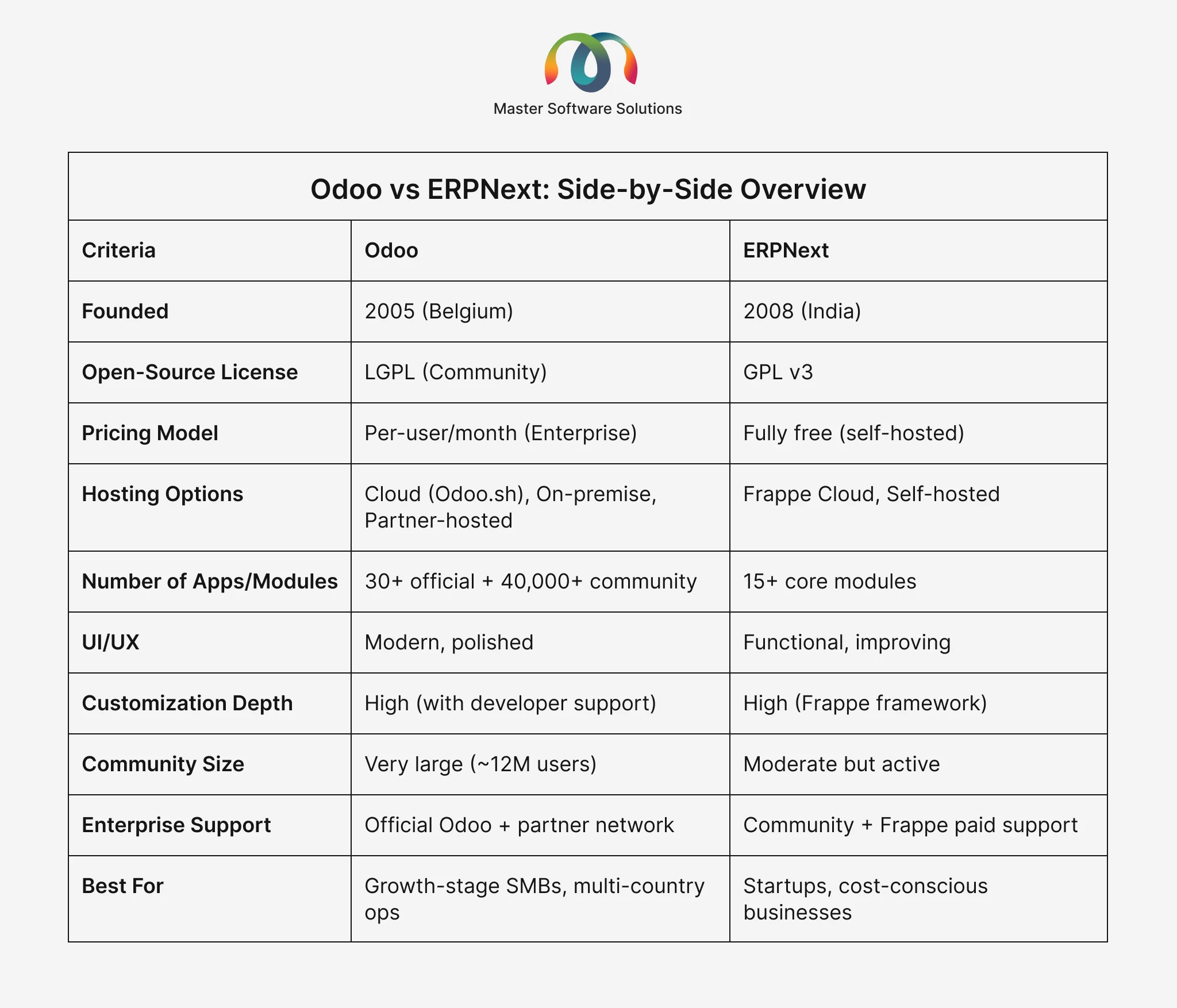
Odoo vs ERPNext: Side-by-Side Overview
Detailed Feature Comparison
Core ERP Modules
Odoo covers virtually every business function with dedicated apps, including Sales, Purchase, Inventory, Manufacturing (MRP/MRP II), Accounting, HR & Payroll, CRM, Project Management, Field Service, Helpdesk, E-commerce, Point of Sale, and more. Each module is tightly integrated, and data flows seamlessly between them.
ERPNext includes comparable core modules, such as Accounting, Inventory, HR & Payroll, Manufacturing, CRM, and Projects, and the breadth of functionality within each module is somewhat narrower with respect to Odoo Enterprise. That said, for most SMB use cases, ERPNext covers the essentials competently.
User Interface & Experience
One of Odoo’s biggest competitive advantages is its consumer-grade UI. The platform feels intuitive to non-technical users, reducing training time and improving adoption rates. Dashboards are visual, navigation is logical, and the mobile experience is solid.
ERPNext’s interface has improved significantly in recent versions (v14 and v15), but it remains more utilitarian. Power users appreciate its clean, form-based layouts, but less tech-savvy staff may face a steeper learning curve.
Accounting & Finance
Both platforms offer double-entry accounting, multi-currency support, bank reconciliation, tax management, and financial reporting.
Odoo supports localized accounting out of the box for 60+ countries, including automated tax compliance, e-invoicing standards (e.g., PEPPOL, UBL), and country-specific charts of accounts.
ERPNext also supports multi-currency and GST/VAT accounting and is particularly strong in markets like India, where it was originally built. However, its localization coverage is narrower for Western markets.
Manufacturing & Inventory
Odoo Manufacturing supports Bills of Materials, Work Orders, Multi-step routing, MRP (Material Resource Planning), Quality Control, Maintenance, and PLM (Product Lifecycle Management) in Enterprise.
ERPNext covers BOM, Work Orders, MRP, sub-contracting, and batch tracking. It is well-regarded for discrete manufacturing use cases, particularly in the Indian market.
For businesses with complex production workflows, including multi-level BOMs, capacity planning, and real-time shop floor monitoring, Odoo Enterprise has an edge.
CRM & Sales
Odoo CRM is polished, with a Kanban pipeline view, lead scoring, email integration, automated follow-ups, and tight integration with Odoo Sales, Invoicing, and E-commerce.
ERPNext CRM covers leads, opportunities, quotations, and customer tracking, functional but less visually rich.
For businesses running active sales teams or field sales operations, Odoo delivers a noticeably better experience.
HR & Payroll
Both platforms handle employee management, leave tracking, attendance, appraisals, and payroll.
Odoo’s HR suite includes recruitment (with a careers portal), expense management, and fleet management.
ERPNext has a comparable HR module and is particularly strong for Indian payroll compliance (PF, ESI, TDS).
E-Commerce & Website
This is an area where Odoo clearly dominates.
Odoo includes a built-in website builder, e-commerce module, and blog platform, all tightly connected to inventory, pricing, and CRM. You can build a full product catalog, manage orders, run promotions, and track everything in one system.
ERPNext does not have a native website or e-commerce builder.
Pricing Comparison: Odoo vs ERPNext
Odoo Pricing
- Community Edition: Free (open-source, self-hosted)
- Enterprise Edition: Starts at approximately $9.10/user/month (One App) up to ~$28.80/user/month (All Apps), billed annually
- Additional costs: hosting (Odoo.sh), implementation partner fees, customization
ERPNext Pricing
- Self-hosted: Completely free (open-source)
- Frappe Cloud (managed hosting): Starts at ~$50/month for a basic site
- Implementation, customization, and support costs are separate
Total Cost of Ownership for a 20-user SMB (3-year estimate):
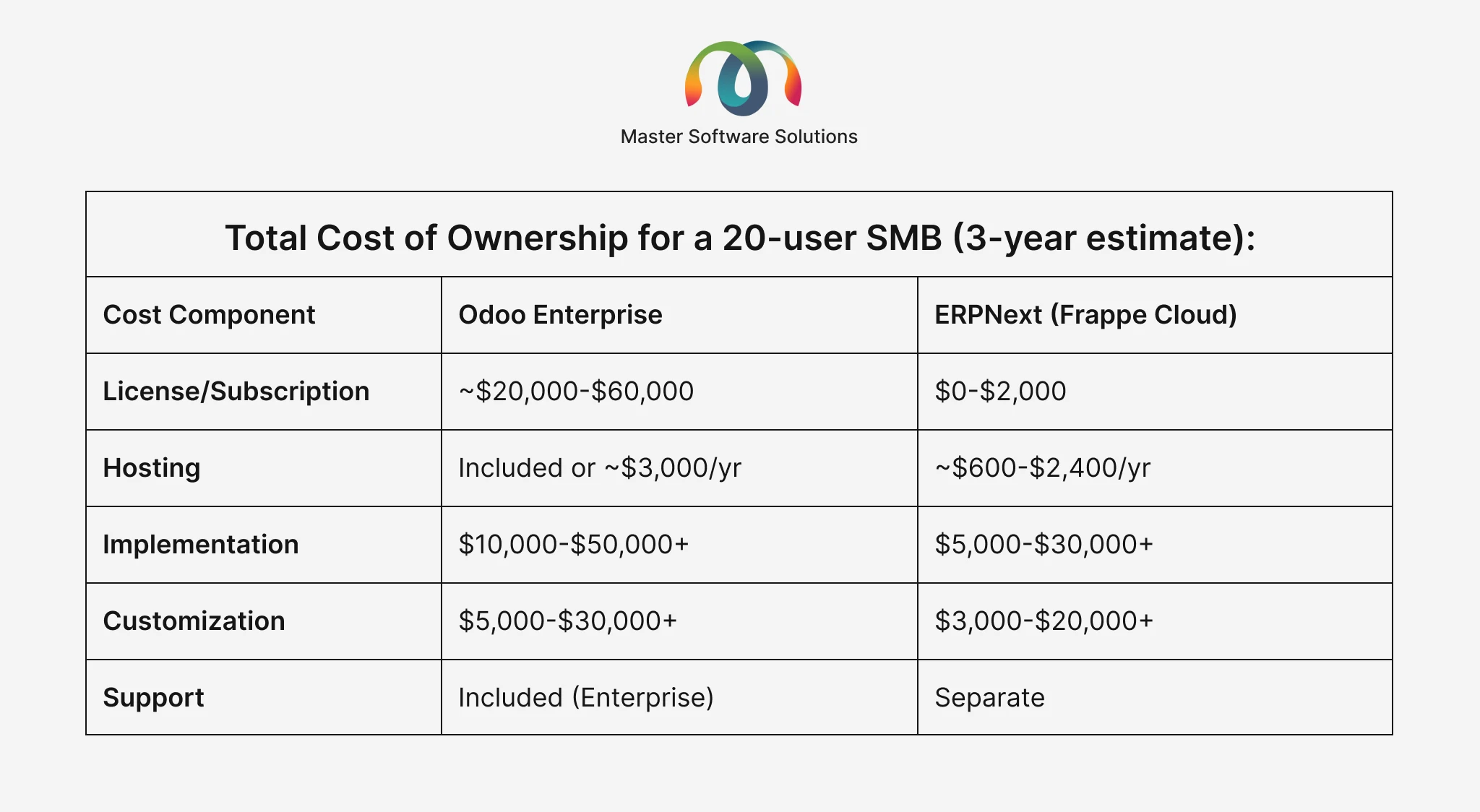
Key insight: ERPNext can be significantly cheaper upfront, but the total cost gap narrows once implementation, customization, and ongoing support are factored in. Odoo’s larger partner ecosystem also makes it easier to find qualified local support.
Not sure which ERP fits your budget? Book a free consultation with our ERP experts. We’ll map the right platform to your business needs and budget without the sales pressure.
Customization & Integration
Odoo Customization
Odoo is highly customizable through its Studio tool (Enterprise, no-code), Python-based module development, and XML views. With over 40,000 community modules available in the Odoo Apps Store, many customization needs are already solved out of the box.
Master Software Solutions offers dedicated Odoo Customisation Services to tailor Odoo to your specific workflows, from custom fields and automated rules to full module development.
ERPNext Customization
ERPNext’s Frappe framework is developer-friendly and allows significant customization via DocTypes, server scripts, and custom apps. The learning curve is steeper for non-developers compared to Odoo Studio, but developers who know the Frappe framework can build powerful custom solutions.
Integrations
- Odoo integrates natively with payment gateways, shipping carriers, and accounting tools (e.g., QuickBooks, Xero), e-commerce platforms (Shopify, WooCommerce via connectors), and offers REST APIs + webhooks.
- ERPNext also offers REST APIs and has growing integrations, but the third-party ecosystem is smaller.
Scalability & Performance
Odoo is built to scale, from a 5-person startup to a multinational with thousands of users. Odoo.sh (the official cloud platform) provides auto-scaling, staging environments, and continuous deployment. Large enterprises (500+ users) successfully run Odoo on dedicated infrastructure.
ERPNext scales reasonably well for SMBs, but very high-volume deployments (hundreds of concurrent users with complex workflows) can require significant infrastructure tuning. It is generally considered better suited for small-to-mid-sized businesses than large enterprises.
Community & Support Ecosystem
Odoo
- Official support available via Odoo Enterprise subscription
- Global partner network of 3,000+ certified partners (including Master Software Solutions)
- Large community forums, extensive documentation, and video tutorials via Odoo eLearning
- Annual Odoo Experience conference with 10,000+ attendees
ERPNext
- Primarily community-driven support on an active GitHub repo and discussion forums (discuss.frappe.io)
- Frappe Technologies offers paid support and cloud hosting
- Smaller but passionate community, particularly strong in India
Implementation Timeline
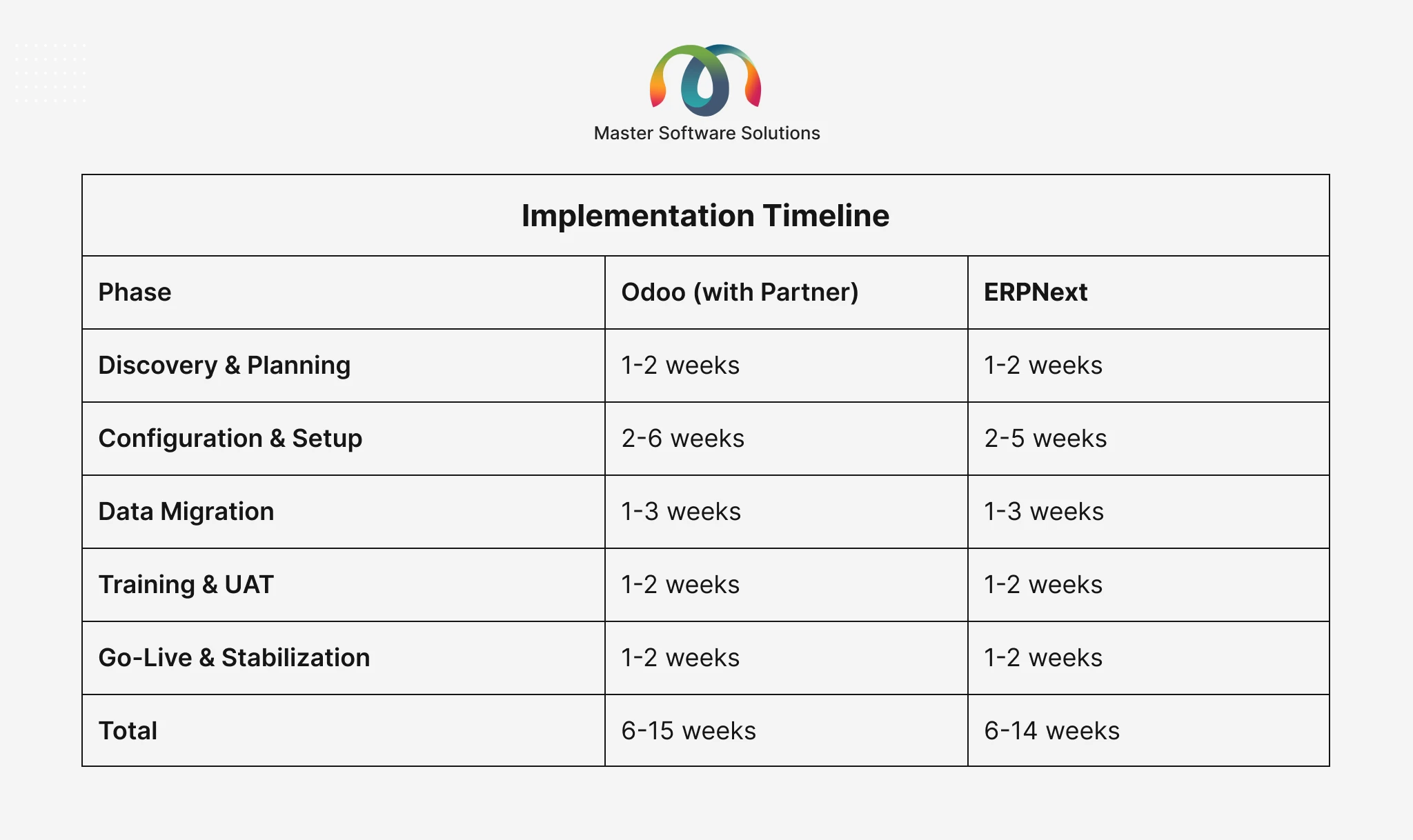
Both platforms have comparable implementation timelines. The key differentiator is partner availability; finding experienced Odoo implementation partners is generally easier due to the larger certified partner network.
Ready to implement ERP without the guesswork? Our certified Odoo consultants have delivered 100+ successful implementations. Talk to our certified Odoo team today.
Security & Compliance
Odoo Enterprise (Odoo.sh) is ISO 27001 certified, offers role-based access controls, 2FA, audit logs, automated backups, and GDPR compliance tools. Odoo handles security patches as part of the enterprise subscription.
ERPNext (self-hosted) gives you full data ownership and control, but you are responsible for server security, patching, and compliance. Frappe Cloud manages security for hosted instances.
For businesses in regulated industries (healthcare, finance, food manufacturing), Odoo Enterprise’s compliance infrastructure is generally more production-ready.
When to Choose Odoo
Choose Odoo if you:
- Is a growth-stage SMB planning to scale operations
- Need a polished, user-friendly UI that drives fast adoption
- Require e-commerce, website, or POS integration with your ERP
- Operate in multiple countries and need localized accounting
- Want reliable commercial support with an official partner network
- Have a moderate budget and want a lower-risk implementation
Explore our Odoo Consulting Services
When to Choose ERPNext
Choose ERPNext if you:
- Are a budget-constrained startup and want zero licensing costs
- Have strong in-house developer resources for customization and maintenance
- Operate primarily in India, the Middle East, or South/Southeast Asia, where the community is strongest
- Need basic ERP functionality without complex workflows
- Are comfortable with community-based support rather than official vendor support
Odoo vs ERPNext: The Bottom-Line
Neither platform is universally “better”; the right choice depends on your business profile.
Choose Odoo if you’re a growing business that values UX, wants a broad ecosystem of apps and integrations, and needs enterprise-grade support. The investment pays for itself through faster adoption, lower customization costs (thanks to the app store), and a more scalable foundation.
Choose ERPNext if you’re a cost-sensitive startup with developer resources and need a functional, free ERP primarily for back-office operations.
For most SMBs evaluating an ERP in 2025, Odoo offers a more complete, future-proof solution, especially when implemented with an experienced partner who can configure it to match your exact workflows.
How Master Software Solutions Can Help
As a certified Odoo Silver Partner, Master Software Solutions has helped businesses across manufacturing, retail, logistics, food & beverage, and professional services implement and scale Odoo ERP. Our team handles everything from initial scoping and configuration to data migration, customization, training, and ongoing support.
Whether you’re choosing between Odoo and ERPNext or have already decided and need a trusted implementation partner, we’re here to help. Book Your Free ERP Consultation