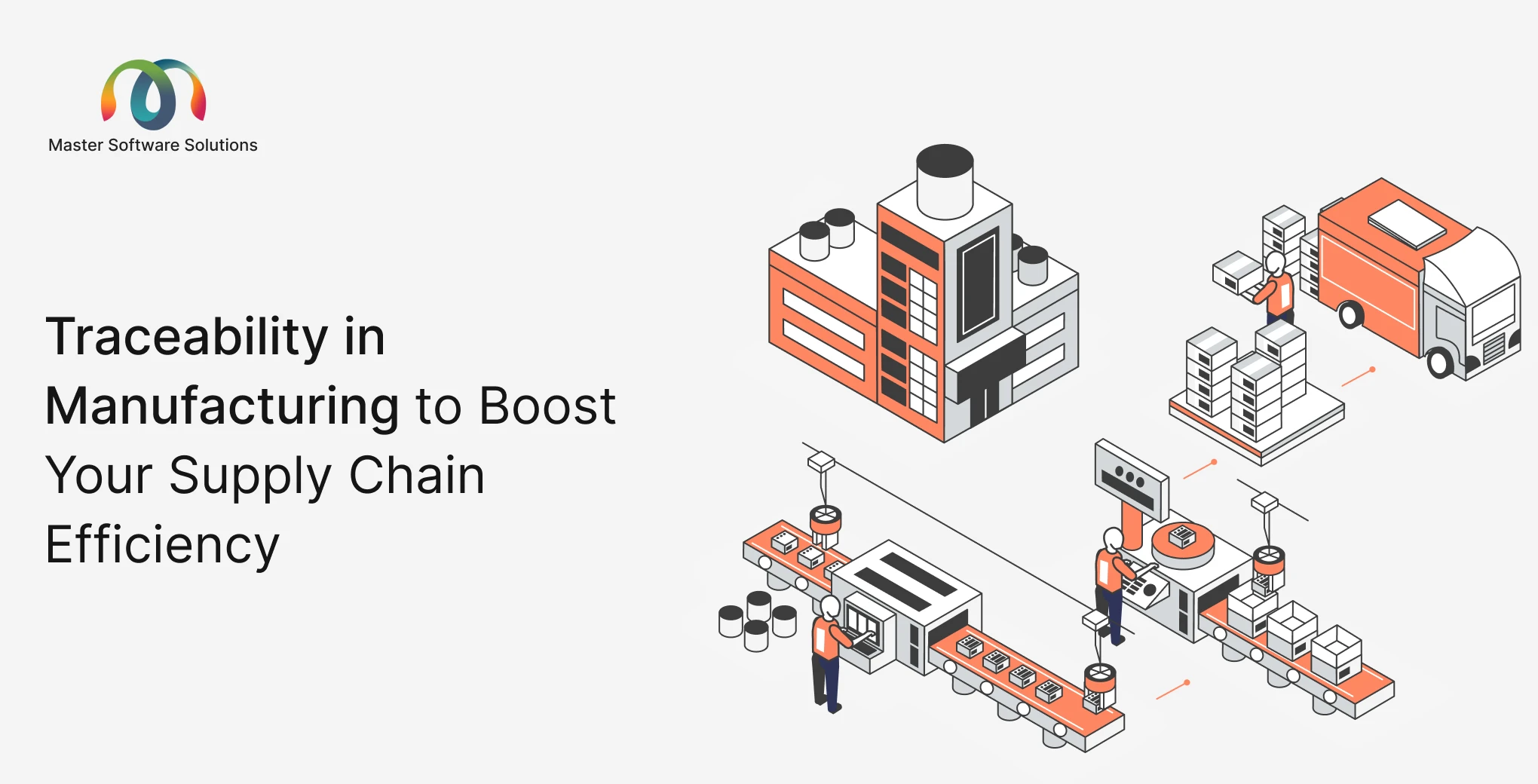
A single contaminated batch can trigger a nationwide recall affecting dozens of distributors, hundreds of retail locations, and thousands of consumers all within hours. When that happens, regulators don’t give you days to trace the problem. Under the FDA’s Food Traceability Rule (FSMA Section 204), you have 24 hours to produce complete lot-level records.
For food and beverage manufacturers, distributors, and processors still relying on spreadsheets, paper logs, or disconnected systems, the deadlines are impossible to meet. Automated lot traceability isn’t just a compliance checkbox—it’s a business imperative.
In this guide, we walk you through exactly how to implement automated lot traceability that meets FDA food safety requirements, reduces the risk of recalls, and builds the operational resilience your business needs as we head into 2026 and beyond.
Ready to build a compliant traceability system? Talk to our food & beverage ERP experts at Master Software Solutions and get a free compliance readiness assessment.
What Is Lot Traceability and Why Does It Matter?
Lot traceability is the ability to track a specific batch (or “lot”) of food product through every stage of the supply chain, from raw material sourcing and manufacturing through storage, shipping, and final delivery to the customer.
In practice, this means being able to answer questions like:
- Which supplier provided the raw ingredient in Lot #4421?
- Which finished products contain that ingredient?
- Which retailers received those products, and when did they receive them?
- Which customers purchased them?
When traceability is automated, this information is captured in real time by software systems, such as barcode scanners, ERP modules, and IoT sensors, rather than by humans manually entering data into spreadsheets. The result is faster recall response, fewer data errors, and a continuous audit trail that meets regulatory scrutiny.
Why it matters financially: According to the FDA, foodborne illness costs the U.S. economy over $15 billion annually. A poorly managed recall can cost a mid-sized food company $10 million or more in direct costs, not counting reputational damage. Automated lot traceability dramatically reduces both the scope and the cost of recalls.
See how Master Software Solutions helps food and beverage businesses automate operations end-to-end: Explore our Food & Beverage ERP solutions.
Understanding FDA FSMA Section 204: The Food Traceability Rule
The Food Safety Modernization Act (FSMA) Section 204 authorizes the FDA to establish enhanced recordkeeping requirements for high-risk foods. The Food Traceability Final Rule is the most significant update to U.S. food safety recordkeeping in decades.
Key Facts About the Rule
- Original compliance deadline: January 20, 2026
- Extended compliance deadline: July 20, 2028 (30-month extension published August 2025)
- 24-hour record retrieval requirement: Covered entities must provide requested records to the FDA within 24 hours of a request
- Written Traceability Plan: Every covered entity must maintain a documented plan describing its traceability system
- Scope: Applies to manufacturers, processors, packers, and holders of foods on the FDA’s Food Traceability List (FTL)
Note: While the enforcement deadline has been extended to July 2028, the FDA is actively hosting stakeholder engagement sessions (including a virtual public meeting on June 15, 2026) and continues to expect businesses to be building toward compliance now. Don’t wait.
For more details, visit the official FDA FSMA Food Traceability Rule page.
Who Must Comply? Foods on the FDA Traceability List
The rule applies to anyone who manufactures, processes, packs, or holds foods included on the FDA Food Traceability List (FTL). These are foods identified as carrying a higher risk of foodborne illness outbreaks.
FDA Food Traceability List: Key Categories
Fresh Produce
- Fresh leafy greens (whole and cut)
- Fresh herbs
- Cucumbers, peppers, tomatoes, melons, sprouts
- Tropical tree fruits
- Fresh-cut fruits and vegetables
Dairy
- Soft and semi-soft cheeses
Eggs
- Shell eggs
Seafood
- Finfish, smoked finfish, crustaceans, molluscan shellfish.
Nuts
- Nut butters (peanut and tree-nut spreads)
Prepared Foods
- Refrigerated ready-to-eat deli salads (egg, pasta, seafood-based)
Beverages
- Fruit juices and vegetable juices
- Cold-pressed and fresh-squeezed juices
- Ready-to-drink coffee and cold brew beverages
- Kombucha and fermented beverages
- Flavored waters and functional beverages
Even if your product isn’t on the FTL, building robust lot traceability is a best practice for any food business. Many retailers and foodservice customers now require it as a condition of doing business.
See the complete FDA Food Traceability List for the full reference.
Key Data Elements (KDEs) and Critical Tracking Events (CTEs) Explained
The core architecture of FSMA 204 is built on two concepts: Critical Tracking Events (CTEs) and Key Data Elements (KDEs). Mastering these is essential for designing your traceability system.
Critical Tracking Events (CTEs)
CTEs are the specific points in the food supply chain where records must be created or updated. The FDA defines the following CTEs:
Key Data Elements (KDEs)
KDEs are the data points that must be captured and recorded at each CTE. These typically include:
- Traceability Lot Code (TLC): A unique identifier assigned to a specific lot of food
- TLC Source: The name and location of the business that assigned the lot code
- Quantity and unit of measure
- Product description
- Date of the CTE (harvest date, ship date, receive date, etc.)
- Location description (for shipping and receiving CTEs)
- Reference document type and number (e.g., purchase order, bill of lading)
- Transporter name (for shipping CTEs)
Your automated traceability system must capture and store all required KDEs at every applicable CTE and make them retrievable within 24 hours on FDA request.
Step-by-Step: How to Implement Automated Lot Traceability
Implementing automated lot traceability is a project, not a product purchase. Here is a proven implementation roadmap.
Step 1: Conduct a Traceability Gap Assessment
Before buying any software, map your current state:
- Which foods do you handle on the FTL?
- Which CTEs apply to your operations?
- What data are you currently capturing, and where?
- Where are the gaps between what you capture now and what FSMA 204 requires?
This assessment is the foundation of your Written Traceability Plan, which the rule requires you to maintain.
Step 2: Write Your Traceability Plan
Your Traceability Plan must document:
- A description of the foods you handle that are on the FTL
- The CTEs that apply to your operations
- How and where KDEs are recorded
- How lot codes are assigned and formatted
- The contact information of your designated traceability point of contact
This is a living document; update it whenever your processes change.
Step 3: Assign Traceability Lot Codes (TLCs)
Establish a standardized, consistent lot coding system. Best practices include:
- Using GS1 GTIN + lot number formats for interoperability with trading partners
- Assigning a new TLC at each transformation event
- Ensuring lot codes are printed on labels and encoded in barcodes or QR codes
- Linking incoming supplier lot codes to your internal lot codes in your system
Step 4: Select and Configure Traceability Software
Choose a platform (see Section 6) and configure it to:
- Capture all required KDEs automatically at each CTE
- Link lot codes across raw materials, work-in-progress, and finished goods
- Generate reports and recall simulations in real time
- Integrate with your ERP, WMS, and supplier systems
Step 5: Integrate with Barcode Scanners and IoT Devices
Deploy hardware at key points:
- Receiving docks: Scan incoming supplier lot codes
- Production lines: Scan ingredient lots being consumed; assign new lots to finished goods
- Packing and shipping: Scan outbound lots and link to shipping documents
- Cold storage: Track movement between storage locations by lot
Every scan feeds directly into your central traceability database with a timestamp and location.
Step 6: Train Your Team
Technology alone won’t ensure compliance. Run structured training for:
- Receiving staff on scanning incoming shipments
- Production workers on the lot assignment and transformation records
- QA/compliance staff on system monitoring and reporting
- Management on how to generate FDA-ready reports on demand
Step 7: Run a Mock Recall
Before going live, simulate a recall:
- Pick a lot from two to three months ago
- Use your system to trace it forward (which finished products contain it?) and backward (which raw material suppliers?)
- Generate a full record set
- Verify you can produce all required KDEs within 24 hours
A successful mock recall is your proof of compliance. (See Section 9 for a detailed guide.)
Step 8: Continuously Monitor and Improve
Schedule quarterly internal audits. Review:
- Data completeness (are all KDEs being captured?)
- Lot code consistency (are there any gaps or duplicates?)
- System integrations (are all connected systems syncing correctly?)
- Staff adherence (are employees following procedures?)
Need help mapping your traceability gaps and selecting the right system? Contact Master Software Solutions for a complimentary consultation.
Choosing the Right Traceability Software and ERP Platform
Not all food traceability software is created equal. When evaluating platforms, prioritize these capabilities:
Must-Have Features
Lot-level tracking across the full supply chain
The system must link supplier lot codes to internal production lots, finished goods lots, and shipment records in a single, unbroken chain.
Automated KDE capture
Manual data entry is a source of errors and gaps. The platform should pull KDEs automatically from barcode scans, EDI messages, and connected production equipment.
Real-time inventory visibility by lot
Know exactly how many units of each lot are on hand, where they are, and where they’ve been shipped at any moment.
One-click recall simulation
Generate forward and backward traces instantly. If a recall is ever triggered, you need this in minutes, not hours.
FDA-ready reporting
Produce structured reports that directly map to the FDA’s KDE requirements, ready to submit within 24 hours.
ERP and WMS integration
Your traceability system should not be a silo. Look for native integration with your ERP (Odoo, Microsoft Dynamics 365, etc.) and warehouse management system.
Audit trail and record retention
FSMA 204 requires the maintenance of records for two years. Make sure your system is built for this with immutable audit logs.
ERP Platforms with Strong Food Traceability Support
Odoo ERP
Odoo’s Inventory and Manufacturing modules include native lot/serial number tracking, quality control integration, and recall management. As a certified Odoo Partner, Master Software Solutions specializes in configuring Odoo for food and beverage compliance.
Microsoft Dynamics 365 Business Central
Strong traceability features with deep integration into financial and supply chain modules. Well-suited for mid-market and enterprise food businesses. Learn more about our Microsoft Dynamics 365 consulting services.
Not sure which ERP is right for your food business? Talk to our ERP consultants. We’ll help you evaluate options based on your size, complexity, and compliance requirements.
GS1 Standards, Barcodes, and EDI in Food Traceability
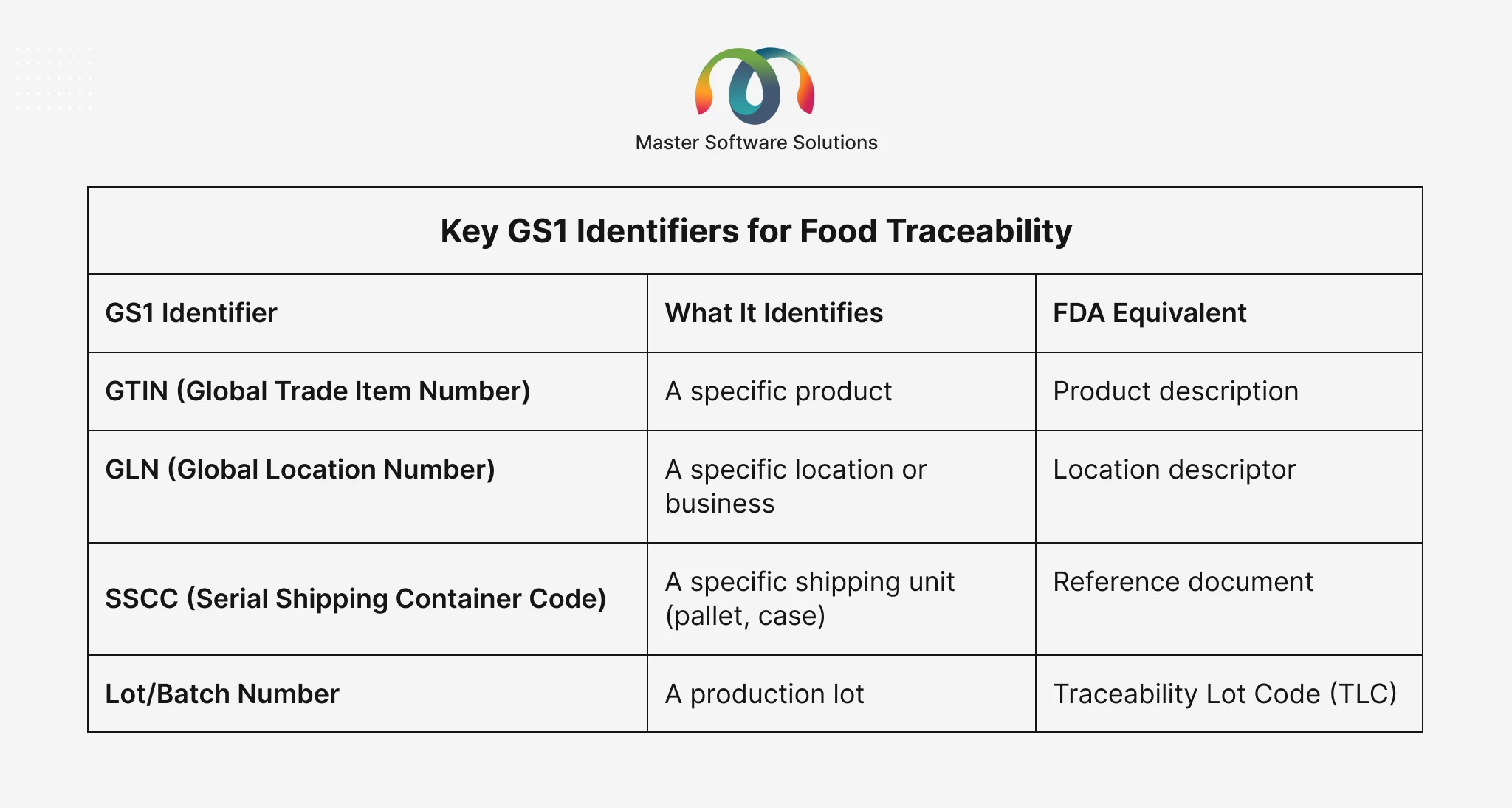
GS1 standards are the global language of supply chain identification and align directly to the FDA’s KDE requirements.
Key GS1 Identifiers for Food Traceability
Barcode Standards
- GS1-128 / ITF-14: Standard for case and pallet labels in food supply chains
- GS1 DataMatrix / QR: Compact 2D codes increasingly used on fresh produce
- RFID: Used in cold chain and high-volume distribution for real-time location tracking
If your suppliers use GS1 labels and your scanners can read into your ERP, then the lot code and product information flow automatically without having to be transcribed by hand.
EDI and Automated Data Exchange
Electronic Data Interchange (EDI) enables structured business documents (purchase orders, advance ship notices, invoices) to be exchanged automatically between trading partners’ systems. For food traceability, key EDI transactions include:
- EDI 856 (Advance Ship Notice): Communicates incoming lot numbers and quantities before physical receipt
- EDI 214 (Transportation Carrier Shipment Status): Tracks in-transit lots
- EDI 824 (Application Advice): Confirms receipt and acceptance of lot data
When GS1 scanning and EDI are combined, lot-level data flows seamlessly between suppliers, manufacturers, distributors, and retailers, meeting the FDA’s traceability chain requirements with minimal manual effort.
Want to automate your supply chain data exchange? Explore our Business Process Automation & Consultation services.
Integrating Traceability with Your ERP System
The most common traceability failure mode isn’t bad software; it’s disconnected software. No communication between your traceability system and your ERP means the lot data is siloed, and you can’t respond to the FDA in 24 hours.
What a Well-Integrated System Looks Like
Inbound flow (receiving)
- Barcode scan at receiving dock
- ERP automatically creates a receipt record with the supplier lot code, quantity, date, and location
- Purchasing order linked
- Inventory updated in real time.
Production flow (transformation)
- The production order in ERP specifies ingredient lots to consume
- Operators scan ingredients at the line
- System records consumption KDEs
- New finished goods lot assigned
- Quality hold or release status tracked
Outbound flow (shipping)
- Pick list generated by ERP
- Lots assigned to shipment
- Shipping label with GS1 lot code generated
- EDI 856 sent to customer
- The shipment record with lot code, date, transporter, and recipient is stored
Recall simulation
- Single query in ERP
- The system returns all raw material sources, production records, and customer shipments linked to a specific lot
- FDA-formatted report generated
Integration Architecture Options
- Native ERP module: Platforms like Odoo include lot tracking natively. This is the simplest integration path.
- Third-party traceability software connected via API: Tools like FoodLogiQ, Wherefour, and TraceGains can connect to your ERP via REST APIs. Requires development work but offers specialized features.
- Custom development: For unique workflows, Master Software Solutions develops custom application integrations that connect your existing systems into a unified traceability architecture.
Looking to integrate your existing systems into a compliant traceability workflow? Get a technical assessment from our team.
9. How to Conduct a Mock Recall {#mock-recall}
A mock recall is a simulated product recall conducted to test whether your traceability system can produce the records needed in a real emergency. The FDA expects companies to be able to execute a meaningful recall exercise—and a successful one is your best proof of readiness.
Mock Recall Protocol
Step 1
Select a trigger lot. Choose a finished goods lot from 60-90 days ago. This is typically old enough to have been shipped to multiple customers.
Step 2
Run a forward trace. Starting from the finished goods lot, identify:
- All customers who received a product from this lot
- Quantities shipped, dates, and locations
- Any remaining inventory in your facility
Step 3
Run a backward trace. Starting from the same finished goods lot, identify:
- All raw ingredient lots that went into it
- The suppliers who provided those ingredients
- Any other finished goods lots that used the same raw ingredient lots
Step 4
Generate the FDA record set. Pull all KDEs for every applicable CTE in the chain. Verify that all required data fields are populated and that records are accurate.
Step 5
Measure the time. How long did steps 2-4 take? FSMA 204 requires the ability to provide records within 24 hours. Best-in-class systems do this in minutes.
Step 6
Document and remediate gaps. Record what data was missing, inaccurate, or hard to retrieve. Update your processes or system configuration to close those gaps before the next audit.
Run mock recalls at least twice per year. Many companies do them quarterly.
Common Lot Traceability Mistakes to Avoid
Even companies that invest in traceability software frequently make implementation errors that undermine their compliance posture.
Mistake 1: Treating lot traceability as an IT project, not an operations project
Technology enables traceability on your production floor, receiving dock, and shipping department. If operators don’t understand why lot codes matter, data quality degrades.
Mistake 2: Allowing lot code gaps or duplicates
A lot of code that’s reused, skipped, or inconsistently formatted breaks the traceability chain. Implement system-enforced validation rules that prevent lot code errors at the point of entry.
Mistake 3: Not linking supplier lot codes to internal lot codes
When you receive raw materials, you must link your supplier’s lot code to your internal receiving record. Failure to do this makes backward traces impossible.
Mistake 4: Siloed traceability systems
The lot data that lives in a separate traceability app but not in your ERP, accounting system, or WMS is incomplete. Integration is non-negotiable.
Mistake 5: Assuming the deadline extension means you have time to delay
The July 2028 extension is a grace period, not a reset. Companies that begin implementation now will be compliant and operationally stronger. Companies that wait until 2027 will face a rushed, error-prone implementation.
Mistake 6: Skipping the written Traceability Plan
The written plan is explicitly required by FSMA 204. It’s also the foundation of any compliance audit. Build it early and update it as your processes evolve.
Mistake 7: Not testing with mock recalls
A system that’s never been tested is a system of unknown reliability. Mock recalls reveal gaps before an actual FDA inspection or recall event does.
Ready to Build a Compliant, Future-Proof Traceability System?
Implementing automated lot traceability is a multi-step journey—but you don’t have to navigate it alone. Master Software Solutions brings deep expertise in ERP implementation, food & beverage operations, and business process automation to help you design, build, and deploy a traceability system that satisfies FDA requirements and scales with your business.
What we offer:
- Traceability gap assessments and Written Traceability Plan development
- Odoo ERP and Microsoft Dynamics 365 implementation with native lot tracking
- Custom integrations connecting your ERP, WMS, barcode systems, and EDI networks
- AI-powered agents for compliance monitoring and reporting automation
- Ongoing support and compliance auditing