Growth is exciting, but it also exposes the cracks in your systems. The spreadsheet that once tracked every order now takes hours to reconcile. Your accountant re-keys invoices that already exist in three other places. Your online store says an item is in stock, while your warehouse quietly ran out of it yesterday. When a business scales, disconnected tools stop being an inconvenience and start being a liability.
This is exactly where Odoo ERP integration changes the game. Odoo is one of the most flexible, modular ERP platforms in the world, and its real power shows when it stops being an island and starts talking to the other tools you already rely on: your accounting software, your e-commerce store, your point of sale, and your payment processors. The right Odoo integration turns a collection of disconnected apps into a single source of truth.
In this guide, we break down the top 5 Odoo ERP integrations every growing business needs, why each one matters, and how professional Odoo integration services help you implement them without disrupting daily operations. Whether you are evaluating your first connection or planning a fully connected ecosystem, this is your roadmap.
Need a shortcut? If you already know your systems are out of sync, skip the guesswork. Talk to our Odoo integration experts for a free integration assessment.
Why Odoo Integration Matters More As You Grow
Before we get to the list, it helps to understand what is actually at stake. Every business runs on data, including orders, inventory, invoices, customers, and payments. When each system stores its own version of that data, you get three predictable problems: duplicate manual entry, delayed or conflicting information, and no reliable way to see the whole business at once.
A well-planned Odoo ERP integration solves all three. Instead of copying data between apps, information flows automatically between them. Industry data shows that connected Odoo environments typically deliver meaningful gains: businesses commonly report 40–60% fewer data-entry errors, roughly 50% less manual admin labor, and dramatically faster reconciliation once systems sync in real time. Those numbers are not magic; they are the direct result of removing humans from repetitive copy-paste work and letting software handle it.
The other reason integration matters is scale. A manual process that works at 50 orders a day quietly collapses at 500. Integration is how you prepare your operations for the volume you are trying to reach, not just the volume you have today.
Five Odoo ERP Integrations For Growing Companies
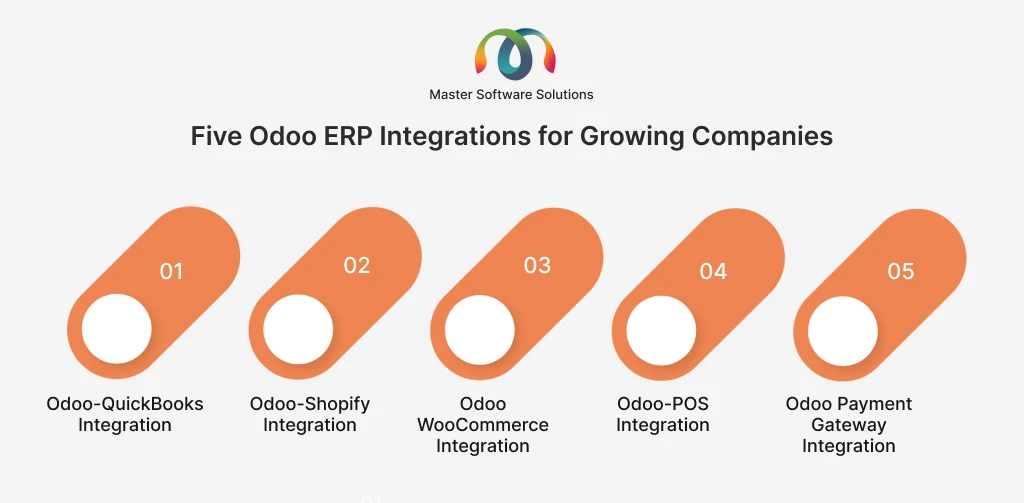
Odoo-QuickBooks Integration
For a huge number of small and mid-sized businesses, accounting lives in QuickBooks. It is familiar, your bookkeeper knows it, and your financial history is already there. The challenge is that your operations, such as sales orders, inventory, or purchasing, increasingly live in Odoo. Without a connection, someone has to bridge the gap by hand, and that person is usually retyping invoices, bills, and payments from one system into the other.
Odoo-QuickBooks integration removes that bridge entirely. Invoices, bills, payments, customers, and chart-of-accounts data sync between the two platforms in many cases, in both directions. When a sale is closed in Odoo, the corresponding entry in QuickBooks is automatically created. When a payment is recorded, both systems reflect it.
The business impact is immediate and measurable:
- Fewer errors. Double entry is the single biggest source of accounting mistakes. Eliminating it can dramatically cut reconciliation-related errors.
- Faster closes. Month-end reconciliation shrinks from days to hours when the numbers already match.
- A clean audit trail. Every transaction has a consistent record across both systems.
This is the essence of solid Odoo accounting integration: your team keeps working on the tools they know while the data stays perfectly aligned underneath. If your finance team is spending more time reconciling than analyzing, this is usually the first integration to prioritize.
Ready to stop re-keying invoices? Learn how our Odoo integration services connect your accounting stack in days, not months.
Odoo-Shopify Integration
If you sell online, your storefront and your back office need to move as one. Odoo-Shopify integration connects your Shopify store directly to Odoo’s Sales, Inventory, and Accounting modules so that everything from the “Add to Cart” click to the shipped package is handled in a single connected system.
Here is what that looks like in practice. A customer places an order on Shopify. That order flows instantly into Odoo as a sales order. Inventory is decremented in real time, ensuring that stock levels are consistent across all channels. Customer details are stored once, fulfillment status updates automatically, and the financial record lands where your accounting expects it. No one re-types anything.
The value of a strong Odoo-Shopify integration compounds as your order volume grows:
- Accurate inventory everywhere. Overselling, promising stock you don’t have, is one of the fastest ways to damage customer trust. Real-time sync prevents it.
- Faster fulfillment. Orders route straight to your warehouse workflow rather than sitting in a queue waiting for manual entry.
- Multi-channel visibility. Sell on Shopify, in a physical store, and elsewhere, and still see one unified picture of demand.
For businesses building a serious online presence, this integration is the backbone of scalable Odoo e-commerce integration. It is what lets you 2x your sales channels without 2x-ing your admin headcount.
Want the technical breakdown? See our detailed guide on Odoo Shopify integration and automatic inventory sync.
Odoo WooCommerce Integration
Not everyone runs on Shopify. A significant share of online stores are built on WooCommerce, the WordPress e-commerce plugin that powers millions of sites. If your store lives there, you need the same seamless data flow, and Odoo WooCommerce integration delivers exactly that.
With WooCommerce connected to Odoo, orders placed on your WordPress site flow straight into Odoo’s Sales and Inventory modules. Customer records and shipment statuses update automatically, and product data can be managed centrally rather than separately. You avoid the retyping, the mismatched stock counts, and the “which system is right?” confusion that plagues disconnected stores.
The benefits mirror those of a Shopify connection but are tailored to the WooCommerce and WordPress ecosystem:
- Centralized product and pricing management. Update once in Odoo, and reflect everywhere.
- Automatic order and customer sync. Every WooCommerce order becomes an actionable Odoo record.
- Reliable stock accuracy. Inventory stays truthful across your website and warehouse.
Whether you are on Shopify or WooCommerce, the underlying principle of Odoo e-commerce integration is the same: your store should never be a data silo. It should be a fully connected part of your operations. A skilled Odoo integration expert will assess your specific plugins, themes, and workflows to ensure the connection is stable through updates and traffic spikes.
Selling on WordPress? Explore how we integrate Odoo eCommerce with your existing tech stack — no rebuild required.
Odoo-POS Integration
For any business with a physical presence, including retail shops, cafés, showrooms, and service counters, the point of sale is where a lot of the action happens. But if your POS operates separately from the rest of your business, you end up with two versions of reality: what sold in-store and what your ERP thinks you have.
Odoo POS integration closes that gap. In-store transactions sync directly with your central inventory and accounting, so a sale at the counter updates the same stock numbers that your online store and warehouse rely on. That is the foundation of true omnichannel retail: one inventory, one customer view, and one set of numbers, regardless of where the sale happens.
Beyond inventory, a well-built Odoo POS integration can connect your point of sale to third-party systems, such as loyalty programs, e-commerce platforms, and payment processors, creating a genuinely unified ecosystem.
The advantages for a growing retailer are substantial:
- Omnichannel inventory accuracy. Sell the same item in-store and online without overselling either channel.
- Unified customer profiles. Recognize repeat customers and reward loyalty across touchpoints.
- Real-time sales reporting. See store performance and online performance side by side, instantly.
If you run both a storefront and an online shop, POS integration is what makes them feel like one business to you and your customers. For a deeper look at capabilities, see our overview of the Odoo ERP POS module features and benefits.
Odoo Payment Gateway Integration
The final integration on our list closes the loop on the entire customer journey: getting paid. Odoo payment gateway integration connects processors like Stripe, PayPal, and other major providers directly to Odoo, so payments are captured and reconciled automatically.
Without this connection, payments become another manual matching exercise; someone compares the processor’s report to the ERP’s records and reconciles them by hand. With it, when a customer pays, the transaction is recorded in Odoo, matched to the right invoice or order, and reflected in your accounting immediately. The money movement and the record-keeping happen together.
For a growing business, the benefits touch both cash flow and customer experience:
- Automatic reconciliation. Payments automatically match invoices, significantly reducing reconciliation time.
- Faster cash flow visibility. Know exactly what has been paid and what is outstanding in real time.
- A smoother checkout. Offer customers the payment options they expect, integrated cleanly into your Odoo-powered store or POS.
Payment gateway integration is often the piece that ties the other four together; it ensures that every sale, whether from Shopify, WooCommerce, or your POS, ends in a clean, reconciled payment record.
The Common Thread: Odoo API Integration
You may have noticed that all five of these connections rely on the same foundation. Under the hood, they are powered by Odoo API integration, the technical layer that lets Odoo securely exchange data with external systems.
Odoo exposes several APIs for this purpose, including REST, XML-RPC, and JSON-RPC, which allow controlled, secure data exchange between Odoo and virtually any other platform. This is important because it means your options are not limited to the five integrations above. If a tool has an API, it can very likely be connected to Odoo. Custom CRMs, shipping carriers, marketing platforms, and business intelligence tools can all be integrated into your connected ecosystem using the Odoo API.
For teams that want to understand the technical details, Odoo’s own documentation covers its external API in depth. But for most growing businesses, the right move is to partner with an experienced team rather than build and maintain these connections in-house.
Why Work With an Odoo Integration Expert
Integration sounds simple in theory: connect A to B and let the data flow. In practice, real-world integrations involve data mapping, error handling, edge cases, security, and ongoing maintenance as each platform releases updates. A connection that breaks silently can be worse than no connection at all, because you may not notice until the numbers are already wrong.
This is why working with a certified Odoo integration expert matters.
A qualified partner will:
- Assess your actual stack before recommending anything, so you integrate what genuinely moves the needle.
- Map your data carefully so fields, taxes, currencies, and customer records are correct across systems.
- Build for reliability, with error handling and monitoring so problems are caught early.
- Maintain the connection as Odoo, Shopify, QuickBooks, and other platforms evolve.
Master Software Solutions is a certified Odoo Ready Partner offering complete Odoo ERP integration services, from accounting and e-commerce to POS and payment gateways. We help growing businesses build a single, connected digital ecosystem rather than a patchwork of disconnected tools.
Not sure which integration to start with? Book a free consultation with our Odoo integration experts and get a prioritized roadmap tailored to your business.
How to Choose Which Integration to Prioritize
If all five sound valuable but you can only start with one, use this simple framework. Ask where you are losing the most time or making the most errors right now.
If your finance team is drowning in manual entry, start with Odoo-QuickBooks integration. If overselling and stock mismatches are hurting your online store, prioritize Odoo-Shopify integration or Odoo-WooCommerce integration depending on your platform. If your in-store and online operations feel like two separate businesses, Odoo POS integration is your answer. And if reconciling payments is eating your team’s time, Odoo Payment Gateway integration delivers fast relief.
The good news is that these integrations build on each other. Most growing businesses eventually connect all of them, and a thoughtful partner will sequence the rollout so each one delivers value before the next begins.
Final Thoughts
Disconnected systems are one of the most common and most fixable obstacles to growth. Each of the five integrations covered here removes a specific bottleneck: QuickBooks for accounting accuracy, Shopify and WooCommerce for e-commerce, POS for unified retail, and payment gateways for seamless cash flow. Together, powered by flexible Odoo API integration, they transform Odoo from a standalone ERP into the connected core of your entire business.
The businesses that scale smoothly are rarely the ones with the most tools. They are the ones whose tools actually talk to each other. If you are ready to build that kind of connected operation, the right Odoo integration services partner will get you there faster and with fewer headaches.
Ready to connect your systems? Get in touch with Master Software Solutions, certified Odoo integration experts, and turn your disconnected tools into one seamless ecosystem.