Choosing an ERP is one of the highest-stakes technology decisions a manufacturer will ever make. The system you pick will run your production schedules, control your inventory, track every bill of materials, and determine how fast you can respond to customers. Two names appear on almost every shortlist for small and mid-sized manufacturers: Odoo and SAP Business One.
Both are proven platforms, but they solve the same problems in very different ways. Odoo is an open-source, modular suite known for flexibility and a low entry cost. SAP Business One is a mature, highly structured ERP backed by the world’s largest enterprise software vendor.
In this guide, we compare Odoo and SAP Business One for manufacturing across features, pricing, total cost of ownership, implementation time, customization, and scalability, so you can decide which system best fits your shop floor, budget, and growth plans.
Quick Verdict: Odoo vs. SAP Business One at a Glance
Short on time? Here is the summary:
- Choose Odoo if you want a flexible, affordable, all-in-one ERP that deploys in weeks, adapts to your processes, and scales module by module. It is the stronger fit for most small- and mid-sized manufacturers in 2026.
- Choose SAP Business One if you run highly standardized processes, need deep out-of-the-box financial controls, or are strategically committed to the SAP ecosystem.
For most growing manufacturers, Odoo delivers comparable manufacturing functionality at roughly 40–60% lower total cost of ownership than SAP Business One.
What Is Odoo?
Odoo is an open-source ERP platform with more than 80 integrated business applications covering manufacturing (MRP), inventory, purchasing, quality, maintenance, PLM, accounting, CRM, and eCommerce, all on a single database. Its manufacturing suite handles multi-level bills of materials, work orders, tablet-based shop floor terminals, and master production scheduling without third-party tools.
Recent releases have moved fast: Odoo 19, launched in September 2025, introduced AI-assisted workflows, roughly 40% faster performance, and deeper industry functionality. If you are evaluating versions, see our complete Odoo 19 module overview.
What Is SAP Business One?
SAP Business One (often shortened to SAP B1) is SAP’s ERP for small and mid-sized companies. It centralizes financials, sales, purchasing, inventory, and production in a single system, with standard processes refined over more than two decades. Its manufacturing capabilities cover production BOMs, production orders, MRP runs, and resource planning, and a large network of certified add-ons extends it for needs like MES integration and advanced scheduling.
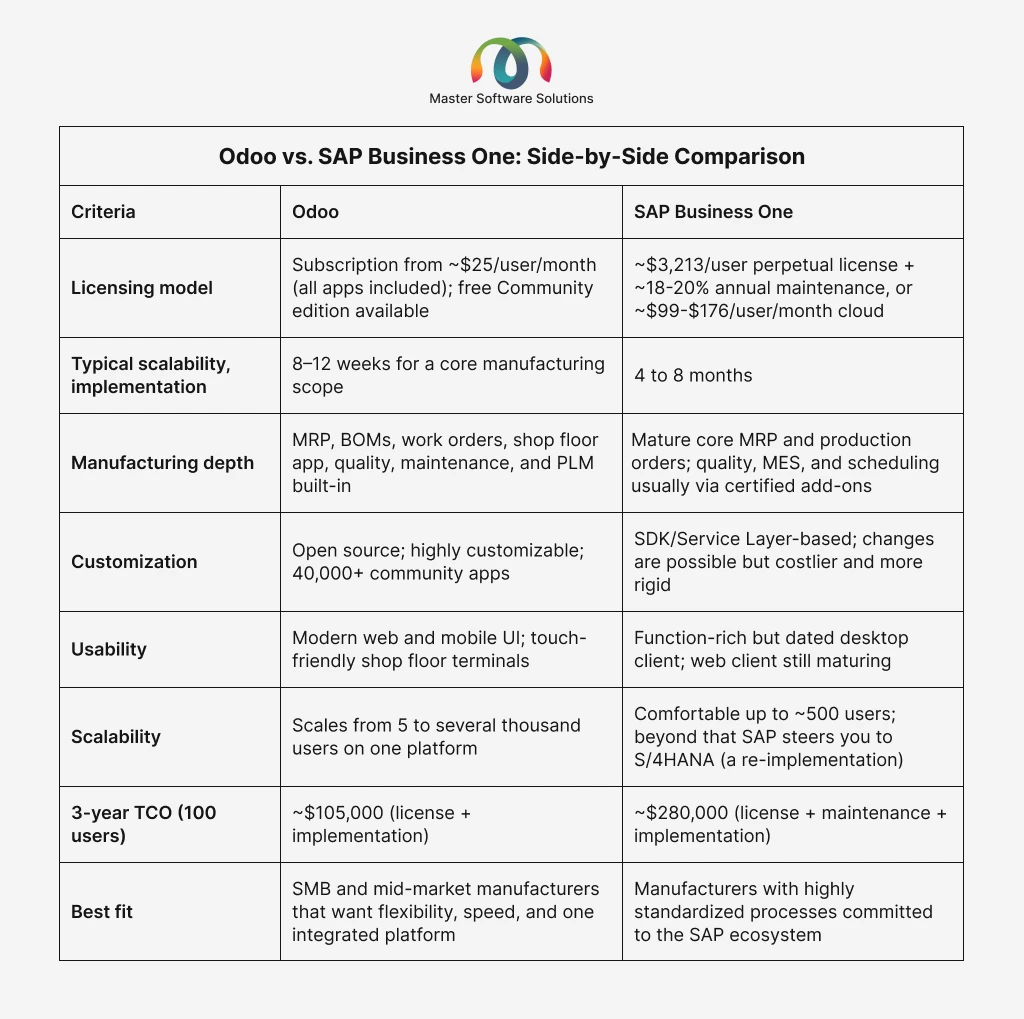
Odoo vs. SAP Business One: Side-by-Side Comparison
Manufacturing Features Head-to-Head
Production Planning and MRP
Both systems run material requirements planning that converts demand into purchase and production orders. SAP B1’s MRP wizard is mature and dependable for classic make-to-stock scenarios, and it keeps an edge in complex multi-level forecasting and available-to-promise (ATP) calculations. Odoo’s MRP, however, has closed the gap dramatically across versions 17 to 19: its Master Production Schedule, automated replenishment rules, and forecasted-demand views now cover the needs of most discrete and process manufacturers, inside a far more modern interface.
Bills of Materials and Engineering Changes
Odoo supports multi-level BOMs, kits, by-products, subcontracting, and BOM versioning through its built-in PLM app, where engineering change orders route through approval workflows. SAP B1 handles multi-level production BOMs well, but PLM-style versioning and engineering change management usually require partner add-ons, which add licensing cost and integration complexity.
Shop Floor Control and Work Orders
Odoo ships a dedicated shop floor app: touch-friendly work-center terminals where operators start jobs, log time, register output, report scrap, and follow digital worksheets in real time. SAP B1 primarily records production activity through back-office transactions; capturing live shop floor data usually requires the addition of a third-party MES.
Quality and Maintenance
Quality and Maintenance are native Odoo modules. Control points initiate checks at receiving, in-process, or before delivery, and preventive maintenance schedules display equipment uptime alongside production data. In SAP Business One, quality management and maintenance are largely add-on territory, capable but at extra cost.
Inventory and Warehouse Management
Both platforms handle multi-warehouse operations, lot and serial tracking, and barcode scanning. Odoo’s double-entry inventory system adds flexible routes, such as pick-pack-ship, cross-docking, and drop-shipping, that can be configured without code; SAP B1 provides solid bin-level management, which is frequently combined with WMS add-ons. For a deeper look at how Odoo handles stock, read our Odoo inventory management guide.
Financials and Product Costing
This is where SAP B1 traditionally shines: robust standard costing, landed costs, and multi-currency consolidation out of the box. Odoo’s accounting has evolved into a full double-entry system that supports standard, FIFO, and average costing, as well as real-time inventory valuation, and is localized in over 100 countries. Very complex intercompany structures may still favor SAP; for everyone else, Odoo’s financials are more than sufficient and far easier to use.
Pricing and Total Cost of Ownership (TCO)
Licensing is where the two platforms diverge most visibly. Odoo’s subscription starts at roughly $25 per user per month and includes every application, including manufacturing, inventory, accounting, CRM, and more, with no per-module fees. SAP Business One is available as a perpetual license for about $3,213 per user plus 18-20% annual maintenance, or as a cloud subscription for around $99-$176 per user per month.
The bigger picture is total cost of ownership. Independent 2026 comparisons estimate that a 100-user manufacturer spends about $105,000 over three years on Odoo (licenses plus implementation) versus about $280,000 on SAP Business One once maintenance and longer implementation are included. Implementation effort is usually the largest variable in both cases; our breakdown of Odoo implementation costs in the USA shows what drives the number up or down.
Want a precise number for your plant? Master Software Solutions will map your user count, modules, and integrations into a free, no-obligation ERP cost estimate. Talk to our ERP consultants.
Implementation Time and Complexity
Speed to go-live matters: every month on spreadsheets or a legacy system costs real money. A core Odoo manufacturing scope, including inventory, MRP, purchasing, and accounting, typically goes live in 8–12 weeks. SAP Business One projects for a similar scope usually run 4–8 months, driven by heavier configuration, add-on integration, and data migration overhead.
Odoo’s modularity also enables phased rollouts: go live with inventory and manufacturing first, then switch on quality, PLM, eCommerce, or HR as the team is ready. Our step-by-step Odoo ERP implementation guide shows you how to set up a phased deployment that keeps production running.
Customization, Integrations, and Scalability
Odoo is open-source and is built on Python, making deep customization practical and affordable: workflows, screens, and reports can be tailored to how your factory operates, and the Odoo app store includes over 40,000 community and partner modules. Open REST and XML-RPC APIs connect shop floor equipment, e-commerce platforms, and logistics carriers.
SAP Business One is customized through its SDK and Service Layer, usually by certified partners. It is dependable but comparatively rigid; most companies adapt their processes to SAP rather than the reverse, and every add-on carries its own license and upgrade cycle.
On scalability, Odoo runs the same platform from 5 users to several thousand, so you never face a forced migration. SAP B1 is comfortable up to roughly 500 users; beyond that, SAP’s path is S/4HANA, effectively a new ERP project with a new budget.
Usability and User Adoption
ERP value depends on people actually using the system. Odoo’s modern web and mobile interface keeps training time short, and its shop floor terminals were designed for gloves-on, touchscreen use. SAP B1’s classic desktop client is powerful but visibly dated, and while its web client is improving, operator-level adoption typically takes longer. For manufacturers battling labor turnover, faster onboarding is a quiet but significant cost saving.
Which ERP Should Your Manufacturing Business Choose?
Choose Odoo if you:
- Are an SMB or mid-market manufacturer that needs to go live within a quarter, not a year
- Want manufacturing, quality, maintenance, PLM, accounting, and CRM in one platform without add-on sprawl
- Expect your processes to evolve and want an ERP that can be reshaped affordably
- Care about total cost of ownership and predictable subscription pricing
Choose SAP Business One if you:
- Run mature, standardized processes you do not intend to change
- Need SAP-grade financial consolidation across complex legal entities from day one
- Are already invested in the SAP ecosystem or are required to be by a parent company
Still on the fence? Book a free ERP fit assessment with Master Software Solutions. We will benchmark both platforms against your BOM complexity, order volumes, and budget, and give you an honest recommendation, even if it is not us. Schedule your assessment.
Final Thoughts
SAP Business One remains a solid, structured ERP, but in 2026 the momentum in SMB and mid-market manufacturing is clearly with Odoo. It delivers the manufacturing depth most factories need, deploys in weeks, adapts as you grow, and costs roughly half as much to own. Unless your business is strategically tied to the SAP ecosystem, Odoo is the pragmatic choice.
The deciding factor, in either case, is the implementation partner. The right partner turns software into shorter lead times, cleaner inventory, and faster closes; the wrong one turns any ERP into shelfware.
Ready to modernize your manufacturing operations? Master Software Solutions is an Odoo implementation partner serving manufacturers across the USA and beyond. Explore our Odoo implementation services for a free consultation.