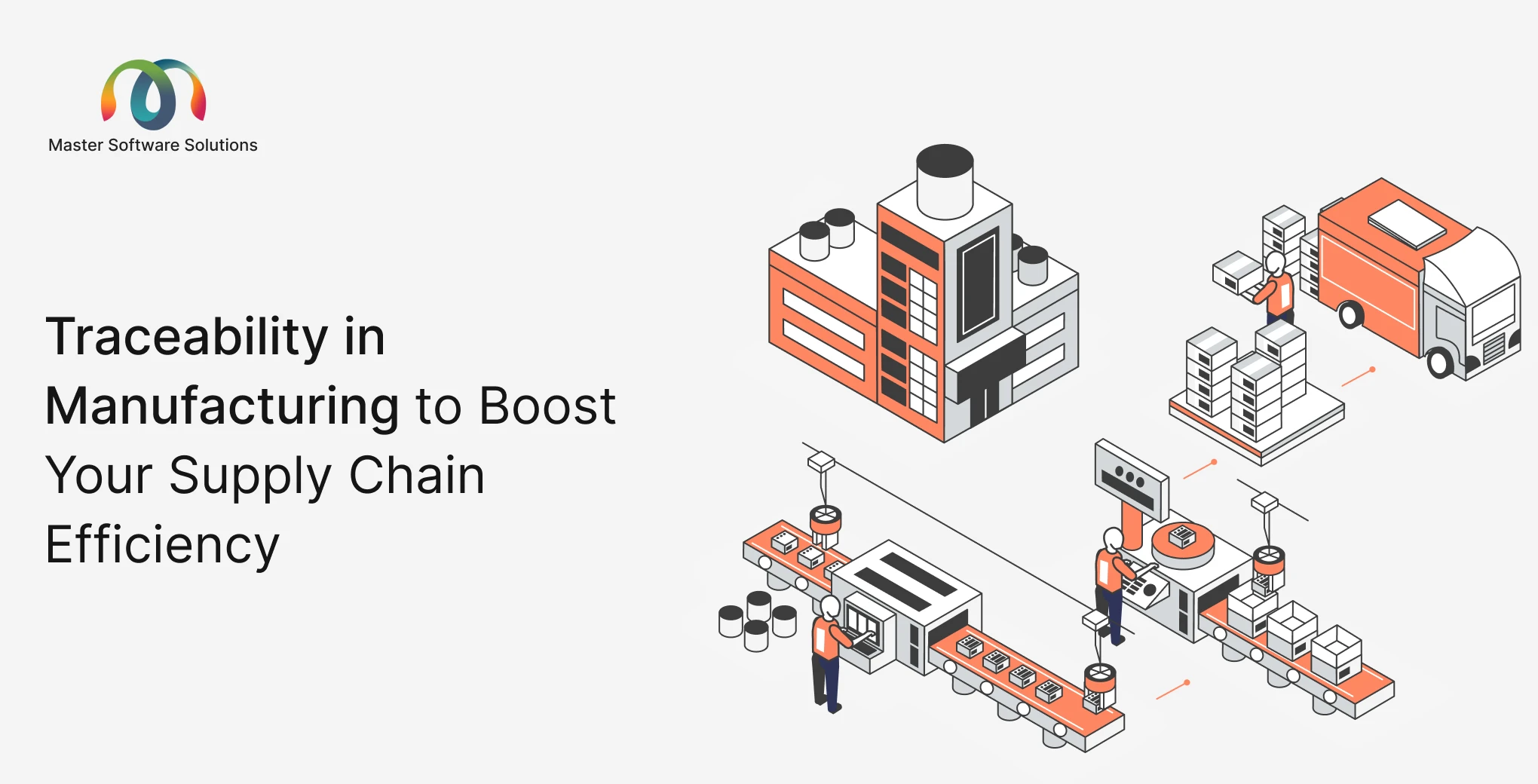
In today’s hyper-connected global economy, a single untraceable component can cascade into a costly product recall, a compliance violation, or a complete breakdown of customer trust.
Manufacturers across every vertical, from food and beverage to automotive to pharmaceuticals, are under mounting pressure to know exactly where every raw material came from, where it went, and what happened to it along the way.
Traceability in manufacturing is no longer a “nice to have.” It is the backbone of supply chain resilience.
This guide breaks down everything manufacturers need to know about building and sustaining a traceability system: why it matters, how modern ERP platforms enable it, the challenges to watch out for, and the measurable efficiency gains waiting on the other side.
What Is Traceability in Manufacturing?
Traceability in manufacturing is the ability to track and document the complete lifecycle of a product, from raw material sourcing through production, quality control, warehousing, and delivery to the end customer. It answers three fundamental questions:
- Where did it come from? (backward traceability/upstream)
- Where is it now? (in-process traceability)
- Where did it go? (forward traceability / downstream)
A complete traceability system captures data at every stage: lot and batch numbers, supplier details, machine and operator records, inspection results, storage conditions, shipping documents, and customer delivery confirmations.
Types of Traceability
- Batch/Lot Traceability: Tracks groups of products manufactured together under the same conditions. This is critical for food safety and pharmaceutical compliance.
- Serial Traceability: Tracks individual units using unique identifiers, common in high-value manufacturing sectors such as aerospace, medical devices, and electronics.
- Component Traceability: Tracks specific parts within a finished product, enabling targeted recalls rather than broad, expensive ones.
- Process Traceability: Captures machine settings, operator actions, and environmental data at each production step.
Why Traceability Matters for Supply Chain Efficiency
Many manufacturers think of traceability primarily as a compliance checkbox. In reality, it is one of the most powerful levers for supply chain efficiency available.
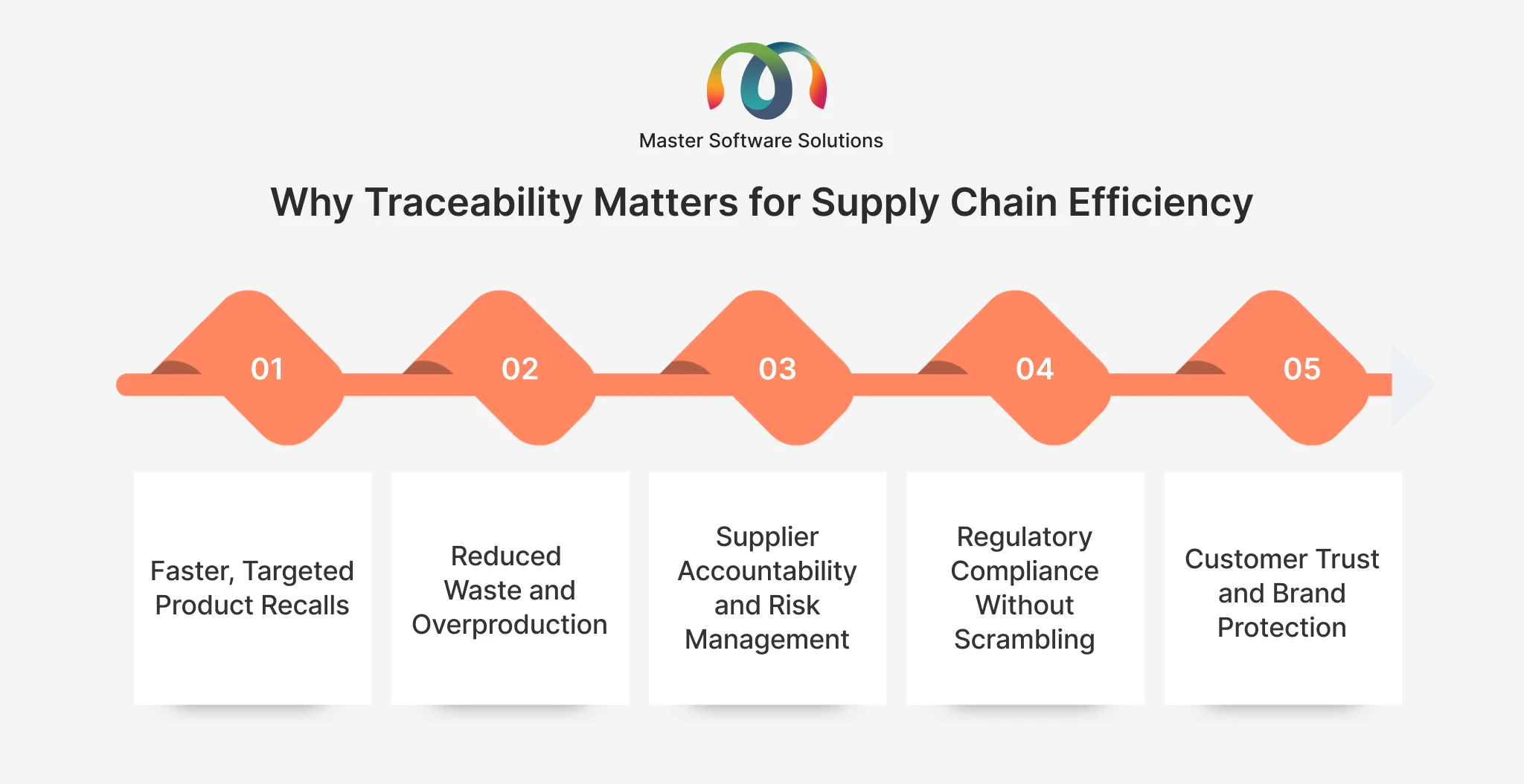
Faster, Targeted Product Recalls
Without traceability, a contamination or defect event forces manufacturers to recall entire product lines, often millions of units, at enormous cost. With lot-level traceability, teams can isolate exactly which batches were affected, reducing the scope of a recall by up to 80% in some cases.
Reduced Waste and Overproduction
Traceability data reveals where in the production process materials are being lost, damaged, or scrapped. This granular visibility enables manufacturers to address root causes rather than compensating with overproduction.
Supplier Accountability and Risk Management
Knowing the origin of every input means manufacturers can quickly identify which supplier is responsible when quality issues arise. It also supports better supplier scorecards and risk diversification decisions.
Regulatory Compliance Without Scrambling
Industries like food and beverage, pharmaceuticals, medical devices, and automotive are subject to strict traceability mandates from regulators, including the FDA, ISO, and EU product safety frameworks. A robust traceability system turns compliance from a reactive scramble into a continuous, automated process.
Customer Trust and Brand Protection
End-to-end transparency is increasingly a customer expectation. Retailers, distributors, and enterprise buyers want proof of ethical sourcing, quality standards, and regulatory compliance before they commit to a supplier relationship.
Ready to implement traceability in your manufacturing operations? Schedule a Free Consultation with Master Software Solutions. Our ERP and supply chain experts will assess your current setup and design a traceability roadmap tailored to your industry.
Key Components of a Manufacturing Traceability System
Building effective traceability requires more than a spreadsheet. A mature traceability system integrates five core components:
Unique Identifiers
Every item, batch, or component must carry a unique ID, typically a barcode, QR code, or RFID tag. This identifier links the physical product to its digital record across all systems.
Data Capture at the Point of Action
Traceability is only as good as the data feeding it. Automated data capture via barcode scanners, IoT sensors, RFID readers, or machine integrations ensures that records are accurate, timestamped, and free of human error.
Centralized Data Repository
All traceability data needs to live in a single, accessible system, not scattered across departmental silos. This is where ERP software plays a defining role (more on this below).
Real-Time Visibility and Reporting
Static reports won’t cut it. Manufacturers need live dashboards that show inventory location, production status, quality-hold items, and shipment tracking, all linked back to their traceability records.
Audit Trails and Document Management
Regulators and enterprise customers will ask for documentation. A traceability system must automatically maintain audit trails: who accessed what, when changes were made, and what the data showed at any given point in time.
How ERP Systems Enable End-to-End Traceability
A modern ERP (Enterprise Resource Planning) system is the most effective way to operationalize traceability across a manufacturing business. Rather than stitching together disconnected point solutions, an ERP provides a single system of record that connects procurement, production, quality, inventory, and logistics.
Here’s how ERP capabilities map to traceability needs:
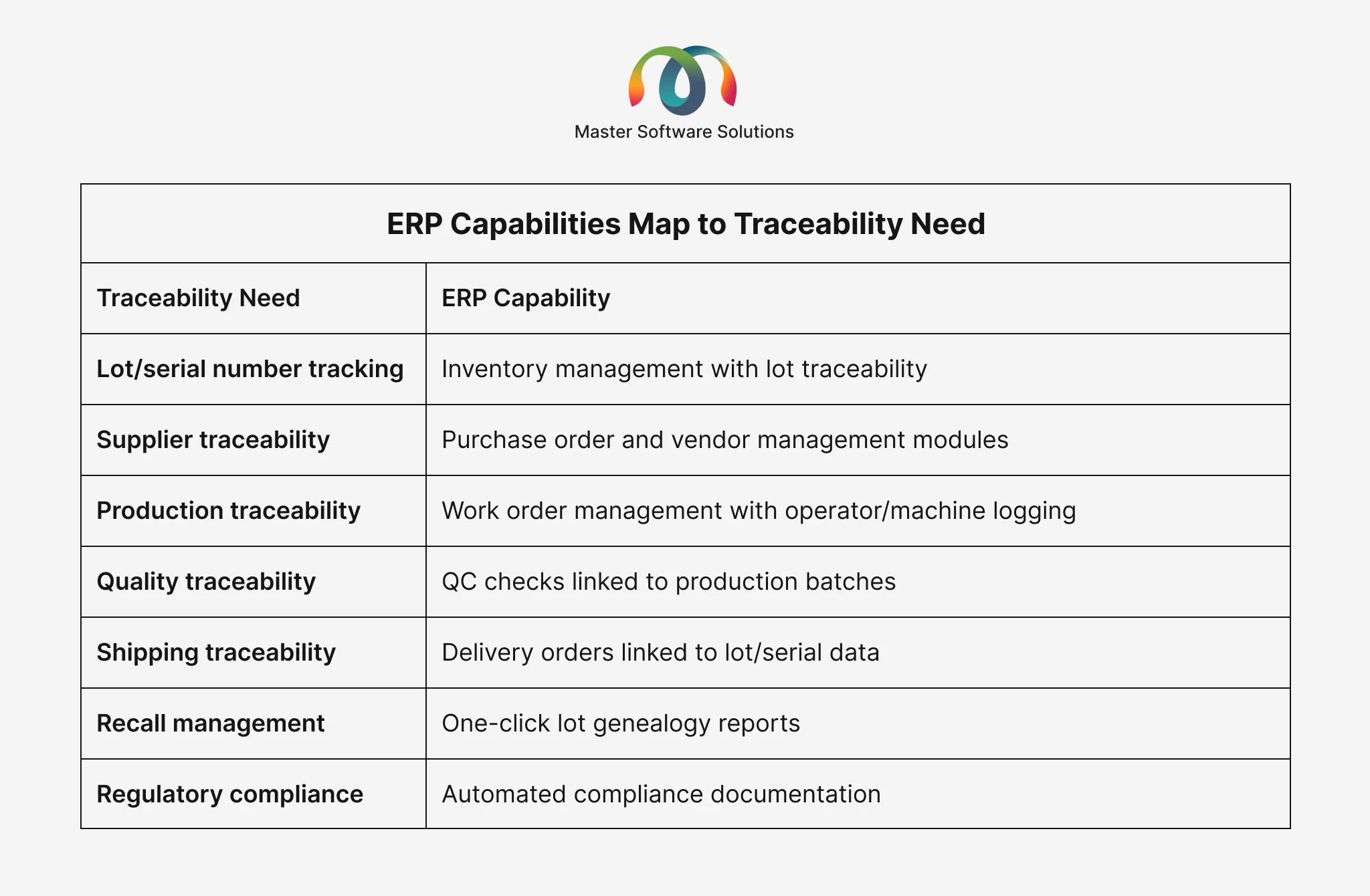
Platforms like Odoo ERP offer native lot and serial number traceability, integrated quality control, and full audit trails, making it a practical choice for manufacturers of all sizes looking to build traceability without deploying multiple disconnected tools.
According to GS1 global traceability standards, interoperability between systems is a core requirement for supply chain traceability, something modern ERP integrations are specifically designed to support. Learn how Master Software Solutions implements manufacturing ERP solutions.
Industry-Specific Traceability Requirements
Traceability requirements vary significantly by industry. Here’s what manufacturers in key verticals need to know:
Food and Beverage
The FDA’s Food Safety Modernization Act (FSMA) and its final Traceability Rule require food manufacturers to maintain records of critical tracking events and key data elements for high-risk foods. Non-compliance can result in facility shutdowns and significant fines.
See how Master Software Solutions serves the Food and Beverage industry
Pharmaceuticals and Life Sciences
Serialization and traceability at the unit level are required under the Drug Supply Chain Security Act (DSCSA) in the US and the Falsified Medicines Directive (FMD) in the EU. Chain-of-custody documentation must be maintained throughout the distribution network.
Automotive
The automotive industry follows IATF 16949 quality management standards, which require full traceability of components from raw materials to vehicle assembly. OEMs frequently require traceability as part of their supplier qualification process.
Electronics and Aerospace
The standards of IPC-1782 (electronics) and AS9100 (aerospace) call for component-level traceability, with a particular focus on counterfeit part detection and failure analysis capability.
Benefits of Traceability in Manufacturing: By the Numbers
The business case for traceability is well-documented:
- Recall cost reduction: Targeted recalls enabled by traceability systems can reduce recall costs by 50-80% compared to broad recalls.
- Waste reduction: Manufacturers with full production traceability report 15-25% reductions in material waste through root-cause analysis.
- Audit preparation time: ERP traceability reduces this time from days to hours.
- Supplier risk: Companies with end-to-end supply chain visibility are 2x more likely to identify and mitigate supplier risks before they escalate.
- Customer satisfaction: Transparency-enabled trust leads to stronger buyer relationships and reduced churn among enterprise customers.
According to McKinsey & Company’s research on supply chain resilience, companies that invest in supply chain visibility and traceability capabilities consistently outperform peers in recovery speed after disruptions.
Common Challenges in Implementing Traceability and How to Overcome Them
Challenge 1: Data Silos Across Departments
The problem: Procurement, production, QC, and logistics each maintain their own records in disconnected systems.
The solution: A unified ERP platform that forces all functions to work from a single data model, eliminating reconciliation overhead.
Challenge 2: Manual Data Entry Errors
The problem: Paper-based or manual processes introduce errors that corrupt traceability records.
The solution: Barcode scanning, RFID, and IoT-based automated data capture integrated directly into ERP workflows.
Challenge 3: Supplier Non-Compliance
The problem: Your traceability is only as strong as your weakest supplier. If tier-2 or tier-3 suppliers don’t capture data, your upstream traceability breaks.
The solution: Supplier portals and EDI integrations that require suppliers to submit standardized traceability data as part of their order fulfillment process.
Challenge 4: Scalability as SKU Count Grows
The problem: Traceability that works for 50 SKUs often breaks under 5,000 SKUs.
The solution: ERP systems built on scalable data architectures, with configurable lot tracking rules that can be applied across product categories.
Challenge 5: Change Management and Adoption
The problem: Warehouse staff and operators resist new scanning and logging requirements.
The solution: Phased rollouts, role-specific training, and UX-optimized mobile interfaces that make compliance the path of least resistance.
Is your ERP system ready to support full manufacturing traceability? Talk to Our ERP Experts. Master Software Solutions specializes in Odoo ERP implementation for manufacturing businesses across food & beverage, logistics, distribution, and more.
How to Build a Manufacturing Traceability Strategy: Step-by-Step
Step 1: Define Your Traceability Scope
Determine which products, materials, and processes require traceability. Start with your highest-risk products or those subject to regulatory requirements.
Step 2: Map Your Current Data Flows
Document how data currently flows from supplier receipt through production to customer delivery. Identify gaps, silos, and manual handoffs that break the chain.
Step 3: Select Your Traceability Technology
Choose between barcode, QR code, RFID, or a hybrid approach based on your production environment, volumes, and budget. Align your choice with your ERP’s data capture capabilities.
Step 4: Implement or Upgrade Your ERP
If your current system can’t natively support lot/serial traceability, quality linking, and audit trails, it’s time to upgrade. This is the foundation on which everything else is built.
Step 5: Connect Your Suppliers
Roll out supplier data requirements and portal access so upstream traceability data flows automatically into your system with each receipt.
Step 6: Train Your Team
Invest in role-based training and champion a culture where accurate data capture is treated as a core job responsibility, not a bureaucratic burden.
Step 7: Continuously Improve
Use traceability data to generate insights. Identify recurring quality issues, optimize workflows, and refine supplier relationships. Traceability should be a living system, not a static compliance tool.
The Role of AI and Automation in Manufacturing Traceability
The next frontier of traceability is not just capturing data; it’s using that data intelligently.
AI-driven anomaly detection can scan traceability records in real time to flag unusual patterns: a batch with high rejection rates, a supplier whose lead times are creeping up, or a production line where scrap rates are climbing before a human would notice.
Machine learning for predictive quality uses historical traceability data to predict which incoming batches or production runs are at higher risk of defects, enabling proactive intervention before the problem reaches finished goods.
Automated compliance reporting uses AI to generate regulatory documentation directly from traceability records, reducing the manual burden of audit preparation and dramatically cutting compliance risk.
Digital twin integration pairs traceability data with simulation models of the production environment, enabling manufacturers to test process changes virtually before implementing them on the floor.
As an ERP partner and AI engineering services provider, Master Software Solutions helps manufacturers combine the structural traceability of ERP systems with the predictive intelligence of AI, creating supply chains that don’t just record what happened but anticipate what’s coming next.
Conclusion
Traceability in manufacturing is the difference between reacting to supply chain failures and preventing them. When manufacturers have complete visibility into every component, every batch, and every step in the production process to cut costs, protect their brand, satisfy regulators, and win the confidence of discerning enterprise customers.
The technology to achieve this is no longer out of reach. Modern ERP platforms combined with AI-powered analytics and the right implementation partner make end-to-end traceability an operational reality for manufacturers of all sizes.
Master Software Solutions works with manufacturing businesses to design, implement, and optimize ERP-driven traceability systems that are practical, scalable, and built for the real demands of your industry.
Take the first step toward full supply chain traceability. Contact Our Experts at Master Software Solutions Today. Get a no-obligation consultation with our manufacturing ERP experts and discover what’s possible for your business.