 Discrete manufacturing is one of the most complex segments of the manufacturing industry. Whether you’re producing electronics, industrial machinery, automotive components, or consumer appliances, you’re dealing with a constant juggle of managing bills of materials (BOMs), tracking work orders across multiple workcenters, maintaining quality standards, and delivering finished goods on time, all while keeping costs under control.
For many discrete manufacturers, outdated ERP systems or disconnected spreadsheets create blind spots across the shop floor, supply chain, and finance, resulting in delays, excess inventory, and poor margins.
Odoo ERP has emerged as a leading choice for discrete manufacturers worldwide, offering a fully integrated, modular platform that covers everything from production planning and inventory to quality control and product lifecycle management (PLM). With over 15 million users globally, Odoo is purpose-built for manufacturers who need precision, flexibility, and real-time visibility.
This guide covers everything you need to know about Odoo for discrete manufacturing, what it does, how it helps, and why it could be the right ERP for your business.
What Is Discrete Manufacturing?
Discrete manufacturing is the production of distinct, countable items, such as products that can be individually identified and tracked by a serial number or lot. Common examples include:
- Electronics (computers, mobile devices, circuit boards)
- Automotive parts and vehicles
- Industrial machinery and equipment
- Furniture and consumer goods
- Aerospace and defense components
- Medical devices
Unlike process manufacturing (which works with formulas and recipes, think chemicals or food), discrete manufacturing assembles separate components and sub-assemblies into a finished product. This makes it inherently more complex to manage, since every component, operation, and workcenter must be tracked with precision.
Why Discrete Manufacturers Need a Specialized ERP
Generic business software simply doesn’t cut it for discrete manufacturing. The challenges that manufacturers face every day, including multi-level bills of materials, finite capacity scheduling, lot/serial traceability, and quality inspections on the shop floor, require purpose-built manufacturing tools.
Without a specialized ERP, discrete manufacturers typically struggle with:
- Poor production visibility: No real-time view of what’s happening on the shop floor
- Inventory inaccuracies: Stockouts of critical components are causing production stoppages
- Manual scheduling: Inability to optimize capacity across multiple workcenters
- Quality escapes: Defects catch customers rather than production teams
- Siloed data: Finance, production, and procurement working from different sources of truth
A well-implemented discrete manufacturing ERP eliminates these pain points by connecting every department on a single platform. That’s precisely where Odoo excels.
Ready to explore Odoo for your manufacturing operations? Book a free consultation with our experts. We’ll assess your current workflows and show you exactly how Odoo can transform your shop floor.
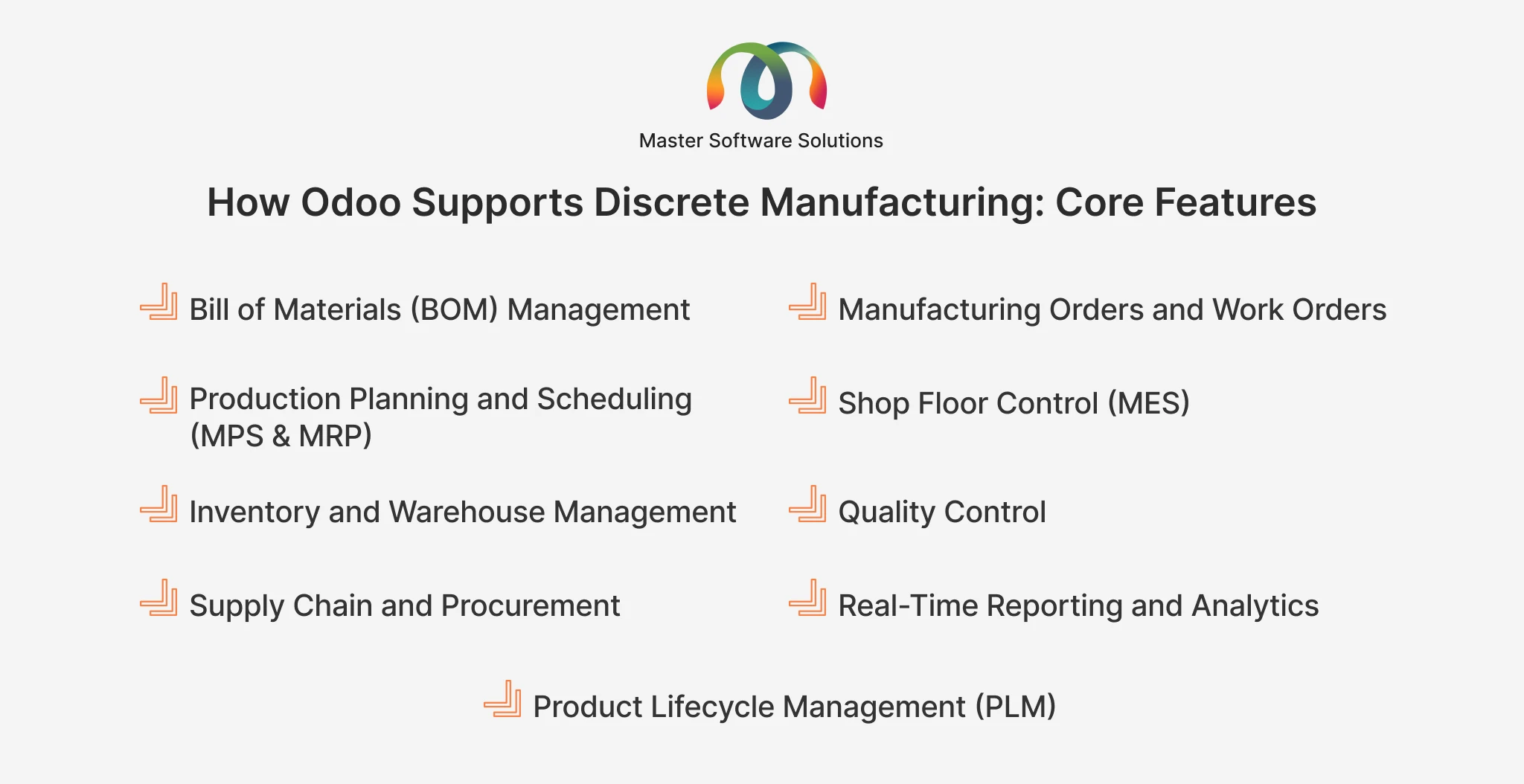
How Odoo Supports Discrete Manufacturing: Core Features
The Odoo Manufacturing module delivers a comprehensive MRP + MES + PLM + Quality platform designed for the way discrete manufacturers actually work. Here’s a deep dive into its key capabilities.
Bill of Materials (BOM) Management
The BOM is the foundation of every discrete manufacturing operation. Odoo allows you to create and manage multi-level, complex BOMs with ease, defining components, sub-assemblies, quantities, routing operations, and work center assignments in one place.
Key capabilities include:
- Multi-level BOM support for assemblies with deep component hierarchies
- BOM versioning to track engineering changes over time
- By-product management to account for residual or co-products
- Flexible BOM types, such as manufactured, kit, subcontracting
When a sales order is placed or a manufacturing order is triggered, Odoo automatically references the BOM to generate component demand, validate availability, and schedule production, all without manual intervention.
Manufacturing Orders and Work Orders
Once a manufacturing order (MO) is created, Odoo breaks it down into individual work orders assigned to specific work centers. This gives production managers granular control over the shop floor while keeping the whole team aligned.
- Create, split, and merge manufacturing orders based on demand
- Assign work orders to workcenters with defined capacities
- Track time per operation using employee timesheets
- Manage scrap, rework, and quality holds directly on the work order
- Use the tablet-optimized Shop Floor app for paperless production execution
Workers on the floor get a simple, intuitive interface and don’t need ERP training. They can record production quantities, flag quality issues, log downtime, and move components through operations with just a few taps.
Production Planning and Scheduling (MPS & MRP)
Odoo’s Material Requirements Planning (MRP) engine calculates what to produce, when to produce it, and what materials need to be automatically procured. The Master Production Schedule (MPS) provides a higher-level planning view, perfect for aligning sales forecasts with manufacturing capacity in your S&OP meetings.
- Real-time simulated manufacturing orders with capacity and availability checks
- Finite capacity planning via a Gantt chart for easy visual scheduling
- Just-in-time replenishment suggestions to minimize working capital
- Make-or-buy decisions integrated into replenishment workflows
- Demand-driven MRP that responds dynamically to sales orders and forecasts
This eliminates the painful manual scheduling spreadsheets that most mid-sized manufacturers still depend on.
Shop Floor Control (MES)
Odoo’s Manufacturing Execution System (MES), the Shop Floor app, bridges the gap between planning and execution. It gives real-time visibility into what’s happening at each work center, so production managers can intervene proactively when issues arise.
- Workcenter dashboards showing active work orders, operator assignments, and status
- Offline-capable barcode scanning for recording component consumption and output
- IoT integrations to connect machines, barcode printers, and quality instruments
- Built-in worksheets and step-by-step instructions are displayed to workers
- Real-time OEE (Overall Equipment Effectiveness) tracking
According to industry practitioners discussing Odoo for discrete manufacturers, the Shop Floor app in particular is a game changer for facilities transitioning from paper-based production tracking to fully digital operations.
Inventory and Warehouse Management
Discrete manufacturing depends on having the right components available at the right time.
Odoo’s integrated inventory module provides the following:
- Real-time stock tracking across multiple warehouses and storage locations
- Lot and serial number traceability includes upstream and downstream, in a single click
- Automated reordering rules (min/max or MRP-driven)
- Component reservations linked directly to manufacturing orders
- Barcode-powered receiving, picking, and put-away workflows
The result: production teams never have to stop a line because procurement didn’t get notified of a stockout.
Quality Control
Maintaining product quality is non-negotiable in discrete manufacturing. Odoo’s Quality module lets you define control points at any stage of production, incoming goods inspection, in-process checks, or final inspection, enforcing them directly in the shop floor app.
- Create quality control plans with pass/fail criteria, tolerances, and instructions.
- Six Sigma-level statistical process control to detect trends before defects occur
- Automated quality alerts are routed to the right team member
- Non-conformance reports (NCRs) with root cause analysis workflows
- Quality cost tracking is integrated into product costing
Workers can submit quality observations and improvement suggestions directly from the shop floor, supporting Kaizen and continuous improvement programs.
Supply Chain and Procurement
Odoo connects your manufacturing operations directly to procurement, so purchase orders are generated automatically when stock drops below thresholds or MRP identifies component shortages.
- Supplier price lists and lead time management
- Request for Quotation (RFQ) workflows with multi-vendor comparison
- Subcontracting workflows for outsourced operations
- Drop-shipping and cross-docking support
- Full landed cost computation for accurate product costing
See how Master Software Solutions’ Odoo Implementation Services can bring these capabilities to your manufacturing facility. Our team has successfully deployed Odoo for manufacturers across 40+ countries. Get in touch today.
Real-Time Reporting and Analytics
Odoo’s built-in reporting gives manufacturing executives and operations managers a live pulse on performance:
- Production efficiency (planned vs. actual)
- Workcenter utilization and OEE
- Scrap and rework rates by product and operation
- Cost variance analysis (standard vs. actual)
- Inventory turnover and component availability
Dashboards are fully customizable, and data can be exported or connected to Power BI or Tableau for deeper analysis, a key capability for manufacturers pursuing Industry 4.0 initiatives.
Product Lifecycle Management (PLM)
For manufacturers that regularly update products or respond to engineering change orders (ECOs), Odoo PLM keeps design and manufacturing perfectly in sync:
- Version-controlled BOMs and routings
- Engineering Change Orders with approval workflows
- Direct integration with CAD tools
- New product introduction (NPI) project tracking
Maintenance Management
Unplanned equipment downtime is one of the costliest disruptions in discrete manufacturing.
Odoo Maintenance enables:
- Preventive maintenance schedules by equipment and workcenter
- Maintenance requests triggered from the shop floor
- MTBF/MTTR tracking and failure analysis
- Spare parts inventory management
Key Industries That Benefit from Odoo Discrete Manufacturing ERP
Odoo’s flexibility makes it an excellent fit for a wide range of discrete manufacturing verticals.
Our manufacturing ERP solutions at Master Software Solutions have served clients across:
- Electronics & High-Tech Manufacturing: complex multi-level BOMs, serial traceability, revision control
- Industrial Machinery & Equipment: custom-configured products, project-based manufacturing (ETO)
- Automotive & Transportation Parts: lean manufacturing, JIT replenishment, supplier quality
- Furniture & Consumer Goods: make-to-order and make-to-stock, variant management
- Medical Devices: lot traceability, quality compliance, documentation control
- Aerospace & Defense: multi-level BOM, revision management, compliance reporting
Odoo vs. Other Discrete Manufacturing ERP Solutions
Odoo’s open-source foundation and modular architecture make it uniquely cost-effective for growing discrete manufacturers without sacrificing enterprise-grade capability. A well-known Odoo discrete manufacturing ERP analysis by Bista Solutions highlights how Odoo competes with far more expensive alternatives at a fraction of the implementation cost.
How to Implement Odoo for Discrete Manufacturing: A Step-by-Step Overview
A successful Odoo manufacturing implementation follows a structured approach:
Step 1: Discovery & Process Mapping
Map your current production workflows, identify pain points, and define the future-state process. Document your BOMs, routings, workcenter structure, and quality checkpoints.
Step 2: System Configuration
Configure Odoo modules, such as Manufacturing, Inventory, Purchase, Quality, PLM, and Maintenance, to match your production model. Set up workcenters, operations, and scheduling rules.
Step 3: Data Migration
Migrate data, including BOMs, routings, product catalogs, vendor records, opening inventory balances, and historical data as needed.
Step 4: Integration
Connect Odoo to adjacent systems, such as CRM, e-commerce, accounting, barcode hardware, IoT sensors, and third-party tools as required.
Step 5: Training & Change Management
Train production staff, planners, procurement, and quality teams. The Shop Floor app is designed to minimize training time for floor-level users.
Step 6: Go-Live & Hypercare
Launch in a controlled rollout with a dedicated support team on standby for the first weeks of live production.
Step 7: Continuous Improvement
Use Odoo’s analytics to identify further optimization opportunities, including cycle time reduction, quality improvements, and inventory rationalization.
Planning an Odoo implementation for your facility? Master Software Solutions, an Odoo Silver Partner with 800+ clients served and operations in 40+ countries, can guide you from business case to go-live. Request a Free Business Audit
Conclusion
Discrete manufacturing demands precision at every step, from the first BOM line to the final quality inspection. Odoo delivers a unified, intelligent manufacturing platform that connects your shop floor, supply chain, quality teams, and finance on a single system, eliminating silos, reducing manual work, and giving you the real-time visibility to make faster, better decisions.
With its native MRP, MES, PLM, and quality modules, Odoo is not just an ERP; it’s a complete digital operating system for the modern discrete manufacturer.
Master Software Solutions is an Odoo Silver Partner with deep expertise in manufacturing ERP implementation. We’ve helped 800+ businesses across 40+ countries streamline their operations with Odoo, from initial consulting through to ongoing support.
Take the first step toward a smarter, more connected manufacturing operation. Schedule a free consultation with our Odoo experts. Let’s build the Odoo manufacturing solution your business deserves.