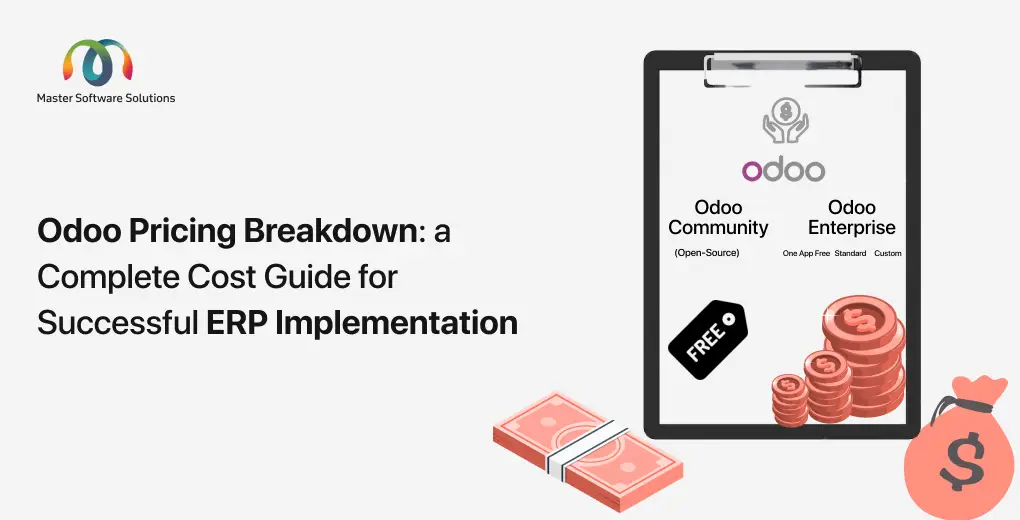
Are you planning to implement ERP solutions in your business? Implementing the right tool can make a significant difference. ERP platforms have made that difference, and among those platforms, Odoo stands apart due to its open-source platforms and flexible pricing plans.
Unlike traditional ERP systems that require heavy upfront investments, Odoo offers a scalable approach where businesses can start with the modules they need and expand as their operations grow. From sales and accounting to inventory, manufacturing, and CRM, Odoo provides a wide range of integrated applications that help companies manage their entire workflow within a single platform.
However, understanding the actual cost of Odoo implementation can sometimes be confusing. Pricing depends on several factors such as licensing, customization, integrations, number of users, and implementation services. Without a clear understanding of these components, businesses may struggle to estimate the total investment required.
This blog explores the breakdown of Odoo pricing, its complexities, and its pricing structure. We’ll also explore additional and hidden costs associated with it.
We’ll cover:
Odoo ERP – Overview
Odoo SA started developing TinyERP in 2005, which eventually became OpenERP. Later, the paid Enterprise Version was released to fund the Odoo Community.
Odoo ERP is an open-source, all-in-one platform that streamlines your entire business operations. Let’s explore all the aspects of Odoo ERP:
Modules and features
Odoo offers various modules with advanced features to simplify your operations. They include Accounting and Finance, Sales Management, Human Resources, Inventory and Warehouse, Project Management, Manufacturing (MRP), Purchasing and Vendor management, E-commerce and Website, Marketing Automation, and Point of Sale (POS).
Technical features of Odoo
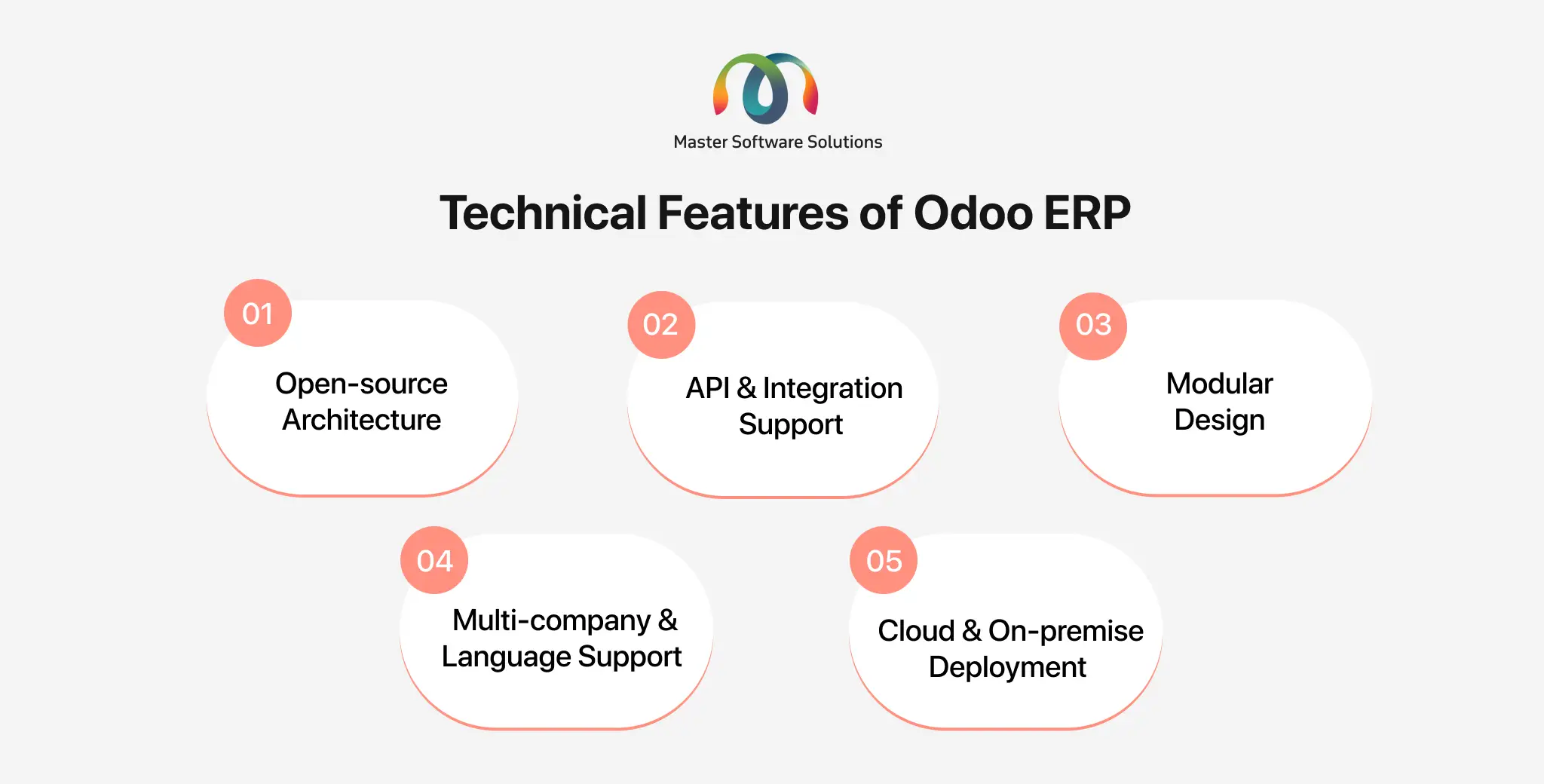
- Open-source architecture – It is fully customizable and flexible to meet the unique demands of your business.
- API and integration support – It allows third-party integrations, like payment gateways and CRM tools.
- Modular design – You can install only the modules you need and add more per your requirements.
- Multi-company and multi-language support – It enables you to handle your operations across different entities and regions in other languages.
- Cloud and on-premise deployment – Odoo offers you the flexibility for deployment – Odoo Cloud (Odoo.sh), third-party cloud, and self-hosting.
Business benefits of Odoo implementation
Implementing Odoo offers various benefits across different industries. These benefits include:
- Odoo ERP offers a central platform to handle multiple business operations.
- It automates repetitive tasks, optimizing the workflows and bottlenecks.
- Provides real-time operation insights for making prompt data-driven decisions. It ensures data accuracy and consistency.
- Offers a modular structure to support growing businesses. They are highly customizable to provide tailored solutions.
- Odoo offers better customer relationship management, which includes managing and tracking leads and improving the sales pipeline.
- Monitor and optimize inventory and the entire supply chain in real-time to prevent stockouts and overstocking.
Odoo ERP Pricing: Cost Analysis
Odoo offers flexible pricing that caters to businesses’ needs regardless of their size and needs. The pricing model is based on the scalable user model, which means that Odoo is highly adaptable to your requirements. ERP implementation services typically account for 40–60% of the total project cost, since they include configuration, testing, and deployment.
Odoo offers two Editions:
- Odoo Community
- Odoo Enterprise
This blog will explore the detailed Odoo pricing plans for both Editions.
Odoo Community
Odoo Community is an open-source Odoo platform that doesn’t need licensing. This edition depends on community support and forums for Odoo assistance. Odoo Community pricing breakdown:
Odoo licensing fees
The Odoo Community Edition is open-source, meaning it doesn’t require you to buy a license. You can download the software and start using it without any upfront costs.
Hosting costs
The hosting costs depend on the hosting type you choose. You can choose two types of hosting with Odoo Community:
- Self-hosting – If you are hosting the platform on your own server, it includes hardware and infrastructure costs, which can be expensive.
- Third-party servers – If you use third-party cloud service providers like Azure, Google Cloud, or AWS. You will incur recurring fees based on resource usage.
Customization and development fees
Odoo customization refers to tailoring the platform to cater to specific business requirements. The pricing depends on the level of customization you need, from simple to complex – the more complicated customizations, the higher the price. If you are looking for specific customizations, you must prepare your budget.
Implementation and deployment costs
The Odoo implementation and deployment process requires hiring Odoo consulting services to guide and help you set up Odoo, configure modules, and migrate data, ensuring a smooth transition.
Module pricing
The basic features of Odoo Community are free; however, you might need more for your business. The platform offers additional apps under Odoo apps. You can consider their pricing while creating your project estimation. These apps can have recurring or one-time fees.
Integration costs
Integrating third-party systems like payment gateways, CRM, or e-commerce comes with additional costs. It includes fees for development, middleware, and third-party integration tools.
Training costs
You must train your team to ensure everyone is in the same room and uses the platform efficiently, improving the UI adoption. Training your team requires valuable resources.
Support and maintenance
Odoo Community is free; however, the system requires bug fixing, troubleshooting, and updating, which requires a dedicated in-house or third-party IT team. Odoo has an online community and forums that can also help you.
Additional costs
Additional costs can include data backups, security audits, and performance optimization. Understanding these well is important when creating a budget.
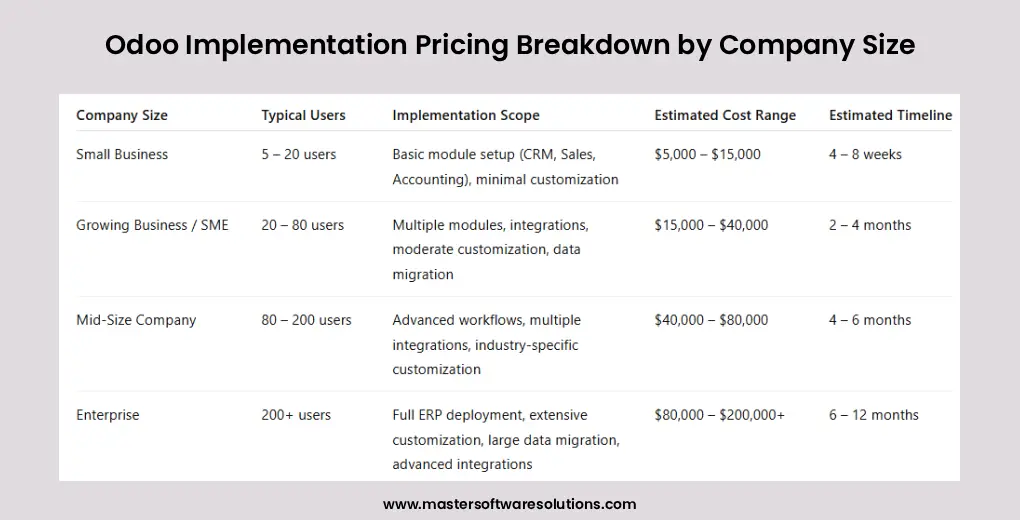
Odoo Implementation Pricing Breakdown by Company Size
The actual cost of Odoo implementation may vary depending on factors such as customization requirements, number of modules, third-party integrations, deployment type (cloud or on-premise), and ongoing support services.
Odoo Enterprise
Odoo Enterprise Edition is not an open-source platform and requires licensing. It is an advanced version of Odoo ERP with advanced functionalities and operational tools that support businesses regardless of their type, size, and industry. Odoo Enterprise pricing breakdown:
Licensing cost
The Odoo Enterprise edition is an advanced version of the Odoo Community edition and is not open-source. You need to buy it and the licensing cost depends on the number of modules you need. They have three plans under the Odoo Enterprise editions:
- One App Free – You get one application free of cost for unlimited users. This plan allows you to access other Odoo modules if the application depends on other business applications. You can always switch to a Standard or a Custom plan based on your requirements.
- Standard – The Standard Odoo Enterprise plan provides access to all applications with standard hosting on Odoo Online. The subscription price varies based on the users, region, and country. You can install as many Odoo apps as you need.
- Custom – The Custom Odoo Enterprise plan is for businesses looking for heavy customizations with features like Odoo Studio, custom development, or API integrations. This can help you tailor the system to meet your business needs while managing multiple companies in a single database.
Hosting costs
Hosting defines the way you access your database and your responsibilities. The Odoo Enterprise Edition offers 3 types of hosting:
- On-premises – This type of hosting requires you to download the software to your system or server. You are responsible for all software operations. On-premise hosting requires you to purchase network infrastructure, electricity, a server, an operating system, etc. You need to bear extra costs to maintain the necessary infrastructure.
- Odoo Online – Odoo Online enables you to access your database from the cloud. You do not have to manage the database; Odoo manages everything. This is a Software-as-a-Service (SaaS) type of hosting available for all the plans in the Enterprise edition.
- Odoo.sh – Odoo provides a platform-as-a-service (PaaS) and a highly customizable platform for custom Enterprise editions. It is a dedicated server for businesses with complex operations.
Note* Odoo.sh is available free for Odoo Partners.
Customization costs
Customizations include customizing Odoo modules and interfaces, integrating other systems, and automating workflows. The Odoo customization cost depends on the level of customization needed.
Implementation and deployment costs
Hire Odoo consultants or an in-house team for setup, development, configurations, data migrations, and deployment. This process requires a proficient team to implement the plan and ensure successful Odoo implementation. This process requires professionals, which means Odoo implementation costs may rise.
Training costs
The Odoo Enterprise edition is more advanced than its Community version and requires mandatory training for successful Odoo UI user adoption.
Support and maintenance
You can opt for support and maintenance from third-party services or an in-house IT team. Support and maintenance include bug fixing, troubleshooting, and updates to ensure your system works at its peak.
You may also rely on the Odoo community and forums; however, it is sufficient when using the advanced Odoo Enterprise version.
Hidden costs of Odoo implementation
When businesses plan an ERP project, they often focus on licensing and initial implementation costs. However, the total cost of Odoo implementation can be higher than expected due to several additional factors that arise during deployment. Understanding these hidden costs in advance helps organizations plan their budget more effectively and avoid unexpected expenses during the implementation process.
Third-party integrations
Connecting Odoo with tools like payment gateways, e-commerce platforms, or shipping systems may require custom integrations, which can add to overall cost.
Data migration and data cleanup
Transferring data from legacy systems to Odoo may require data cleaning, formatting, and testing to ensure accuracy.
Custom module development
Some businesses need features that are not available in standard Odoo modules, requiring custom module development.
User training
Employees need proper training to use the new ERP system effectively, which can involve additional time and resources.
Ongoing maintenance and support
Post-implement support, updates, and system maintenance are necessary to keep the ERP running smoothly.
Cost benefits of hiring Odoo Implementation services
Opting for Odoo implementation services gives you access to expertise and streamlines the setup, development, and deployment process. Ways in which hiring Odoo implementation services can help you reduce costs:
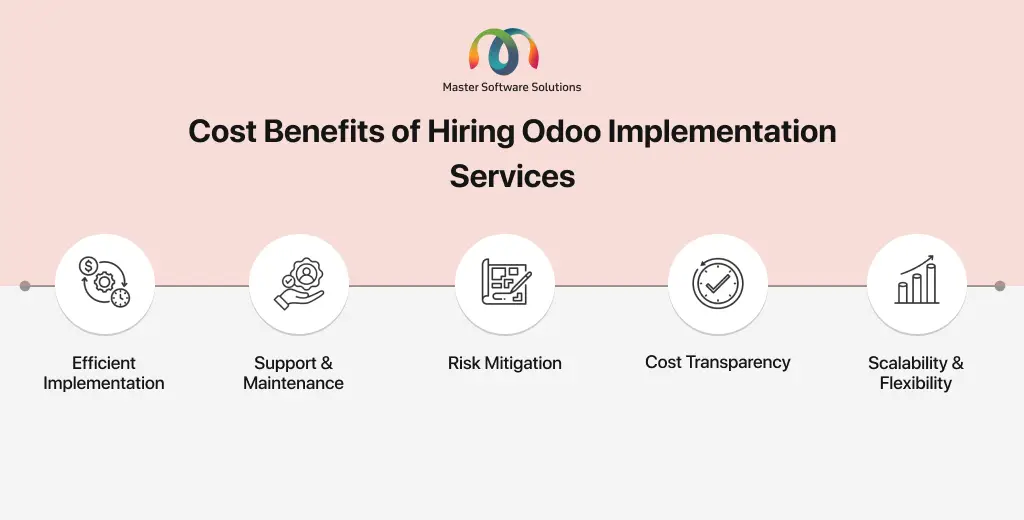
Efficient implementation
Odoo partners are proficient and have extensive experience streamlining the implementation process. Improved implementation efficiency can reduce costs and efforts, providing time-to-value and minimizing costs.
Support and maintenance
Odoo implementation services offer support and maintenance to ensure high system performance and avoid unexpected expenses due to system breakdown and troubleshooting.
Scalability and flexibility
Odoo partners can help you design and develop a scalable platform to grow your business. You do not have to invest in any new ERP system when your business expands.
Risk mitigation
As the Odoo partners are highly experienced, they know the potential risks and hurdles in Odoo implementation. They follow refined implementation strategies to ensure successful implementation without any backlogs.
Cost transparency
Odoo implementation partners provide detailed pricing estimations with breakdowns, fostering transparent costing and enabling you to prepare your budget efficiently.
Conclusion
Although your budget is one of the major factors, it is not the only one you need to care about. You need to hire an experienced Odoo partner, which is much more important. Opt for an Odoo partner with the potential to transform your ideas and dreams into reality. Are you ready to transform your business?
Master Software Solutions is a premier Odoo Silver Partner with a team of 90+ Odoo experts. We provide consultation, implementation, customization, integrations, data migration, and support and maintenance services. We can provide the necessary technical assistance to transform your business. Schedule a call with us to discuss your business and see how we can help your business.
Frequently Asked Questions
Q1. How much does Odoo ERP implementation cost?
A1. The cost of Odoo implementation depends on multiple factors, including the number of users, modules required, customization needs, and integrations. Costs by company size
- Small businesses: Start around $5000
- Medium-sized: $15000 to $50000
- Large enterprises: $80,000
Q2. Is Odoo free to use?
A2. Odoo offers a Community Edition, which is open-source and free to use. However, businesses that need advanced features, additional modules, and official support usually opt for the Enterprise Edition, which requires a subscription fee based on the number of users and selected applications.
Q3. What factors affect the cost of Odoo implementation?
A3. Several factors influence the cost of Odoo implementation, including the number of users, selected modules, level of customization, third-party integrations, data migration requirements, and training. The experience and pricing structure of the implementation partner can also impact the final cost.
Q4. What is included in Odoo implementation services?
A4. Odoo Implementation services typically include requirement analysis, system configuration, module setup, customization, data migration, integration with existing tools, testing, deployment, and user training. Many Service providers also offer post-implementation support and maintenance.
Q5. Is Odoo suitable for small and medium-sized businesses?
A5. Yes, odoo is widely used by small and medium-sized businesses because of its modular structure and scalable pricing model. Companies can start with essential modules and add more features as their business grows.