Construction is one of the most complex industries to run. A single project pulls together labor, subcontractors, heavy equipment, raw materials, permits, safety compliance, progress billing, and razor-thin margins, often across multiple sites at once. When that information lives in spreadsheets, WhatsApp groups, and disconnected accounting software, delays and cost overruns become inevitable.
This is exactly why more builders are moving to a single, connected platform. If you have been searching for the best ERP for construction company operations, Odoo consistently ranks among the strongest options available today.
In this guide, we break down the specific features of Odoo ERP that help construction firms plan, execute, and profit from their projects, and explain why Odoo has become a serious contender for anyone comparing ERP software for the construction industry.
Why Construction Businesses Need a Dedicated ERP
The construction sector runs on tight coordination and even tighter finances. Materials prices fluctuate, subcontractors work on separate schedules, and a small miscalculation in job costing can wipe out a project’s profit. The global construction and cloud ERP market continues to expand rapidly, and firms that still rely on manual processes are steadily losing ground to competitors who have digitized their workflows.
A purpose-fit ERP replaces disconnected tools with one source of truth. Instead of reconciling five systems at month-end, project managers, accountants, and site supervisors all work from the same live data. That is the core promise of good ERP software for construction industry workflows, and it is where Odoo’s modular design gives it a distinct advantage over rigid, all-or-nothing platforms. According to Grand View Research, the cloud ERP market is growing at a double-digit CAGR, and construction is one of the fastest-adopting verticals.
What Is Odoo, and Why Does It Fit the Construction Industry?
Odoo is an open-source, modular ERP suite with 80+ integrated business applications covering accounting, project management, inventory, purchasing, HR, CRM, field service, and more. Because you activate only the modules you need, Odoo deployments for construction companies can start lean and scale as the business grows. New to the platform? Our team has written a complete primer on what Odoo ERP is and how it works.
What makes Odoo construction setups so effective is integration. When a purchase order for cement is raised, it automatically links to the project budget, updates inventory, and flows into job-cost reporting — no re-entry, no reconciliation. Below are the features that matter most for builders and contractors.
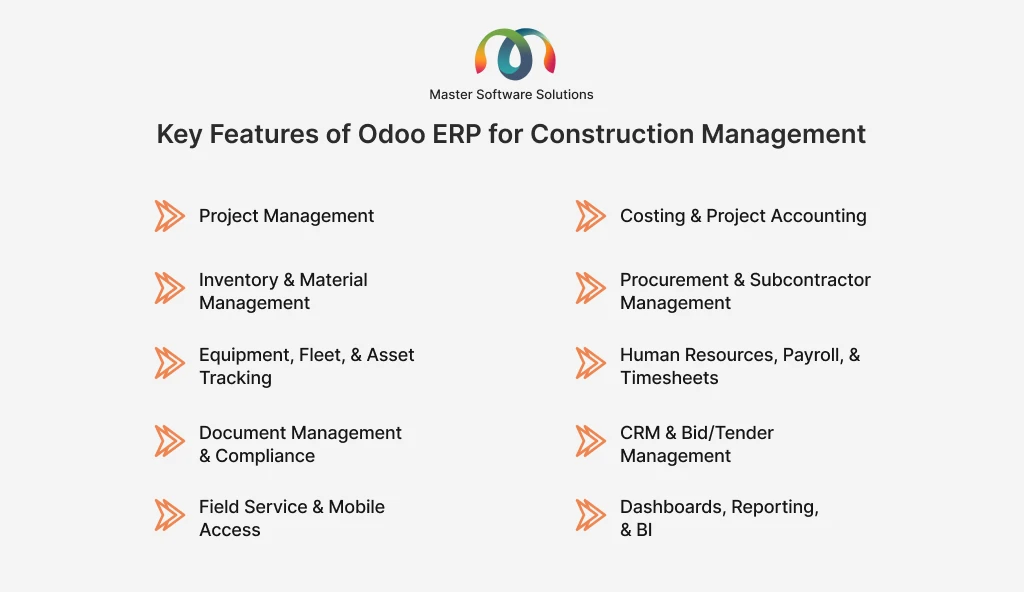
Key Features of Odoo ERP for Construction Management
End-to-End Project Management
At the heart of any Odoo construction management deployment is the Project module. It gives you Gantt charts for scheduling, Kanban boards for task tracking, milestones, dependencies, and real-time progress views. Site managers can break a build into phases, assign crews and subcontractors, set deadlines, and instantly see which tasks are slipping. Because the project module connects directly to timesheets and accounting, every hour logged on-site feeds straight into project cost and billing.
Accurate Job Costing and Project Accounting
Profitability in construction lives and dies on job costing. Odoo’s Accounting module supports analytic accounting, so every cost, including labor, materials, equipment, and overhead, is tagged to a specific project or cost center. This enables percentage-of-completion revenue recognition, work-in-progress (WIP) schedules, retention handling, and progress billing. Managers can compare budgeted versus actual costs in real time and catch overruns before they eat the margin. For any firm evaluating the best ERP software for construction, this level of financial control is often the deciding factor.
Inventory and Material Management
Material shortages stall sites; over-ordering ties up cash. Odoo’s Inventory module tracks stock across multiple warehouses and job sites, sets automatic reorder points, and manages material transfers between locations. Builders can reserve materials against specific projects, monitor consumption, and prevent theft or wastage with full traceability, a critical capability for ERP software for builders managing several active sites.
Procurement and Subcontractor Management
The Purchase module streamlines vendor management, request for quotations, purchase orders, and three-way matching of receipts and invoices. Construction firms can maintain a preferred-vendor list, compare supplier pricing, and route subcontractor bills through structured approval workflows. Every procurement action links back to the project budget, keeping costs transparent from tender to handover.
Equipment, Fleet, and Asset Tracking
Heavy machinery and vehicles are among a contractor’s biggest investments. Odoo’s Maintenance and Fleet modules track equipment allocation across sites, schedule preventive maintenance, log breakdowns, and monitor fuel and running costs. Knowing the location of each truck and excavator as well as when maintenance is due prolongs asset life and minimizes downtime.
Human Resources, Payroll, and Timesheets
Construction workforces are large, mobile, and often paid by different structures. Odoo’s HR suite handles employee records, attendance, shift planning, and payroll, while mobile timesheets let workers log hours from the field. Those hours feed directly into job costing and client billing, closing the gap between labor spent and labor invoiced.
Document Management and Compliance
Blueprints, contracts, permits, safety certificates, and inspection reports pile up fast. Odoo’s Documents module centralizes them all with version control and access permissions, so the right drawing or approval is always a search away. This is invaluable for audits, regulatory compliance, and dispute resolution.
CRM and Bid/Tender Management
Winning work is half the battle. Odoo’s CRM tracks leads, manages the sales pipeline, and helps estimators build and send quotations. Entering the estimate directly into the project budget allows businesses to monitor the tenders they have bid on, follow up methodically, and swiftly convert winning bids into active projects.
Field Service and Mobile Access
Construction happens on site, not behind a desk. Odoo’s mobile apps and Field Service module let supervisors update task status, capture site photos, log issues, and approve work from their phones. Real-time field data keeps the office and the site perfectly in sync.
Dashboards, Reporting, and Business Intelligence
Every module feeds Odoo’s reporting engine, giving leadership live dashboards on project profitability, cash flow, resource utilization, and pipeline health. Custom reports and KPIs turn raw project data into decisions, the analytical backbone that puts Odoo on many shortlists of the top 10 construction ERP software platforms.
Not sure which Odoo modules your construction business actually needs? Book a free ERP consultation with our experts and get a tailored module roadmap.
How Odoo Compares as the Best ERP for Construction Companies
Contractors typically consider cost, flexibility, and time-to-value when deciding which ERP is best for their construction company’s needs. Traditional construction ERPs can be expensive and rigid, forcing you to buy modules you will never use.
Odoo’s open-source core and pay-for-what-you-use pricing make it more affordable for small and medium-sized businesses, while its extensibility meets the needs of large enterprises. Odoo’s fully customizable nature allows it to be tailored to region-specific tax rules, billing formats, and workflows, which is something generic construction ERP software frequently fails to deliver.
That flexibility is also its main caveat: getting the most out of Odoo depends on a well-planned implementation. This is where working with a certified partner pays for itself.
Why Implementation Partner Choice Matters
Odoo is powerful, but its value is unlocked during configuration, mapping your real construction workflows to the software, customizing modules, and training your teams. A poor rollout leaves you with an expensive tool no one uses. As an Odoo-certified partner serving clients across the USA, Canada, and India, Master Software Solutions specializes in tailoring Odoo for construction company environments end-to-end.
Our services span the full lifecycle: Odoo implementation to get you live quickly, custom module development for construction-specific requirements, and ongoing Odoo support and maintenance to keep everything running smoothly as you scale.
Ready to run your projects on the best ERP software for construction? Talk to our Odoo construction experts today and get a personalized demo.
Final Thoughts
From project scheduling and job costing to inventory, procurement, equipment tracking, and live dashboards, Odoo delivers the connected toolkit that construction firms need to protect margins and deliver on time. Its modular, affordable, and highly customizable nature is exactly why it stands out as one of the best ERPs for construction company operations of every size. Whether you are an independent builder or a multi-site contractor, the right implementation turns Odoo into your single source of truth.
Take the next step: Master Software Solutions is your certified partner for everything Odoo. Get started with a free consultation and see how Odoo construction management can transform your business.