It’s a fair question, and one we hear from almost every business evaluating Odoo: “If Odoo itself offers implementation services, why should I pay a partner to do it?”
The short answer: Odoo’s in-house implementation (Odoo Direct) is designed for standard, out-of-the-box deployments. The moment your business needs deep customization, complex data migration, third-party integrations, industry-specific workflows, or hands-on support in your time zone, a certified Odoo partner becomes the difference between an ERP that works on paper and one that works for your business.
In this guide, we break down exactly what Odoo Direct covers, where it stops, and the role an Odoo partner plays at every stage of implementation, so you can make an informed decision before you sign anything.
What Is Odoo Direct Implementation?
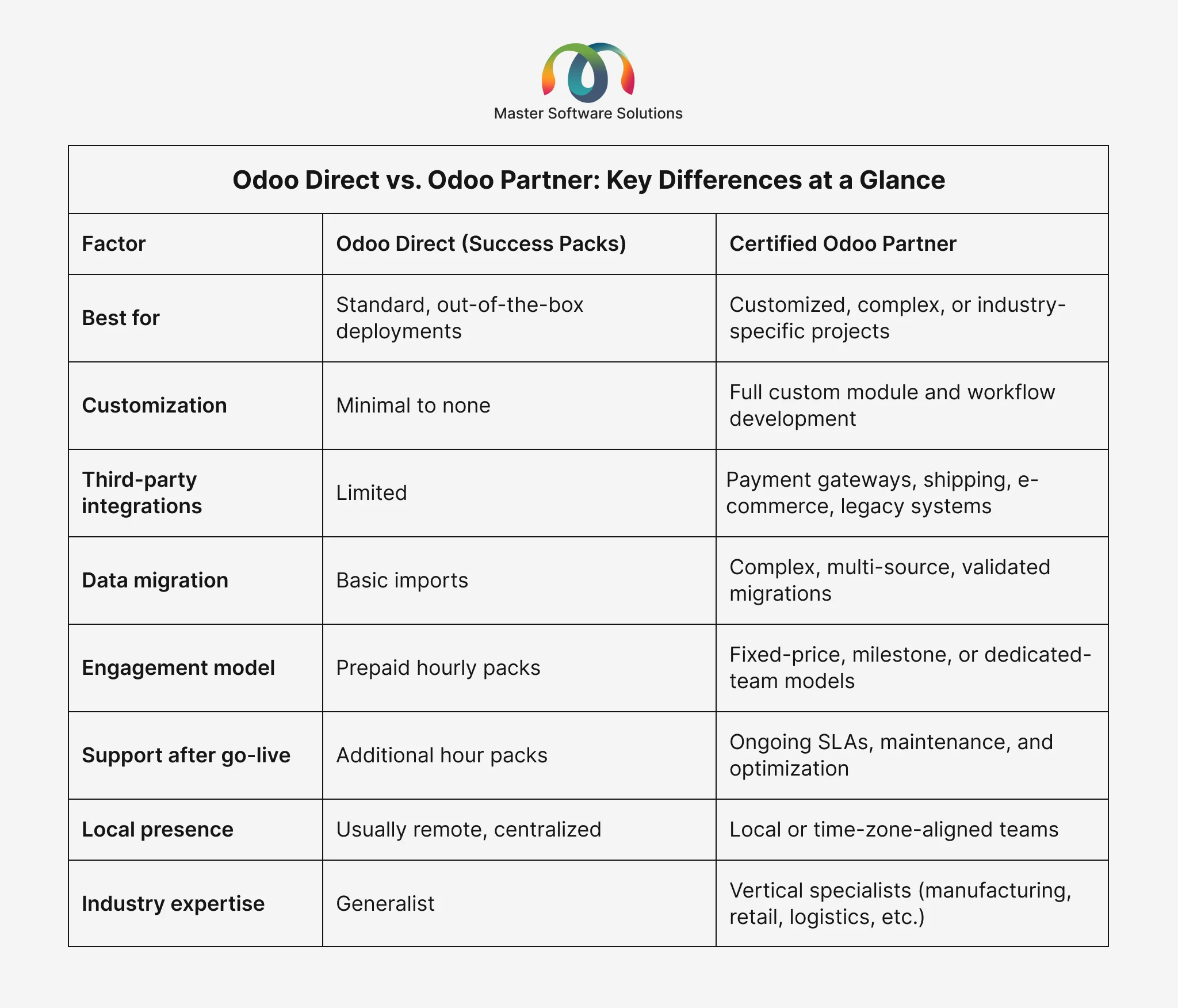
When you buy Odoo Enterprise, Odoo S.A. offers implementation through its own success packs. An in-house Odoo consultant is assigned to your project with a fixed number of prepaid hours. Their mandate is clear: get you live on standard Odoo as quickly as possible.
This model works well when your requirements map neatly onto Odoo’s default modules. Odoo’s consultants know the product inside out, follow a standardized methodology, and deliberately avoid customization, because custom code is harder to support at their scale and slows down their delivery model.
The limitations follow directly from that design. Success pack hours are finite and consumed quickly by meetings, configuration, and training. Custom development is discouraged or out of scope. Consultants often work remotely from a different region and juggle many accounts at once. And when your prepaid hours run out, additional support means buying more hours.
What Is an Odoo Partner?
An Odoo partner is an independent company officially certified by Odoo S.A. to sell, implement, customize, and support Odoo. Partners are ranked, including Ready, Silver, and Gold, based on the number of certified consultants on staff, retention of customers, and successful project deliveries. You can verify any partner’s status in the official Odoo partner directory.
Unlike Odoo Direct, partners build their entire business on implementation depth. They employ developers, business analysts, and functional consultants whose job is not just to switch Odoo on but to reshape it around how your company actually operates.
Odoo Direct vs. Odoo Partner: Key Differences at a Glance
The Role of Odoo Partners in Implementation: Stage by Stage
The real value of a partner shows up when you look at what a full ERP implementation actually involves. Here is the role a partner plays at each phase.
Discovery and Business Process Analysis
Before any configuration happens, a good partner sits with your teams, such as sales, accounting, warehouse, production, and mapping, to show how work actually flows through your business. They document pain points, redundancies, and the reports leadership actually needs. Odoo Direct’s model leaves little room for this depth; its hours are budgeted for configuration, not consulting. Partners, by contrast, treat ERP consulting as the foundation of the project, because a misdiagnosed process becomes a misconfigured system.
Gap Analysis and Solution Design
No ERP fits any business 100% out of the box. A partner identifies the gaps between standard Odoo and your requirements, then decides deliberately which gaps to close through configuration, which through customization, and which by adapting your process to the software. This judgment call is where experienced partners save clients enormous money: over-customizing makes upgrades painful, while under-customizing forces teams into workarounds that kill adoption.
Customization and Custom Module Development
This is the clearest dividing line. Odoo Direct avoids custom development; partners specialize in it. To ensure your customizations endure version upgrades rather than break them, partners provide Odoo customization services and custom module development that follow Odoo’s coding standards. This includes bespoke approval workflows, custom pricing logic, industry-specific documents, and entirely new modules.
Data Migration
Moving years of customers, products, invoices, stock levels, and open orders from legacy systems (Tally, QuickBooks, SAP, spreadsheets, or an older Odoo version) is consistently the riskiest phase of any ERP project. Partners provide structured Odoo migration services such as data cleansing, field mapping, trial migrations, and reconciliation reports that show that nothing was lost or duplicated. Odoo Direct typically supports standard imports; the heavy lifting stays with you.
Third-Party Integrations
Your ERP doesn’t live alone. It needs to talk to payment gateways, shipping carriers, e-commerce storefronts, banks, biometric attendance devices, BI tools, and industry platforms. Partners build and maintain these connections through multi-platform integration services, including error handling and sync monitoring, the unglamorous work that determines whether your integrations survive real-world volume.
Testing and User Acceptance
Partners run structured UAT cycles with your actual users, on your actual data, before go-live. They catch the edge cases: the customer with three delivery addresses and the product sold in two units of measure that standard demos never surface.
Training and Change Management
ERP projects rarely fail because of technology; they fail because people don’t use the system. Partners deliver role-based training (a warehouse picker needs different training than a CFO), create documentation in your business’s language, and stay present during the first weeks after go-live when resistance is highest.
Post-Go-Live Support and Continuous Improvement
Go-live is the beginning, not the end. Partners provide ongoing Odoo support and maintenance under clear SLAs: bug fixes, performance tuning, new user onboarding, version upgrades, and phased rollouts of additional modules as your business grows. Post-go-live assistance with Odoo Direct requires buying an additional pack of hours.
Planning an Odoo rollout? Get a free 30-minute consultation with our certified Odoo experts, and we’ll review your requirements and tell you honestly whether you need a partner at all. Request a free consultation.
7 Reasons Businesses Choose an Odoo Partner Over Odoo Direct
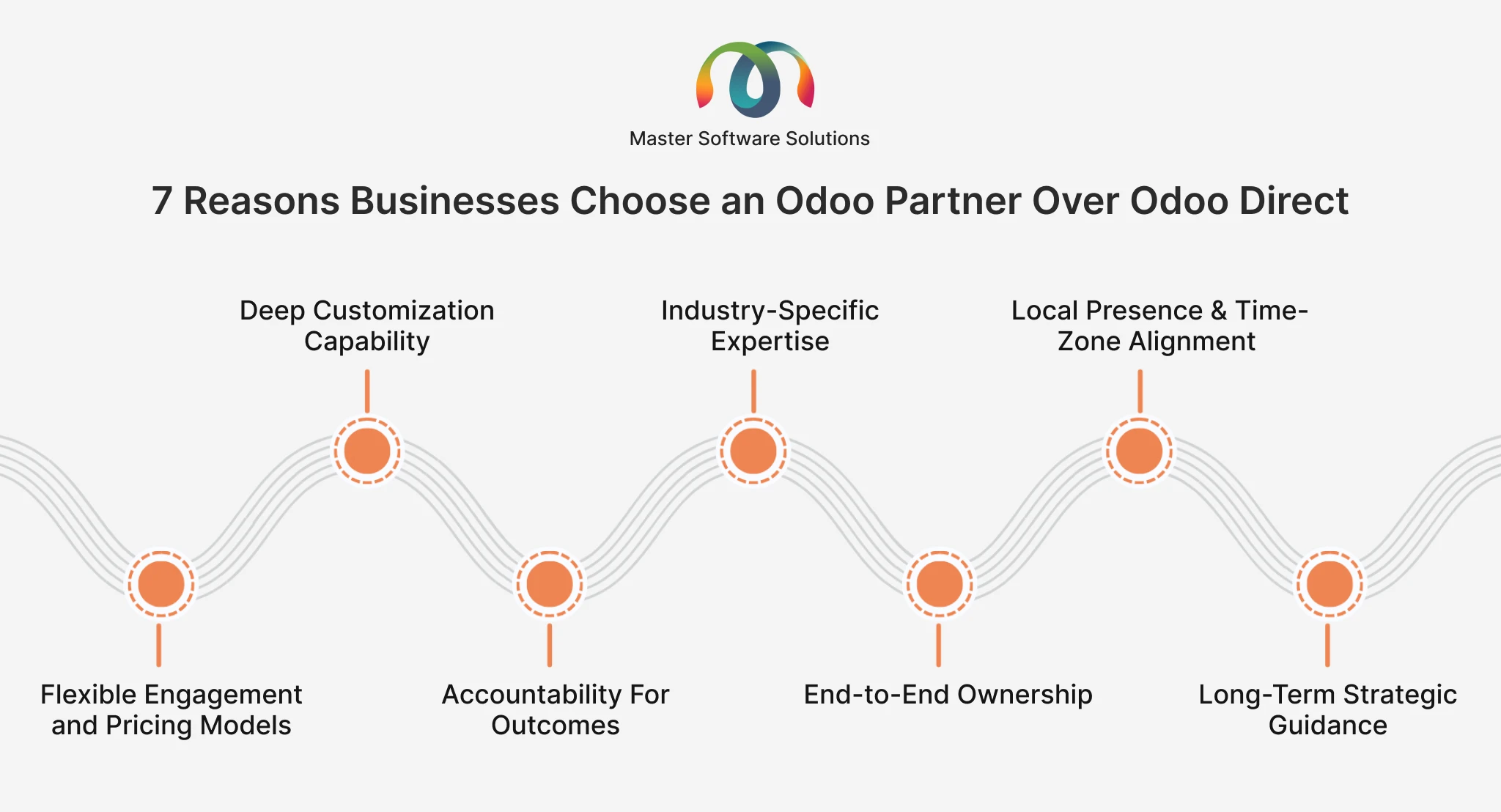
Deep customization capability
Partners hire dedicated Odoo developers who can extend any module. If your competitive advantage is based on a nonstandard process, a partner will protect it rather than flatten it.
Industry-specific expertise
Established partners have implemented Odoo across manufacturing, retail, logistics, healthcare, and e-commerce. They arrive knowing your industry’s compliance requirements, costing methods, and operational patterns and often bring pre-built accelerators.
Local presence and time-zone alignment
When your warehouse can’t ship orders at 8 a.m., you need someone answering the phone at 8 a.m., not a ticket queue nine time zones away.
Flexible engagement and pricing models
Partners offer fixed-price projects, milestone-based billing, dedicated teams, or the option to hire Odoo developers on demand. You choose the risk model; with success packs, hourly prepayment is the only option.
Accountability for outcomes
A partner’s business depends on referenceable projects, reviews, and long-term client relationships. That creates a fundamentally different incentive for a consultant working through a queue of prepaid-hour accounts.
End-to-end ownership
One team handles analysis, development, migration, integration, training, and support. No handoffs, no “that’s out of scope for this pack.”
Long-term strategic guidance
As Odoo releases new versions annually, partners plan your upgrade path, evaluate new features (including Odoo’s expanding AI capabilities), and keep your system aligned with your growth, like a relationship, not a transaction.
Common Odoo Implementation Challenges an Odoo Partner Solves
Industry research consistently shows that a large share of ERP projects run over budget, over schedule, or fail to deliver expected benefits, and the causes are remarkably consistent. Here’s how each maps to the partner’s role.
Scope creep and unclear requirements
Projects that start without a documented process map inevitably discover “missing” requirements mid-build. A partner’s discovery phase produces a signed-off scope document, so changes become conscious decisions with visible cost, not silent budget leaks.
Dirty or incompatible legacy data
Duplicate customers, inconsistent product codes, and unreconciled ledgers don’t fix themselves during import. Partners budget for data cleansing and run trial migrations precisely because they’ve seen go-lives collapse over a chart of accounts that didn’t balance.
Poor user adoption
If your sales team keeps quoting from spreadsheets after go-live, the ERP has failed regardless of how well it was configured. Partners mitigate this by providing role-based training, champions in each department, and rapid response support during the critical first month.
Over-customization
Ironically, the opposite risk is just as real. Inexperienced teams customize everything users ask for, producing a system so heavily modified that every annual Odoo upgrade becomes a rewrite. Seasoned partners push back, keeping customization to what genuinely differentiates your business.
Integration failures at volume
An integration that works in a demo with ten orders may fail when handling thousands of orders per day. Partners load-test integrations and develop retry and alerting logic before your peak season uncovers the weakness for you.
The Hybrid Approach: Odoo Direct + Partner
It’s also worth knowing that this isn’t strictly an either/or decision. Some businesses license Odoo Enterprise directly, use a small success pack for initial setup, and then hire a partner in parallel or later for the Odoo components.
Direct won’t touch: custom modules, integrations, historical data migration, and ongoing support. Partners routinely take over or extend Odoo Direct implementations; a competent one will begin with a technical and functional audit of what’s already been configured rather than rebuilding from zero. If you’ve already started with a success pack and hit its limits, you haven’t wasted your investment; you’ve completed phase one.
When Odoo Direct Might Be Enough
A balanced answer, because it exists: if you’re a small team (under ~10 users), your processes are simple and standard, you need only two or three core apps, you have no legacy data worth migrating, and you’re comfortable with remote-only, English-language support, Odoo’s success packs can absolutely get you live at a reasonable cost. The moment any one of those conditions fails, the economics tilt toward a partner.
How to Choose the Right Odoo Partner
Not all partners are equal. Before signing, verify these six things: their certification level and listing in Odoo’s official partner directory; the number of Odoo-certified consultants on staff; documented case studies in your industry; their upgrade and post-go-live support policy; whether they follow Odoo’s development guidelines for custom code; and client references you can actually call. According to Odoo’s own partnership program, partner rank reflects certified consultant count and proven project delivery, so rank is a useful signal, but industry fit matters more.
Why Master Software Solutions as Your Odoo Partner
Master Software Solutions is an official Odoo partner delivering end-to-end Odoo implementation services, such as consulting, customization, migration, integration, training, and long-term support, for businesses across manufacturing, distribution, retail, logistics, e-commerce, and more. Our certified consultants and developers have delivered Odoo projects globally, with engagement models that flex from fixed-price implementations to dedicated development teams.
We don’t sell hours; we deliver working systems that your team actually adopts.
Ready to see the difference a partner makes? Talk to our Odoo consultants or request a quote for your implementation; we’ll respond within one business day.
Beyond Go-Live: Upgrades, Scaling, and New Odoo Capabilities
Odoo releases a major new version every year, and Odoo Enterprise customers are expected to remain on supported versions. For a standard, uncustomized system, upgrades are relatively painless. For a real-world system with custom modules, integrations, and years of transactional data, every upgrade is a small project: code must be ported to the new version, integrations retested, and users briefed on interface changes.
This is where the partner relationship compounds in value. A partner who built your customizations understands exactly what needs to be ported and budgets it into an annual maintenance plan, ensuring that upgrades occur on time rather than deferred until you’re three versions behind and facing a costly forced migration.
The same applies to growth. Adding a second warehouse, a new legal entity, a new country with different tax rules, or new modules like Quality, Maintenance, or Field Service is far cheaper as an incremental phase with a team that already knows your setup than as a fresh engagement. And as Odoo continues to ship AI-assisted features across its apps, a partner helps you separate the genuinely useful ones for your workflows from the ones that just demo well.
What an Odoo Partner Costs, and How to Think About ROI
Partner pricing varies by region and complexity, but the structure is what matters. Most partners quote either a fixed price against a defined scope, a milestone-based schedule tied to deliverables, or a monthly rate for a dedicated team. Each model shifts risk differently: a fixed price transfers delivery risk to the partner, whereas dedicated teams provide maximum flexibility for changing requirements.
When comparing against Odoo Direct’s success packs, compare total cost of ownership, not the first invoice. Add up the initial implementation, the customizations you’ll inevitably need, integration development, data migration effort, training time, and three years of support and upgrades. On that basis, a partner-led project with a fixed scope frequently costs less than the sum of repeated success-pack purchases plus internal workarounds, while delivering a system tailored to your operations rather than approximating them.
The ROI question worth asking isn’t “which option is cheaper?” but “which option gets my team actually using the system?” An ERP that’s 20% cheaper to implement and 50% adopted is the most expensive software you’ll ever buy.
Conclusion
Odoo Direct and Odoo partners aren’t competitors; they serve different kinds of projects. If your business runs on standard processes and needs a fast, no-frills deployment, Odoo’s success packs do the job. But if your ERP needs to bend around your business, such as custom workflows, legacy data, integrations, industry compliance, and a support team that knows your name, the role of an Odoo partner isn’t optional. It’s the difference between installing software and implementing a system your company runs on for the next decade.
Take the next step: Book a free Odoo consultation with Master Software Solutions and get a clear, honest recommendation for your project: direct, partner-led, or hybrid.