The construction industry runs on tight margins, tighter deadlines, and a moving network of sites, subcontractors, suppliers, and equipment. Yet many construction companies still manage all of this with spreadsheets, WhatsApp groups, and disconnected software tools. The result? Cost overruns, delayed projects, material wastage, and zero real-time visibility into profitability.
According to McKinsey’s research on construction productivity, large construction projects typically run 20% over schedule and up to 80% over budget, largely due to poor coordination and fragmented data.
This is exactly the problem an ERP (Enterprise Resource Planning) system solves. And among all the options available, Odoo ERP for the construction industry stands out for one simple reason: it brings project management, job costing, procurement, inventory, HR, accounting, and now AI-powered automation into a single, affordable platform.
In this guide, we’ll break down how Odoo works for construction businesses, which modules matter most, how AI is changing construction ERP, real benefits, pricing considerations, and how to implement it successfully.
Thinking about ERP for your construction business? Talk to our Odoo consultants for a free consultation and demo tailored to construction workflows.
Why Do Construction Companies Need an ERP System?
Before looking at Odoo specifically, it helps to understand the operational challenges that make construction one of the most ERP-hungry industries:
- Fragmented project data: Estimates live in Excel, drawings in email, site updates in chat apps, and invoices in accounting software. Nobody has a single source of truth.
- Poor cost visibility: By the time cost overruns show up in the accounts, the damage is already done. Contractors need real-time job costing, not month-end surprises.
- Material and inventory chaos: Multiple sites, multiple warehouses, theft, wastage, and last-minute purchases at premium prices eat directly into margins.
- Subcontractor and workforce coordination: Tracking labor hours, subcontractor billing, equipment allocation, and compliance across sites is nearly impossible manually.
- Cash flow pressure: Milestone billing, retention money, advance payments, and delayed client payments demand precise financial control.
An ERP built for construction connects all of these into one system, and that’s where Odoo excels.
What Is Odoo ERP, and Why Is It a Good Fit for Construction?
Odoo is an open-source ERP platform used by over 12 million users worldwide, built as a suite of integrated business applications, including CRM, Sales, Project, Inventory, Purchase, Accounting, HR, Field Service, and more. You can explore the full app ecosystem on the official Odoo website.
For construction companies, Odoo’s appeal comes down to four things:
- Modularity: Start with the modules you need (say, Project + Purchase + Accounting) and add more as you grow. Your subscription price doesn’t balloon as you activate additional standard apps.
- Integrations: Every module shares the same database. A material purchase order automatically reflects in project costs, inventory, and accounting, without re-entry and reconciliation.
- Customizability: Construction workflows vary wildly between residential builders, EPC contractors, and interior fit-out firms. Odoo’s open-source architecture allows deep customization to match how you actually work.
- Affordability: Compared to legacy construction ERPs, Odoo delivers enterprise-grade capability at a fraction of the licensing cost, a decisive factor for small and mid-sized contractors.
Key Odoo Modules for Construction Management
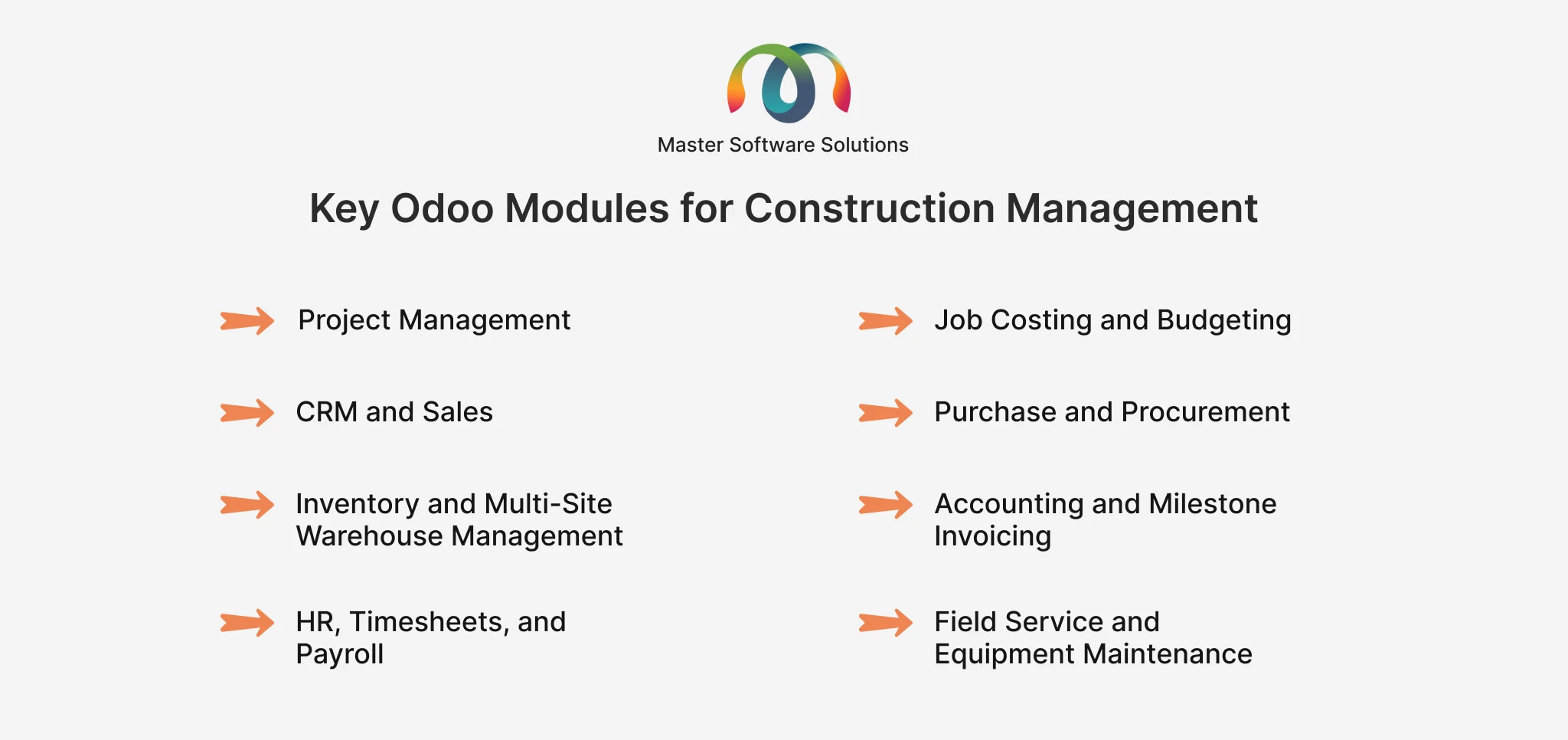
Project Management: Your Site Command Center
Odoo’s Project module lets you manage every construction project with Kanban boards, Gantt charts, task dependencies, and milestone tracking. Site engineers update task status from mobile devices, project managers see progress in real time, and management gets portfolio-level dashboards showing which projects are profitable and which are bleeding.
Job Costing and Budgeting
This is where construction firms feel the biggest impact. Odoo’s analytic accounting links every expense, including materials, labor, subcontractors, and equipment rental, to a specific project or cost center. Compare budgeted vs. actual costs live, track margins while the project is running, and catch overruns before they become losses.
CRM and Sales: Winning More Bids
Track leads, tenders, and bids through a visual pipeline. Build professional quotations from predefined product/service templates with per-unit pricing (per square meter/foot), monitor margins while quoting, and get contracts signed digitally with Odoo Sign.
Purchase and Procurement
Create purchase orders linked to projects, compare supplier price lists, automate reordering rules for fast-moving materials, and manage subcontractor agreements. Three-way matching (PO → receipt → vendor bill) prevents overbilling.
Inventory and Multi-Site Warehouse Management
Track materials across the central warehouse and every project site. Manage inter-site transfers, monitor consumption per project, reduce theft and wastage, and maintain a complete register of tools and equipment across locations.
Accounting and Milestone Invoicing
Handle advance payments, progress billing, milestone-based invoicing, retention amounts, and multi-tax compliance. Because accounting is native to Odoo, every project transaction flows into the ledgers automatically.
HR, Timesheets, and Payroll
Capture attendance and labor hours on-site (including via mobile), allocate labor costs to projects through timesheets, and manage payroll, contracts, and compliance for both permanent staff and contract workers.
Field Service and Equipment Maintenance
Schedule site visits, manage snag lists and inspections, and implement preventive maintenance schedules for heavy machinery to reduce costly equipment downtime during the project.
Not sure which modules your business needs? Our team at Master Software Solutions maps your workflows to the right Odoo apps, without overbuying or gaps. Book a free process audit.
The AI Advantage: How Artificial Intelligence Supercharges Odoo for Construction
AI is no longer a buzzword in construction ERP; it’s becoming the difference between reactive and proactive project management. Here’s how AI capabilities within and around Odoo transform construction operations:
AI-powered cost forecasting
Machine learning models trained on your historical project data can predict cost overruns and schedule slippage weeks in advance, allowing project managers to intervene earlier.
Intelligent document processing
Odoo’s AI-driven OCR automatically reads vendor bills, delivery challans, and receipts, extracts the data, and posts entries, eliminating hours of manual data entry per week.
Smart demand and material forecasting
AI analyzes consumption patterns across projects to predict material requirements, optimizing purchase timing and reducing both stockouts and dead stock.
AI assistants and agents
Conversational AI agents built on top of Odoo can answer questions like “Which projects are over budget this month?” or “What’s the pending material request status for Site B?” instantly, no report-digging required. Explore practical AI use cases in Odoo ERP that we’ve implemented for clients.
Automated workflows
Combining Odoo with AI automation tools (Claude, n8n, and Zapier) enables intelligent approval routing, anomaly detection, and auto-generated project status reports.
Predictive equipment maintenance
AI models identify machinery likely to fail based on usage data and maintenance history, allowing repairs to take place during planned downtime rather than in the middle of a downpour.
At Master Software Solutions, we specialize in embedding these AI capabilities directly into Odoo deployments, turning a standard ERP into an intelligent construction management platform.
Top Benefits of Odoo ERP for Construction Companies
- Real-time project profitability: Know exactly where every project stands financially, every day, not at month-end.
- 20–30% reduction in administrative workload: Automation of data entry, approvals, invoicing, and reporting frees your team to focus on delivery.
- Lower material costs: Better procurement planning, supplier comparison, and inventory control directly reduce material spend and wastage.
- Faster billing and healthier cash flow: Milestone invoices generate automatically as project stages complete, shortening the billing cycle.
- One system, one truth: Sales, sites, stores, accounts, and management all work from the same live data.
- Scalability: Whether you run 3 projects or 300, Odoo scales without forcing a platform change.
Odoo Community vs. Enterprise: Which Version for Construction?
Odoo Community (free, open-source) covers basics like CRM, Project, Inventory, and Purchase, a reasonable starting point for very small contractors. Odoo Enterprise adds crucial construction-relevant capabilities: Gantt planning views, field service, documents with AI-based digitization, helpdesk, advanced accounting, and mobile apps, backed by official support and hosting options.
For most construction companies managing multiple concurrent projects, Enterprise pays for itself quickly through the planning, accounting, and automation features alone. An experienced implementation partner can help you compare total cost of ownership for both editions against your specific requirements.
How to Implement Odoo ERP in a Construction Company: 6 Steps
- Process discovery and gap analysis: Document how estimating, procurement, site execution, and billing actually work today.
- Module selection and solution design: Map processes to Odoo apps; identify where customization is genuinely needed vs. where standard features suffice.
- Configuration and customization: Set up projects, cost centers, approval workflows, BOQ templates, and any custom modules.
- Data migration: Move master data (customers, vendors, items, opening balances) and live project data safely into Odoo.
- Training and pilot rollout: Run one or two live projects on Odoo in parallel before full cutover; train site and office teams separately on what each needs.
- Go-live and continuous optimization: Hypercare support in the initial weeks, then iterative improvements and AI-automation add-ons.
Implementation quality determines ERP success far more than software choice. This is why partnering with an experienced Odoo implementation company matters; a botched rollout costs more than the software ever will.
Why Choose Master Software Solutions as Your Odoo Partner?
Master Software Solutions brings together deep Odoo expertise and AI engineering capability, a combination few implementation partners offer. Our team handles end-to-end delivery: consulting, implementation, custom module development, third-party integrations, migration, and long-term support.
We’ve helped businesses gain full operational visibility with Odoo and see how we did it in our Good As Gold case study, and we build AI-powered extensions that make your ERP genuinely intelligent, not just digital.
Ready to modernize your construction business? Hire dedicated Odoo developers or get in touch for a free, no-obligation demo of Odoo configured for construction.
Conclusion
The construction industry can no longer afford disconnected tools and delayed data. Odoo ERP gives construction companies what they’ve always needed: one platform where bids, budgets, sites, stores, people, and payments stay connected in real time, now amplified by AI that predicts problems before they cost you money.
The technology is proven. The pricing is accessible. The only variable is implementation — and that’s where the right partner changes everything.
Start your construction digital transformation today. Schedule a free consultation with Master Software Solutions and see Odoo configured for a real construction workflow and yours.