Construction is one of the most complex industries to run. A single project pulls together dozens of subcontractors, thousands of materials, tight margins, shifting timelines, and a mountain of compliance paperwork. When all of that lives in spreadsheets, WhatsApp threads, and disconnected apps, things slip through the cracks, and slippage in construction is expensive.
The numbers back this up. Research covering 258 infrastructure projects across 20 countries found that 85% experienced cost overruns, averaging 28% above budget, while a KPMG global survey found only 31% of projects came within 10% of their planned budget. This is exactly why more builders are turning to ERP software for the construction industry, and why Odoo has become one of the most talked-about platforms for the sector. Choosing the right ERP software for the construction industry needs is no longer a nice-to-have; it is fast becoming the difference between projects that stay profitable and projects that quietly bleed money.
This guide walks through everything a contractor, builder, or developer needs to know about Odoo construction management: what it does, why it fits construction workflows, how implementation works step by step, and how to get it right the first time.
Construction is one of several sectors where Odoo earns its place – see which industries benefit most from Odoo implementation.
Why Construction Businesses Need a Dedicated ERP
Generic accounting tools and standalone project apps were never built for the realities of a job site. Construction runs on project-based accounting, progressive billing, retention, change orders, subcontractor management, and equipment tracking, none of which off-the-shelf software handles well.
A purpose-built ERP integrates all aspects of a project into a single system, ensuring that estimating, procurement, scheduling, labor, and finance all communicate in the same language. The market reflects demand: the global construction ERP software market was valued at USD 3.7 billion in 2024 and is expected to grow at a 7.7% CAGR through 2034, with 67% of construction firms having deployed or evaluating a construction-specific ERP, up from 48% in 2022.
The payoff is measurable. According to McKinsey research on construction productivity, full digitization of construction workflows could raise industry productivity by up to 15% and cut project overruns by 10–15%. That is the gap the best ERP for construction company operations is designed to close, and it is why the search for the best ERP for a construction company now tops the priority list for so many builders and developers.
If you are still weighing your options, here is what separates the best ERP software for construction from a generic system:
- Real-time cost tracking against budget, per project and per phase
- Integrated procurement tied directly to project material requirements
- Progress and milestone billing with retention handling
- Subcontractor and labor management with timesheets and payroll links
- Document control for drawings, permits, and compliance records
- Mobile access so site teams update data from the field
What Is Odoo and Why It Works for Construction
Odoo is an open-source, modular ERP platform used by more than 12 million users worldwide across manufacturing, retail, services, and increasingly construction. Its biggest advantage is its modularity: instead of buying a bloated all-in-one suite, you activate only the apps you need and add more as you grow.
As of 2026, Odoo 19 is the current stable release, and Odoo 20 is introducing dedicated vertical industry modules, including a purpose-built Construction module, expected to be unveiled at Odoo Experience 2026 in Brussels (September 24–26). This signals a clear commitment from Odoo to the construction sector, making now an ideal time to adopt.
For a construction company, Odoo brings together the specific apps that map to how projects actually run.
Core Odoo Modules for Construction
Project
Create and manage construction projects, set milestones, break work into tasks, assign crews, and monitor progress in real time across multiple simultaneous jobs.
Accounting
Handle project-based accounting, progress billing, retention, vendor bills, and real-time profitability per project. This is where Odoo Construction delivers its biggest financial control wins.
Purchase & Inventory
Manage procurement, track material consumption, control inventory across warehouses and job sites, and link each purchase order to a project budget.
Manufacturing / MRP
Useful for prefabrication, precast, and modular construction workflows.
Timesheets & Payroll
Automatically track labor hours by project and task, then flow them into payroll and cost reports.
Field Service
Dispatch teams, manage on-site work orders, and capture data from mobile devices in the field.
Documents & Sign
Centralize drawings, contracts, permits, and RFIs, and collect e-signatures on change orders and approvals.
CRM & Sales
Manage the bidding pipeline, quotations, and client relationships from initial contact through contract signing.
Together, these turn Odoo for construction management into a single source of truth, replacing the patchwork of tools most builders juggle today.
Want to see these modules in action for your business? Book a personalized Odoo demo with Master Software Solutions and see your workflows mapped live.
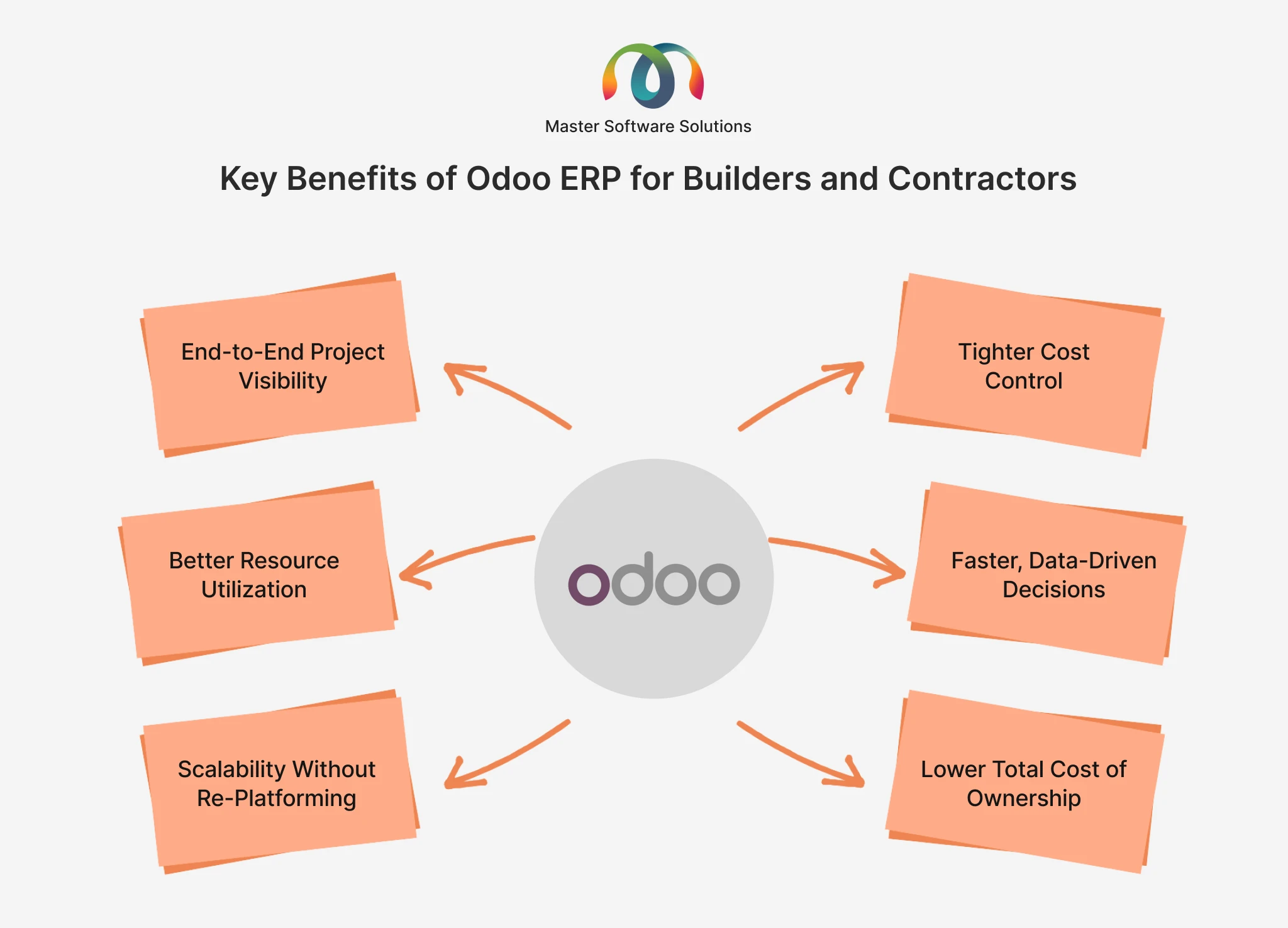
Key Benefits of Odoo ERP for Builders and Contractors
Adopting ERP software for builders through Odoo delivers advantages that compound over every project.
End-to-end project visibility
Managers can view budget vs. actual cost, schedule status, and resource allocation on a single dashboard; no more chasing updates across teams.
Tighter cost control
Real-time tracking, automated variance reporting, and integrated change-order management let you catch overruns early, when you can still do something about them.
Better resource utilization
Monitor labor hours, equipment usage, and material consumption so nothing sits idle and nothing runs short.
Faster, data-driven decisions
Small businesses report making decisions up to 36% faster after implementing ERP because all of their data is now in one place and up to date.
Scalability without re-platforming
Start with Project and Accounting, then add Inventory, Field Service, or Manufacturing as you grow, no rip-and-replace.
Lower total cost of ownership
As an open-source platform, Odoo’s licensing is typically far more affordable than legacy construction ERPs, which is why it consistently appears on lists of the top 10 construction ERP software for value.
Odoo Implementation for Construction: A Step-by-Step Roadmap
A successful Odoo construction management rollout is a structured project in its own right. Rushing it is the single most common cause of failed ERP deployments. Here is the proven roadmap Master Software Solutions follows.
Step 1: Discovery and Requirement Analysis
Map your current processes, including estimating, procurement, billing, payroll, and reporting, and identify the gaps and bottlenecks. Define what success looks like in measurable terms (fewer overruns, faster billing cycles, real-time cost visibility).
Step 2: Solution Design and Module Selection
Based on your workflows, select the right combination of Odoo modules and design how they connect. A small residential builder needs a different configuration than a large infrastructure contractor. This is where experienced consultants earn their keep.
Step 3: Configuration and Customization
Configure Odoo to match your chart of accounts, project templates, approval workflows, and reporting formats. Where standard features fall short, for example, specialized retention rules or a custom bid-to-project handoff, targeted custom development bridges the gap.
Step 4: Data Migration
Move your existing project, vendor, customer, and financial data into Odoo cleanly. Data quality here directly determines how trustworthy your reports will be on day one.
Step 5: Integration
Connect Odoo to the tools you keep, banking, payment gateways, CAD/BIM systems, payroll providers, or e-commerce, so data flows automatically instead of being re-keyed.
Step 6: Testing and User Acceptance
Run real project scenarios through the system before go-live. Involve site managers and accountants early; their buy-in makes or breaks adoption.
Step 7: Training and Change Management
Train each role on the parts of the system they actually use. The best configuration in the world fails if the crew won’t use it, so invest in hands-on, role-based training.
Step 8: Go-Live and Ongoing Support
Launch with support on standby, monitor closely for the first few cycles, and refine. Odoo is not a “set and forget” tool; continuous optimization is where long-term ROI lives.
Planning an implementation? Get a free implementation roadmap and quote from Master Software Solutions — we handle discovery to go-live.
Common Implementation Challenges (and How to Avoid Them)
Even the best ERP software for construction can stumble without the right approach. The most frequent pitfalls:
Under-scoping the project
Trying to digitize everything at once overwhelms teams. Start with the highest-pain area (usually project accounting) and expand in phases.
Poor data hygiene
Migrating messy legacy data produces messy reports. Clean and standardize data before migration.
Skipping change management
Technology is only half the job. Field crews and back-office staff need clear reasons, training, and support to change habits.
Choosing the wrong partner
Construction has industry-specific requirements. A partner who understands both Odoo and construction, like Master Software Solutions, dramatically de-risks the project.
Odoo vs. Traditional Construction ERPs
When builders shortlist the best ERP for a construction company, Odoo competes directly with names like Procore, Sage 300 CRE, Viewpoint, and CMiC. Where legacy systems tend to be expensive, rigid, and slow to configure, Odoo stands out on three fronts: it is open-source and modular (pay only for what you use), it is highly customizable without vendor lock-in, and it offers a single integrated suite that covers finance, projects, procurement, and HR rather than forcing you to bolt on separate products.
That combination is why Odoo is increasingly appearing on analyst and reviewer lists of the top ten construction ERP software, particularly for small and medium-sized businesses that require enterprise capabilities without the enterprise price tag.
Which Construction Businesses Benefit Most from Odoo
Odoo is flexible enough to serve almost every corner of the industry, which is part of why it has earned a reputation as versatile ERP software for builders of all sizes.
Residential and commercial builders use Odoo to manage multiple concurrent projects, track subcontractors, and keep client billing on schedule. General contractors rely on it to consolidate estimating, procurement, and job costing so bids stay accurate, and margins stay protected. Real estate developers use the integrated CRM, project, and accounting modules to run everything from land acquisition through handover. Specialty trades, such as electrical, mechanical, plumbing, and HVAC, use Field Service and Timesheets to dispatch crews and capture billable hours. Firms that do prefabrication or modular construction use the Manufacturing module to plan production alongside site work.
In every case, the appeal is the same: one connected system replaces a stack of disconnected tools, giving owners and project managers a live, accurate picture of every job. That universality is a big reason Odoo keeps appearing on reviewer roundups of the top 10 construction ERP software year after year.
How to Choose the Right Odoo Implementation Partner
The software is only as good as the team that deploys it. When evaluating a partner for Odoo for your construction company, look for:
- Proven construction ERP experience, not just generic Odoo installs
- A structured implementation methodology (discovery through support)
- In-house customization and development capability
- Strong training and change-management practices
- Ongoing support and optimization after go-live
Master Software Solutions is a certified Odoo partner with deep experience helping construction and real estate businesses implement, customize, and scale Odoo. From module selection to custom development and long-term support, the team delivers Odoo construction solutions built around how your business actually runs.
Take the next step. Schedule your free consultation with Master Software Solutions today and start building on a smarter foundation.
Final Thoughts
Construction margins are too thin and projects too complex to run on disconnected tools. Odoo ERP for construction brings estimating, procurement, project management, finance, and field operations into one connected system, giving builders real-time visibility and cost control that directly protect the bottom line.
Whether you are a residential builder, a commercial contractor, or a large developer, a well-planned Odoo implementation can transform how you deliver projects. The key is doing it right: the right modules, clean data, strong training, and an experienced partner.
Build smarter with Odoo. Contact Master Software Solutions for a free consultation and discover how the best ERP software for construction can work for your business.