The construction industry runs on tight margins, moving parts, and unforgiving deadlines. Yet many builders and contractors still try to manage multi-crore projects with spreadsheets, disconnected apps, and paper trails. The result is predictable: cost overruns, delays, and decisions made on stale data. According to McKinsey, large construction projects typically run up to 80% over budget and take 20% longer than expected, a gap that integrated technology is designed to close.
This is where ERP software for the construction industry changes the game, and why so many firms are turning to Odoo Construction as their platform of choice. In this blog, we break down the real challenges construction businesses face without a modern ERP and how Odoo for construction company operations solves them.
Why Construction Is One of the Hardest Industries to Manage
Construction isn’t a single business; it’s dozens of businesses running at once. On any given project, you are simultaneously managing procurement, inventory, labor, subcontractors, equipment, compliance, billing, and client relationships, often across multiple sites in multiple cities. Each of these functions generates data, and each depends on the others.
When those functions live in separate tools that don’t communicate, you get data silos. Industry research shows that fragmented systems and manual processes cost the sector an estimated $177 billion in lost productivity every year. That is the true baseline problem a construction ERP is built to fix.
The Biggest Challenges Construction Businesses Face Without an ERP
Here are the most damaging problems that show up when a construction firm operates without a unified system, and why the right ERP software for builders is no longer optional.
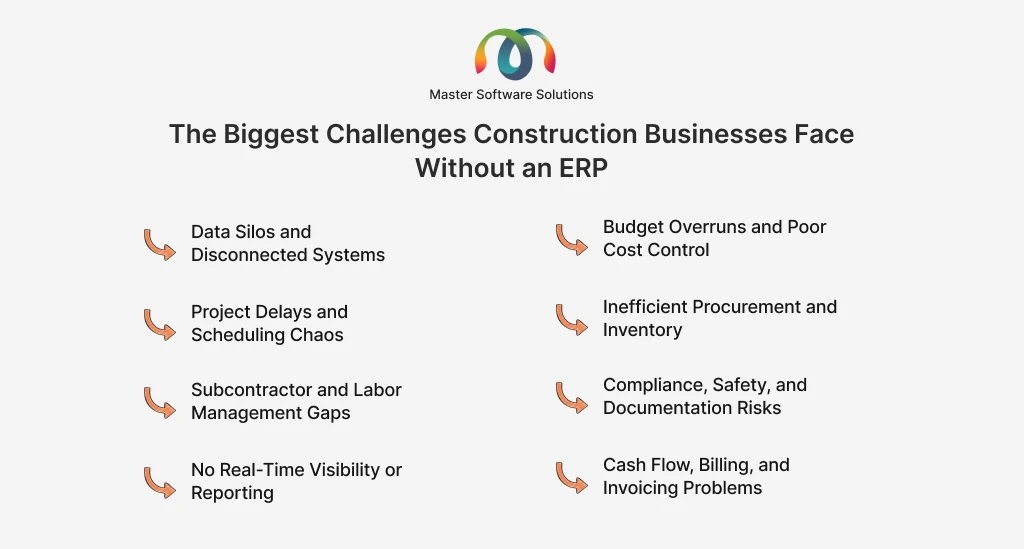
Data Silos and Disconnected Systems
Estimating works in one tool, project managers track progress in another, accounts reconcile in a third, and site crews still submit timesheets on paper. Every gap between systems is an opportunity for errors, duplicate entries, and delays. No single person ever sees the full picture of project health until it’s too late to correct course.
Budget Overruns and Poor Cost Control
Roughly 90% of construction projects experience budget overruns of 15% to 28% above their initial estimates. Without real-time cost tracking against budgets, small leaks due to material wastage, rework, and idle equipment go unnoticed until they’ve eaten your margin. You can’t control what you can’t see.
Project Delays and Scheduling Chaos
Manual scheduling can’t keep up with the dependencies of a live construction site. A delayed material delivery cascades into idle labor, missed milestones, and penalty clauses. Without Gantt charts, resource planning, and automated alerts, project managers are always reacting instead of planning.
Inefficient Procurement and Inventory
Over-ordering ties up cash; under-ordering stalls the site. Managing materials across multiple warehouses and job sites with spreadsheets almost guarantees stockouts, theft, and wastage. Procurement without ERP means no purchase visibility, no vendor comparison, and no link between what was ordered and what the project actually needed.
Subcontractor and Labor Management Gaps
Construction depends heavily on subcontractors and a mobile workforce. Without a central system, tracking subcontractor contracts, work completion, attendance, certifications, and payments becomes a paperwork nightmare and a source of disputes, compliance gaps, and payroll errors.
Compliance, Safety, and Documentation Risks
Contracts, drawings, RFIs, submittals, safety records, and daily reports pile up across email, drives, and filing cabinets. When an auditor, client, or regulator asks for a document, finding the current version is a scramble. Missing safety records or expired certifications aren’t just inconvenient; they’re legal and financial liabilities.
No Real-Time Visibility or Reporting
Leadership needs to know today which projects are profitable, which are slipping, and where cash is stuck. When reports are compiled manually at month-end, decisions are always based on the past. This lack of real-time insight is the single biggest reason firms invest in the best ERP software for construction.
Cash Flow, Billing, and Invoicing Problems
Progress billing, retention, and milestone-based invoicing are complex. Manual billing leads to under-billing, delayed invoices, and revenue leakage. Without integration between project progress and finance, cash flow, the lifeblood of any contractor, becomes impossible to forecast.
Struggling with any of these challenges? Master Software Solutions helps construction firms replace scattered tools with one connected Odoo platform. Talk to our Odoo experts.
The Hidden Cost of Sticking With Spreadsheets and Legacy Tools
Due to their existing procedures, many construction companies put off implementing ERP. But the cost of doing nothing is rarely visible on a balance sheet. It shows up as the margin lost to a project that quietly went over budget, the tender missed because data took a week to compile, the client lost after a billing dispute, and the senior staff hours burned on manual reconciliation instead of winning new work.
Legacy and point solutions also don’t scale. As you take on more projects and sites, the cracks widen.
Because Odoo grows with you rather than against you, companies comparing the top 10 construction ERP software options are increasingly shortlisting it.
How Odoo Construction ERP Solves These Challenges
Odoo Construction Management replaces the patchwork with a single, integrated suite of modules that share the same real-time data. Instead of eight disconnected tools, you get one platform covering every stage of a project.
Here’s how Odoo directly answers each challenge above:
- One connected database: Project management, accounting, procurement, inventory, HR, and CRM all share live data, eliminating silos and duplicate entry.
- Real-time cost control: Budgets, expenses, and analytic accounting track actuals against estimates as they happen, so overruns are caught early.
- Visual scheduling: Gantt charts, Kanban boards, and resource planning keep tasks, crews, and dependencies in sync.
- Smart procurement & inventory: Automated reordering, multi-warehouse tracking, and vendor comparison cut wastage and stockouts.
- Subcontractor & labor management: Centralized contracts, attendance, payroll, and certification tracking reduce disputes and compliance gaps.
- Document management: Contracts, drawings, RFIs, and safety records live in one place with version control and role-based access.
- Live dashboards: Leadership sees project profitability, cash flow, and progress in real time decisions based on now, not last month.
- Integrated billing: Progress and milestone billing tie directly to project completion, protecting cash flow and stopping revenue leakage.
You can explore the platform’s capabilities directly on the official Odoo website and learn more about tailored implementation through our Odoo development services.
Why Odoo Is Considered the Best ERP for Construction Company Operations
When firms evaluate the best ERP for construction company needs, Odoo consistently stands out for a few reasons:
- Modular and scalable: start with project and accounting, and add modules as you grow. You never pay for what you don’t use.
- Highly customizable: construction workflows are unique; Odoo can be tailored to progress billing, retention, and site-specific processes.
- Cost-effective: compared with heavyweight legacy ERPs, Odoo delivers enterprise capability at a fraction of the total cost of ownership.
- Cloud and mobile: manage projects from the head office or the job site on any device.
- One vendor, one system: no more stitching together five subscriptions that don’t integrate.
That combination is why Odoo construction is frequently ranked among the best ERP software for construction firms of every size, from growing contractors to large developers.
What to Look for in the Best ERP Software for Construction
If you’re building a shortlist of construction ERP platforms, judge each option against the criteria that actually matter on a job site:
- Industry-specific features: progress billing, subcontractor management, and project costing out of the box.
- Real-time integration: finance, field, and procurement sharing one live database.
- Mobile access: site teams must be able to log time, materials, and progress from the field.
- Scalability: the system should handle 3 projects and 300 equally well.
- Customization & support: a strong implementation partner matters as much as the software itself.
Odoo checks every one of these boxes, which is why it earns a place on nearly every credible list of top construction ERP software and remains a leading choice of ERP software for builders.
Signs Your Construction Business Is Ready for Odoo
Not sure if it’s time? You’re likely ready for an ERP if you recognize these signs:
- Your teams re-enter the same data into multiple systems.
- You discover budget overruns only after they’ve happened.
- Compiling a management report takes days, not minutes.
- Billing and cash-flow forecasting feel like guesswork.
- You’re turning down projects because you can’t scale operations.
Ready to see it in action? Get a customized Odoo demo for your construction workflows by scheduling a free consultation with Master Software Solutions. Request your free demo.
Final Thoughts
The challenges construction businesses face without an ERP, including data silos, cost overruns, delays, and blind decision-making, aren’t isolated problems. They compound. Each disconnected tool adds friction, and every manual process adds risk. Odoo for construction company operations replaces that chaos with one connected, real-time platform that scales as you grow.
If you’re comparing the best ERP software for construction, the smartest first step is a conversation with an experienced Odoo implementation partner who understands the industry.
Master Software Solutions is a trusted Odoo partner helping construction firms streamline projects, control costs, and scale confidently. Get started with Odoo today.