The global e-commerce market is projected to surpass $7.9 trillion by 2027. But raw market size means nothing if your store is slow, siloed, and hard to manage. The businesses winning online aren’t just selling more; they’re operating smarter.
What Is Odoo E-commerce?
Odoo E-commerce is a fully integrated online store module built natively into the Odoo ERP ecosystem. Unlike standalone platforms that require expensive plugins and third-party glue, Odoo’s e-commerce module shares a single database with your inventory, accounting, CRM, and shipping operations out of the box.
That means when a customer places an order on your storefront, your warehouse team sees it instantly, your accountant books it automatically, and your CRM logs the interaction, all without a single API call or manual sync.
For businesses that have outgrown Shopify’s limitations or are frustrated by WooCommerce’s plugin dependency sprawl, Odoo offers a fundamentally different architecture: one platform, zero silos.
Why Odoo E-commerce Outperforms Other Platforms
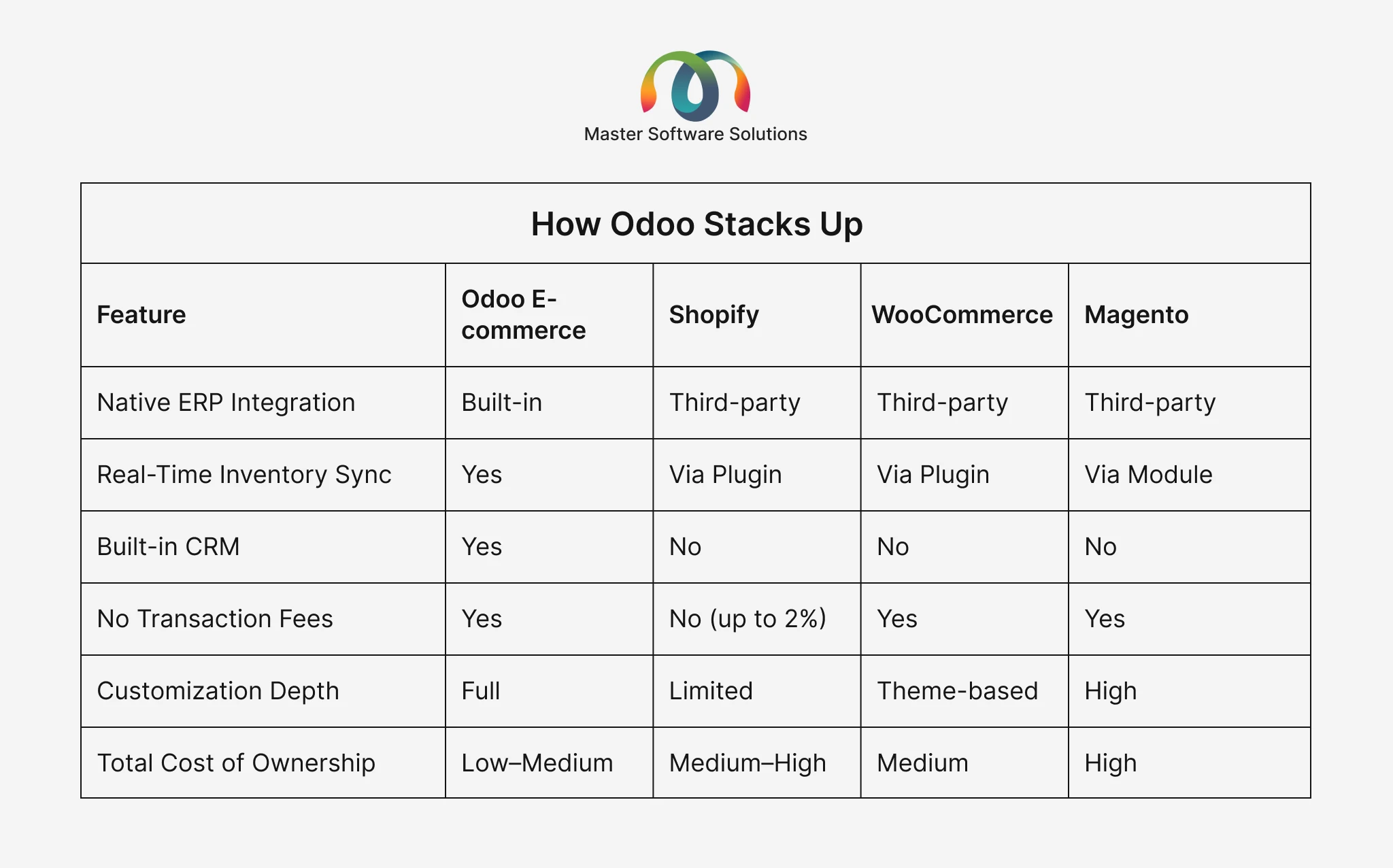
Choosing the right e-commerce platform is one of the most consequential technology decisions a growing business makes. Here’s how Odoo stacks up:
For a deeper breakdown of how Odoo stacks up on features, pricing, and real-world pros and cons, see our detailed Odoo E-commerce features, benefits, and review.
The verdict: if your business needs deep operational integration, not just a storefront, Odoo wins by design.
Key Features of Odoo E-commerce Development
Drag-and-Drop Website Builder
Odoo’s built-in website builder lets you create product pages, landing pages, and blog posts without touching a line of code. Designers can work visually while developers extend functionality through Python and XML, giving both teams the freedom they need.
Product Catalog & Variant Management
Manage thousands of SKUs with configurable attributes (size, color, material), pricing rules, and dynamic filtering. Customers can narrow product searches with faceted filters, and you can set up product comparisons, wishlists, and recently viewed items with minimal configuration.
Real-Time Inventory & Stock Alerts
Because Odoo E-commerce runs on the same database as Odoo Inventory, stock levels update in real time. Overselling becomes a thing of the past. You can configure low-stock alerts, back-order rules, and even allow customers to sign up for restock notifications.
Multi-Currency & Multi-Language Support
Sell globally without building separate storefronts. Odoo natively supports multiple currencies with automatic exchange rate updates, and its translation framework lets you publish product descriptions, pages, and checkout flows in any language.
B2B & B2C in One Store
One of Odoo’s most underrated capabilities: it supports both B2C and B2B selling from a single platform. Set up customer-specific price lists, volume discounts, tax exemptions, and credit terms without needing a separate enterprise portal.
Ready to see what Odoo can do for your store? Talk to our Odoo specialists at Master Software Solutions, and we’ll map the right architecture for your business.
Seamless ERP Integration: The Real Differentiator
This is where Odoo’s e-commerce module genuinely separates itself from every standalone platform on the market.
When your online store is natively connected to your ERP, you eliminate the most expensive problem in digital commerce: data fragmentation.
Here’s what native ERP integration looks like in practice:
- Order-to-cash automation: An order placed at 2 AM is invoiced, fulfilled, and tracked without human intervention.
- Unified customer records: Every touchpoint (purchase, support ticket, email, quote) is visible on a customer profile shared across sales, support, and marketing.
- Procurement triggers: Low stock on a best-seller automatically generates a purchase order to your supplier.
- Financial accuracy: Revenue, taxes, and cost of goods are booked correctly instantly after a transaction occurs.
Businesses using our Odoo Integration Services routinely report a 30–50% reduction in order processing time after connecting their storefront to their ERP.
Case Study: Aquatech Skin Care, a Toronto wholesale manufacturer, was losing orders to duplicate SKU references breaking their Odoo–WooCommerce sync. We audited the catalog, resolved the conflicting internal references, and rebuilt the integration for stable two-way sync. → How we solved Aquatech’s Odoo–WooCommerce sync issues
Odoo E-commerce Customization: Build It Your Way
No two businesses sell the same way. Odoo’s open-source architecture means you’re never locked into a rigid template.
Custom Themes & Storefronts
Our Odoo Website Design and Development team builds pixel-perfect storefronts that match your brand identity, from custom product configurators for manufacturing clients to subscription-based portals for SaaS businesses.
Custom Checkout Flows
Reduce cart abandonment with streamlined, single-page checkouts. Add upsell prompts, loyalty point displays, or custom shipping calculators at checkout, all built natively, not bolted on.
Industry-Specific Modules
Running a food and beverage operation? A wholesale distributor? A B2B supply company? Our Odoo Customization Services team has built bespoke modules for:
- Subscription and recurring order management
- Route-optimized delivery scheduling
- Volume-based B2B pricing engines
- Warehouse-proximity-based stock allocation
Not sure what customization you need? Book a free consultation, and our team will audit your current setup and recommend the highest-ROI customizations.
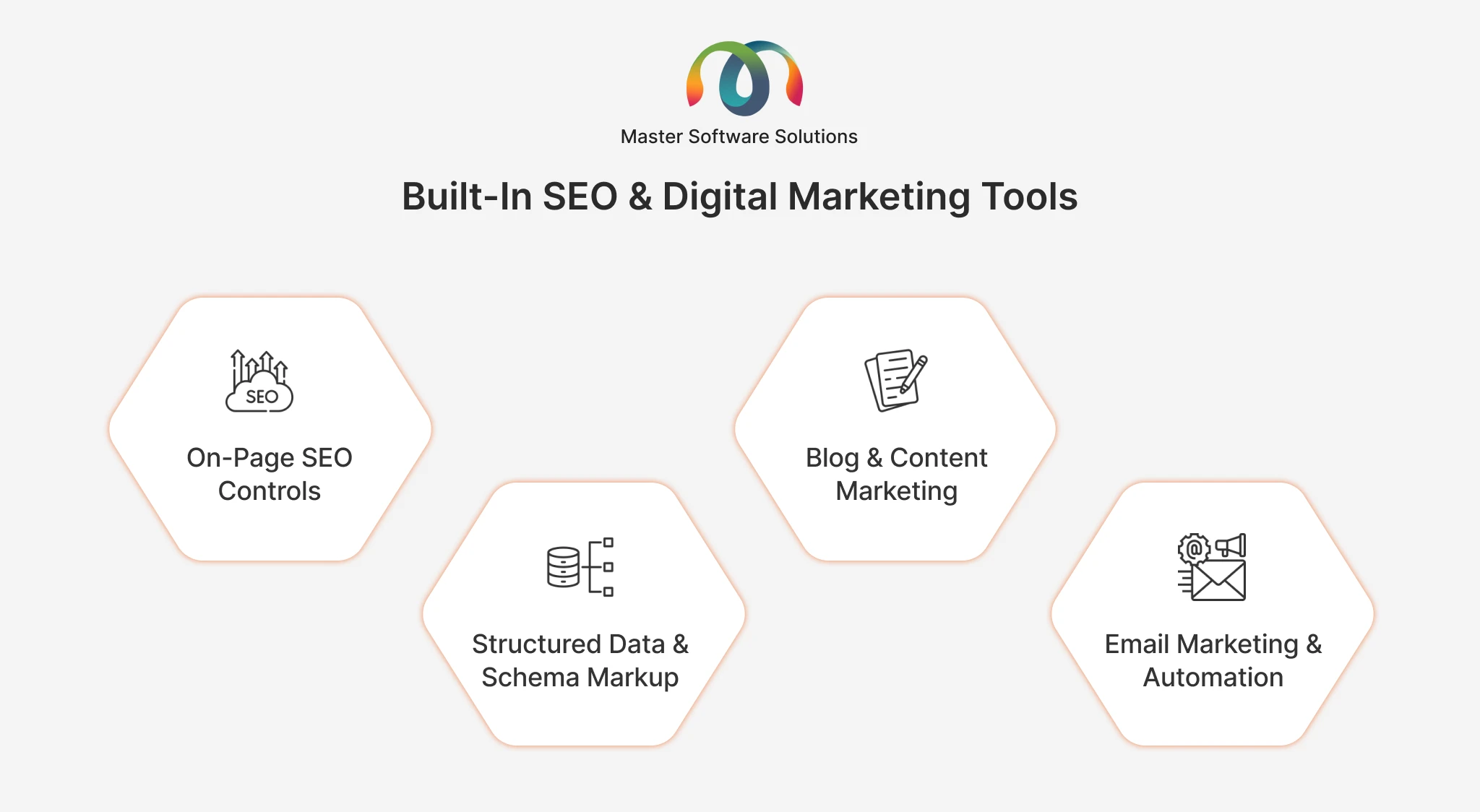
Built-In SEO & Digital Marketing Tools
Ranking on Google isn’t an afterthought in Odoo; it’s baked into the platform.
On-Page SEO Controls
Every product page, category, and blog post has native fields for meta titles, meta descriptions, URL slugs, and canonical tags. You control the exact markup search engines see, without installing plugins.
Structured Data & Schema Markup
Odoo automatically generates product schema markup (name, price, availability, reviews) that feeds rich results in Google Search and AI-powered answer engines. This is increasingly critical for visibility in AI overviews and Bing Copilot answers.
Blog & Content Marketing
The integrated blog module lets you publish SEO content, like this post, that lives on the same domain as your store. Unlike Shopify, where a separate blog can dilute domain authority, Odoo keeps your content and commerce unified.
Email Marketing & Automation
Design and send segmented campaigns directly from Odoo’s Marketing module. Trigger abandoned cart emails, post-purchase follow-ups, and win-back sequences without a Klaviyo subscription.
According to Salesforce’s State of Commerce Report, businesses that unify marketing and commerce data see 36% higher customer retention rates, which is exactly what Odoo’s integrated architecture enables.
Payment Gateways & Shipping Integrations
Odoo E-commerce supports all major payment providers out of the box:
- Stripe, PayPal, Authorize.net, Mollie, Adyen
- Buy Now Pay Later options via Afterpay and Klarna integrations
- Crypto payments through third-party modules
On the shipping side, you get native connectors for FedEx, UPS, DHL, USPS, and regional carriers. Shipping rates are calculated in real time at checkout, labels are automatically printed directly from Odoo, and tracking numbers are emailed to customers.
Mobile-Optimized Storefront
More than 60% of e-commerce traffic now comes from mobile devices. Every Odoo storefront is built on a responsive framework that delivers fast, thumb-friendly experiences without separate mobile development.
Key mobile performance features include the following:
- Lazy-loading product images
- Touch-optimized navigation menus
- One-tap checkout for returning customers
- Progressive Web App (PWA) capabilities for app-like experiences
Inventory & Order Management That Actually Works
Odoo’s inventory module is one of the most powerful in any ERP, and it’s fully wired to your store.
- Multi-warehouse fulfillment: Route orders to the nearest or best-stocked warehouse automatically
- Batch picking & packing: Warehouse staff pick multiple orders in a single walk
- Return & RMA management: Handle product returns with configurable return policies and automatic refund processing
- Dropshipping: Trigger supplier fulfillment directly from customer orders
For e-commerce businesses scaling toward enterprise volumes, this operational depth is what makes Odoo genuinely competitive with platforms costing ten times as much.
How Master Software Solutions Delivers Odoo E-commerce Projects
We don’t do one-size-fits-all implementations. Every engagement begins with a discovery phase where we map your current workflows, identify gaps, and design an Odoo architecture that fits, not one that forces you to change how you operate.
Our delivery process:
- Discovery & Scoping: Business process mapping and requirements gathering
- Architecture Design: Module selection, integration planning, data migration strategy
- Development & Customization: Sprint-based delivery with continuous client feedback
- QA & UAT: Rigorous testing across devices, payment flows, and edge cases
- Go-Live & Training: Phased launch with staff training and documentation
- Ongoing Support: Post-launch optimization and Odoo Support & Maintenance
Our team has delivered Odoo E-commerce implementations across retail, wholesale, food & beverage, manufacturing, and logistics, and we understand the operational nuances that generic consultants miss.
Explore our Odoo Implementation Services or learn more about our work across the E-commerce industry.
Let’s build your smarter store. Contact Master Software Solutions today and get a free e-commerce readiness assessment.
Conclusion
Building a smarter online store isn’t about choosing the most popular platform; it’s about choosing the one that fits how your business actually operates. Odoo E-commerce gives you a storefront that is genuinely connected to your operations: inventory, finances, customer data, and fulfillment are all moving as one.
The businesses that will win the next decade of e-commerce won’t be running five disconnected tools. They’ll be running one intelligent system.
Master Software Solutions has the Odoo expertise to build that system for you — from architecture and customization to launch and long-term support. Get your free Odoo E-commerce consultation