Seamless communications have become an integral part of a successful business. Twilio is a platform that enables developers to integrate SMS notifications into apps, set up a robust call center, and deploy video conferencing solutions. Twilio is a leading cloud communication platform that helps you build, scale, and operate real-time communications within software applications.
This blog article will explore the core features of Twilio and its services and provide practical examples of how businesses can leverage Twilio’s capabilities to enhance customer engagement.
What is Twilio?
Twilio is a cloud Communications Platform as a Service (CPaaS) company that enables developers to build applications to receive phone calls, send and receive messages, and perform other communication tasks using its web service API.
Twilio revolutionizes customer service by providing a suite of voice, messaging, video, and authentication APIs for businesses of all sizes, from startups to big firms.
Does Twilio use WebRTC?
WebRTC is an open-source technology for building customized real-time communication web and mobile applications. Users can join audio/video calls directly from the link. Twilio is built on WebRTC, which allows developers to leverage its features when building applications.
The Twilio Programmable Video APIs enable Twilio developers to build and implement real-time video conferencing capabilities using WebRTC technology. It doesn’t need developers to build backend infrastructure from scratch. Twilio considers server scaling, which allows the platform to handle user load.
It also provides TURN/ STUN infrastructure for WebRTC developers. This implies that the developers do not need to set up and manage their STUN/ TURN servers, simplifying the development process and ensuring reliable connectivity for WebRTC applications.
What are the features of Twilio?
Twilio is highly flexible, allowing businesses to integrate and scale communication capabilities that align with their needs. The platform offers various features across various communication services. The key features of Twilio are:
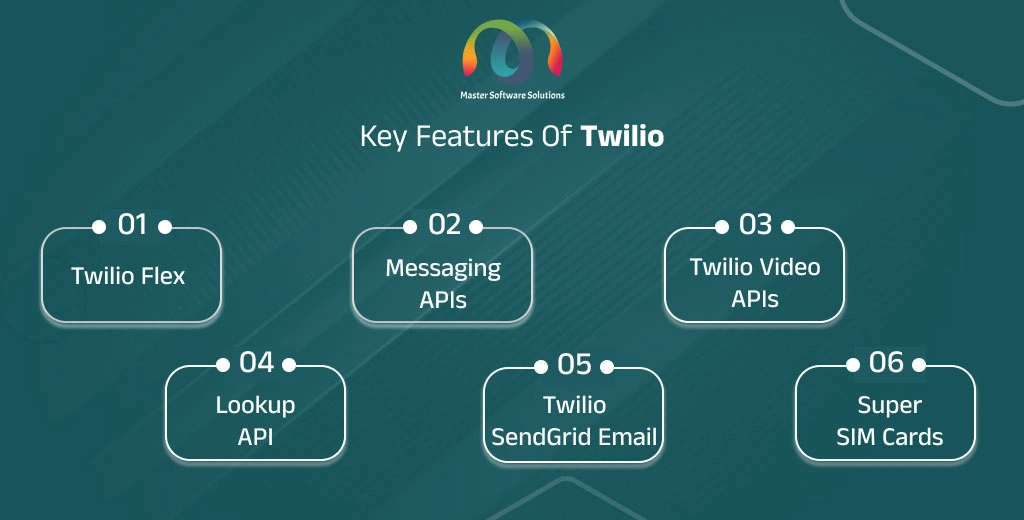
Twilio Flex
Twilio can make, receive, and programmatically control voice calls, offering customer service lines, automated surveys, appointment reminders, and click-to-call buttons on the website. It supports phone numbers in over 100 countries, providing a global reach and enabling global customer support, international marketing campaigns, and remote team communication.
You can track and analyze calls and monitor their performance. The platform allows users to record calls for quality assurance and compliance. An IVR (Interactive Voice Response) enables callers to connect with a computerized system using prompts and keypad inputs, automating call handling. Users can convert voice calls to text using the transcription feature.
Messaging APIs
Twilio enables you to send and receive SMS and MMS messages globally. Companies can use them to send alerts and notifications, handle marketing campaigns, and engage customers. The platform allows WhatsApp integrations into the applications for customer support, notifications, and two-factor authentication. Twilio offers short codes for high-throughput messaging (sending messages in bulk) for SMS marketing campaigns, emergency alerts, and voting systems.
The platform provides toll-free numbers for messaging used in customer support lines, service subscriptions, and collecting feedback. Twilio enables two-way communication, allowing the receivers to reply to the messages. Two-way messaging is used in customer support, appointment scheduling, and interactive marketing. It queues messages and has an auto-retry mechanism, ensuring the successful delivery of messages.
Twilio video APIs
Twilio provides APIs to build and scale real-time video applications. These apps can be used in videoconferencing, telemedicine, and e-learning. The platform supports multi-party video rooms with up to 50 participants for virtual, webinars, and online meetings. Users can record video sessions and provide playback capabilities. The users can record meetings, educational content, and compliance documentation.
Twilio enables screen sharing during video calls, which is helpful for remote presentations, technical support, and online training. The platform uses WebRTC for high-quality audio/ video. It supports browser-based video chats, live customer support, and social media integrations. Master Software Solutions offers WebRTC development services for businesses looking to build their own real-time communication platform on Twilio.
Lookup API
Twilio enables users to implement Two-Factor Authentication (2FA) with SMS, voice, or push notifications. 2FA is used to secure user logins, protect sensitive transactions, and verify user identity. The platform provides Authy APIs for robust authentication solutions for user account security, application login protection, and transaction verification.
It verifies the user’s phone number during account registration, preventing fraud, ensuring accurate user data, and enhancing security. Twilio can generate one-time passwords (OTPs) for secure logins. The OTP generation feature is used in passwordless authentication, transaction confirmation, and account recovery.
Twilio SendGrid Email
Twilio integration allows you to send automated transactional emails (such as order confirmations or password resets). These emails include e-commerce notifications, account updates, and system alerts. It allows users to send and manage marketing emails, including newsletters, promotional offers, and event announcements.
The platform provides customized email templates for consistent branding, quick deployment of common email types, and personalized messaging. It enables users to monitor and optimize deliverability rates, including inbox placement, avoiding spam filters, and improving customer engagement rates.
Super SIM cards
The platform enables connecting to IoT devices using SIM cards. It is used in fleet management, remote monitoring, and connected devices. It offers cellular connectivity for IoT devices, allowing international IoT deployments, asset tracking, and remote control systems.
The features like provisioning, monitoring, and controlling connectivity enable users to manage and secure SIM cards and IoT devices. This ensures secure IoT deployments, usage monitoring, and efficient cost management.
Other features of Twilio
- APIs and SDKs – Twilio offers APIs (Application Programming Interfaces) and SDKs (Software Development Kit) for various programmable languages and platforms to guide developers for seamless integrations. It enables developers to create custom communication solutions, rapid application development, and integration with existing systems.
- Serverless service – The developers can run code without managing servers using Twilio functionalities. It can be used for event-driven applications, real-time data processing, and simplified backend management.
- Reports and analytics – Twilio provides detailed analytics and insights on communication performance to optimize and troubleshoot applications. This is used to monitor performance, develop business intelligence, and optimize operations.
- Compliance and security – The platform ensures compliance with global regulations and implements strong security measures to protect data. This is helpful for GDPR compliance, secure communication, and industry regulatory adherence.
What are the benefits of Twilio?
The Twilio platform is a scalable, powerful, and flexible platform that can help businesses enhance communication strategies, improve customer engagement, and drive growth. It offers numerous benefits that make it an attractive choice for those looking to integrate communication capabilities into their applications.
The benefits of implementing the Twilio platform are:
- Ease of integration – Twilio provides a range of APIs that make integration easier into existing applications, enabling developers to add communication features. Developers do not have to build the applications from scratch. It also provides in-depth and well-documented APIs and SDKs for various programming languages to developers, helping them to implement and troubleshoot.
- Scalable – Twilio is a cloud-based platform that can handle high levels of traffic and can accommodate demand. It enables businesses to expand internationally with support for phone numbers and messaging capability in over 100 countries.
- Reliability – The high availability and reliability infrastructure of Twilio ensures accessible communication services. The built-in redundancy and failover mechanisms help maintain continuous service in case of disruptions.
- Flexibility – The APIs of the Twilio cloud solution are highly customizable, allowing developers to tailor the solution to their specific needs. It supports various communication channels, including voice, SMS, MMS, email, video, and chat. This enables businesses to connect with customers on their preferred platforms.
- Customer engagement – Twilio’s multi-channel communication features allow businesses to provide personalized and engaging customer experiences. They can use features like programmable IVR and automated messaging to streamline operations and improve efficiency.
- Security and compliance – Twilio uses strong security practices, like encryption, authentication, and access control, to protect data. The platform is regulated, which makes it compatible with GDPR, HIPAA, and PCI-DSS.
Used cases of Twilio
Twilio is used in several communication solutions that cater to various aspects of modern communication. It enables developers and businesses to build robust, scalable, and versatile communication solutions that align with business-specific needs. The key areas where Twilio is used are:
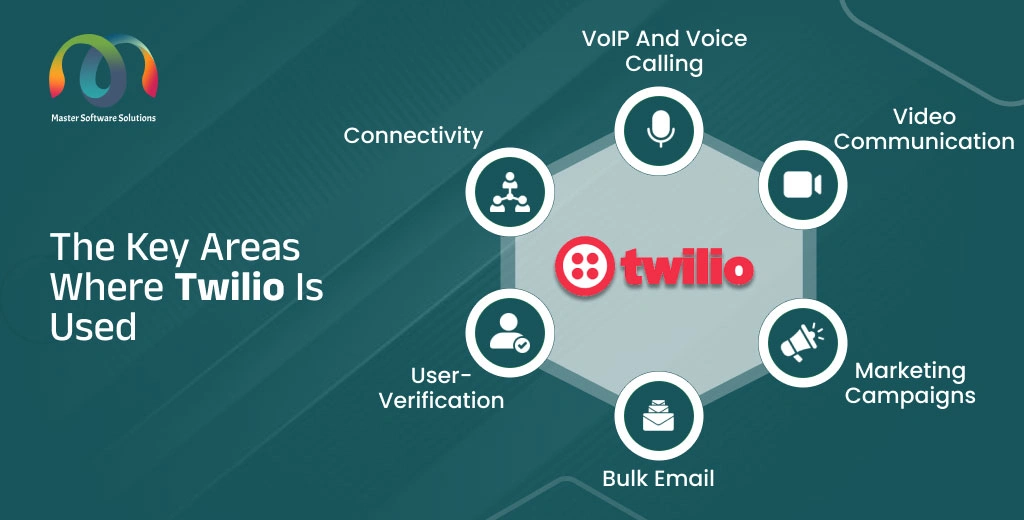
VoIP and voice calling
Twilio Flex is a customizable cloud-based contact center platform. It enables businesses to handle customer interaction via voice, messaging, chat, and video. The platform allows integrations that can help you establish multiple communication channels.
It gives customers the flexibility to choose their preferred communication channel. Twilio can be integrated with CRM systems and other databases, which provide relevant customer information.
Video communication
Twilio programmable APIs enable developers to integrate video calling capabilities into their applications to support one-on-one or group video calls. The global video conferencing market was worth USD 7.2 billion in 2022& is estimated to reach USD 21 billion in 2032. Industries such as telehealth providers, online education, e-learning, and remote collaboration use Twilio to build secure and reliable video conferencing solutions.
It supports interactive video sessions, screen sharing, and whiteboarding.
Marketing campaigns
Twilio allows businesses to send personalized promotional messages, notifications, and updates via SMS and MMS. It also supports marketing through popular messaging applications like WhatsApp, enabling a wider audience reach. APIs of Twilio can automate marketing workflows, including customer segmentation, personalized messaging, and follow-up reminders.
It also allows businesses to track the effectiveness of their campaigns with delivery reports, open rates, and other metrics.
Bulk email
It automates transactional emails, including order confirmations, password resets, and account notifications. Bulk mail enables the creation and management of email marketing campaigns. It enhances customer engagement rates through newsletters and promotional emails. Twilio ensures high deliverability rates and reduces the chances of emails landing in spam folders.
The businesses can also fetch detailed analytics on email performance, including open rates, click-through rates, bounce rates, and bounce rates, helping them to optimize their email strategies.
User-verification
Twilio Authy offers advanced 2-factor authentication to enhance security, using SMS, voice, and push notifications. The APIs verify phone numbers while creating an account to avoid fraud and ensure the authenticity of the user.
Twilio generates time-based one-time passwords (TOTPs) for secure and reliable user authentication.
Connectivity
Twilio provides SIM cards and connectivity solutions for IoT devices that allow users to communicate over cellular networks. It offers wireless services to manage IoT devices and data usage, which ensures reliable and scalable connectivity.
The infrastructure of Twilio supports global communication and enables users to connect worldwide through various communication channels.
Conclusion
Twilio is a powerful cloud solution that offers a comprehensive suite of APIs that enable seamless integration and scalability for voice calls, messaging, and authentication. Twilio provides tools and features that can enhance customer engagement and streamline operations. If you are also looking to integrate communication solutions into your business, book a consultation with our tech experts and see how we can help.
Frequently Asked Questions
Q1. What is Twilio and how does it work?
A1. Twilio is a cloud-based Communications Platform as a Service (CPaaS) that enables developers to integrate communication features like voice calls, SMS, video, and email into applications using APIs. It works by providing programmable interfaces that connect your software with global telecom networks.
Q2. Does Twilio use WebRTC technology?
A2. Yes, Twilio leverages WebRTC to enable real-time audio and video communication directly in browsers and mobile apps. This allows developers to build video conferencing and calling solutions without managing complex infrastructure.
Q3. What services does Twilio provide?
A3. Twilio offers a wide range of communication services, including:
- Voice calling and call center solutions
- SMS, MMS, and WhatsApp messaging
- Video conferencing APIs
- Email services via Twilio SendGrid
- Authentication tools like OTP and 2FA
- IoT connectivity through Super SIM
Q4. What is Twilio Flex?
A4. Twilio Flex is a fully programmable cloud contact center solution. It allows businesses to manage customer interactions across voice, chat, email, and messaging channels in a unified interface.
Q5. What are the key features of Twilio?
A5. Some of the core features include:
- Programmable voice and messaging APIs
- Multi-channel communication (SMS, email, video, chat)
- Two-factor authentication and security tools
- Real-time analytics and reporting
- Serverless computing capabilities
- Global scalability with support in 100+ countries
Q6. What are the benefits of using Twilio?
A6. Twilio provides several advantages:
- Easy integration with existing applications
- Highly scalable cloud infrastructure
- Reliable and secure communication services
- Flexible APIs for customization
- Enhanced customer engagement through multi-channel communication
Q7. How can businesses use Twilio for customer engagement?
A7. Businesses can use Twilio to:
- Send personalized SMS notifications and alerts
- Enable two-way customer communication
- Automate responses using IVR systems
- Provide real-time support via chat or video
- Run targeted marketing campaigns
Q8. Can Twilio be used for video conferencing?
A8. Yes, Twilio’s Programmable Video APIs allow developers to build secure and scalable video conferencing applications. These can support features like screen sharing, recording, and multi-party video rooms.
Q9. How does Twilio support user authentication?
A9. Twilio offers authentication solutions through tools like Authy, enabling:
- Two-factor authentication (2FA)
- One-time passwords (OTP)
- Phone number verification
- Secure login and transaction validation
Q10. Is Twilio for small businesses?
A10. Yes, Twilio is highly flexible and scalable, making it suitable for startups, small businesses, and large enterprises alike. Businesses can start small and scale their communication capabilities as they grow.
Q11. What Industries commonly use Twilio?
A11. Twilio is widely used across industries such as
- E-commerce (order updates, notifications)
- Healthcare (telemedicine, appointment reminders)
- Education (e-learning, virtual classrooms)
- Finance (secure authentication, alerts)
- Customer support (call centers, chat support)
Q12. Does Twilio support global communication?
A12. Yes, Twilio supports global communication by providing phone numbers and messaging capabilities in over 100 countries, enabling businesses to reach customers worldwide.
Q13. Can Twilio be used for marketing campaigns?
A13. Absolutely. Twilio enables businesses to run SMS, MMS, email, and WhatsApp marketing campaigns. It also provides analytics to track delivery rates, engagement, and campaign performance.
Q14. How secure is Twilio?
A14. Twilio follows strong security practices such as encryption, access controls, and authentication. It also complies with major regulations like GDPR, HIPAA, and PCI-DSS, ensuring secure communication.
Q15. Does Twilio support IoT connectivity?
A15. Yes, Twilio offers Super SIM solutions that allow IoT devices to connect over cellular networks. This is useful for applications like fleet tracking, remote monitoring, and smart devices.