ravi garg, master software solutions, odoo partner, top banner, usa, uk, canada, india, odoo implementation partner company, image

2012

Founded

90+

Professionals in our Team

800+

Clients Served

40+

Countries on Global Map

Common Accounting Challenges We Solve

Finance teams are under more pressure than ever to close faster, report more accurately, and stay ahead of compliance requirements, often with the same headcount and increasingly complex operations.

01

Month-End Close Takes Too Long

Journal entries are still being created manually, bank reconciliation is done line by line, and inter-company transactions need hours of manual matching. A process that should take days is stretching into weeks, delaying management reporting and frustrating every stakeholder waiting for the numbers.

02

Manual Invoice Processing and Payment Chasing

Sales invoices are created manually from spreadsheets or separate systems, and chasing overdue payments falls to whoever remembers to check the aged debtor report. Cash collection is slow, DSO is high, and revenue sits uncollected far longer than it should.

03

Disconnected Systems Creating Reconciliation Gaps

Sales, purchasing, inventory, and payroll all run in separate systems that don't talk to each other. Every transaction has to be re-entered or exported and imported into the accounting system, creating reconciliation gaps, duplicate data, and a permanent lag between operational reality and the financial books.

04

Tax Compliance Is a Constant Fire Drill

VAT, GST, sales tax, and withholding tax calculations are done manually or in spreadsheets. Filing deadlines are met through last-minute heroics rather than a reliable process, and the risk of errors, and the penalties that follow, is ever-present.

05

No Real-Time Financial Visibility

Management is making decisions based on financial data that is days or weeks old. A P&L that reflects last month's performance is not useful for this month's decisions, but that's all the current system can produce.

06

Multi-Currency and Multi-Company Complexity

Businesses operating across multiple countries, currencies, or legal entities are managing the complexity manually, with spreadsheet-based consolidations, manual exchange rate adjustments, and inter-company billing that takes days to reconcile.

Key Features of the Odoo Accounting Module

From automated invoicing to real-time financial reporting, the Odoo Accounting module gives your finance team every tool they need to close faster, report accurately, and stay in full control of the numbers.

Chart of Accounts and General Ledger

Configure a fully customizable chart of accounts aligned to your industry, jurisdiction, and reporting requirements. Every transaction across the Odoo ecosystem posts automatically to the correct GL accounts in real time — with a complete, auditable journal entry behind every entry.

Customer Invoicing and Accounts Receivable

Generate professional invoices directly from confirmed sales orders or delivery records with a single click. Batch invoicing, recurring invoice schedules, and automated payment reminders reduce the manual effort in billing and accelerate cash collection.

Vendor Bills and Accounts Payable

Vendor bills are created automatically from validated purchase orders through three-way matching. Payment terms, due dates, and early payment discounts are applied automatically, and batch payment runs are processed with a single approval, reducing AP processing time significantly.

Bank Feeds and Automated Reconciliation

Connect your bank accounts directly to Odoo via live bank feeds. Transactions are imported automatically, and Odoo's AI-powered reconciliation engine matches bank entries to outstanding invoices, bills, and journal entries, reducing manual reconciliation to exception handling only.

Tax Configuration and Compliance

Configure tax rules for any jurisdiction, VAT, GST, sales tax, withholding tax, and more. Tax is calculated automatically on every transaction based on the product, customer location, and applicable tax rule. Tax return reports are generated in the correct format for your jurisdiction, ready for filing.

Multi-Currency Management

Process transactions in any currency with automatic exchange rate updates from live rate feeds. Unrealized and realized foreign exchange gains and losses are calculated and posted automatically, and multi-currency bank accounts are reconciled without manual rate adjustments.

Multi-Company and Consolidation

Manage multiple legal entities within a single Odoo instance. Inter-company transactions are posted automatically to both entities. Consolidated financial statements, such as P&L, balance sheet, and cash flow, are generated across the group with a single report run.

Financial Reporting and Dashboards

Out-of-the-box financial reports include Profit and Loss, Balance Sheet, Cash Flow Statement, Aged Receivables, Aged Payables, and General Ledger. Reports are generated in real time from live transaction data and can be exported to Excel or PDF for board and management packs.

Budgeting and Budget Control

Define budgets by account, department, project, or analytic account. Odoo tracks actual versus budget in real time and alerts finance when committed spend is approaching or exceeding the approved budget, giving management proactive control over financial performance.

Analytic Accounting and Cost Centres

Assign revenues and costs to analytic accounts, projects, departments, or cost centers. Generate profitability reports by dimension, such as project, product line, region, or business unit, without any additional spreadsheet work.

Expense Management

Employees submit expenses through the Odoo Expenses app on desktop or mobile, with receipts attached. Approval workflows route expense reports to the correct manager, and approved expenses are posted directly to the accounting system, eliminating paper-based processes entirely.

Asset Management

Register fixed assets, define depreciation methods, and let Odoo calculate and post depreciation entries automatically on schedule. Asset disposals, revaluations, and partial write-offs are handled within the same module, with all entries posted to the correct GL accounts automatically.
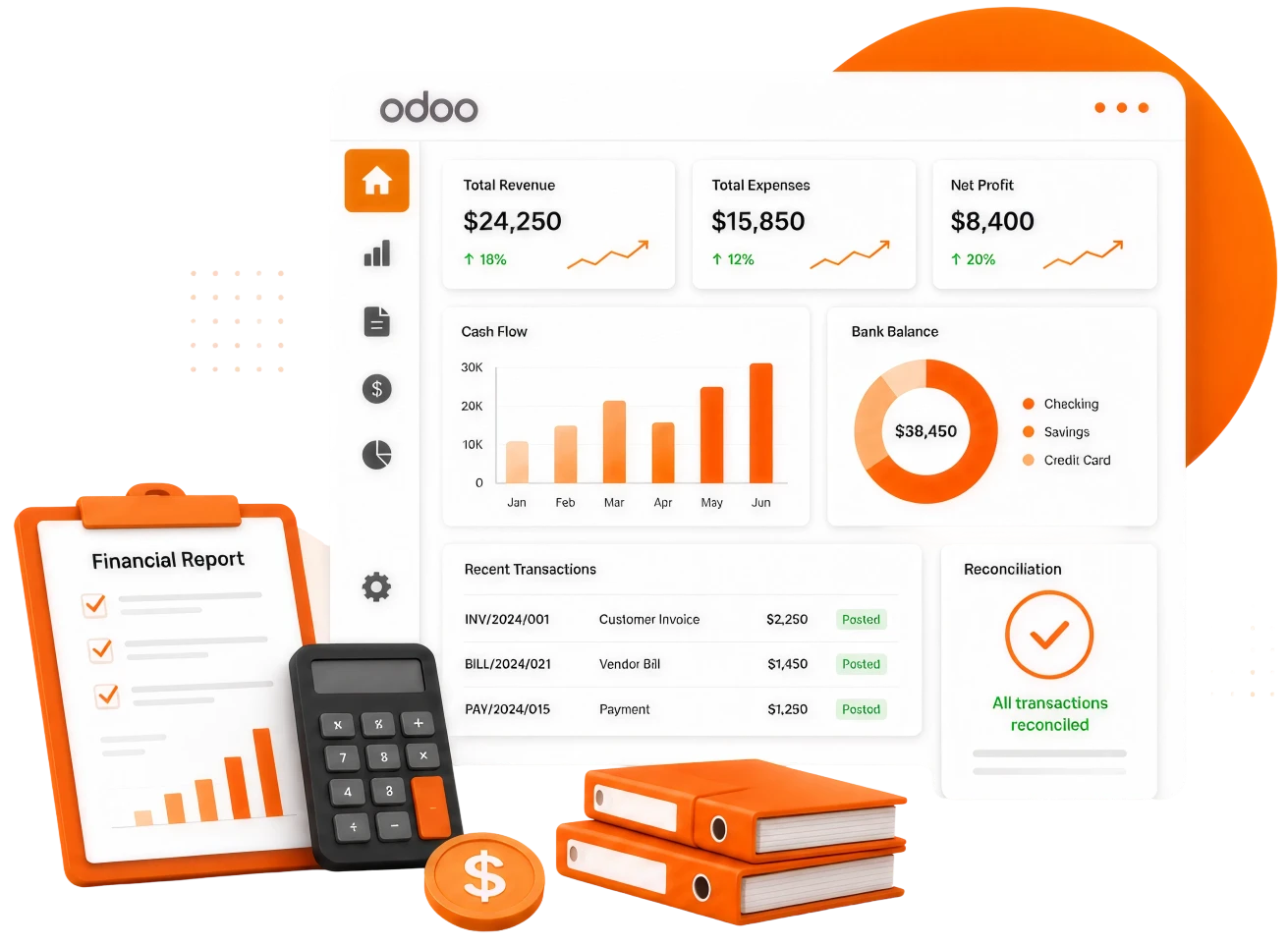

Benefits of the Odoo Accounting Module

The right accounting platform doesn't just record transactions; it actively accelerates close, improves cash flow, and gives leadership the real-time financial intelligence to make better decisions.

Faster month-end close

Automated journal posting, bank reconciliation, and intercompany matching cut the close cycle from weeks to days, giving management the numbers they need sooner.

Better cash flow management

Automated payment reminders, real-time aged debtor reports, and streamlined payment runs improve DSO and ensure cash is collected and disbursed on time.

Accurate financial data, always

Every transaction from Sales, Purchase, Inventory, and Payroll posts to the correct GL account automatically, eliminating the reconciliation gaps created by disconnected systems.

Tax compliance without the fire drill

Automated tax calculation, real-time tax return reports, and jurisdiction-specific configurations remove the last-minute scramble from every filing period.

Real-time financial visibility for management

Live P&L, balance sheet, and cash flow reports give leadership an accurate picture of financial performance today, not last week.

Reduced finance headcount requirements

Automation of invoice processing, bank reconciliation, expense management, and depreciation posting frees your finance team to focus on analysis and strategic support rather than transaction processing.

Multi-company management from one platform

Run multiple legal entities, currencies, and jurisdictions in a single Odoo instance, with consolidated group reporting available at any time.

A platform that scales with business complexity

Add new entities, currencies, tax jurisdictions, or reporting dimensions without re-implementation as your business grows.

Our Odoo Accounting Development and Implementation Process

We don't just configure a chart of accounts; we build an accounting system that fits your financial structure, compliance requirements, and reporting needs from the ground up.

Discovery and Financial Process Mapping

  • Workshops with your teams
  • Document the current workflow

Solution Design and Configuration Blueprint

  • Full accounting system design
  • Integrate with operational modules

Configuration and Custom Development

  • Standard module configuration
  • Custom financial flows

Data Migration and Opening Balances

  • Clean, validate, & migrate data
  • Ensure minimal downtime

Bank Feed and Payment Integration Setup

  • Live bank feeds
  • Payment gateway integrations

Testing and User Acceptance

  • Test accounting scenario
  • Validate before go-live

Training and Adoption Support

  • Role-based training for users
  • Quick-reference guides & process documentation

Go-Live, Hypercare, and Ongoing Support

  • Managed go-live
  • Flexible support packages

Module Compatibility

Odoo Accounting doesn't work in isolation; it works better because of what it connects to. This integrates across the Odoo ecosystem, offering a complete, real-time view of every financial transaction across the business.

Central Module

Odoo Accounting

The financial engine connected across your Odoo stack.

Odoo Sales

Confirmed sales orders generate invoices automatically. Payments received update the customer balance in real time, and revenue is recognized according to your accounting policy without manual intervention.

Odoo Purchase

Validated purchase orders flow directly into Accounts Payable as vendor bills. Three-way matching between PO, goods receipt, and invoice is automated, and payment runs are generated from a single approval screen.

Odoo Inventory

Every stock movement with a financial impact, goods receipt, delivery, adjustment, or return posts automatically to the correct inventory and cost of goods accounts, keeping stock valuation always accurate.

Odoo Payroll

Approved payroll runs post salary journals, tax liabilities, and pension contributions directly to the general ledger, eliminating manual payroll accounting entries.

Odoo Expenses

Approved employee expense reports post directly to the correct expense accounts and cost centers, with payment processing triggered automatically through the next payment run.

Odoo Subscriptions

Recurring subscription invoices and revenue recognition entries are generated and posted automatically, giving finance real-time visibility into subscription revenue without any manual billing effort.

Ready to Modernize Your Finance Function With Odoo Accounting?

Book a free consultation and we'll review your current accounting setup, identify the gaps, and show you exactly what Odoo Accounting can do for your finance function.

Industries Where Odoo Accounting Fits Best

Odoo Accounting is flexible enough to handle the financial complexity of any industry — from single-entity SMEs to multi-company groups with complex tax and consolidation requirements.

Frequently Asked Questions

A1. The Odoo Accounting module manages the full financial lifecycle, from customer invoicing, vendor bill processing, and bank reconciliation through tax compliance, financial reporting, and multi-company consolidation. Every transaction across Sales, Purchase, Inventory, Payroll, and Expenses posts to the general ledger automatically, giving finance a real-time, accurate picture of the business at all times.
A2. Unlike standalone accounting tools, Odoo Accounting is fully integrated with every operational module in the Odoo suite. There are no data exports, no third-party sync fees, and no reconciliation gaps between the operational business and the books. Every sales order, purchase order, stock movement, and payroll run posts to the correct account automatically in real time.
A3. Yes. Odoo processes transactions in any currency with automatic exchange rate updates from live feeds. Unrealized and realized foreign exchange gains and losses are calculated and posted automatically, and multi-currency bank accounts are reconciled without manual rate adjustments.
A4. Yes. Multiple legal entities can be managed within a single Odoo instance. Inter-company transactions are posted automatically to both entities, and consolidated group financial statements, such as P&L, balance sheet, and cash flow, are generated with a single report run.
A5. Bank accounts connect directly to Odoo via live bank feeds, importing transactions automatically. Odoo's AI-powered reconciliation engine matches imported bank entries to outstanding invoices, bills, and journal entries, reducing manual reconciliation to reviewing and confirming exceptions only.
A6. Yes. Odoo supports tax configuration for any jurisdiction, including VAT, GST, sales tax, withholding tax, and more. Tax is calculated automatically on every transaction, and tax return reports are generated in the correct format for your jurisdiction. Master Software Solutions configures your full tax setup as part of every implementation.
A7. A standard implementation covering chart of accounts setup, tax configuration, bank feeds, and core module integration typically takes 6 to 10 weeks. Projects with multi-company structures, complex tax jurisdictions, custom financial reports, or migration from a legacy ERP may take 10 to 20 weeks. We provide a detailed timeline at the end of the discovery phase.
A8. Master Software Solutions offers flexible post-launch support packages from ad-hoc assistance to fully managed monthly retainers with defined SLAs. All packages include access to our certified Odoo finance team for queries, period-end support, and system enhancements, plus quarterly financial process reviews to keep your accounting operation running at peak efficiency.
Contact Us - Click to open form
Restore Widget