In this competitive business landscape, decisions are not taken on intuitions or following spreadsheets. They should be organized and follow a set of rules to provide the best results. Organizations generate a large volume of data that needs to be managed and administered. Without integration solutions, it’s not possible to maintain the records, and it leads to missed opportunities, weak cash flow and inaccurate forecasting.
As businesses are evolving with technological complexity, they need real-time visibility, cross-functionality and proper analysis to keep themselves updated with the new market trends. This is where Enterprise Resource Planning (ERP) comes into play. It encapsulates the complete data of inventory, sales, finance, HR, as well as procurement in a centralized platform, to transform the data into actionable insights.
Role of informed decision-making in businesses
When it comes to informed decision-making, businesses consider comprehensive analysis, prior understanding of all financial and operational data, and keep updated with the current market trends. There should be no assumptions, no guesswork; only optimized results for value-driven outcomes.
Here is how making informed decisions helps businesses:
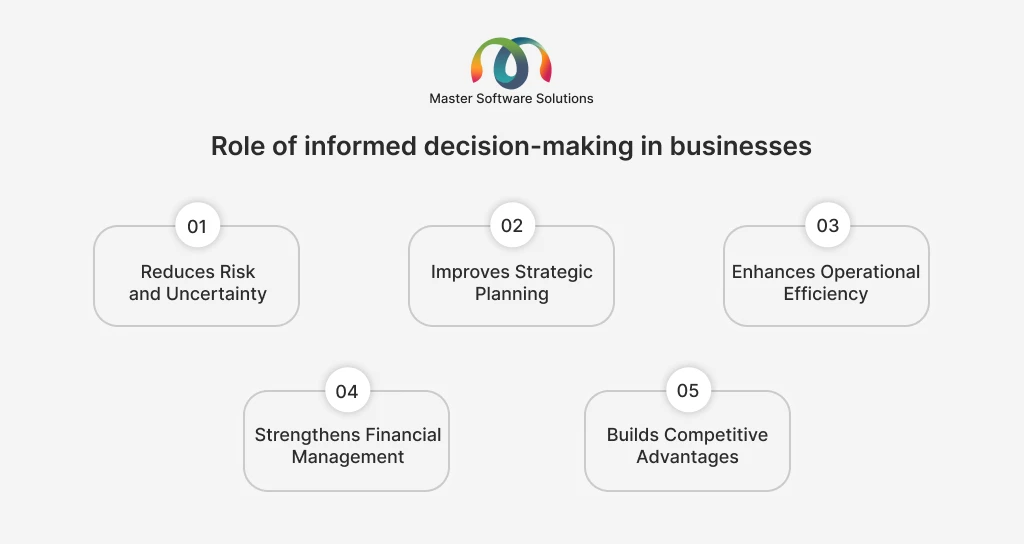
Reduces risk and uncertainty
Decisions supported by reliable data and performance metrics enable businesses to evaluate potential results more objectively and minimize costly mistakes.
Improves strategic planning
If you want to expand or scale your business strategically, it is necessary to follow the proper analysis, market trends, capabilities and operational needs to make the right decision.
Enhances operational efficiency
Accurate data-driven decisions optimize costs, inventory, and resources effectively for value-driven outcomes. This leads to enhanced productivity and improved performance.
Strengthens financial management
Following the right financial structure is important to maintain customer records, invoices, and cash flow. ERP strengthens financial management and ensures business sustainability.
Builds competitive advantages
Real-time insights enable businesses to respond faster to market changes and customer demands, gaining an edge over competitors.
Decision-making challenges in traditional systems
In a 2021 Alation report, “97% of data leaders reported that their organizations experienced negative outcomes from failing to leverage data effectively, including lost revenue opportunities, inaccurate performance forecasts, and misguided investment decisions.” Slow processes, limited information flow, and high resistance to change can hinder traditional decision-making. Key decision-making challenges many businesses face are:
Slow decision approvals
Traditional systems limit decentralized authority and real-time visibility, disrupting on-time decision-making and reducing business agility.
Information silos
Data is stored in separate systems and is not shared properly, limiting visibility of the scenario. This leads to making decisions based on incomplete information.
Human limitations
Without accurate and complete data, decisions may be influenced by personal opinions and mental shortcuts. As a result, one may agree with a group without challenging it or adhere to tried-and-true beliefs.
Slow change adaptation
Traditional systems often follow fixed plans and strict procedures. When the market changes or a new opportunity appears, the organization struggles to adjust quickly.
Systemic risk management
Businesses face complex risks such as cyberattacks or sudden market shifts. With traditional systems, it can be hard to identify how risks are connected, making it difficult to respond effectively.
How do ERP systems enable informed decision-making?
An ERP system is a centralized platform that connects all the departments in real time. Unifying all the business data helps in providing accurate data, KPIs and financial results. It helps businesses create proactive strategies in advance to avoid further consequences.
Real-time visibility
When the business data is visible in real time, it gives the team head and the employees the calculative result of their performance. This will eliminate reporting delays, identify disruptions early and make the right decisions.
Improved agility and responsiveness: Businesses get real-time data that helps in making the right decisions for further growth and productivity.
Single source of truth: There is no disconnected system to extract the data from. The ERP system provides real-time visibility for consistent, confident decision-making.
Optimized operations and inventory: When the stock is updated in a timely manner and production is preplanned, there are fewer chances of errors.
Proactive financial management: Real-time finance data helps to identify potential issues and fix them on time.
Enhanced customer experience: When customers get a real-time update of every purchase, delivery and shipping, they gain confidence and feel valued and trusted.
Advanced analytics & forecasting
Advanced analytics and forecasting play an important role in optimizing resources accordingly and increasing operational agility as per demand.
Real-time data access: Advanced analytics tools provide real-time data of all the processes from procurement to finance, enabling faster, evidence-based actions.
Predictive demand planning: By analyzing market trends and predictions, organizations can create a pre-organized plan to improve forecasting and reduce overstocking and stockouts.
Operational optimization: Every operation is optimized according to the resources to eliminate operational costs.
Enhanced customer insights: Customer behaviour plays a key role in business success. These insights help in improving services and cater to improvements for better strategies.
Cross-functional coordination
The entire data is consolidated in a single system to eliminate the gaps and maintain transparency of information. It breaks the gaps into visible operations to help businesses take proactive action.
Real-time data visibility: There is no glitch in the data as the entire process is automated to provide fast, accurate results.
Eliminates silos and ensures data integrity: Getting all departments’ data in one consolidated system mitigates data discrepancies and works on a trusted data set.
Faster, proactive decision-making: When data is clear and defined, it is easy for organizations to take the decision for newer opportunities.
Process automation and consistency: The entire process is automated to fill the data gaps and fix the risk of errors.
Predictive analytics and forecasting: ERP systems help in analyzing the previous and new data to make the decision and demand planning.
Enhanced collaboration: ERP systems create a safe, secure, and transparent environment to align a common goal set.
Risk mitigation & compliance
Implementing an ERP system replaces guesswork and spreadsheets with real-time data to maintain legal standards. Managers can easily identify risks and take proactive action.
Enhanced data accuracy: The data generated from inventory, sales, finance, reporting and analytics is accurate without any errors.
Proactive risk identification and mitigation: Real-time monitoring, audit trails, and alerts help businesses identify financial discrepancies and supply chain disruptions, and eliminate operational risks.
Streamlined compliance management: Compliance control is important for every business. The ERP system comes with built-in compliance controls, automated documentation and reporting.
Strategic planning and decision support: By analyzing the risk, it is easy to strategically plan the process to get the value-driven result.
Features to look for in a decision-driven ERP system
When choosing an ERP system for your business, it is important to understand your business goal and futuristic needs. The ERP-driven data is accurate, well defined and helps in taking actionable insights.
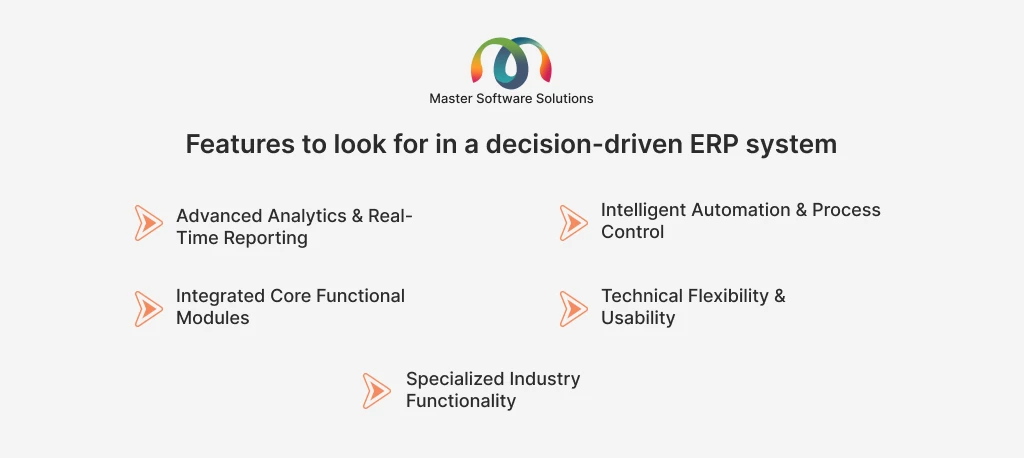
Advanced analytics & real-time reporting
Analyzing every process is time-consuming. A strong ERP system comes with inbuilt features, i.e., live dashboards, customizable reports, and drill-down capabilities. The system consolidates the entire data and generates a real-time report for strategic planning.
Intelligent automation & process control
The entire process from procurement to finance is well managed and controlled via the ERP system to get refined results. Automation helps in improving control and making the value-driven decision for business.
Integrated core functional modules
A decision-driven ERP integrates finance, inventory, sales, procurement, HR, and operations within a single system, enabling cross-functional decision-making.
Technical flexibility & usability
The ERP platform is scalable, cloud-enabled, and easy to use. Its flexible configuration, API integrations, and mobile accessibility give complete control to the IT team.
Conclusion
ERP platforms undeniably elevate decision-making, from pure intuition to data-backed informed decisions. The system prioritizes real-time visibility, data integration, data accuracy, and system flexibility, which support businesses in making informed decisions. Without informed decision-making, it is difficult for organizations to collect, store, and access information from all the business departments. If you are looking to implement an ERP system, partnering with the right ERP implementation company is critical.
Master Software Solutions is your trusted partner that provides specialized ERP consulting services that include implementation, migration, integration, development and customization. We work on different ERP platforms, that include Odoo and Microsoft Dynamics 365, that align with your business needs.
Contact our team today and get a free consultation for Odoo ERP implementation.