Operational cost is a major concern across all industries. Whether it’s labor, inventory, manual operations, or disconnected systems. Every unit has a cost that quietly drains profits. As per industry research, businesses lose 20% to 30% of revenue due to poor integration & lack of real-time visibility. Businesses still rely on spreadsheets to manage their data, which leads to delays, errors & duplication.
To fill this gap, Enterprise Resource Planning comes into play. An efficient ERP system integrates all the modules, i.e inventory, finance, HR, Reporting, sales & operations, in a single unified place in order to maintain data consistency, transparency & real time visibility.
Core ERP Modules
Here, we will understand core ERP modules that help organizations to streamline their business operations. The key modules include:
- Finance: Manages accounting, budgeting, invoicing & cash flow,
- Inventory: Tracks stock, warehouse in & out movement, and predictive forecasting.
- Procurement: Automates purchasing orders & vendor management.
- HR (Human Resources): Handles the entire HR processes
- Manufacturing: Production planning, managing Bill of Materials (BOM), MRP & quality.
- Sales & CRM: Manages customer data, order & sales.
How does ERP centralize business processes?
ERP is a centralized platform that manages all the business processes in a single database. All the data is automatically reflected via software to the team lead and employees to move with further processing. This helps reduce team workload and resource allocation
Ways ERP implementation can minimize operational costs
Here, we will understand the key ERP implementation ways that help in reducing the operational costs. Instead of manual entries, ERP offers real-time visibility of the data to reduce operational costs.
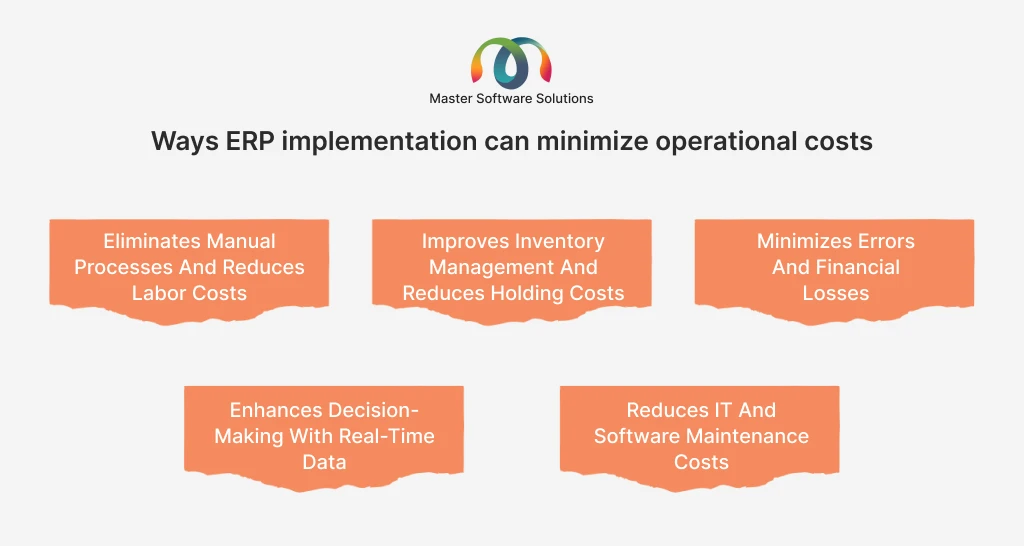
Eliminates manual processes and reduces labor costs
Teams have to fill out spreadsheets and data entries, which goes wth guesswork that is time-consuming and involves lots of human errors. ERP systems automate this functionality into a better one and create a process where all operational data is stored and provides correct, actionable insights. Organizations get stronger team hold that leads to productivity & enhanced efficiency.
Improves inventory management and reduces holding costs
Inventory is another concern that most businesses struggle with. The procurement process is initiated by poor vendor management and inconsistent pricing. This affects business productivity. With consolidated data management, businesses can structure the procurement process for improved transparency & consistency.
Minimizes errors and financial losses
When an ERP system provides accurate data insights, there will be fewer errors & financial losses. Whether it’s billing, accounting, invoicing, or reporting records, everything is managed well to fix the inaccuracies & generate accurate financial statements.
Enhances decision-making with real-time data
The real-time data of business operations strengthens decision-making. ERP systems include real-time dashboards, analytics records. Identify inefficiencies as well as provide timely insights for value-driven decisions.
Reduces IT and software maintenance costs
Most businesses use disconnected tools that automatically increase license fees, integration expenses & IT maintenance. An ERP consolidates all the processes and defines a core business goal in an integrated system that maintains cost & reduce dependency on multiple vendors.
Challenges and initial investments vs long-term savings
ERP implementation holds long-term savings that help businesses to create the strategy accordingly. The entire process includes upfront investment and organizational commitment. It’s necessary to analyze both short-term challenges as well as long-term returns to set a clear expectation.
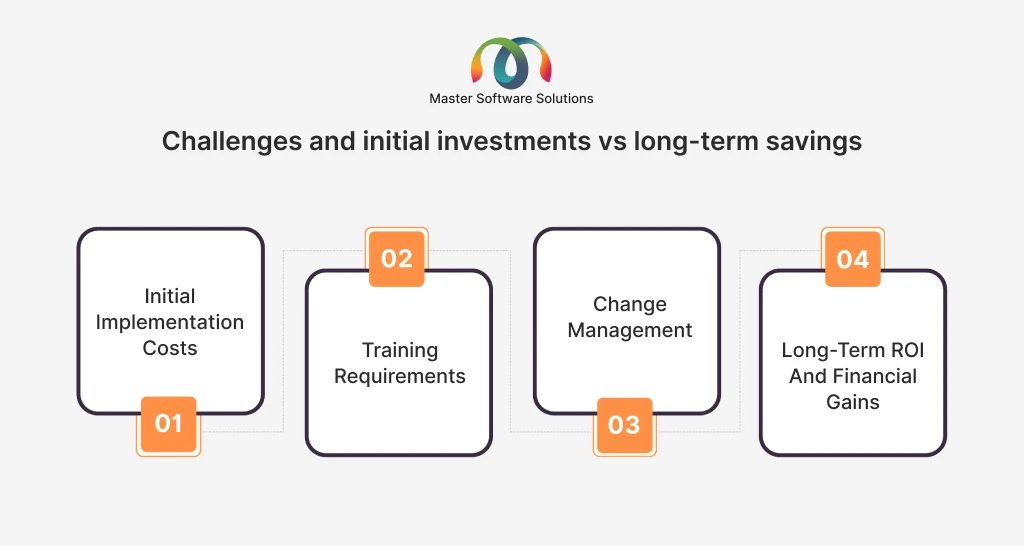
Initial implementation costs
There are a lot of parameters included in ERP implementation, including software licensing or subscription fees, system customization, data migration, infrastructure upgrades, and consulting services. According to business size & complexity, the initial implementation cost will be decided.
Training requirements
Every employee must have the proper knowledge and understanding of using ERP’s various tools & software. Training plays a paramount role in adapting to new workflows and guidelines. This will be helpful for enhanced productivity & quick realization of benefits.
Change management
ERP is an advanced approach that aligns with market trends & cultural shifts within the organization. Being resist on one parameter leads to delays & inefficiencies. Strong business leadership supports transparent communication & implements correct strategies.
Long-term ROI and financial gains
ERP integration in business operations serves long-term ROI & offers measurable returns. With time, costs will be reduced via automation, inventory control & streamlined procurement. Also, ERP delivers sustained efficiency and improved cash flow.
Want to migrate your Odoo to the newer version?
Read our blog: Cost for Odoo ERP Migration – Pricing and Estimation. This blog will help you understand migration & pricing estimation to make the right decision for your business.
Tips for successful ERP implementation to improve cost savings
Implementing an ERP system is not just a strategic move but a necessity for businesses to adapt to new market trends. Here, we will go through the tips for a successful ERP implementation to improve operational efficiency.
Choose the right ERP vendor
An experienced and right ERP consultant helps you achieve long-term cost efficiency without any future consequences. Conduct thorough research and find the appropriate vendor that meets your business needs and perspective. Firstly, understand your business and go for the one that covers all the aspects for enhanced business productivity and efficiency.
Define clear goals and KPIs
Business goals and KPI’s is the primary concern that should never be overlooked. Before implementation, establish common measurable objectives that include inventory cost, processing time, and cost reduction priorities. Define clear goals & key performance indicators to get accurate results.
Implement in phases
Never move to direct implementation. Always move step by step to eliminate the financial risk. Instead of deploying all modules at once, integrate from the basic module to fit in with your system functionality. This approach helps businesses to adopt the process gradually and identify issues early, before they become major ones.
Monitor performance and optimize continuously
It’s not that ERP is implemented and results start rolling in. After implementation, timely monitor performance metrics like processing time, transactions, and procurement costing to get the expected cost value.
Conclusion
ERP implementation is not only a technology upgrade but a strategic investment that streamlines your business productivity & lessens operational cost. By automating manual processes & integrating departments in one unified platform, ERP eliminates inefficiencies, minimizes errors & streamlines cost structure.
Master Software Solutions helps businesses design, customize, and deploy ERP solutions aligned with their operational goals. With expertise in process optimization, system integration, and scalable ERP development, their team ensures smooth implementation and maximum return on investment.