A finance team member runs accounts payable for a mid-size distributor & their ERP is already automated. When the supplier invoice arrives, the system matches it to the purchase order & goods receipt, then sends it straight to approval. For most of the month, he/she rarely touches the records.
Today, there is something different: forty-one invoices have failed to match & each failed for some reason, supplier bill shows as a separate line. Every process works as it is specified, and it does not fulfill changes per business needs. The automation is doing what it was built to do. Each invoice that comes under the matching rules was stopped because the system has no rule for these cases.
Automation handles the cases someone planned for, whereas AI-driven ERP helps with the cases nobody planned for. In this blog, we will walk through Automation ERPs & AI-driven ERPs to make the right choice as operations evolve.
What ERP Automation Means
Automation is a foundation that lets businesses get the real value before AI enters the picture. It works on a simple structure: a trigger, a filter & an action.
The trigger decides when the rule runs, such as when the record is created or updated. The filter decides which records the rule applies to, based on the conditions you set. The action is what happens next, such as updating a record or sending an email or SMS.
This structure is easy to build and works well for steps that rarely change, like approvals, reminders, stock replenishment, and status updates. But it only follows the rules written into it. It cannot predict what will happen next, and every new business condition needs a new rule.
That gap is why more businesses are moving toward AI. IDC predicts that by 2027, agentic automation will enhance capabilities in over 40% of enterprise applications. An AI-driven ERP automation applies this to daily operations, instead of waiting for a new rule.
What Makes an ERP “AI-Driven”
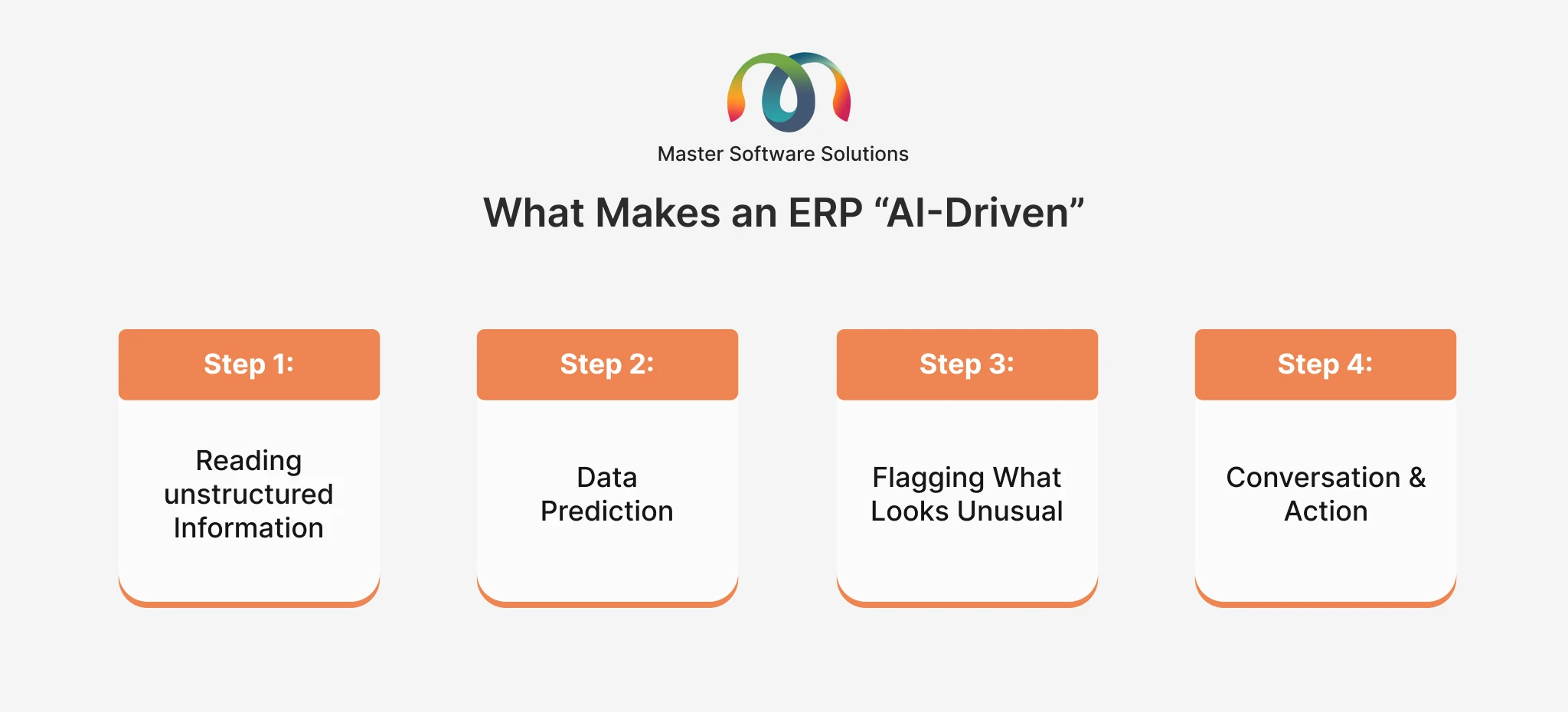
AI-driven ERP is not considered a different product with a set of records. It is an ERP where AI handles all tasks in a smarter way without any error or manual intervention. Here, we discussed some steps to ensure ERP is AI-driven.
Step 1: Reading unstructured Information
Supplier invoices, purchase orders, contracts, as well as emails come in different layouts. AI extracts & proposes how they map to ERP records, instead of relying on a template for every user.
Step 2: Data Prediction
In prediction, forecasting demand, cash flow, or stock needs from historical patterns and real-time signals goes beyond a fixed reorder point.
Step 3: Flagging What Looks Unusual
Duplicate invoices, inappropriate purchase quantities & irregular payments need human intervention. AI helps prioritize which exception to review first.
Step 4: Conversation & Action
Instead of building a report, a user asks the question in simple language & gets an answer from live data. In the Odoo 20 Accounting app, for eg, an AI agent can answer questions from the rebuilt reports
In an advanced setup, the agent goes one step further & chooses the next step, such as drafting a purchase request for approval. Odoo 20, released in September 2026, builds this advanced feature into the platform. However, users can customize records, not just answer the questions.
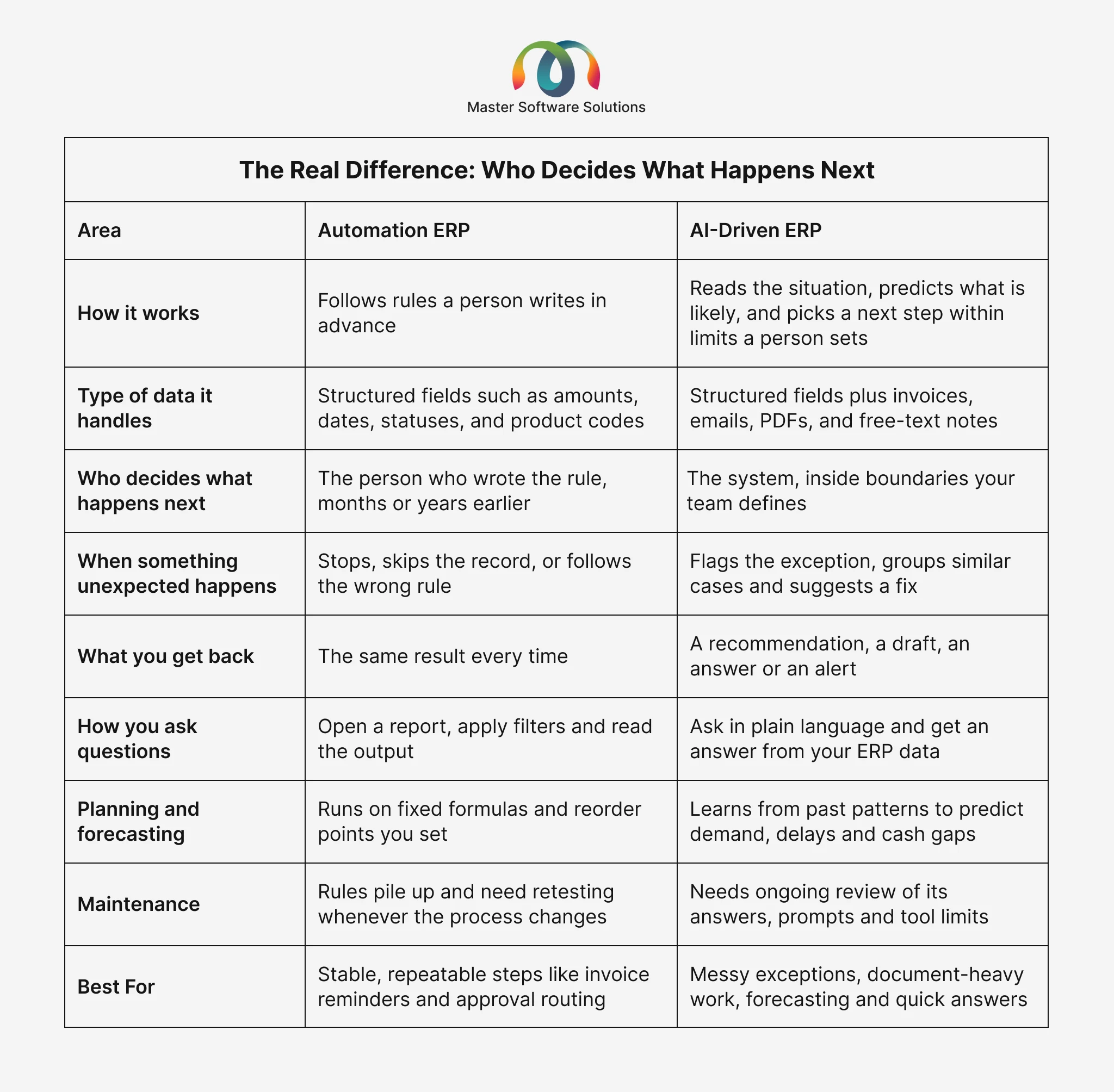
The Real Difference: Who Decides What Happens Next
In an automation ERP, a user decides in advance. Someone writes the rule, tests it, and takes responsibility for its outcome. The system never chooses. Whereas in an AI ERP software, the system chooses within the boundaries a person sets, which serve a different value.
Gartner predicts that over 40 percent of agentic AI projects will be canceled by the end of 2027, citing rising costs, unclear business value, and inadequate risk controls. It describes most current projects as early-stage experiments driven by hype, and estimates 130 out of 1000 vendors claiming agentic capabilities are real.
Where the Difference Shows Up in Daily Operations
- In inventory and purchasing, automation triggers a reorder when stock drops below a set level, whereas an AI layer moves with the demand patterns, supplier lead times, and open orders together, and flags that a product is likely to run short before the fixed threshold is reached.
- In finance, automation posts recurring entries and enforces approval limits. On the other hand, AI helps with the work around them, i.e., reading incoming documents, matching bank lines, and explaining why a number moves when a controller asks.
- In sales and customer support, automation sends a reminder when a lead is not responded for seven days. On the other side, AI reads the history, summarizes where the deal stands, and drafts a follow-up that reflects the last conversation.
- In management reporting, automation refreshes a dashboard on a schedule. However, AI answers a question nobody built a report for, such as which product lines are declining in the regions where lead times grew.
For businesses that connect external models with Odoo, it involves integrating Odoo with Claude AI & choosing between ChatGPT and Claude for Odoo, which serves the real meaning of connection & gives real-time visibility of the data.
Major Pain Points Businesses Face Today
When teams evaluate AI in ERP, the conversation rarely starts with “we want AI.” It starts with specific pain points. Here we discuss a few pain points that businesses actually face.
- Finance teams want a faster closure with less manual intervention. Whereas Operations leaders want fewer or no stockouts without hiring more planners. Everyone wants the real-time numbers to stay trustworthy & auditable.
- Businesses do not want a system that acts in a way nobody explains; they want clear recommendations they can inspect, actions that stay within permissions & a clear record of approvals.
- This is a major setback between AI & Automation. The stronger setup uses both; that includes rules that handle what is predictable & never vary, whereas AI handles interpretation, prioritization & exceptions. Humans approve anything that carries financial, legal, or customer risk.
AI Agents vs. Traditional Automation covers everything about AI & automation. For a detailed understanding of AI-Powered Odoo ERP, this reference on enterprise software helps you grasp Odoo AI, what it actually means & how it helps businesses to get consistent operational results.
What It Takes to Make AI Work Inside an ERP
AI is not a replacement; it executes tasks smartly without human intervention. AI does not fix a messy ERP. It tends to amplify what is already there. The first concern is data quality, duplicate customers, and inconsistent item codes that need to be fixed. Clearing master data before adding AI is a necessity.
Inventory comes next. If inventory lives in one system, sales in another & finance in a third, AI sees a fragment of the business. A reliable platform like Odoo, where sales, purchasing, inventory, and accounting share one database, gives AI more context to work with than a set of disconnected tools. A better understanding of how an ERP improves business operations covers the foundation & transforms businesses’ operational activities.
Conclusion
Automation and AI solve different problems. Automation makes predictable work fast and consistent. Whereas AI helps with the work that rules cannot anticipate, such as messy documents, unusual transactions, forecasts, and questions nobody builds a report for.
Businesses that get value from AI-driven ERP tend to follow the same pattern. They keep the rules where rules work, add AI where exceptions pile up, keep a person in the approval step, and measure results against a baseline.
Master Software Solutions is an Odoo Silver Partner headquartered in Toronto, Canada. It helps businesses automate Odoo workflows and add AI where it pays off, with the controls, permissions, and approval steps your finance and operations teams expect. Our team will map what to automate, what to hand to AI, and what should stay with businesses. Talk to our experts for reliable AI solutions that meet your business needs
Ready to Make Your ERP Work Smarter? Tell us your requirements & we will help you with a reliable AI solution for enhanced operational productivity.