Most retail and eCommerce businesses today sell through more than one channel, i.e., a physical store, a website and a marketplace. All these platforms are expected to show the same stock, the same prices, and the same customer information at all times.
Odoo’s POS, Inventory, and Website/eCommerce apps do connect natively, but being connected isn’t the same as being built for how your business actually sells. A default Odoo setup is designed to fit many different kinds of businesses, but it rarely matches an individual business’s pricing, products, promotions, stock across locations, or checkout. To fill this gap, Odoo ERP customization comes into play. It shapes POS, inventory, and checkout specifically around how retail and eCommerce businesses actually operate.
Where Multi-Channel Retail Breaks Down
Selling online and in-store is the easy part, but keeping stock, pricing, and orders consistent across every channel is where most teams struggle. Only 10% of retailers reported having a common order management system (OMS) for order orchestration and execution across all channels, according to RCP Retail Research — a clear gap in connecting multi-channel fulfilment operations.
- Stock is out of sync across channels. Store, website, and marketplace inventory often live in separate systems, which leads to oversells, stockouts, and hours of manual reconciliation just to figure out what’s actually in stock.
- Orders are scattered across tools. Orders arrive through WhatsApp, email, live chat, and multiple eCommerce platforms. This creates chaos between teams and leads to misaligned communication.
- Pricing and promotions are painful. Pricing and promotions are handled manually and duplicated per channel, which makes it difficult to run promotions in real time.
- Finance reconciliation eats time. Manually managing payments, refunds, and multiple gateways is time-consuming and error-prone. This stalls the finance workflow and causes delays.
- Reporting doesn’t show the full picture. Everything runs through spreadsheets, from inventory detail to reporting. Different reports are generated from multiple exports, creating confusion and never showing the complete picture.
What Odoo Customization Means for Retail & eCommerce
As the retail and eCommerce markets evolve, businesses require smarter workflows and features that help them compete. For retail and eCommerce, Odoo ERP customization services cover POS, inventory, and checkout so the system reflects real business operations.
Odoo POS Customization for Store-Specific Selling Processes
Odoo POS customization includes quick taps for important items, barcode and hardware integration, and support workflows. For businesses that offer click and collect, POS is the ideal place to manage that data from the same screen.
Odoo Inventory Customization for Multi-Store Retail Operations
Inventory customizations cover warehousing, picking, packing, shipping, and courier handoff. Multi-store retail operations can set automated reordering rules to check inventory and to flag overstock, understock, and replenishment orders.
Odoo Checkout Customization: From Cart to Payment
Odoo checkout customization works for small businesses and large organisations alike. Odoo website customization applies region-specific tax and shipping rules to simplify buying for online customers. For first-time buyers, offers and discounts can be surfaced at checkout to build confidence.
Unlock seamless POS, eCommerce, inventory, and checkout workflows with our Odoo customization services tailored to your business. Talk to our Odoo experts today.
When Retail & eCommerce Businesses Need Odoo Customization
According to Deloitte’s 2026 Global Retail Industry Outlook, 67% of retail executives surveyed expect to have AI-driven personalization capabilities within the next year, unlocking tailored experiences, targeted campaigns, and loyalty programs that adapt dynamically to each customer. Customization usually becomes necessary in the following situations.
- Expanding to new sales channels. Businesses adding marketplaces, social commerce, or other sales channels need customization to synchronize orders, products, pricing, and inventory across platforms.
- Complex promotions and loyalty programs. Retailers running promotions, loyalty programmes, gift cards, or customer-specific offers need those rules to work consistently everywhere.
- Multi-store and multi-warehouse operations. Multiple stores or warehouses need customized workflows for real-time stock visibility, inventory data, order reports, and location-specific fulfilment.
- Managing retail and wholesale customers together. Serving both retail and wholesale customers requires customized pricing, product visibility, payment terms, and order workflows.
- Region-specific tax and compliance requirements. Businesses operating across regions face different tax rules. Odoo can be configured for the right tax calculations, invoicing rules, reporting, and compliance processes.
- POS hardware and payment integrations. Connect Odoo with specific POS hardware, payment gateways, barcode scanners, or other in-store technology for real-time reporting.
Benefits of Odoo Customization for Retail & eCommerce
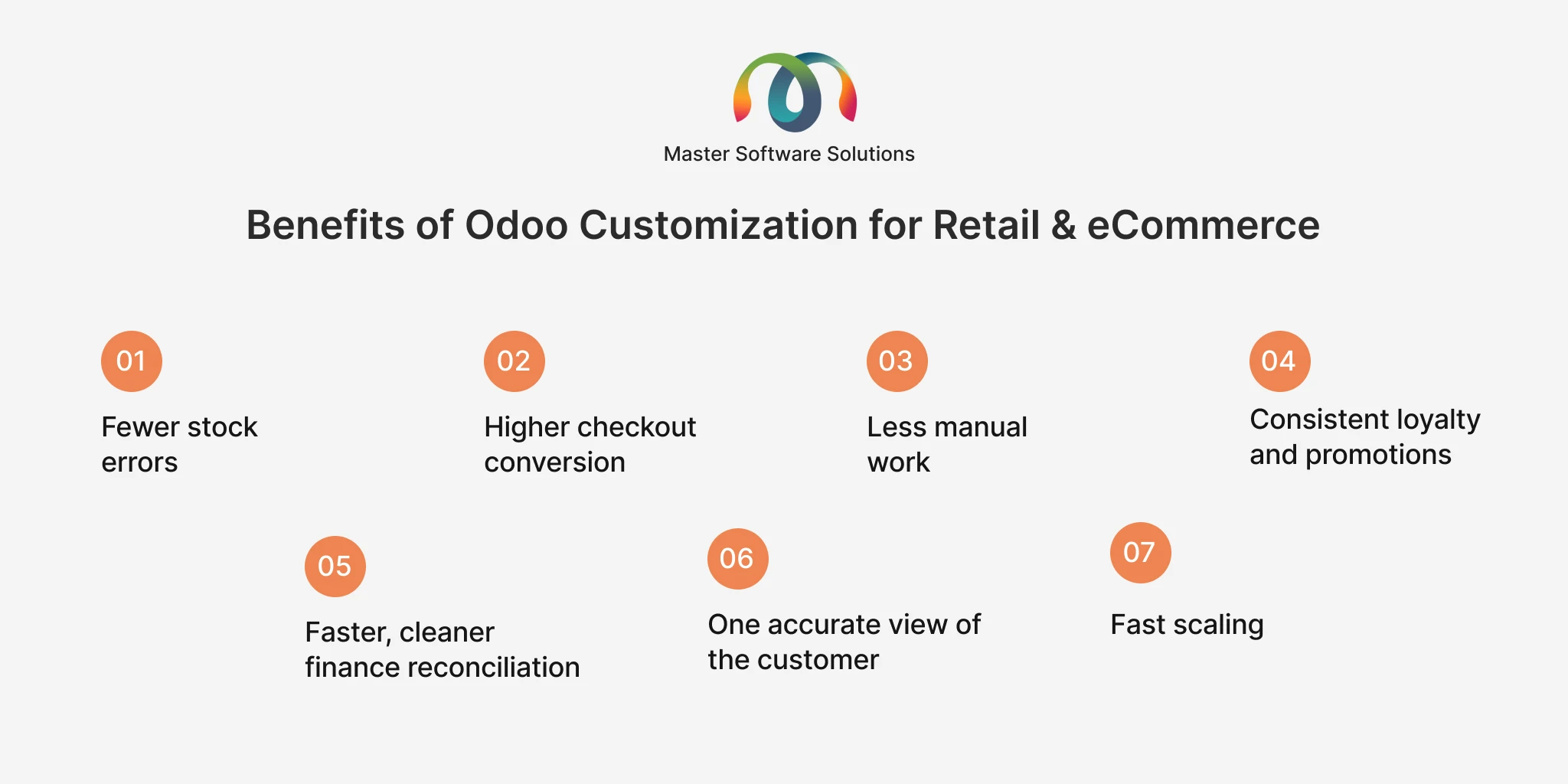
Tailoring POS, inventory, and checkout to your specific operation pays off in ways that are easy to see in day-to-day numbers:
- Fewer stock errors — a unified, real-time view of inventory across every store and channel means fewer overselling incidents.
- Higher checkout conversion — a checkout flow built around how your actual customers buy, not a generic default, reduces drop-off and gets more carts to completion.
- Less manual work — stock reconciliation and price adjustments happen automatically instead of by hand, freeing up time for higher-value tasks.
- Consistent loyalty and promotions — gift cards, loyalty points, and discounts work the same way whether a customer is at the counter or on the website, strengthening repeat business.
- Faster, cleaner finance reconciliation — payments and payouts across gateways and marketplaces match up against sales without manual cross-checking.
- One accurate view of the customer — purchase history and preferences follow the customer across channels, so staff and marketing teams work from the same data.
- Faster scaling — because customization is built around your workflows rather than a one-size-fits-all setup, the platform extends cleanly as you add new stores, channels, or product lines instead of requiring a rebuild each time.
Conclusion
Odoo gives retail and eCommerce businesses a solid foundation, but the same foundation does not suit every business. The companies that get the most out of Odoo are the ones that shape its POS, inventory, and checkout flows around every store, channel, and customer type they serve.
As a recognised Odoo silver partner, Master Software Solutions specializes in Odoo ERP customization services for retail and eCommerce businesses, tailoring POS, inventory, and checkout flows to match how your business actually operates. We have helped businesses close exactly these integration gaps. Read our case study on how we helped Aquatech solve their Odoo-WooCommerce sync issues — a real example of what proper customization looks like in practice.
Want to upgrade your Odoo with advanced features and functionality? Consult with our experts to get the right guidance and support.