Odoo is a powerful platform that brings all your business into a unified place. It comes with various modules that streamline complex workflows and simplify processes. Suppose a third-party logistics (3PL) company focuses on various work processes, including warehouse, orders, picking, packing, as well as shipping. It’s quite challenging to maintain everything simultaneously in the correct order. After giving a thought to Odoo, they were confused between customization and configuration to manage their logistics needs.
It’s important to understand your business needs rather than moving towards a random choice. The right choice leads to greater productivity focused on upgrades and futuristic outcomes, but a wrong choice ruins your business. Odoo ERP customization helps businesses meet their modern needs, whereas configuration may leave important operational requirements unresolved.
What is Odoo Customization
Odoo customization involves modifying or extending the standard Odoo functionality to support business requirements in order to compete in the competitive marketplace.
According to Mordor Intelligence, the ERP integration services market is projected to reach USD 14.45 billion in 2026, up from USD 13.28 billion in 2025, and is forecast to reach USD 24.25 billion by 2031, growing at a 10.92% CAGR from 2026 to 2031. As 3PL operations become more complex, standard ERP workflows may not always accommodate every client, warehouse, or fulfillment requirement. This significant shift is due to integrating new features and functionality, i.e Odoo customization.
Customizations are helpful for businesses to streamline their operational workflows and provide greater flexibility. Additional services include development, testing, maintenance, as well as upgrades. Move to customizations only when standard Odoo functionality cannot meet a genuine business requirement.
What is Odoo Configuration
Odoo configuration involves existing functionality and features that align with the business needs and processes without manual coding. For example, for 3PL, configurations include settings as per business logistics needs. According to their requirements, they can configure their system to set inventory rules, allow user permissions, and introduce other standard features.
Configuration is faster than customization, and it is also easy to maintain. Businesses that are looking for existing capabilities must opt for Odoo configuration.
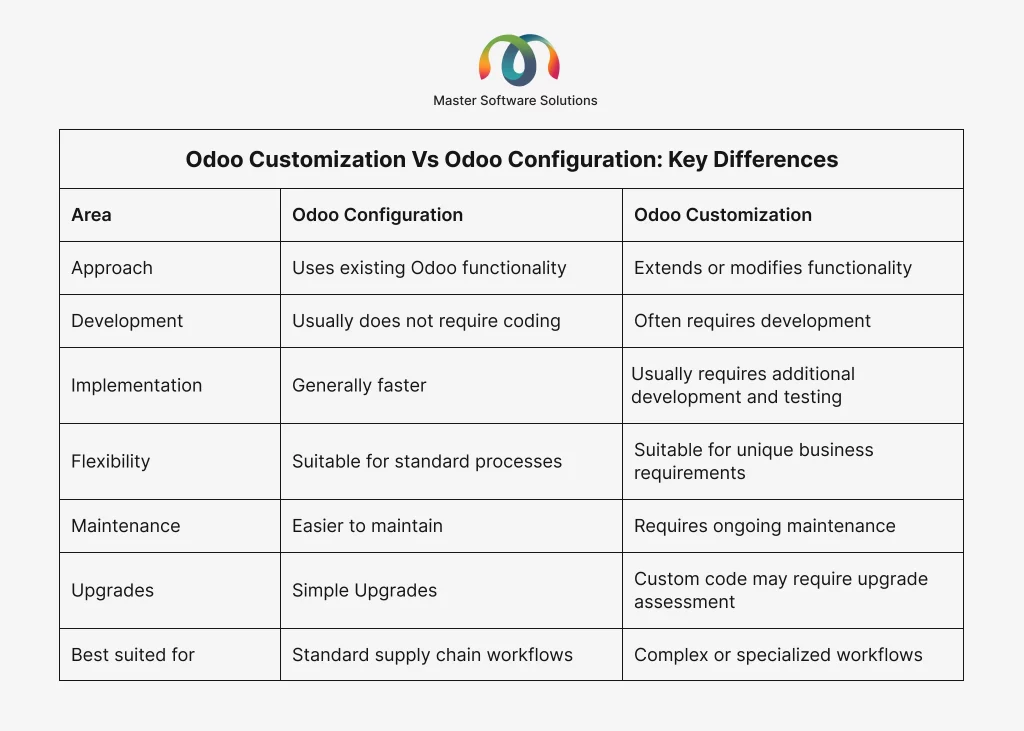
Odoo Customization vs Odoo Configuration: Key Differences
Both Odoo customization and configuration serve their own purpose. Both approaches help businesses adapt Odoo for smooth business processes.
When Does Your Business Need Odoo Customization
Odoo customization is needed when your business needs new functionality that cannot be effectively handled through standard Odoo functionality or configuration. Here, we will go through some parameters that enable businesses to shift towards Odoo customization services.
Unique Business Workflows
Every business may have processes that differ from standard Odoo workflows. When Odoo configuration does not meet modern business needs, customization plays a significant role.
Custom Fields & Features
Businesses may need additional fields, screens, or functionality to capture information that is not available in standard Odoo. This will be helpful to maintain the business information within the ERP.
Advanced Reporting
Standard Odoo reports may not always provide the exact level of information required by management. Custom reports and dashboards can combine relevant business data and present it in a format that supports specific reporting requirements.
Complex Automation
If a business needs automated actions based on specific conditions that standard Odoo automation cannot handle, custom development can introduce additional business logic and workflow automation.
Specialized Integrations
Businesses often use third-party applications alongside Odoo. When an existing connector or standard integration cannot meet a specific requirement, custom integration can enable data exchange between Odoo and external systems.
When Does Your Business Need Odoo Configuration?
Odoo configuration is the top-level approach when your business requires basic functionality. It involves adjusting existing settings and features without modifying the underlying Odoo code.
Module & Feature Configuration
Businesses can configure Odoo modules according to their requirements, including sales, accounting, inventory, manufacturing, purchase, CRM, and other business functions.
Workflow Configuration
Existing Odoo workflows can be adjusted to reflect how different business processes operate. This can include approval steps, activities, automated actions, and operational rules available within the standard platform.
User Roles & Access Rights
Odoo allows businesses to configure user roles and access permissions based on responsibilities. Employees can be given access to the information and functions required for their specific roles.
Reports & Dashboards
Standard reports and dashboards can be configured to display relevant business information. Filters, views, and available reporting options can often provide the required visibility without custom development.
Automation & Business Rules
Many repetitive activities can be automated using Odoo’s existing automation and configuration capabilities. This can reduce manual work while keeping the implementation within standard Odoo functionality.
Are you confused between Odoo customization and configuration? We are here to help you with the right Odoo implementation service to streamline your business operations.
How to Decide Between Odoo Customization and Configuration
When it comes to deciding between Odoo customization and configuration, it all depends on business requirements rather than technology. If you are confused about choosing the right option, we have covered some major points to consider.
Start With Standard Odoo Functionality
Review the relevant Odoo module and its available features before considering custom development. Sometimes, the requirement can be configured through existing Odoo rather than moving to customization.
Evaluate the Process Gap
If standard Odoo functionality can meet the requirement with appropriate settings, configuration is generally sufficient. If there is a genuine functional gap, customization may be considered.
Consider Long-Term Maintenance
Customization introduces additional development and maintenance requirements. Businesses should consider how new customization may affect future Odoo upgrades, testing, and ongoing system management.
Measure Business Value
Customization should provide a clear business benefit. If it eliminates significant manual work, improves operational accuracy, automates an important process, or provides essential functionality, the investment may be justified.
Common Mistakes Businesses Make: Odoo Customization vs Configuration
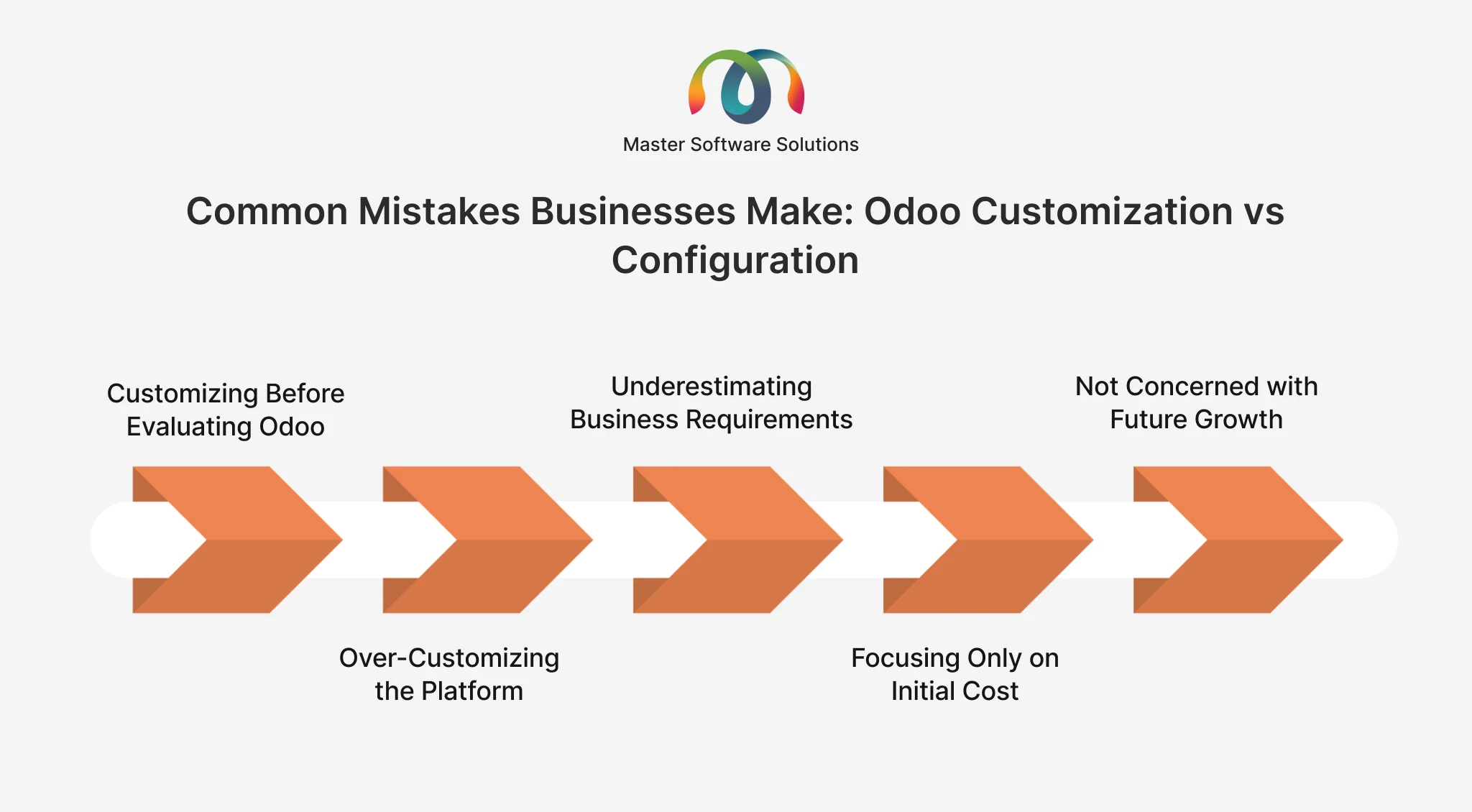
Here, we will go through some common mistakes that businesses make when choosing between Odoo customization and configuration.
Customizing Before Evaluating Odoo
One of the common mistakes is requesting custom development without first checking whether Odoo already provides the required functionality. This can increase implementation complexity unnecessarily.
Over-Customizing the Platform
Adding too many custom features can make Odoo harder to maintain and may increase the effort required during future upgrades. Go for the necessary customization that will be helpful for your business growth and productivity.
Underestimating Business Requirements
Choosing configuration or customization without clearly defining the business process can result in an ineffective implementation. Requirements should be documented before deciding on the technical approach.
Focusing Only on Initial Cost
A lower initial cost does not always mean a better implementation. Businesses should consider development, maintenance, upgrades, scalability, and long-term operational value when making the decision. Lower cost sometimes leads to greater scarcity in the future.
Not Concerned with Future Growth
The selected approach should support future changes in business processes and Odoo requirements. A solution that works today but creates significant limitations later can increase the overall cost of the ERP.
Conclusion
Odoo customization and configuration serve different purposes, and choosing between them depends on the actual business requirement. Configuration is the preferred approach when Odoo’s existing functionality can meet the requirement, while customization is appropriate when a genuine functional gap exists.
Whether you want to customize Odoo or want to introduce existing Odoo functionality in your business, Master Software Solutions is your trusted Odoo silver partner, focusing on providing Odoo customization and integration services to boost operational, sales, and customer service efficiency. Connect with our Odoo experts to get the right guidance to choose the right option.