Running an online store today means juggling product listings, inventory, payments, marketing, and customer service, often across multiple disconnected tools. Odoo Ecommerce changes that equation entirely.
As an open-source, fully integrated e-commerce platform, Odoo gives businesses a single system to build their online store and run their entire operation, from warehouse to checkout. Whether you’re a growing D2C brand, a B2B distributor, or a retailer scaling online, Odoo E-commerce deserves a close look.
In this guide, we cover Odoo E-commerce’s standout features, real-world benefits, honest pros and cons, how it compares with alternatives, and who it’s best suited for.
What Is Odoo E-commerce?
Odoo Ecommerce is the online store module within the Odoo ERP suite, one of the world’s most widely used open-source business platforms, trusted by over 15 million users globally.
Unlike standalone e-commerce tools, Odoo E-commerce is natively integrated with Odoo’s CRM, Inventory, Accounting, Marketing, and Helpdesk modules. This means that the moment a customer places an order in your store, your inventory adjusts, your accounts update, and your fulfillment team is automatically notified in real time.
This tight integration is what makes Odoo Ecommerce fundamentally different from platforms like Shopify or WooCommerce, which rely heavily on third-party plugins to achieve the same result.
Key Features of Odoo E-commerce
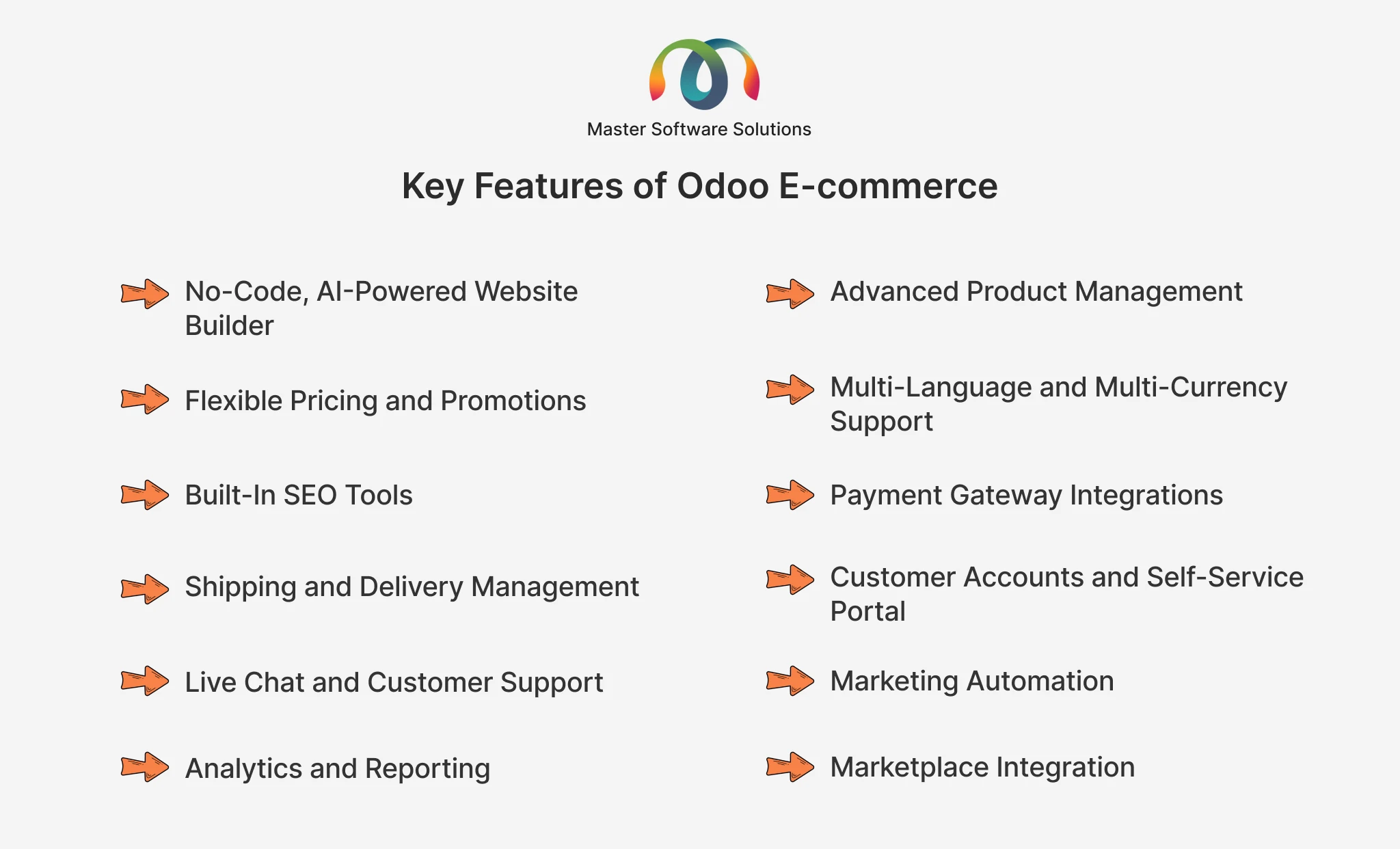
No-Code, AI-Powered Website Builder
Odoo’s drag-and-drop website builder lets you create a professional online store without writing a single line of code. In 2025–2026, Odoo added AI-based design assistance, letting you generate page layouts, product descriptions, and themes using simple prompts. Over 3 million free stock photos are available directly within the builder.
Advanced Product Management
Odoo handles complex product catalogs with ease:
- Product variants: define sizes, colors, materials, and other attributes on a single product page
- Real-time stock updates: inventory reflects every purchase instantly across all variants
- Digital & physical products: sell downloadable files, services, or physical goods on the same platform
- Upselling and cross-selling: configure recommended products to increase average order value automatically
Flexible Pricing and Promotions
Odoo’s pricelists engine is particularly powerful for B2B businesses. You can configure:
- Customer-specific pricing tiers
- Volume discounts and bulk pricing
- Time-limited promotional prices
- Coupon codes and gift cards
- Loyalty reward programs
Master Software Solutions offers a B2B Volume Based Pricing plugin that extends Odoo’s native pricing capabilities for wholesale and distribution businesses.
Multi-Language and Multi-Currency Support
Odoo Ecommerce supports cross-border selling out of the box. You can publish your store in multiple languages, display prices in local currencies, and manage different tax rules by region without additional plugins.
Built-In SEO Tools
Every product page and blog post in Odoo has native SEO controls: meta titles, descriptions, structured URLs, sitemap generation, and Open Graph tags. There’s also a built-in blog module to support content marketing. This makes Odoo a strong choice for businesses that want to grow organic traffic without relying on expensive SEO plugins.
Payment Gateway Integrations
Odoo supports a wide range of payment providers, including Stripe, PayPal, Authorize.net, Mollie, Adyen, and many more. Multi-currency payments, split payments, and deferred billing are all supported natively.
Shipping and Delivery Management
Integrate directly with carriers, including FedEx, UPS, DHL, and USPS for real-time shipping rates and label generation. Click-and-collect (buy online, pick up in-store) is also supported natively, a critical feature for omnichannel retailers.
Customer Accounts and Self-Service Portal
Customers can create accounts, view order history, track shipments, download invoices, and reorder, all from a self-service portal. This reduces support load while improving the post-purchase experience.
Live Chat and Customer Support
Odoo’s built-in Live Chat module connects directly to your storefront. Support agents can see what products a customer is viewing and proactively offer assistance. Chat transcripts are stored and linked to the customer’s CRM record.
Marketing Automation
Odoo connects your store directly to email marketing, SMS campaigns, and social media marketing — without external tools. You can segment customers based on purchase history, cart abandonment, and browsing behavior, then trigger automated sequences.
Analytics and Reporting
The built-in analytics dashboard gives you real-time visibility into revenue, conversion rates, top products, and traffic sources. Odoo integrates natively with Google Analytics as well, giving you both operational and behavioral data in one view.
Marketplace Integration
Odoo can sync with external marketplaces, including Amazon and Facebook Shops, letting you manage listings and orders from a central interface.
Benefits of Odoo E-commerce
One Unified Platform
The single greatest benefit of Odoo Ecommerce is the elimination of data silos. Sales, inventory, accounting, fulfillment, and customer support all run on the same database. There’s no middleware, no sync errors, no duplicate data entry. For growing businesses, this translates into fewer staff hours spent on administrative tasks and fewer costly mistakes.
Open Source and Cost-Effective
Odoo is open source. The Community edition is free to use, and the Enterprise edition is competitively priced compared to Shopify Plus or Magento Commerce, especially when you factor in the cost of the 50+ business apps included at no extra charge. There are no per-transaction fees.
Scalable Architecture
Odoo grows with your business. Whether you’re handling 100 orders a month or 100,000, the platform scales without requiring a platform migration. You can start with just the e-commerce module and progressively activate Inventory, Accounting, CRM, and other modules as your needs evolve.
Deep Customization
Because Odoo is open source, every aspect of the platform can be customized, including storefront design, checkout flow, pricing logic, fulfillment workflows, and reporting. This makes it an ideal choice for businesses with unique processes that off-the-shelf platforms can’t accommodate.
Ready to implement Odoo E-commerce for your business? Talk to our Odoo specialists at Master Software Solutions. We’ll help you design the right architecture and go live faster.
ERP-Grade Operations from Day One
Unlike Shopify or WooCommerce, where you’d bolt on an ERP later (at high cost and complexity), Odoo gives you ERP-grade inventory management, accounting, and procurement built in. This is especially valuable for businesses in manufacturing, distribution, and wholesale.
Odoo Ecommerce vs Competitors
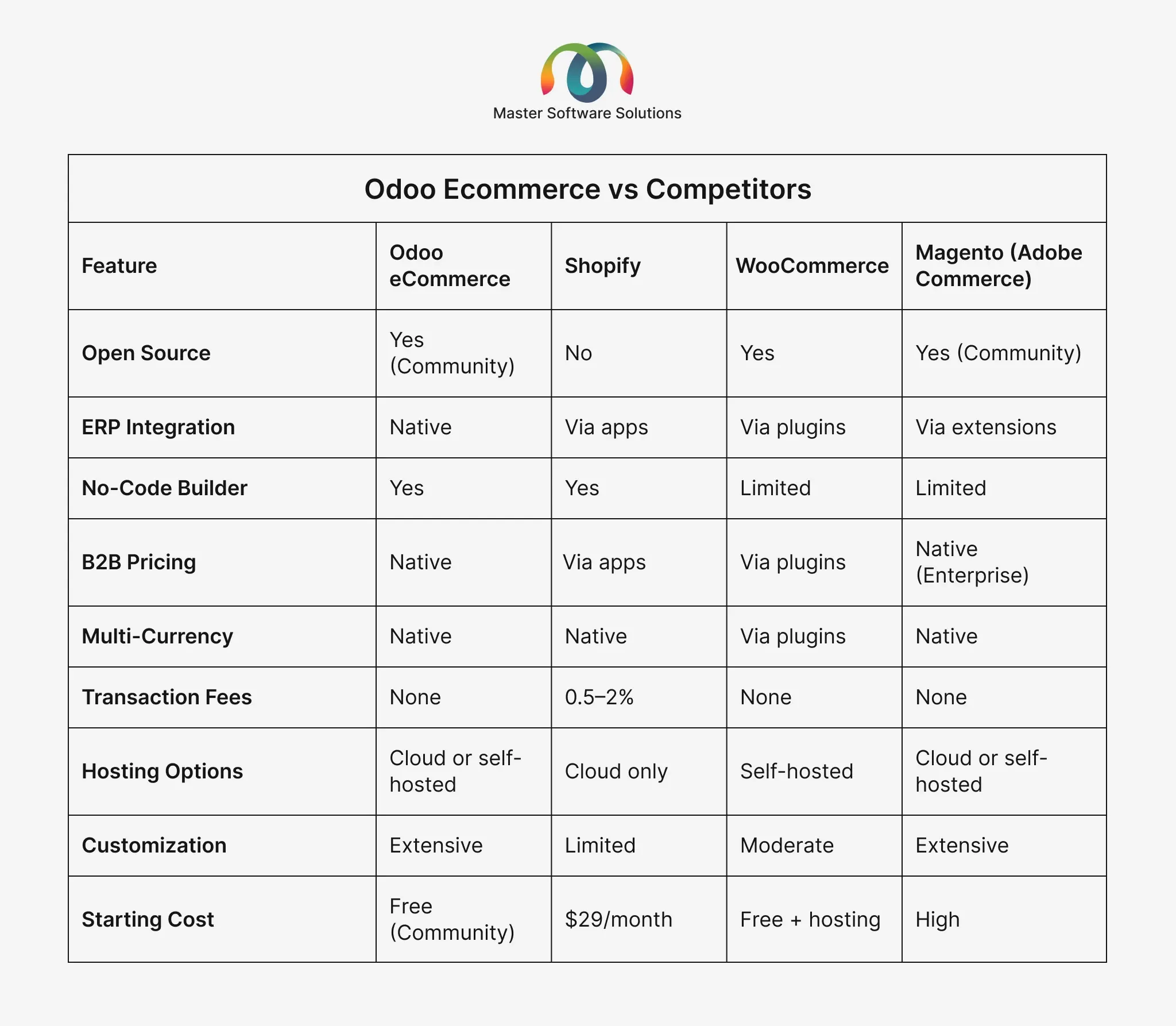
The bottom line: Odoo e-commerce is the strongest option for businesses that need a full-stack solution, including store, ERP, CRM, and marketing, on a single platform. Shopify wins on ease of setup for pure-play e-commerce. WooCommerce is good for content-first websites. Magento is powerful but expensive and complex to implement.
Odoo Ecommerce Pricing
Odoo follows a module-based pricing model:
- Community Edition: Free, self-hosted, includes the core e-commerce module
- Enterprise Edition (Odoo Online): Starts at approximately $31.10/user/month (billed annually in 2026), with hosting included
- Odoo.sh (managed cloud hosting): Starts at $50/month for a staging+production environment
There are no per-transaction fees at any tier. For most SMBs, the total cost of ownership is significantly lower than Shopify Plus when accounting for plugin costs and transaction fees.
Who Should Use Odoo Ecommerce?
Odoo e-commerce is an excellent fit for:
- B2B businesses needing customer-specific pricing, bulk ordering, and account management
- Manufacturers and distributors who need e-commerce tightly coupled with production and inventory
- Omnichannel retailers running both online and physical stores
- Fast-growing D2C brands that will eventually need ERP-level operations
- Businesses are unhappy with Shopify plugin costs and the complexity of syncing third-party tools
It may not be the best fit for solo entrepreneurs or microbusinesses looking for a quick, no-config store; Shopify or Squarespace would be simpler in that scenario.
Odoo Ecommerce: Honest Review
What We Like
Odoo’s native integration with ERP operations is genuinely unmatched at its price point. The product variant system is mature and flexible. B2B pricing capabilities are strong. The open-source model means no vendor lock-in and full customization. The pace of feature development (annual major releases) has been impressive; the AI website builder and enhanced analytics in recent versions are notable additions.
What Could Be Better
Initial setup requires technical knowledge, especially for custom workflows and theme development. The community of certified Odoo partners varies in quality. Out-of-the-box themes, while functional, can feel generic; custom design work is usually needed for a premium look. Documentation is improving but can lag behind new features.
Want to get Odoo Ecommerce right the first time? Our certified Odoo team handles implementation, customization, and ongoing support. Get in touch for a free discovery call.
How to Get Started with Odoo E-commerce
Getting up and running with Odoo E-commerce involves a few key steps:
Step 1: Define your requirements
Map out your product catalog, pricing model, payment methods, shipping regions, and integrations needed (ERP, CRM, warehouse, etc.).
Step 2: Choose your deployment model
Odoo Online (cloud SaaS), Odoo.sh (managed cloud with Git deployment), or self-hosted Community/Enterprise.
Step 3: Configure your store
Use the no-code builder to create your storefront, set up product pages, configure payment gateways, and define shipping rules.
Step 4: Integrate with your operations
Connect Odoo Ecommerce to Inventory, Accounting, and any third-party tools (ERPs, shipping carriers, marketplaces).
Step 5: Test and launch
Run end-to-end order tests, verify tax rules and payment flows, and then go live.
Working with an experienced Odoo implementation partner significantly reduces time-to-launch and avoids common configuration mistakes that are costly to unwind later.
Master Software Solutions has implemented Odoo e-commerce for businesses in retail, distribution, manufacturing, and e-commerce. Our team handles everything from initial architecture design to go-live and post-launch support. Explore our Odoo e-commerce services for your industry
Final Thoughts
Odoo Ecommerce is one of the most capable platforms available for businesses that need more than just a storefront. Its deep integration with ERP operations, open-source flexibility, and competitive pricing make it a compelling alternative to Shopify and WooCommerce, especially for businesses with complex operational needs.
The key to success with Odoo is implementation quality. The platform is powerful, but getting the most out of it requires thoughtful configuration and, often, expert customization.
Master Software Solutions is a certified Odoo partner with deep experience implementing Odoo e-commerce for businesses across industries. Whether you’re starting fresh or migrating from another platform, our team can help you build a store that scales.
Schedule a free Odoo E-commerce consultation with our team