ravi garg, master software solutions, odoo partner, top banner, usa, uk, canada, india, odoo implementation partner company, image

2012

Founded

90+

Professionals in our Team

800+

Clients Served

40+

Countries on Global Map

Common Inventory Challenges We Solve

Poor inventory management doesn't just cost you stock — it costs you customers, cash flow, and credibility. From chronic stockouts and bloated warehouse costs to picking errors and zero traceability, we identify exactly where your inventory process is breaking down and fix it with a tailored Odoo Inventory implementation.

01

No Real-Time Visibility Into Stock Levels

Teams rely on periodic stock counts, outdated spreadsheets, or gut feel to know what's in the warehouse. By the time a stockout is discovered, production has already stopped or a customer order is already late.

02

Inaccurate Stock Records

Stock on paper never matches stock on the shelf. Unrecorded movements, missing adjustments, and manual entry errors create discrepancies that compound over time, eroding trust in the system and triggering expensive emergency counts.

03

Inefficient Warehouse Picking and Putaway

Pickers walk long distances, can't find products, and fulfill orders in the wrong sequence. Without defined putaway rules and optimized pick routes, warehouse labor costs are high and order accuracy is low.

04

Stockouts That Halt Operations

Replenishment is reactive; someone notices the shelf is empty, raises a panic order, and pays premium freight. Without automated reorder rules, stockouts are a recurring crisis rather than a preventable event.

05

Excess Stock Tying Up Working Capital

Without demand-driven replenishment, procurement buys too much of the wrong things. Slow-moving stock accumulates, warehouse space is wasted, and working capital is locked in inventory that isn't selling.

06

No Lot or Serial Number Traceability

When a product recall hits or a customer complaint comes in, the team has no way to quickly identify which batches are affected, where they went, or what raw materials were used. Compliance risk is high, and resolution takes days.

Key Features of the Odoo Inventory Module

From multi-warehouse management and automated replenishment to lot traceability, the Odoo Inventory module gives your warehouse team every tool they need to run a faster, leaner, and more accurate operation.

Multi-Warehouse and Multi-Location Management

Configure unlimited warehouses, storage zones, aisles, racks, and bins. Manage stock transfers between locations, set location-specific reorder rules, and view consolidated or location-specific stock levels from a single dashboard.

Real-Time Stock Tracking

Every stock movement, including goods receipt, internal transfer, pick, pack, ship, return, or adjustment, is recorded in real time. Stock levels are always accurate and always current, with no manual updates or batch processing required.

Automated Replenishment and Reorder Rules

Set minimum and maximum stock thresholds by product, location, and warehouse. Odoo automatically generates draft purchase orders or manufacturing orders when stock falls below the reorder point, preventing stockouts without manual monitoring.

Putaway Rules and Storage Strategies

Define intelligent putaway rules that automatically direct incoming products to the correct location based on product category, supplier, or storage requirements. Reduce search time, improve space utilization, and ensure products are always where they should be.

Optimized Pick, Pack, and Ship Operations

Configure single-step, two-step, or three-step outbound workflows depending on your operation. Odoo optimizes pick routes to minimize warehouse travel time, and packing operations ensure every shipment matches the sales order before it leaves the building.

Barcode Scanning and Mobile Operations

Full barcode support for goods receipt, putaway, picking, packing, inventory adjustments, and transfers. Warehouse operatives work from mobile devices or handheld scanners, eliminating paper-based processes and reducing entry errors to near zero.

Lot and Serial Number Traceability

Assign lot numbers or serial numbers to products at any stage — receipt, production, or sale. Generate full forward and backward traceability reports in seconds, from finished goods delivery back to the originating supplier batch.

Inventory Adjustments and Cycle Counting

Perform full or partial inventory counts without stopping operations. Cycle counting schedules allow high-value or fast-moving products to be counted regularly while normal warehouse activity continues uninterrupted.

Cross-Docking and Drop Shipping

Route incoming supplier deliveries directly to outbound shipments without putting stock away. Configure drop-shipping flows where suppliers deliver directly to customers, with all movements tracked and invoiced through Odoo.

Landed Costs and Stock Valuation

Allocate freight, customs, insurance, and handling costs to incoming shipments and distribute them across product lines automatically. Supports FIFO, AVCO, and standard price valuation methods for accurate cost of goods reporting.

Inter-Company and Inter-Warehouse Transfers

Manage stock movements between warehouses, business units, or legal entities with automated transfer orders, approval workflows, and real-time stock visibility across the entire network.

Returns, Repairs, and Reverse Logistics

Process customer returns, raise quality inspection holds, and manage reverse logistics flows directly in Odoo, with every return movement tracked, valued, and linked back to the original sales order.
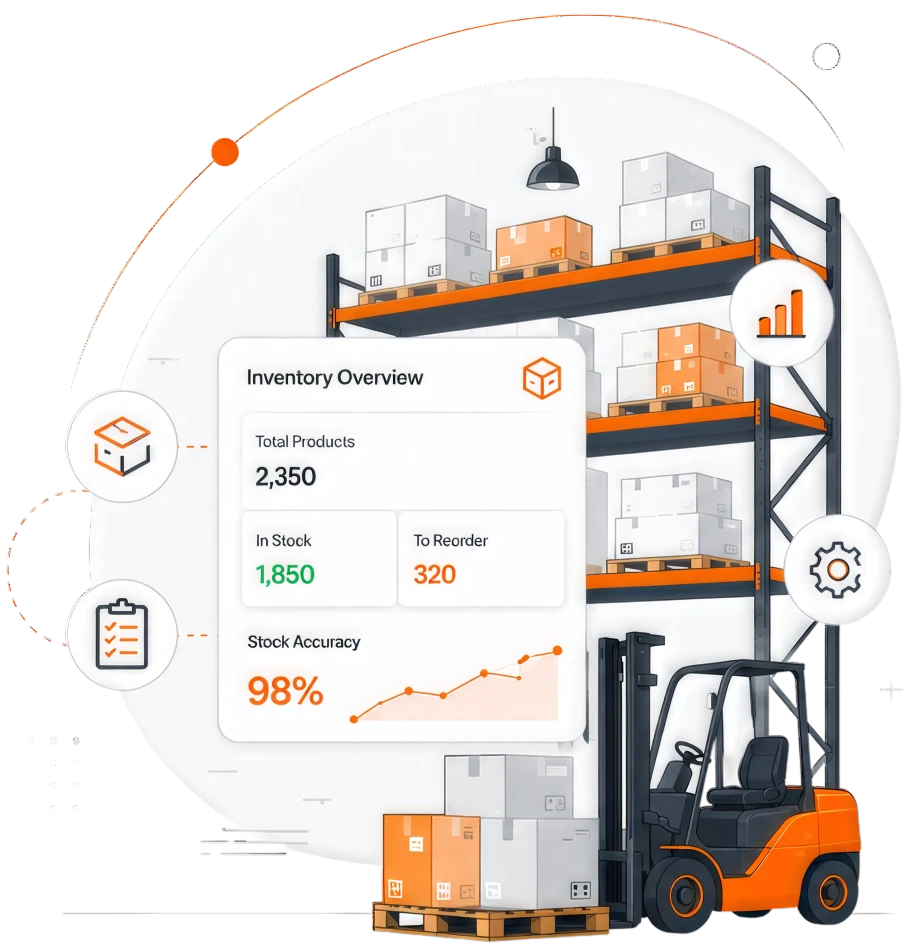

Benefits of the Odoo Inventory Module

The right inventory platform doesn't just track stock; it actively reduces costs, eliminates waste, and ensures your customers receive the right product, in the right quantity, at the right time.

Accurate stock records, always

Real-time tracking of every movement eliminates the gap between system stock and physical stock, ending the guesswork and the costly emergency counts.

Fewer stockouts and overstock situations

Automated reorder rules and demand-driven replenishment keep stock levels optimized, protecting service levels without tying up excess working capital.

Faster and more accurate order fulfillment

Optimized pick routes, barcode scanning, and structured pack-and-ship workflows cut fulfillment time and drive picking accuracy to near 100%.

Full regulatory compliance and traceability

Lot and serial number tracking enables instant recall response, batch traceability reports, and compliance with food, pharmaceutical, and manufacturing regulations.

Lower warehouse operating costs

Defined putaway rules, efficient pick paths, and cycle counting reduce labor costs and the time your team spends searching for stock.

Real-time visibility across every location

One dashboard shows consolidated stock levels, pending transfers, and replenishment alerts across every warehouse, store, and third-party location.

Tighter integration between sales, procurement, and production

Every sales order, purchase order, and manufacturing order automatically drives the right inventory movements, with no manual intervention required.

A platform that scales with growth

Add warehouses, locations, or product lines without re-implementation as your business expands.

Our Odoo Inventory Development and Implementation Process

We don't just configure a warehouse module; we build an inventory system that fits your physical operation, product mix, and fulfillment model from the ground up.

Discovery and Warehouse Process Mapping

  • On-site or virtual workshops
  • Map current operational workflows

Solution Design and Configuration Blueprint

  • Full warehouse design and setup
  • Integration with other modules

Configuration and Custom Development

  • Standard module configuration
  • Custom module development

Product and Stock Master Data Migration

  • Migrated existing data
  • Configuration and testing

Testing and User Acceptance

  • Every flow is tested and validated
  • Identify bugs

Training and Adoption Support

  • Role-based training for managers
  • Quick-reference guides & video walkthroughs

Continuous Optimization and Scaling

  • Periodic health checks and KPI reviews
  • New features, warehouses, and workflows as you grow

Go-Live, Hypercare, and Ongoing Support

  • Managed go-live with our team
  • Flexible support packages

Module Compatibility

Odoo Inventory doesn't work in isolation; it works better because of what it connects to. This connected ecosystem provides your teams with a complete, real-time view of every product at every stage.

Central Module

Odoo Inventory

The stock engine connected across your Odoo stack.

Odoo Purchase

Confirmed purchase orders automatically create incoming shipments. Goods receipts update stock levels instantly and trigger three-way matching with supplier invoices.

Odoo Sales

Confirmed sales orders generate delivery orders automatically. Real-time stock availability is visible at the point of quoting, preventing overselling and managing customer expectations accurately.

Odoo Manufacturing

Component consumption and finished goods receipts are recorded automatically as production progresses, keeping inventory accurate without manual adjustments between the shop floor and the warehouse.

Odoo Accounting

Every stock movement with a financial impact, goods receipt, delivery, adjustment, or return posts automatically to the correct inventory and cost of goods accounts in real time.

Odoo Quality

Incoming goods can be placed on quality hold before entering stock. Quality checks are triggered at defined points in the receipt or transfer flow, with non-conformances linked to the originating delivery.

Odoo Barcode App

A dedicated barcode scanning interface lets warehouse teams process receipts, transfers, picks, and adjustments from mobile devices with no desktop login required on the warehouse floor.

Ready to Get Full Control of Your Inventory With Odoo?

One warehouse or a whole distribution network, Master Software Solutions brings certified Odoo expertise to take your inventory from manual and reactive to real-time and automated.

Industries Where Odoo Inventory Fits Best

Odoo Inventory is flexible enough to handle the stock complexity of any industry, from single-location retail to multi-site distribution networks with thousands of SKUs.

Frequently Asked Questions

A1. The Odoo Inventory module is a fully integrated warehouse management solution that tracks stock in real time across multiple locations, automates replenishment, manages pick/pack/ship operations, and provides full lot and serial number traceability. It integrates natively with Purchase, Sales, Manufacturing, and Accounting, so every stock movement is reflected across the business instantly.
A2. Yes. Odoo supports unlimited warehouses, each with their own storage locations, routes, reorder rules, and transfer workflows. Inter-warehouse transfers, stock consolidation views, and location-specific reporting are all available out of the box.
A3. Yes. The Odoo Barcode app provides a dedicated mobile interface for goods receipts, putaway, picking, packing, inventory counts, and internal transfers compatible with standard barcode scanners and mobile devices. Paper-based processes are eliminated entirely.
A4. Lot and serial numbers are assigned at receipt, production, or any defined point in the workflow. Odoo maintains a complete movement history for every lot and serial number, allowing full forward and backward traceability reports to be generated in seconds, critical for product recalls and regulatory compliance.
A5. Yes. Odoo supports First In First Out (FIFO), Average Cost (AVCO), and standard price inventory valuation methods. Valuation can be set at the product category level, and all cost movements post automatically to the correct accounting journals.
A6. Reorder rules are configured by product, location, and warehouse with minimum and maximum stock thresholds. When stock falls below the reorder point, Odoo automatically generates a draft purchase order or manufacturing order, giving procurement the right information at the right time without manual stock monitoring.
A7. A standard implementation covering warehouse setup, location structure, reorder rules, and basic integrations typically takes 6 to 10 weeks. Projects involving barcode hardware setup, complex multi-warehouse configurations, or data migration from a legacy WMS may take 10 to 16 weeks. We provide a detailed timeline at the end of the discovery phase.
A8. Master Software Solutions offers flexible post-launch support packages from ad-hoc assistance to fully managed monthly retainers with defined SLAs, plus quarterly warehouse performance reviews to ensure your inventory operation continues to improve after go-live.
Contact Us - Click to open form
Restore Widget