For years, one question has followed Odoo through every boardroom conversation about ERP: Can it truly scale for large enterprises?
With Odoo 20, the answer is shifting.
This release is not simply a bundle of new features. It is a foundational shift in how Odoo approaches enterprise-grade operations: read-replica database architecture, Agentic AI capabilities, deeper query optimization, offline operational support, and a more flexible customization framework. Together, these advancements are moving Odoo into conversations once dominated exclusively by SAP S/4HANA and Oracle ERP Cloud.
For enterprises planning long-term digital transformation and for businesses already running Odoo, the question is no longer whether to pay attention to Odoo 20. It is whether you are ready to move.
Ready to future-proof your ERP? Talk to an Odoo Expert at Master Software Solutions
What Makes Odoo 20 Different: A Strategic Shift, Not Just a Version Upgrade
Previous Odoo versions focused primarily on adding modules and improving usability. Odoo 20 goes deeper. It tackles the core infrastructure challenges that have historically held Odoo back from competing in true enterprise environments:
- High-volume data processing at scale
- System performance under heavy concurrent workloads
- Distributed operations across teams, warehouses, and geographies
- AI-driven decision support embedded across business processes
- Upgrade flexibility that doesn’t punish customization
The result is a platform that functions less like a traditional ERP and more like an intelligent business operating system, one that scales alongside the organization rather than constraining it.
What makes this especially significant is that the improvements do not limit IT infrastructure. The business-level impact is visible immediately: faster dashboards for leadership, smoother transactional performance for operations, and reduced friction for customer-facing teams during peak demand.
If you are unsure that Odoo 20 is right for your business, Request a Free ERP Consultation with our Odoo experts
Breaking the Scalability Barrier: The Infrastructure Overhaul
Scalability has always been the Achilles’ heel of mid-market ERP platforms. As businesses grow, adding users, transactions, warehouses, and data, their ERP either scales with them or becomes a bottleneck.
Odoo 20 directly addresses this with infrastructure-level changes designed for enterprise environments:
What has changed at the infrastructure level:
- Horizontal scalability through read-replica database support
- Smarter ORM (Object-Relational Mapping) query execution
- Improved parallel request handling
- Better workload distribution across modules
- Reduced latency during large data operations
These are not cosmetic upgrades. For enterprises managing thousands of concurrent users, multi-warehouse ecosystems, or global supply chains, these changes translate directly into operational stability that previous versions couldn’t consistently deliver.
Instead of performance degrading linearly as complexity grows, Odoo 20 is architecturally designed to distribute workloads more efficiently and maintain stability under pressure.
Agentic AI in Odoo 20: From Rule-Based Automation to Intelligent Operations
One of the most talked-about advancements in Odoo 20 is the introduction of Agentic AI capabilities—a significant leap beyond the rule-based automation that most ERP platforms, including older Odoo versions, rely on.
What is Agentic AI in the context of ERP?
Traditional ERP automation follows fixed rules: if X happens, do Y. Agentic AI goes further. It enables:
- Context-aware decision-making based on real-time operational data
- Autonomous task execution within defined business workflows
- Predictive process optimization using historical patterns
Real-World Use Cases in Odoo 20
- Procurement: Automated purchase recommendations based on demand forecasting and supplier performance data
- Finance: AI-assisted invoice reconciliation and payment validation
- Customer Support: Intelligent ticket prioritization based on urgency, customer value, and SLA risk
- Inventory: Predictive restocking triggers to prevent stock-outs before they happen
- Manufacturing: Proactive maintenance scheduling based on production patterns
Business Impact
The shift to agentic AI means ERP is no longer just a system of record. It becomes a system of action, one that actively supports operations rather than simply documenting them. For enterprises running complex, high-volume operations, this reduces dependency on manual interventions and accelerates decision cycles across departments.
Read-Replica Database Architecture: The Game-Changer for Enterprise Performance
If there is one technical improvement in Odoo 20 that enterprise architects and IT teams need to understand, it is read-replica database support.
The Problem with Single-Database ERP Architectures
In a traditional ERP setup, a single database handles everything simultaneously:
- Transactional write operations (sales orders, approvals, payments)
- Dashboard rendering
- Reporting and analytics queries
- Search requests
- Background processing
As business activity increases, these workloads compete for the same database resources. The result is predictable: slower dashboards, delayed reporting, transaction bottlenecks, and degraded performance exactly when the business needs the system most, during peak hours.
How Read-Replica Architecture Solves This
Odoo 20 separates database responsibilities:
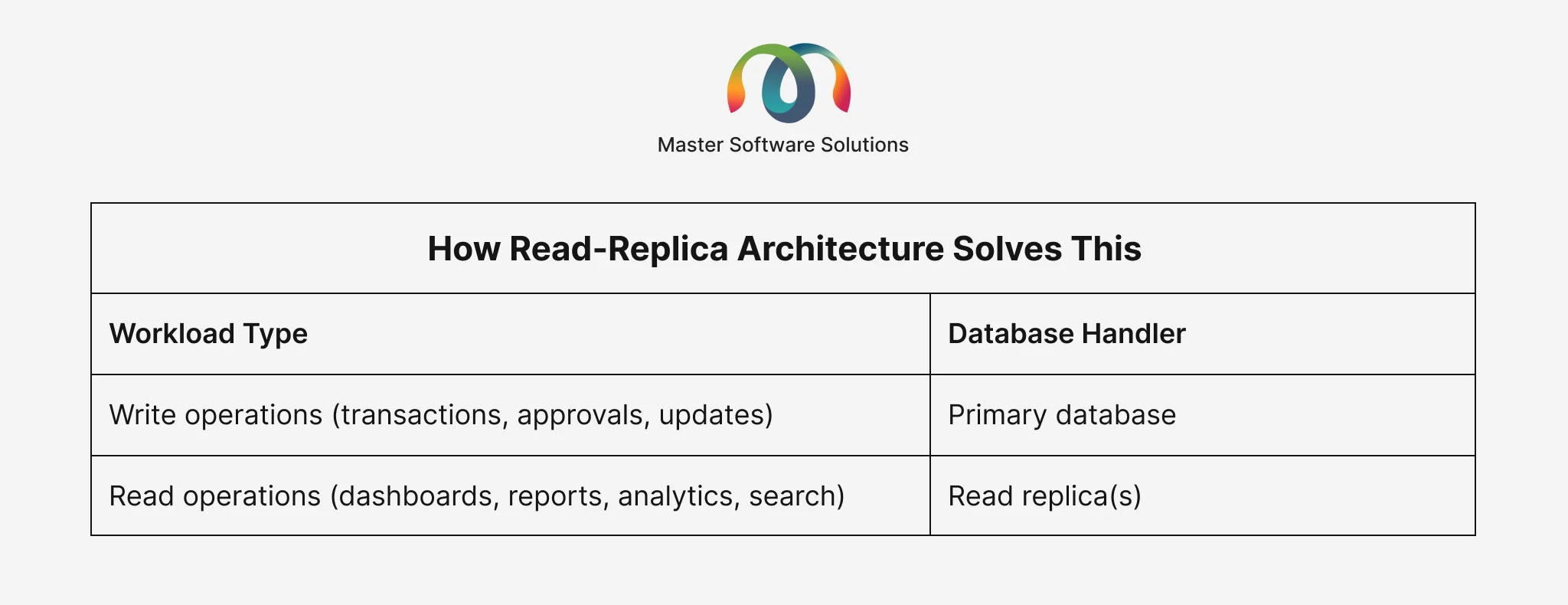
This separation dramatically reduces load on mission-critical transactional systems and improves overall responsiveness across the ERP environment.
Enterprise Benefits
- Faster dashboard and report generation, even during peak hours
- Stable transaction processing under high concurrent user load
- Better concurrency handling for large, distributed teams
- A stronger foundation for horizontal scalability as the business grows
- Reduced risk of system-wide slowdowns from reporting or analytics queries
For enterprises evaluating whether Odoo can handle enterprise scale, read-replica architecture is the single most compelling answer Odoo 20 provides.
Planning to migrate to Odoo 20? Let’s map your upgrade path. Schedule a Migration Assessment with Master Software Solutions
Speed, Performance, and Query Engine Optimization
Beyond architecture, Odoo 20 delivers a range of backend performance improvements that directly affect day-to-day user experience:
- Faster module and page loading times
- Optimized ORM query planning for better database efficiency
- Reduced bottlenecks in reporting and analytics workflows
- Improved caching for frequently accessed data
- Smoother handling of concurrent user sessions
- Smarter index utilization for faster data retrieval
- Optimized transaction handling under heavy system load
Business-Level Impact by Department
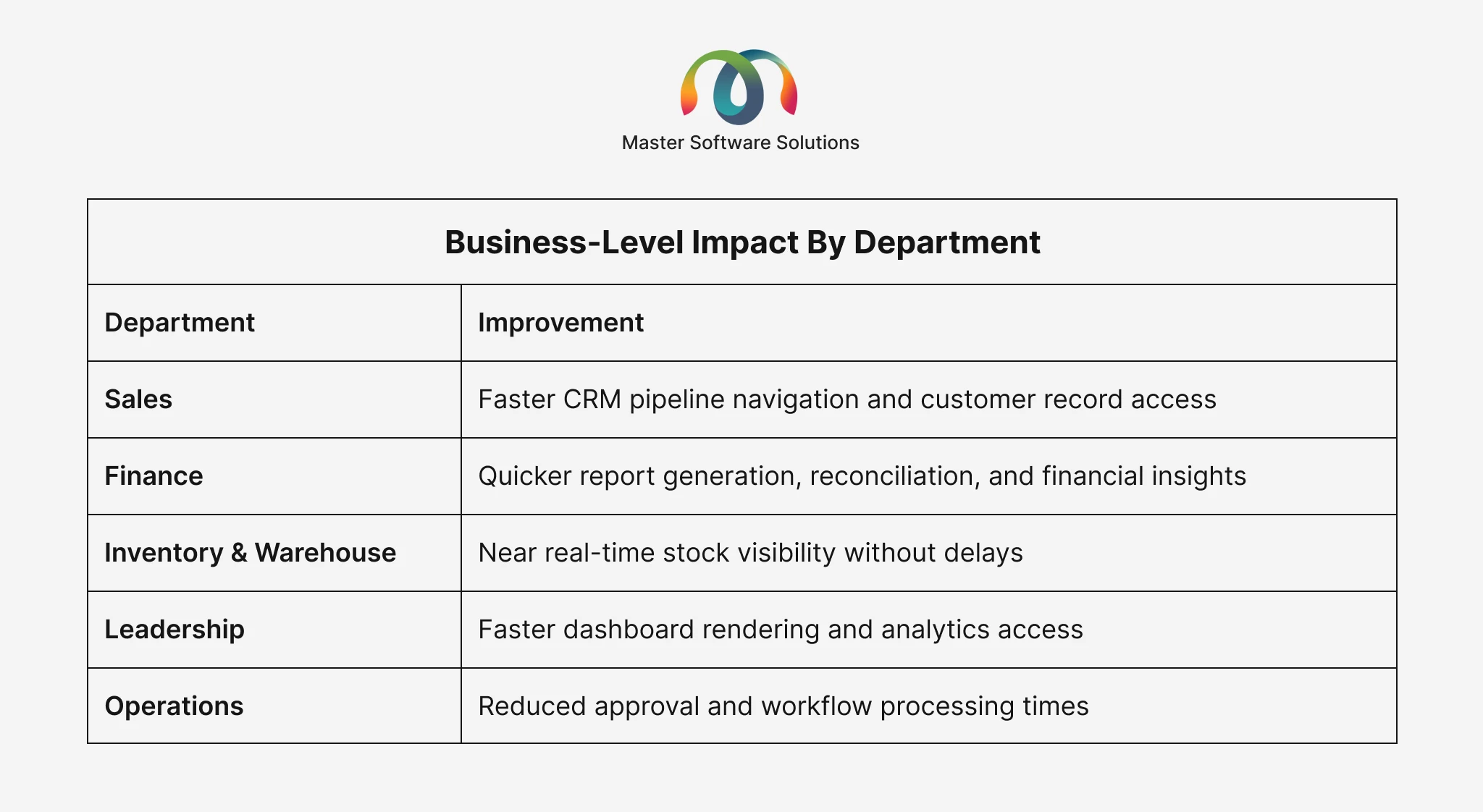
In high-volume environments, even marginal delays compound into significant inefficiencies across an 8-hour workday. The cumulative effect of Odoo 20’s performance improvements is a measurably faster, more productive ERP experience across every department.
Developer Empowerment: Improved Hooks and Customization Flexibility
Enterprises don’t run vanilla ERP. They customize, and those customizations are often the biggest source of pain during version upgrades.
Odoo 20 tackles this with a more mature and upgrade-friendly customization framework:
- Improved lifecycle hooks for cleaner, more modular module extensions
- Better separation between core and custom code, reducing conflict risk
- Enhanced compatibility for future Odoo upgrades
- Reduced migration complexity for customized environments
This matters enormously for enterprises that have delayed upgrades for years because of customization debt. Odoo 20 makes it significantly easier to build custom functionality that survives future version migrations, lowering long-term maintenance costs and reducing the technical risk of staying current.
The result: faster innovation velocity with lower maintenance burden.
Offline Capabilities: Operational Continuity for Distributed Teams
Modern enterprises don’t operate exclusively from well-connected offices. Warehouse workers, field sales teams, logistics operators, and delivery personnel often work in environments with unreliable connectivity.
Odoo 20 introduces improved offline operational capabilities, allowing critical workflows to continue without a live internet connection, syncing automatically when connectivity is restored.
This has direct implications for:
- Warehousing and logistics: Stock movements, pick/pack/ship operations, and inventory counts can proceed offline
- Field sales: Orders and customer interactions logged offline, synced on reconnection
- Manufacturing: Production orders and quality checks continue without network dependency
- Distribution: Delivery confirmations and route updates work offline
For enterprises with distributed operations, this capability removes a significant barrier to ERP adoption at the operational edge.
Odoo 20 vs. Legacy ERP: Why Enterprises Are Re-Evaluating Their Stack
Odoo 20’s advancements are prompting a genuine re-evaluation of ERP strategy at many enterprises, particularly those currently running aging SAP or Oracle deployments.
The core value proposition is compelling:
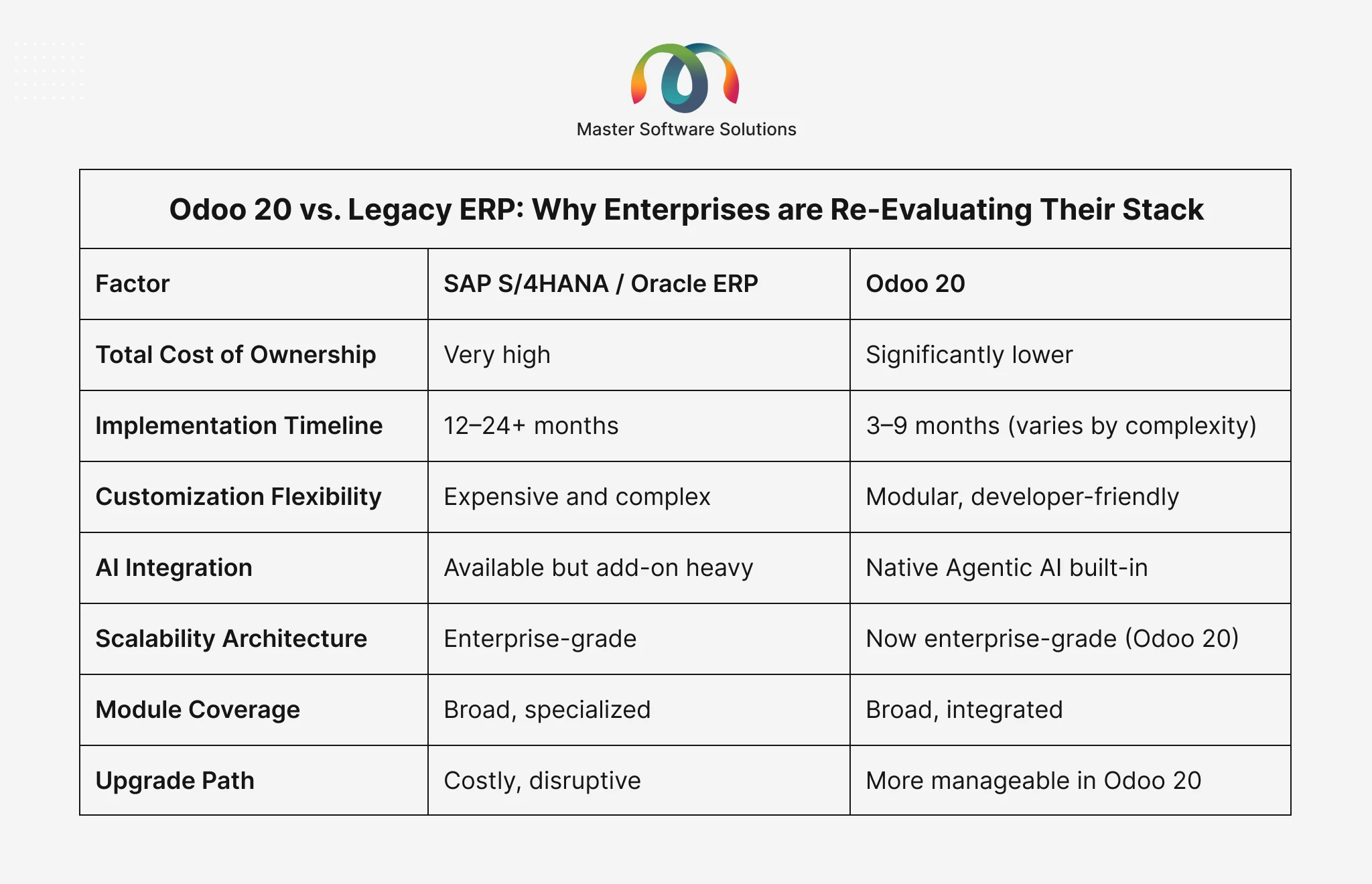
Odoo 20 does not yet match the depth of SAP or Oracle in highly specialized verticals. But for mid-market to large enterprises seeking an integrated, AI-enabled, and cost-effective ERP, one that can now genuinely scale, the calculus is shifting.
Learn more about how Odoo compares to enterprise ERP alternatives in Gartner’s ERP Market Research
Industries That Stand to Gain the Most from Odoo 20
While Odoo 20’s improvements benefit any organization, certain industries are positioned to see outsized returns:
Manufacturing
Read-replica architecture and Agentic AI make high-volume production planning, quality control, and maintenance scheduling more efficient. Offline capabilities ensure shop-floor continuity.
Logistics and Distribution
Offline operational support, real-time inventory visibility, and optimized query performance address the core operational demands of multi-location logistics networks.
Retail and E-commerce
Faster system performance during peak sales periods (holiday seasons, flash sales) and better concurrency handling for high-volume order processing.
Food and Beverage
Traceability, batch management, and compliance workflows benefit directly from the performance improvements and AI-driven automation in Odoo 20.
Professional Services
Faster project reporting, AI-assisted resource allocation, and improved CRM performance support firms managing large client portfolios.
Master Software Solutions has deep expertise in deploying Odoo across manufacturing, logistics, retail, food and beverage, and distribution industries.
Operating in one of these industries? Let’s explore what Odoo 20 can do for your specific operations. Request an Industry-Specific ERP Assessment
How to Migrate to Odoo 20: What Enterprises Need to Know
Migrating to Odoo 20 is not simply a click-to-upgrade exercise, especially for enterprises running customized environments. A structured migration approach is essential to avoid downtime, data issues, and customization conflicts.
Step 1: ERP Environment Audit
Conduct an assessment of your existing Odoo environment, such as active modules, custom developments, database dependencies, third-party integrations, and infrastructure readiness. Identify performance bottlenecks and migration risks early.
Step 2: Custom Module Compatibility Analysis
Customizations are typically the highest-risk element of any ERP upgrade. Use automated code analysis and dependency mapping to detect deprecated methods, identify compatibility issues, and ensure that custom modules are upgrade-ready.
Step 3: Data Validation and Cleansing
Before migration, run comprehensive data quality checks: identify duplicates, validate transactional accuracy, cleanse legacy data, and establish rollback protocols. Data integrity post-migration depends heavily on the quality of pre-migration data.
Step 4: Infrastructure Optimization Planning
If your organization intends to leverage Odoo 20’s read-replica architecture, plan the infrastructure changes required, including database server configuration, network topology, load balancing, and performance benchmarking.
Step 5: Staged Migration and Testing
Never migrate directly to production. Follow a controlled staging approach:
- Sandbox environment testing
- User Acceptance Testing (UAT) with business stakeholders
- Performance testing under simulated production load
- Controlled production cutover with rollback capability
Step 6: Post-Migration Support and Optimization
Migration is the beginning, not the end. Plan for a structured hypercare period post-go-live to address performance tuning, user adoption issues, and any unexpected integration behavior.
For a smooth, risk-managed migration to Odoo 20, Master Software Solutions’ Odoo Migration Services provide end-to-end support from audit to go-live.
For a deeper technical background on Odoo 20’s architecture, Odoo’s official release documentation is the authoritative reference.
Why Master Software Solutions Is Your Ideal Odoo 20 Partner
Master Software Solutions is a trusted Odoo Silver Partner with over a decade of experience implementing, customizing, and migrating Odoo ERP for businesses across manufacturing, logistics, retail, food and beverage, e-commerce, and professional services.
Founded in 2012, Master Software Solutions has served 800+ clients across 40+ countries with a team of 90+ specialized professionals. Beyond Odoo, the company brings complementary expertise in AI agent development, digital transformation, cloud-managed services, and business process automation, making
It’s uniquely positioned to help enterprises not just migrate to Odoo 20 but build an AI-ready ERP ecosystem around it.
Our Odoo Services:
- Odoo Consulting Services
- Odoo Implementation Services
- Odoo Migration Services
- Odoo Customization Services
- Odoo Integration Services
- Odoo Support and Maintenance
- Odoo Module Development
Let’s build your Odoo 20 roadmap together. Book a Free Consultation with Our Odoo Experts
Conclusion
Odoo 20 marks a genuine inflection point in the platform’s evolution. Odoo’s combination of read-replica database architecture, Agentic AI, performance optimization, offline capabilities, and developer-friendly customization tools elevates it from a compelling choice for growing businesses to a credible option for large-scale enterprises.
The question is no longer whether Odoo can scale. The question is whether your organization is ready to move and whether you have the right partner to ensure a smooth transition.
Master Software Solutions combines deep Odoo expertise with AI engineering and digital transformation capabilities to help enterprises get the most out of Odoo 20. From initial assessment through go-live and beyond, we are your end-to-end Odoo partner.
Take the first step toward a smarter, more scalable ERP. Schedule Your Free Odoo 20 Readiness Assessment Today