Quality control is one of the biggest challenges in the dairy supply chain today. Dairy products are highly perishable. Even a small quality issue can create safety risks. They can also lead to product recalls or loss of customer trust. Regulatory authorities enforce stricter food safety rules. Dairy companies must now show clear proof of quality and compliance at every stage.
The dairy supply chain is complex. Milk moves from farms to collection centers, then to processing plants, warehouses, and distributors. Each step increases the risk of contamination and spoilage. Manual processes and disconnected systems accelerate this problem. Quality issues are often found too late. This results in waste, compliance failures, and costly recalls.
Dairy businesses need better visibility and control across the supply chain. Dairy ERP software helps meet this need. It brings all quality data into one system. It tracks batches, monitors quality checks, and supports compliance. With ERP, dairy businesses can manage quality more consistently and reliably.
Understanding quality control gaps in traditional dairy operations
Many dairy businesses still rely on manual processes or disconnected systems to manage quality. These conventional methods create gaps across the supply chain. Lack of visibility, inconsistent checks, and delayed responses increase risks. Over time, these gaps lead to waste, compliance issues, and higher operational costs. Here are the quality control gaps in traditional dairy operations.
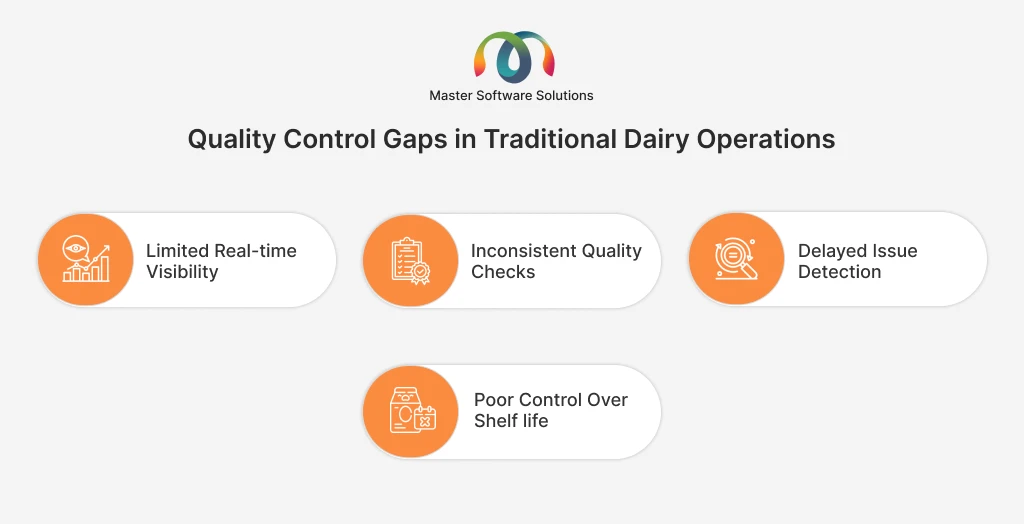
Limited real-time visibility
Traditional systems do not provide real-time data across suppliers and plants. Quality teams often work with delayed or incomplete information. This makes it hard to monitor milk quality from sourcing to distribution. Problems remain hidden until they become serious.
Inconsistent quality checks
Quality checks often vary across locations and teams. Some checks are done manually, while others are skipped due to time pressure. Documentation is not always standardized, leading to errors, missing records, and unreliable quality outcomes.
Delayed issue detection
Quality issues are usually detected after production is complete. By then, large batches may already be affected. This results in higher waste and rework. In some cases, products reach the market and trigger recalls or compliance failures.
Poor control over shelf life
Dairy products have a short shelf life. Traditional systems struggle to track expiry dates accurately. FIFO or FEFO rules are not always followed. This increases spoilage, inventory losses, and customer complaints.
What is dairy ERP software? How does it support quality management?
Dairy ERP software is designed to meet the specific needs of dairy businesses. Unlike generic systems, it supports strict quality, safety, and traceability requirements. It connects quality processes across the supply chain.
ERP software for the dairy industry considers factors such as perishability, shelf life, and regulatory compliance. Generic ERP systems do not fully support these needs. Dairy ERP focuses on quality control at every stage of operations.
Modules of a dairy ERP system that support quality management
The dairy ERP system involves multiple business modules or applications that automate and optimize end-to-end dairy processes. Here are the modules associated with quality management in the system.
Quality control (QC) module
The quality control module controls all quality checks. It defines testing parameters for raw milk, in-process products, and finished goods. Results are recorded digitally and stored centrally. This ensures consistent quality standards across all plants.
Batch and lot traceability
Batch and lot traceability tracks products from source to delivery. Each batch of milk is linked to suppliers, production runs, and shipments. This makes it easy to trace quality issues to their origin. It also enables faster and more accurate recalls.
Supplier quality management
This module tracks milk suppliers’ quality performance. It records test results, rejections, and compliance history. Poor-quality suppliers can be identified early. This helps maintain consistent raw material quality.
Inventory and shelf life control
Dairy ERP tracks expiry dates in real-time. It enforces FIFO or FEFO rules automatically. This reduces spoilage and inventory losses. It also ensures that only complaint products reach customers.
End-to-end process integration
Dairy ERP connects procurement, production, quality assurance, and logistics. Quality data flows across all departments. Teams work with the same information at all times. This integration removes data gaps and improves overall quality control.
Improving quality control at every stage of the dairy supply chain
Quality control in the dairy industry must cover every stage of the supply chain. Issues at any point can affect product safety and compliance. Dairy ERP software helps manage quality from milk collection to final delivery. It ensures consistent checks, better traceability, and faster response to problems. Here is how dairy ERP helps improve quality control.
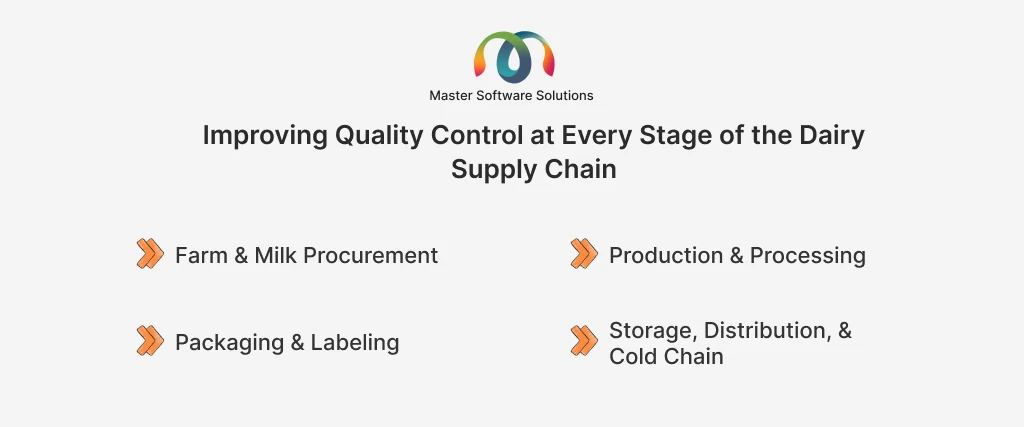
Farm and milk procurement
Quality control starts at the source. Dairy ERP captures milk quality data automatically during collection. It records parameters such as fat content, temperature, and contamination levels. The system tracks supplier compliance over time and creates performance scorecards. If milk fails to meet quality standards, the ERP system triggers rejection and corrective actions. This ensures only approved raw milk enters production.
Production and processing
During production, dairy ERP supports continuous quality monitoring. It manages in-progress quality checks and tracks process stability using standardized controls. Recipes and formulations are strictly controlled to avoid deviations. The system also helps manage allergen and contamination risks. If any quality deviation occurs, ERP sends alerts and guides corrective actions. This reduces defects, rework, and safety risks.
Packaging and labeling
Packaging is a critical quality point. Dairy ERP ensures label accuracy and regulatory compliance. It validates batch numbers, expiry dates, and product details before release. This reduces the risk of incorrect labeling. Accurate labeling also helps prevent recalls and protects brand reputation.
Storage, distribution, and cold chain
After production, ERP continues to monitor quality during storage and distribution. It tracks shelf life and automatically enforces FIFO or FEFO rules. The cold chain can be effectively managed by integrating the system with temperature and condition monitoring tools. End-to-end traceability ensures that products are tracked quickly in case of recalls. This helps dairy businesses respond faster and limit business impact.
Ways a dairy ERP system ensures end-to-end quality visibility and control
Maintaining quality across the dairy supply chain requires full visibility and strong mechanisms. Dairy ERP systems provide a centralized platform to track products, monitor quality data, and manage compliance. They help dairy businesses identify issues early and respond quickly. This reduces risk, improves accountability, and strengthens overall quality management. Here are the ways a dairy ERP system ensures end-to-end quality visibility and control.
Real-time traceability and recall readiness
Dairy ERP systems provide complete lot and batch traceability across the supply chain. Each batch of milk and finished product is linked to suppliers, production runs, storage locations, and shipments. This allows quality teams to trace issues back to their source within minutes. Faster root cause analysis helps prevent repeated quality failures. In the case of a recall, ERP limits the recall scope to affected batches only. This reduces financial losses, protects brand reputation, and ensures customer safety. The system also maintains accurate traceability records that are ready for audits at any time.
Data-driven quality decisions
Dairy ERP systems collect quality data from all operational stages. This data is displayed through real-time dashboards and quality KPIs. Teams can track defect spoilage and non-conformances easily. ERP analytics highlight trends and recurring issues over time. Predictive insights help identify potential quality risks before they escalate. With accurate and timely data, dairy businesses can make informed decisions and continuously improve quality performance.
Regulatory compliance & quality standards
Dairy ERP systems support compliance with food safety and quality standards such as FSMA, FSSAI, ISO, HACCP, GMP, and regional regulations. The system enforces standardized quality processes across locations. It automatically records inspections, test results, and approvals. Audit trails are maintained without manual effort. Regulatory reports can be generated quickly during inspections. This reduces compliance risk and lowers the time and cost of audits.
Business benefits of implementing dairy ERP for quality control
Dairy ERP systems do more than improve quality checks and compliance. They also deliver measurable business value across operations. Reducing errors, improving accountability, and optimizing processes, ERP systems support long-term growth. Benefits of implementing dairy ERP for quality control.
Reduced waste and rework
Quality issues often lead to product waste and reprocessing. Dairy ERP systems help detect quality deviations early. This prevents large batches from being affected. Standardized quality checks reduce production errors. Better shelf-life tracking also reduces spoilage. Together, these controls significantly lower waste and rework costs.
Improved supplier accountability
Dairy ERP systems track supplier quality performance over time. Milk quality data is recorded for every delivery. The system highlights consistent quality issues and non-compliance. Supplier scorecards help identify reliable suppliers. This encourages better quality practices at the source and strengthens supplier relationships.
Higher customer trust and brand reputation
Consistent product quality builds customer confidence. Dairy ERP systems ensure products meet safety and labeling standards. Accurate traceability supports quick and controlled recalls when needed. Fewer quality incidents protect brand image. Over time, reliable quality strengthens customer loyalty and market reputation.
Lower operational and compliance costs
Manual quality processes require more time and labor. Dairy ERP systems automate quality checks and documentation. This reduces administrative effort and errors. Faster audits lower compliance costs. Early issue detection also avoids expensive recalls and penalties.
Scalable quality processes for business growth
As dairy businesses grow, quality complexity increases. Dairy ERP systems support multiple plants, products, and markets. Quality rules and standards can be applied consistently across operations. The system adapts easily to new regulations and volumes. This allows companies to scale without compromising quality control.
Choosing the right ERP system for quality-driven supply chains
Selecting the right ERP system is critical for maintaining strong quality control in the dairy supply chain. Not all ERP solutions are designed to handle ERP-specific challenges. A well-chosen dairy ERP supports compliance, traceability, and consistent quality processes. It also ensures long-term scalability and operational stability. Factors to consider when choosing the right dairy ERP software.
Key quality features to evaluate
The ERP must include strong quality management capabilities. It should support raw milk testing, in-progress checks, and finished goods inspection. Batch and traceability should be built into every transaction. The system must also support shelf-life tracking and FIFO or FEFO rules. Real-time alerts for quality deviations are essential. These features ensure quality issues are detected early and managed effectively.
Industry-specific dairy customization
Dairy operations have unique requirements that generic ERP systems often fail to address. The ERP should support perishability, variable milk composition, and yield management. It should handle dairy recipes, formulations, and co-products accurately. Regulatory requirements specific to dairy must be built into the system. Industry-specific customization ensures quality processes match real operational needs.
Integration with lab equipment and IoT systems
Quality data must be accurate and timely. This reduces manual data entry and errors. Integration with IoT devices supports temperature and cold-chain monitoring. Real-time data from these systems improves visibility and strengthens quality control across storage and distribution.
Implementation and change management
Successful ERP adoption depends on proper implementation planning. Quality teams, production staff, and suppliers must be involved early. The system should be easy to use to encourage adoption. Clear training programs help teams follow standardized quality processes. Strong change management ensures the ERP system delivers consistent quality improvements and long-term value.
Bottom-line
Quality control requires end-to-end visibility, real-time data, and strong process control across the entire dairy supply chain. A purpose-built dairy ERP system helps businesses manage quality consistently, reduce risk, and stay compliant while improving operational efficiency.
Master Software Solutions helps dairy businesses achieve these goals through tailored ERP solutions and end-to-end ERP implementation services. MSS works closely with dairy processors to understand their quality challenges, operational workflows, and regulatory needs. From system design and customization to deployment, training, and ongoing support, we ensure smooth ERP adoption with measurable quality improvements.
We built custom dairy ERP solutions on robust platforms such as Odoo and Microsoft Dynamics 365. These platforms provide the flexibility, scalability, and integration capabilities required for modern dairy operations. Customizing these ERP systems for dairy systems for dairy-specific processes, we enable better traceability, stronger quality control, and improved decision-making across the supply chain.
If you are looking to improve quality control, reduce compliance risk, and gain full visibility across your dairy operations, contact us today.