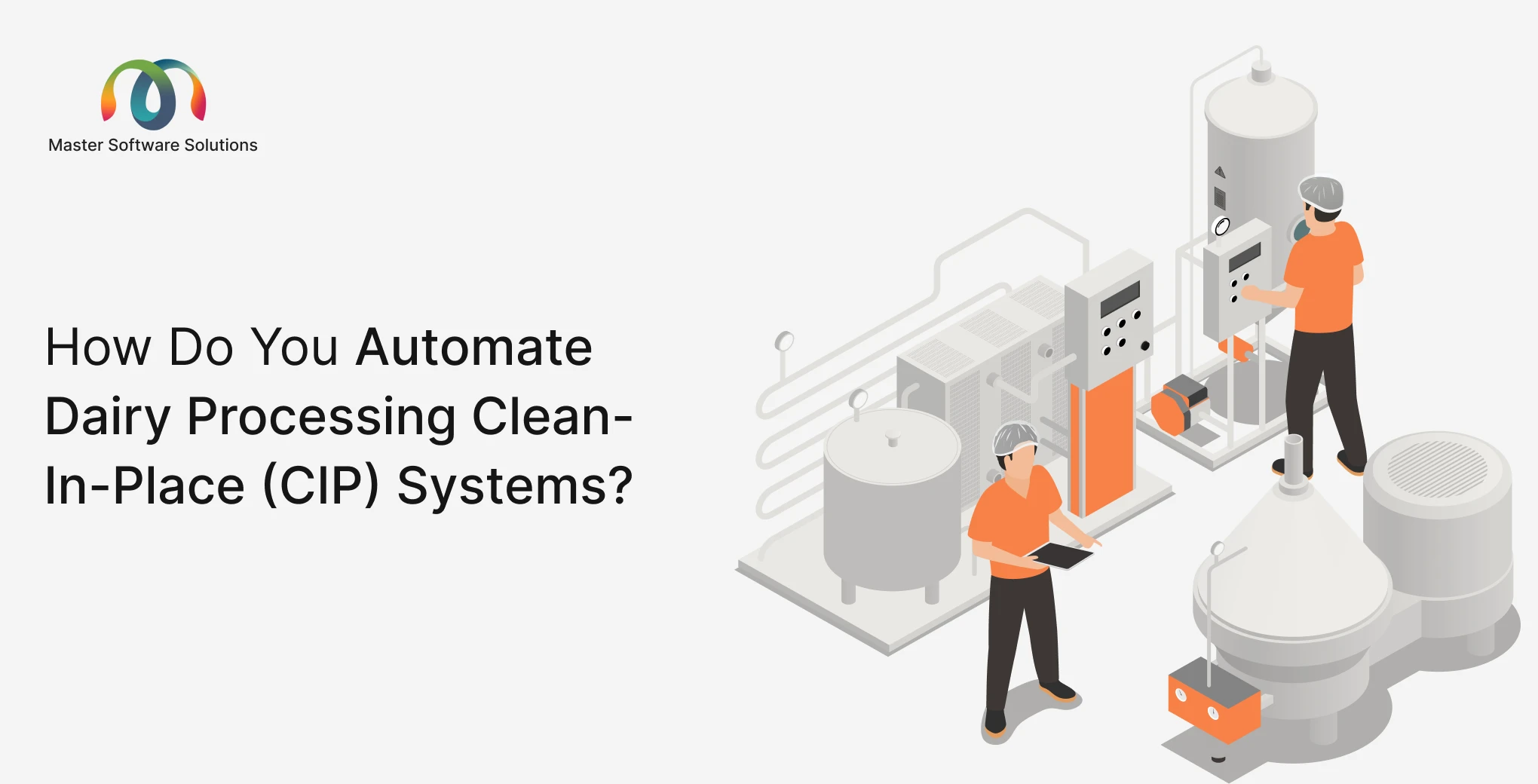
Dairy processing plants run on one non-negotiable rule: clean equipment equals safe product. Yet cleaning is also one of the most resource-intensive activities in any dairy facility, consuming water, chemicals, energy, and hours of manual labor every single day. Clean-In-Place (CIP) systems were designed to solve that. But manual CIP, even when using a CIP skid, still depends heavily on human judgment, timing, and consistency.
That’s where automation changes everything.
In this guide, we break down how dairy plants are automating CIP systems using PLCs, SCADA, IoT sensors, and ERP integration, and why it’s becoming a competitive necessity in 2026.
What Is a Clean-In-Place (CIP) System in Dairy Processing?
A CIP system cleans the interior surfaces of dairy processing equipment, including tanks, pipelines, heat exchangers, valves, and filling lines, without dismantling them. Specially formulated cleaning solutions circulate at high velocity through the equipment, combining mechanical action, heat, and chemical concentration to remove milk residues, biofilms, and microbial contamination.
A standard CIP cycle typically includes these phases:
- Pre-rinse: Cold or warm water flushes loose residues from surfaces
- Caustic wash: Hot alkaline solution (typically 0.5–2% NaOH) removes protein and fat deposits
- Intermediate rinse: Water flush removes caustic residue
- Acid wash: Removes mineral scale and neutralizes alkalinity
- Final rinse: Clean water restores the system to a production-ready state
- Sanitization: Chemical or hot water sanitizers eliminate residual microorganisms
Dairy facilities typically run full CIP cycles every 24–48 hours, with many high-volume plants cleaning after every production shift, sometimes two to three times per day.
The challenge? Every cycle must meet strict parameters: the right temperature, the right chemical concentration, the right flow velocity, and the right contact time. Miss one, and you risk product contamination, regulatory non-compliance, or wasted resources running an ineffective clean.
Why Automate CIP Systems in Dairy Plants?
Manual CIP introduces variability at every step. Operators may measure chemicals imprecisely, misjudge temperatures, or cut cycles short under production pressure. These inconsistencies create both safety and compliance risks.
Automated CIP systems eliminate that variability by controlling every parameter with precision. Here’s what’s at stake:
- Consistency and food safety: Automated systems execute the same validated cleaning sequence every time, regardless of shift, operator, or production volume. This directly reduces contamination risk.
- Regulatory compliance: FDA 21 CFR Part 11, 3-A Sanitary Standards, and EU food hygiene regulations require documented, verifiable cleaning records. Automated systems generate this data automatically.
- Resource efficiency: Studies show automated CIP reduces water consumption by 20–30% and chemical usage by 15–25% versus manual processes by eliminating over-dosing and unnecessary cycle repetitions.
- Production uptime: Automated cycles run faster and more predictably, reducing equipment downtime between production runs.
- Traceability: Every parameter of every cycle is logged with timestamps, making batch-level traceability straightforward for audits and recalls.
Ready to automate your dairy operations end-to-end? Explore Master Software Solutions’ Business Process Automation Services
Core Components of an Automated Dairy CIP System
Automating a CIP system is not a single technology — it’s an integrated stack of hardware, control software, and data infrastructure working in concert.
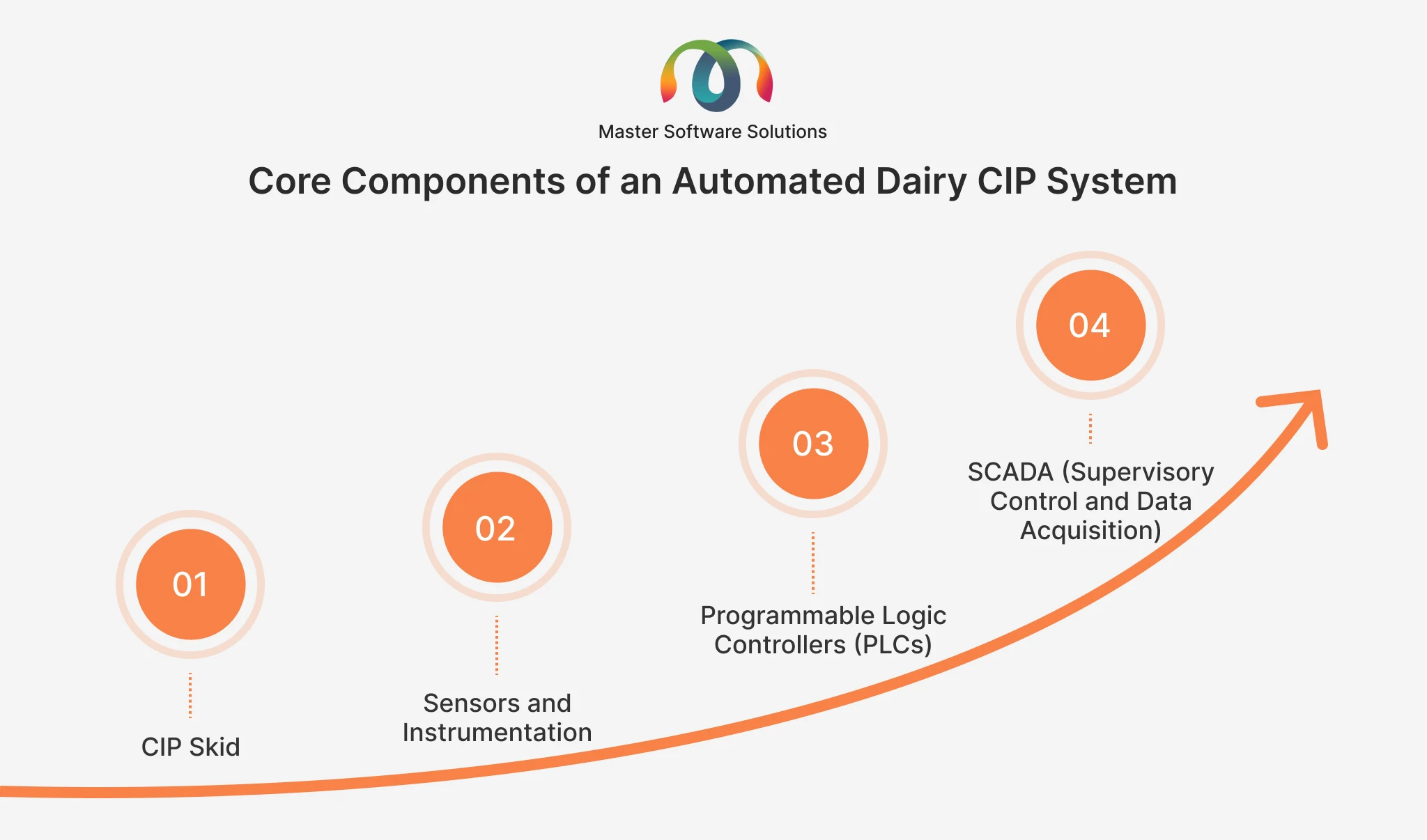
CIP Skid
The CIP skid is the physical hub of the system. It houses the chemical storage tanks (caustic, acid, and sanitant), return tanks, heat exchangers, pumps, and dosing units. In an automated setup, the skid’s components are controlled by actuators that receive commands from the PLC rather than manual valve operation.
Sensors and Instrumentation
Sensors are the nervous system of automated CIP. Key measurements include the following:
- Temperature sensors (RTDs/thermocouples): Monitor solution temperature in real time to ensure the thermal requirement (typically 70–85°C for caustic wash) is met and maintained throughout the cycle
- Conductivity sensors: Measure chemical concentration continuously, enabling the system to dose precisely and confirm when rinse water has reached acceptable purity levels
- Flow meters: Verify the minimum turbulence velocity (typically 1.5–2.0 m/s) needed for effective mechanical cleaning action
- pH sensors: Cross-verify alkalinity/acidity of cleaning solutions
- Pressure sensors: Detect blockages or pressure drops that indicate equipment issues
- Level sensors: Monitor tank levels to prevent pump cavitation and optimize chemical usage.
Programmable Logic Controllers (PLCs)
The PLC is the brain of the CIP automation system. It executes the cleaning program by controlling valves, pumps, heat exchangers, and dosing systems based on predefined sequences and real-time sensor feedback.
PLCs offer several key automation capabilities:
- Sequential control: Executing multi-step CIP phases in the correct order with precise timing
- Conditional logic: Advancing to the next phase only when sensor data confirms the current phase requirements are met (e.g., conductivity confirms correct chemical concentration before starting the wash phase)
- Alarm management: Triggering alerts if any parameter falls out of range
- Recipe management: Storing multiple CIP programs for different equipment types (e.g., pasteurizer circuits vs. storage tanks vs. filling lines)
Major PLC platforms used in dairy CIP automation include Siemens S7, Allen-Bradley ControlLogix, and Beckhoff, often with ISA-88 batch control standards applied for structured recipe management.
SCADA (Supervisory Control and Data Acquisition)
SCADA provides the human-machine interface (HMI) layer on top of the PLC. Operators can monitor all active CIP circuits in real time on graphical dashboards, view trend data, acknowledge alarms, and initiate or abort cleaning programs.
More critically, SCADA logs every CIP event start/stop times, temperature profiles, conductivity curves, chemical dosing volumes, and deviations into a historian database. This data is the foundation for regulatory reporting, process optimization, and troubleshooting.
Cloud-connected SCADA systems now enable remote monitoring, meaning a quality manager can verify that the night shift CIP was completed successfully from their mobile device before authorizing morning production start.
How Automated CIP Works: Step-by-Step
Here is how a fully automated CIP cycle executes in a modern dairy plant:
Step 1: Initiation
The operator selects the CIP program for the target circuit (or the system auto-triggers based on the production schedule) via the SCADA HMI. The PLC confirms all prerequisites: tank levels are adequate, and equipment is isolated from production.
Step 2: Pre-rinse
The PLC opens the appropriate valves, starts the CIP pump, and circulates water at the required flow rate. The system monitors conductivity and automatically advances when the rinse returns indicate acceptable product removal.
Step 3: Caustic phase
The chemical dosing system injects caustic concentrate into the solution loop. Conductivity feedback confirms that concentration reaches the target setpoint. The heat exchanger maintains temperature throughout. The PLC tracks contact time. If any parameter drifts out of range, the system extends the phase or triggers an alarm — it does not advance prematurely.
Step 4: Intermediate rinse
The system flushes caustic with fresh water, monitoring conductivity until return conductivity matches supply conductivity (confirming all chemicals have been removed).
Step 5: Acid phase
Acid concentrate is dosed, and the same concentration-temperature-time logic applies.
Step 6: Final rinse and sanitization
The system confirms rinse quality via conductivity, then executes the sanitization step and logs the completion timestamp with all parameter data.
Step 7: Cycle closure
The SCADA historian records the complete cycle log. The system marks the circuit as clean and production-ready. If any phase failed validation, the system flags the circuit as requiring a re-clean before production authorization.
IoT and Smart Sensing: Taking CIP Automation Further
The next layer of dairy CIP automation leverages Industrial IoT (IIoT) to move beyond reactive monitoring toward predictive and adaptive cleaning.
Wireless sensor networks allow sensors to be deployed in locations where traditional wired instrumentation is impractical, giving complete coverage across complex processing lines.
Edge computing processes sensor data locally, enabling millisecond-level responses to deviations without latency from cloud round-trips.
Machine learning models trained on historical CIP data can predict when a circuit is likely to be heavily soiled based on the type and volume of product run and dynamically adjust cycle parameters before the clean even starts, optimizing chemical and water usage for the actual contamination load.
Digital twin integration creates a virtual model of the CIP circuit that can simulate the cleaning outcome before executing, flagging potential issues in advance.
Anomaly detection algorithms continuously monitor sensor signatures to identify early signs of fouling, sensor drift, or equipment degradation, triggering maintenance alerts before they become production problems.
For more on how IIoT and smart automation are reshaping food manufacturing, read Automation in the Dairy Industry: A Game-Changer for Processing Efficiency.
Odoo ERP Integration: Connecting CIP to Your Business Operations
Automating the CIP system in isolation captures only part of the value. Connecting it to your Odoo ERP system creates a fully integrated operational picture.
When CIP automation integrates with Odoo ERP, dairy processors can:
- Automate chemical inventory management: CIP systems report actual chemical consumption per cycle; Odoo ERP automatically updates inventory and triggers purchase orders when stock falls below reorder points
- Link cleaning records to batch traceability: Every production batch can be associated with the preceding validated CIP cycle, creating a complete food safety chain from clean to product
- Schedule maintenance based on actual cycle data: High cycle counts, repeated parameter deviations, or sensor anomalies trigger work orders in the Odoo ERP maintenance module
- Calculate true CIP cost per production run: Water, chemicals, energy, and downtime are all measurable and attributable to specific products and production lines
- Support regulatory reporting: Compliance documentation is generated automatically from the integrated data rather than compiled manually
Ready to connect your dairy operations under one intelligent platform? Talk to a dairy automation expert at Master Software Solutions
Regulatory Compliance and CIP Validation
Automated CIP systems must satisfy a rigorous set of regulatory and industry standards:
- 3-A Sanitary Standards: Define equipment design criteria that CIP systems must be able to clean effectively. Automated CIP validation must demonstrate that cleaning reaches all surfaces.
- FDA 21 CFR Part 11: Requires that electronic records and signatures used in food safety processes (including CIP logs) meet integrity, authenticity, and audit trail requirements. SCADA historian systems must be Part 11 compliant.
- HACCP and HARPC: CIP is a Critical Control Point (CCP) in most dairy HACCP plans. Automated systems must generate documented evidence that the CCP was met in every cycle.
- EU Regulation (EC) 852/2004: European dairy exporters must comply with EU food hygiene legislation, which requires documented cleaning and disinfection programs with verifiable records.
- ISO 22000 / FSSC 22000: CIP validation is a key element of food safety management system certification audits.
Automated systems make compliance substantially easier. Every parameter of every cycle is recorded automatically, creating an immutable audit trail. Deviations trigger immediate alerts and are logged. Reports for auditors can be generated in minutes rather than days of manual record compilation.
Key Benefits of Automated CIP in Dairy Processing
Water savings
Conductivity-based endpoint detection eliminates the fixed-time rinse overruns common in manual CIP. Plants typically achieve a 20–30% reduction in rinse water consumption.
Chemical savings
Closed-loop concentration control ensures chemicals are dosed accurately to the setpoint rather than overdosed for a safety margin. 15–25% chemical cost reduction is commonly reported.
Energy efficiency
Precise temperature control avoids overheating, and optimized cycle times reduce total hot water demand.
Labor reallocation
Operators are freed from manual CIP tasks to focus on higher-value activities. Automated alarm management means fewer staff are needed for overnight cleaning supervision.
Reduced contamination risk
Automated validation prevents incomplete CIP cycles from being accepted. No cycle advances or closes without meeting all parameters.
Faster production changeovers
Consistent, predictable cycle times allow production scheduling to be optimized around reliable CIP windows.
Audit-ready documentation
Real-time logging eliminates the manual paperwork burden and ensures records are always complete and tamper-evident.
Common Challenges and How to Address Them
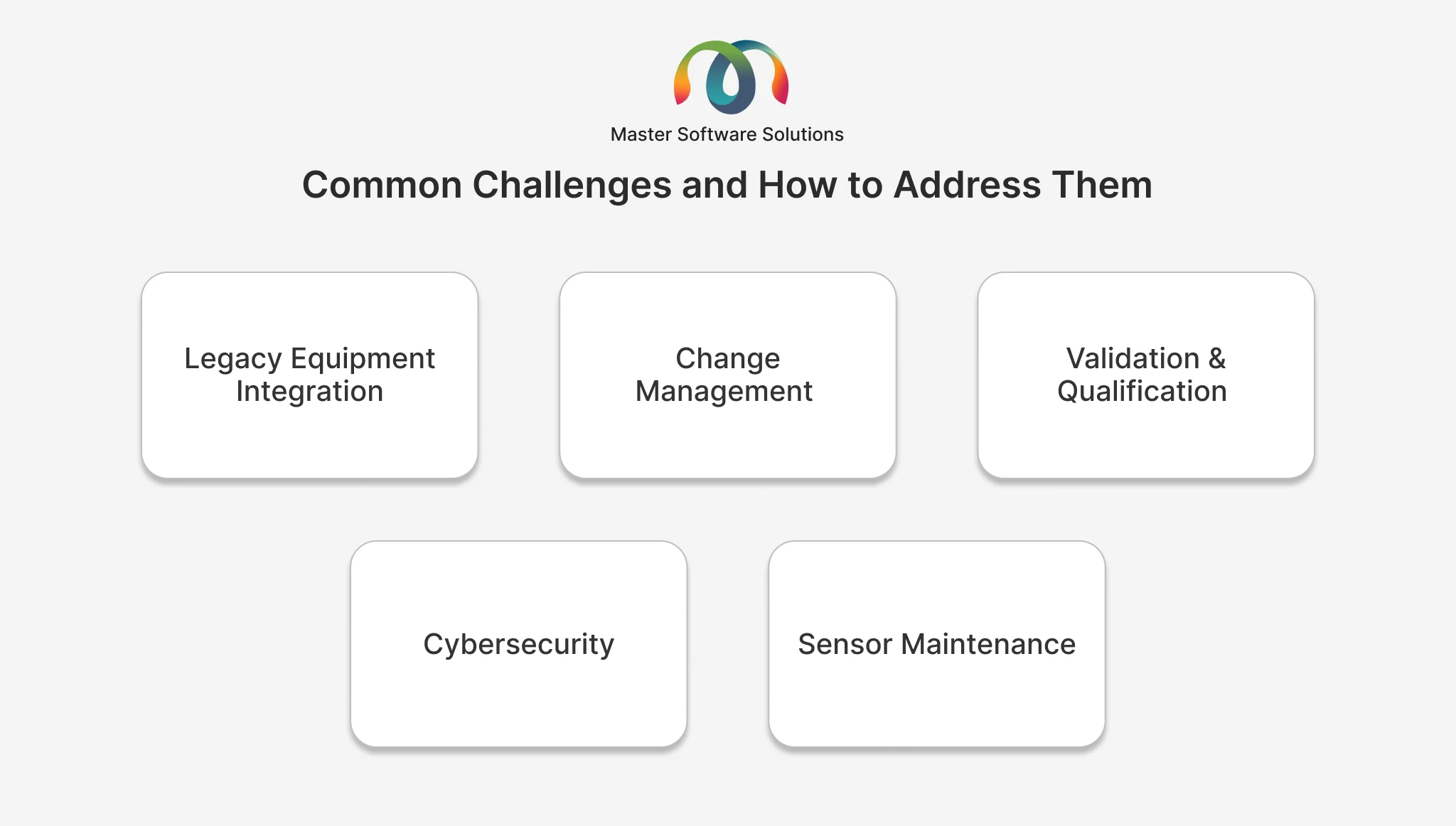
Legacy equipment integration
Older dairy plants often have equipment that was not designed with automation in mind. Retrofitting sensors and actuators requires careful engineering. The solution is a phased approach: start with monitoring (adding sensors and data logging) before moving to closed-loop control.
Change management
Operators accustomed to manual CIP may resist automated systems. Proper training, intuitive HMI design, and involving operators in the commissioning process are critical success factors.
Validation and qualification
Automated CIP systems must be formally validated (IQ/OQ/PQ) to demonstrate they clean as intended. This adds upfront time and cost but is non-negotiable for regulatory compliance.
Cybersecurity
Connected SCADA and IoT systems expand the attack surface. Dairy processors must implement network segmentation, access controls, and regular security audits.
Sensor maintenance
Automated systems are only as good as the sensors feeding them. Conductivity probes and pH sensors require regular calibration and replacement. Building sensor maintenance into the CMMS schedule is essential.
For a deeper technical perspective on PLC and SCADA implementation for dairy CIP, see this guide: Automating Clean-in-Place (CIP) with PLCs and SCADA: A Food Industry Guide.
ROI of CIP Automation: What Dairy Processors Can Expect
The return on investment for CIP automation is well-documented across the industry. A medium-sized dairy processing plant (50,000–100,000 liters per day) can typically expect the following:
- Payback period: 18–36 months, depending on facility size and existing infrastructure
- Annual water savings: $15,000–$40,000 (varies by cycle frequency and local water cost)
- Annual chemical savings: $20,000–$60,000
- Labor cost reduction: 1–2 FTE equivalents redirected from CIP supervision
- Reduced product loss: Fewer contamination-related batch rejections
- Compliance cost reduction: Significant reduction in audit preparation time and external consultant costs
The cumulative five-year ROI of CIP automation is consistently positive across published case studies, and the intangible benefits — reduced contamination risk, brand protection, and regulatory confidence — are often valued even higher than the direct cost savings.
Future Trends in Dairy CIP Automation
AI-driven adaptive cleaning
Machine learning models will soon predict required cleaning intensity based on production data, dynamically adjusting CIP parameters to match actual soiling levels. This will push water and chemical savings beyond what fixed-recipe automation achieves today.
Microbubble and ultrasonic cleaning
Emerging technologies are demonstrating cleaning effectiveness at lower temperatures and chemical concentrations, which could fundamentally change CIP energy and chemical economics.
Fully autonomous CIP scheduling
Integration with production planning systems will enable CIP to be scheduled and executed autonomously, without operator initiation, based on production completion signals from the ERP.
Blockchain-based compliance records
An immutable, distributed ledger recording of CIP validation data will give supply chain partners and regulators real-time access to food safety evidence.
Carbon accounting integration
As sustainability reporting requirements grow, CIP systems will feed water, chemical, and energy data directly into carbon accounting and ESG reporting platforms.
Want to future-proof your dairy processing operations with smart automation? Contact Master Software Solutions for a free consultation
About Master Software Solutions
Master Software Solutions is an Odoo ERP consulting and AI engineering firm helping food, beverage, and dairy businesses automate operations, improve compliance, and accelerate growth. From Odoo ERP implementation to custom automation and AI agent development, we build solutions tailored to the complexity of modern dairy processing.