Dairy manufacturing is one of the most quality-sensitive industries in the world. A single batch of off-spec milk, cheese, or yogurt can trigger recalls, regulatory penalties, and lasting reputational damage. Yet many dairy processors still rely on periodic manual checks.
IoT (Internet of Things) sensors change that equation entirely. By embedding intelligent sensors across your production line, you gain continuous, real-time visibility into every parameter that drives product quality, from raw milk intake to final packaging. The result is fewer defects, less waste, stronger compliance, and a production floor that practically manages itself.
This guide walks you through everything you need to know about integrating IoT sensors for real-time quality control on dairy lines, including sensor types, architecture, compliance benefits, implementation roadmap, and the ROI you can expect.
Why Real-Time Quality Control Is No Longer Optional for Dairy Manufacturers
Traditional quality control in dairy relies on lab sampling at fixed intervals, such as hourly, per batch, or per shift. The problem? Between samples, conditions drift. A temperature excursion during pasteurization, a pH shift during fermentation, or a contamination event mid-run can go undetected until the damage is done.
The stakes are high:
- Regulatory pressure is intensifying. The FDA’s Food Safety Modernization Act (FSMA) Section 204, with compliance deadlines arriving in early 2026, mandates real-time traceability records and Critical Control Point (CCP) documentation for covered dairy products, including soft and semi-soft cheeses.
- Consumer expectations have risen. Shorter shelf-life products, clean-label demands, and allergen sensitivity make consistent quality non-negotiable.
- Waste is costly. In dairy manufacturing, a single rejected batch can represent thousands of dollars in lost raw materials, energy, and labor.
Real-time IoT monitoring doesn’t replace your quality team — it gives them eyes everywhere, all the time.
What Are IoT Sensors and How Do They Work in Dairy Production?
IoT sensors are compact electronic devices that continuously measure physical or chemical parameters and transmit data wirelessly to a central platform. In a dairy context, sensors are placed at strategic points along the production line, in milk receiving tanks, pasteurizers, fermentation vats, filling machines, and cold storage to capture readings in milliseconds and flag anomalies instantly.
The basic architecture of a dairy IoT system has four layers:
- Edge layer: Physical sensors and actuators on the production floor
- Connectivity layer: Wi-Fi, Ethernet, NB-IoT, or 4G/5G transmitting data to the cloud
- Processing layer: Cloud or edge computing platforms that analyse incoming data
- Application layer: Dashboards, ERP integrations, alerting systems, and compliance reports
Modern systems pair this sensor data with machine learning algorithms that learn what “normal” looks like for your specific line and flag deviations before they become defects.
Types of IoT Sensors Used on Dairy Production Lines
Selecting the right sensors is the foundation of any quality control deployment. Here are the core sensor types used in dairy manufacturing:
Temperature Sensors
The most widely used sensor in dairy. Temperature is a CCP at multiple points, such as pasteurization, fermentation, cold chain, and storage. Modern wireless temperature sensors achieve accuracy within ±0.1°C and trigger instant alerts when readings drift outside acceptable ranges. For yogurt production, cultures require a tight window of 42-44°C; deviations of even 2°C affect texture and shelf life.
pH Sensors
pH directly controls the texture, flavor, and safety of cultured dairy products. During cheesemaking, pH governs moisture retention, curd formation, and final flavor complexity. Continuous in-line pH sensors replace manual titration checks and feed real-time data to dashboards and ERP systems.
Flow and Pressure Sensors
These monitor the volume and pressure of milk as it moves through pipes, homogenizers, and filling machines. Abnormal flow rates can indicate blocked lines, pump failures, or incorrect fill weights, all of which affect product consistency and yield.
Turbidity and Optical Sensors
Used primarily in CIP (Clean-in-Place) systems to verify cleaning cycle completion and detect residual product or cleaning agent in lines before the next production run begins.
Near-Infrared (NIR) Spectrometers
Advanced IoT-connected NIR sensors measure fat, protein, lactose, and total solids in real time without sampling. Previously confined to laboratory analysers, compact NIR sensors can now sit inline on milk intake pipes and send compositional data via NB-IoT to any cloud platform.
Conductivity Sensors
Used in CIP validation to detect the transition from water to caustic to acid to water, ensuring cleaning cycles are complete and effective before production resumes.
Gas and VOC Sensors
Detect off-gases produced during spoilage or fermentation anomalies, a useful early-warning system for contamination events that aren’t yet visible in other parameters.
Vision Sensors and Cameras
AI-powered optical sensors inspect labels, fill levels, seal integrity, and packaging defects at line speed, replacing manual visual inspection on high-throughput lines.
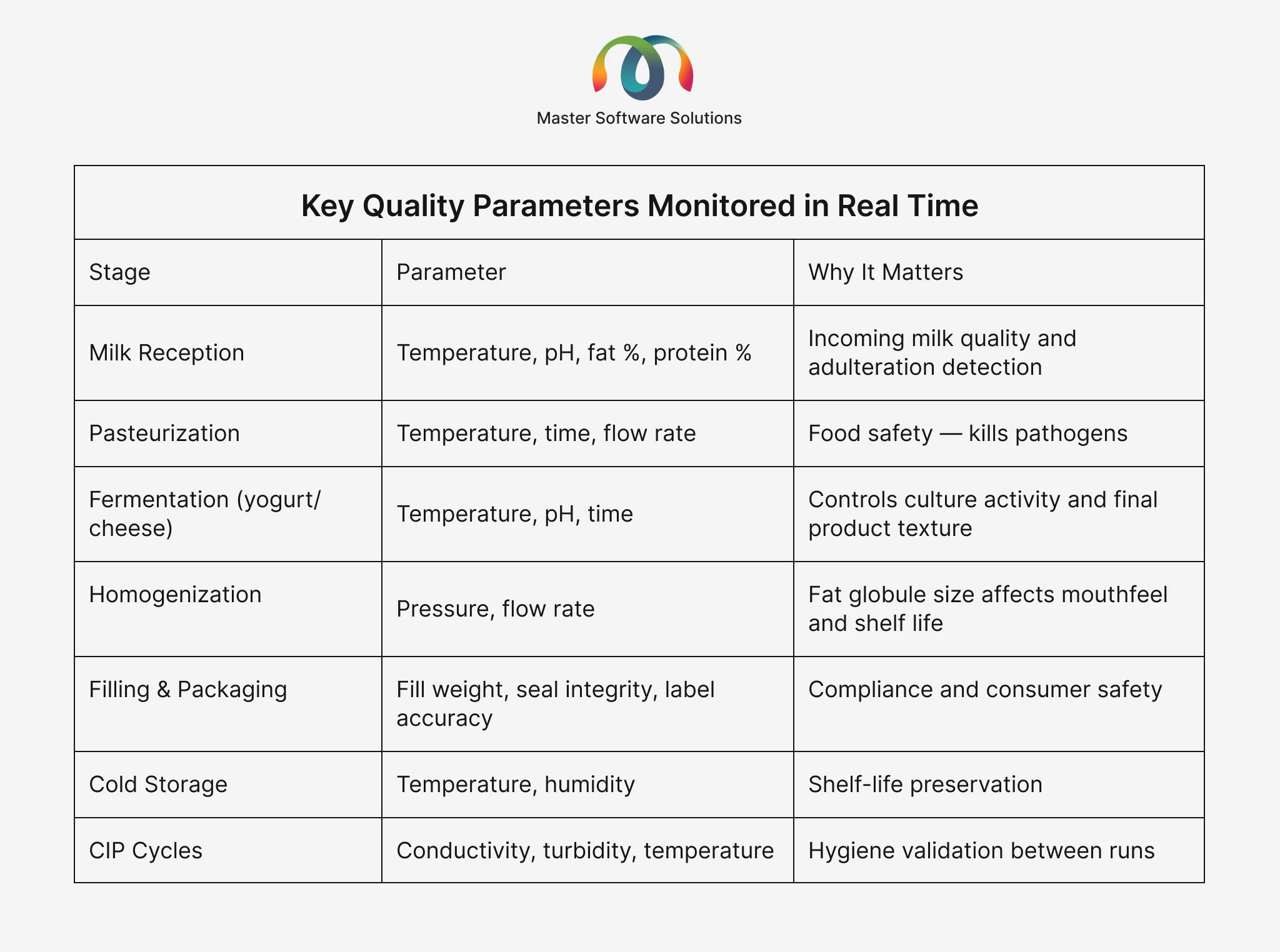
Key Quality Parameters Monitored in Real Time
A well-designed IoT quality control system tracks these parameters across the dairy production workflow:
Step-by-Step: How to Integrate IoT Sensors on Your Dairy Line
Step 1: Conduct a Process Audit and Define Critical Control Points
Before buying a single sensor, map your production flow and identify where quality failures most commonly occur. Define the CCPs where monitoring will have the greatest impact. Engage your quality, production, and maintenance teams at this stage.
Step 2: Select Sensors Matched to Your Process
Not all sensors suit all environments. Dairy lines involve steam, high-pressure washdowns, caustic cleaning agents, and tight temperature ranges. Specify food-grade, IP69K-rated sensors designed for CIP environments. Work with vendors who have dairy-specific deployment experience.
Step 3: Design the Connectivity Architecture
Decide between edge computing (processing data locally at the machine) and cloud processing (sending data to a centralized platform). Most modern deployments use a hybrid approach, such as edge computing for time-critical alerts (e.g., pasteurization temperature excursions) and cloud processing for analytics, trending, and compliance reporting.
Step 4: Integrate with Your ERP or MES
IoT sensor data in isolation is useful; IoT data connected to your ERP is transformative. When your ERP receives live quality readings, it can automatically:
- Hold batches that fall outside the specification
- Trigger corrective action workflows
- Update traceability records in real time for FSMA compliance
- Feed data into production scheduling and inventory decisions
Ready to connect your production floor to your ERP? Master Software Solutions specializes in digital transformation for food and beverage manufacturers.
Step 5: Set Alerting Thresholds and Escalation Protocols
Define acceptable ranges for each parameter, pre-alert and alert thresholds, and critical alert thresholds. Configure automated notifications via SMS, email, or your production management system. Establish clear escalation protocols so operators know exactly what action to take at each alert level.
Step 6: Train Your Team
Technology only works when people trust it. Train operators to interpret dashboards, respond to alerts, and override false positives. Build IoT monitoring into your standard operating procedures and quality management system (QMS).
Step 7: Monitor, Calibrate, and Continuously Improve
Sensors drift over time. Build a calibration schedule into your maintenance program. Review alert frequency and false positive rates monthly. Use accumulated data to tighten processes, predict failures, and continuously reduce defect rates.
Integrating IoT Sensors with ERP for End-to-End Traceability
One of the most powerful applications of IoT in dairy manufacturing is the seamless integration between production-floor sensor data and enterprise resource planning (ERP) systems. This integration creates a single, audit-ready data record that spans from raw milk intake to finished goods dispatch.
With ERP-IoT integration, dairy manufacturers can:
- Automate batch records: sensor readings are automatically logged against batch numbers, eliminating manual data entry errors
- Enable forward and backward traceability: if a quality issue is detected, you can immediately identify every product made during the affected window and every supplier whose milk contributed to it.
- Streamline FSMA 204 compliance: Key Data Elements (KDEs) are captured automatically at each Critical Tracking Event (CTE), satisfying FDA traceability requirements without additional paperwork.
- Trigger automated holds and rework workflows: ERP rules can automatically quarantine batches where sensor readings exceeded thresholds, initiating review before the product ships
- Feed quality data into supplier scorecards: track incoming milk quality by farm or collection route for improving the drive to the supplier.
Master Software Solutions has deep expertise in implementing and customizing ERP systems for food and beverage manufacturers. Our food and beverage industry solutions are built around the operational realities of dairy processing, from batch traceability to regulatory compliance.
Want to see how ERP-IoT integration could work for your dairy operation? Request a free consultation.
Regulatory Compliance: How IoT Sensors Help You Meet FSMA 204 and Food Safety Standards
The FDA’s FSMA Section 204 Food Traceability Rule, which was enforced in early 2026, requires manufacturers of covered foods, including soft and semi-soft cheeses, to maintain detailed electronic records of Key Data Elements at each Critical Tracking Event throughout the supply chain.
IoT sensors make FSMA 204 compliance substantially easier by:
- Automatically logging CCPs: temperature, pH, and other critical parameters are recorded with millisecond timestamps, far exceeding manual documentation standards
- Creating immutable audit trails: cloud-stored sensor data provides verifiable records that cannot be retroactively altered.
- Triggering corrective action documentation: when an alert fires, the system automatically creates an event record linked to the relevant batch and CCP
- Accelerating mock recalls: full forward and backward traceability is available in seconds rather than hours
Beyond FSMA, IoT monitoring supports compliance with HACCP plans, GFSI-benchmarked standards (SQF, BRC, FSSC 22000), and retailer-specific requirements. Many dairy manufacturers report that IoT-enabled compliance systems achieve ROI within 12–24 months through reduced audit preparation time, fewer non-conformances, and avoided recall costs.
The Role of AI and Machine Learning in IoT-Driven Dairy Quality Control
Raw sensor data tells you what is happening. AI tells you what is about to happen and why?
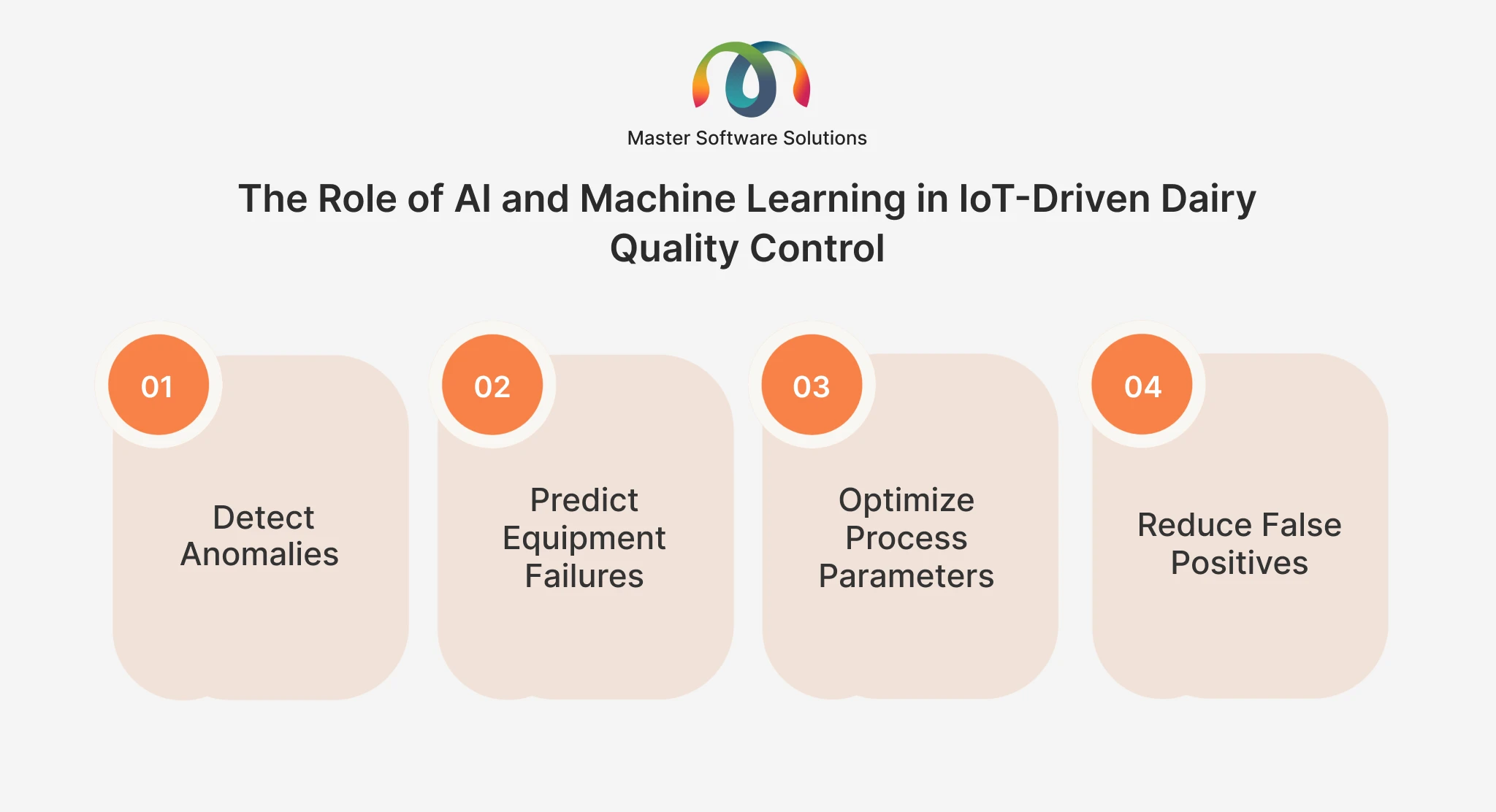
When machine learning algorithms are applied to the continuous streams of data from your IoT sensors, they can:
- Detect anomalies before they become defects: ML models learn the normal signature of your process and flag subtle deviations hours before a quality failure is visible
- Predict equipment failures: It can identify patterns in temperature drift, pressure fluctuations, or vibration data and predict when a pump, valve, or heat exchanger is approaching failure, enabling planned maintenance instead of emergency downtime.
- Optimize process parameters: over time, ML models identify the input conditions that consistently produce the best product quality, enabling operators to move from reactive control to proactive optimization.
- Reduce false positives: as models learn your specific process, alert accuracy improves, and operator alarm fatigue decreases.
AI-powered IoT systems are particularly valuable for real-time monitoring of milk composition. Compact NIR spectrometers integrated with microcontrollers can continuously measure fat and protein across the supply chain, from farm to factory, transmitting results via NB-IoT to cloud analytics platforms where ML models flag composition anomalies and predict downstream quality impacts.
Common Challenges in IoT Integration for Dairy Lines, and How to Overcome Them
Challenge 1: Legacy Equipment Compatibility
Many dairy facilities run equipment that predates IoT by decades. Retrofitting sensors requires careful selection of edge devices and protocol translators (such as Open Platform Communications Unified Architecture (OPC-UA) and Modbus) to connect old machines to modern networks. Work with integration specialists experienced in brownfield dairy deployments.
Challenge 2: Connectivity in Plant Environments
Steam, metal surfaces, and dense equipment can obstruct Wi-Fi signals. Options include industrial Wi-Fi mesh networks, wired Ethernet to fixed sensors, and cellular (NB-IoT or 4G) for sensors in areas where fixed connectivity is impractical.
Challenge 3: Data Overload
A fully instrumented dairy line can generate millions of data points per day. Without a clear data strategy, defining what to measure, what to alert on, what to store, and what to analyze, teams quickly become overwhelmed. Start with the highest-impact CCPs and expand incrementally.
Challenge 4: Cybersecurity
Connected production systems are potential attack surfaces. Ensure your IoT deployment follows industrial cybersecurity best practices: network segmentation, encrypted data transmission, regular firmware updates, and access control policies.
Challenge 5: Change Management
Operators accustomed to manual checks may be skeptical of sensor-driven systems, especially when false positives occur. Invest in training, involve operators in threshold-setting, and demonstrate early wins to build confidence.
ROI of IoT Quality Control in Dairy Manufacturing
The business case for IoT-driven quality control in dairy is compelling across multiple value drivers:
- Waste reduction: real-time detection of out-of-spec batches prevents defective product from progressing through the line, reducing the volume of rework and write-offs
- Yield improvement: tighter process control increases the proportion of product that meets specification the first time
- Energy savings: optimised pasteurisation and refrigeration cycles reduce energy consumption by 10–20% in well-instrumented facilities
- Reduced recall costs: faster detection and more precise traceability dramatically reduce the scope and cost of any recall event
- Labour reallocation: automated monitoring frees quality technicians from routine data collection to focus on higher-value analysis and improvement work
- Compliance efficiency: automated FSMA record-keeping eliminates hundreds of hours of annual audit preparation
Most dairy manufacturers achieve full ROI within 12–24 months, with ongoing annual savings that compound as processes are further optimized.
Getting Started: Your IoT Readiness Checklist
Before launching your IoT integration project, use this checklist to assess your readiness:
- HACCP plan and CCPs are documented and current
- Production floor network infrastructure (Wi-Fi or Ethernet) is available or planned
- The ERP or MES system is in place and integration-ready
- IT/OT security policies are defined
- Budget is allocated for sensors, connectivity, software, and integration
- An internal champion is identified to lead the project
- The quality team is engaged and aligned
Not sure where to start? Master Software Solutions offers IoT readiness assessments tailored to dairy and food manufacturers. Book a free discovery call.
Conclusion
IoT sensors for real-time quality control are no longer a competitive advantage reserved for the largest dairy processors; they are rapidly becoming the baseline expectation for any facility that takes product safety, regulatory compliance, and operational efficiency seriously.
The technology is accessible, the ROI is proven, and the regulatory environment, particularly FSMA 204, is accelerating adoption. The question for most dairy manufacturers is no longer whether to integrate IoT quality control but how to do it in a way that connects seamlessly with their existing systems and delivers measurable value from day one.
Master Software Solutions works with food and beverage manufacturers at every stage of their digital transformation journey, from IoT readiness assessments and sensor integration to full ERP deployment and compliance automation. Our team brings deep industry knowledge and technical expertise to every engagement.
Ready to transform your dairy quality control operation? Talk to a Master Software Solutions expert today.