Every liter of milk that spoils before it reaches a consumer represents a direct financial loss and a missed opportunity. For dairy plant managers, extending milk shelf life is not just a quality goal; it is a business imperative tied to profitability, compliance, and customer trust.
The challenge is that shelf life is not controlled at one point in the process. It is the cumulative result of decisions made across procurement, production, cold chain logistics, quality testing, and distribution. Managing these moving parts manually, with spreadsheets and disconnected systems, leaves too much room for human error, delayed responses, and blind spots.
This is where a dairy ERP (Enterprise Resource Planning) system becomes a game-changer. A purpose-built dairy ERP integrates every stage of milk production into a single, real-time platform, giving dairy plants the visibility and control needed to maximize milk shelf life consistently.
What Is Milk Shelf Life and Why Does It Matter?
Milk shelf life refers to the period during which milk remains safe for consumption and meets quality standards, whether fresh (typically 7–21 days), extended shelf life or ESL (45–90 days), or UHT-treated (6–12 months).
Shelf life is determined by:
- Microbial load at the time of processing and packaging
- Temperature control throughout the cold chain
- Processing quality (pasteurisation efficiency, hygiene standards)
- Packaging integrity
- Raw milk quality from suppliers
Even a minor failure in any of these areas can shorten shelf life, trigger product recalls, and damage brand reputation. According to the Food and Agriculture Organization (FAO), an estimated 14% of global food production is lost between harvest and retail, much of it due to poor temperature management and inadequate traceability. Dairy plants that deploy integrated ERP systems are better positioned to close these gaps systematically.
Key Challenges Dairy Plants Face in Extending Milk Shelf Life
Before exploring how ERP helps, it is worth understanding what dairy plant managers are up against:
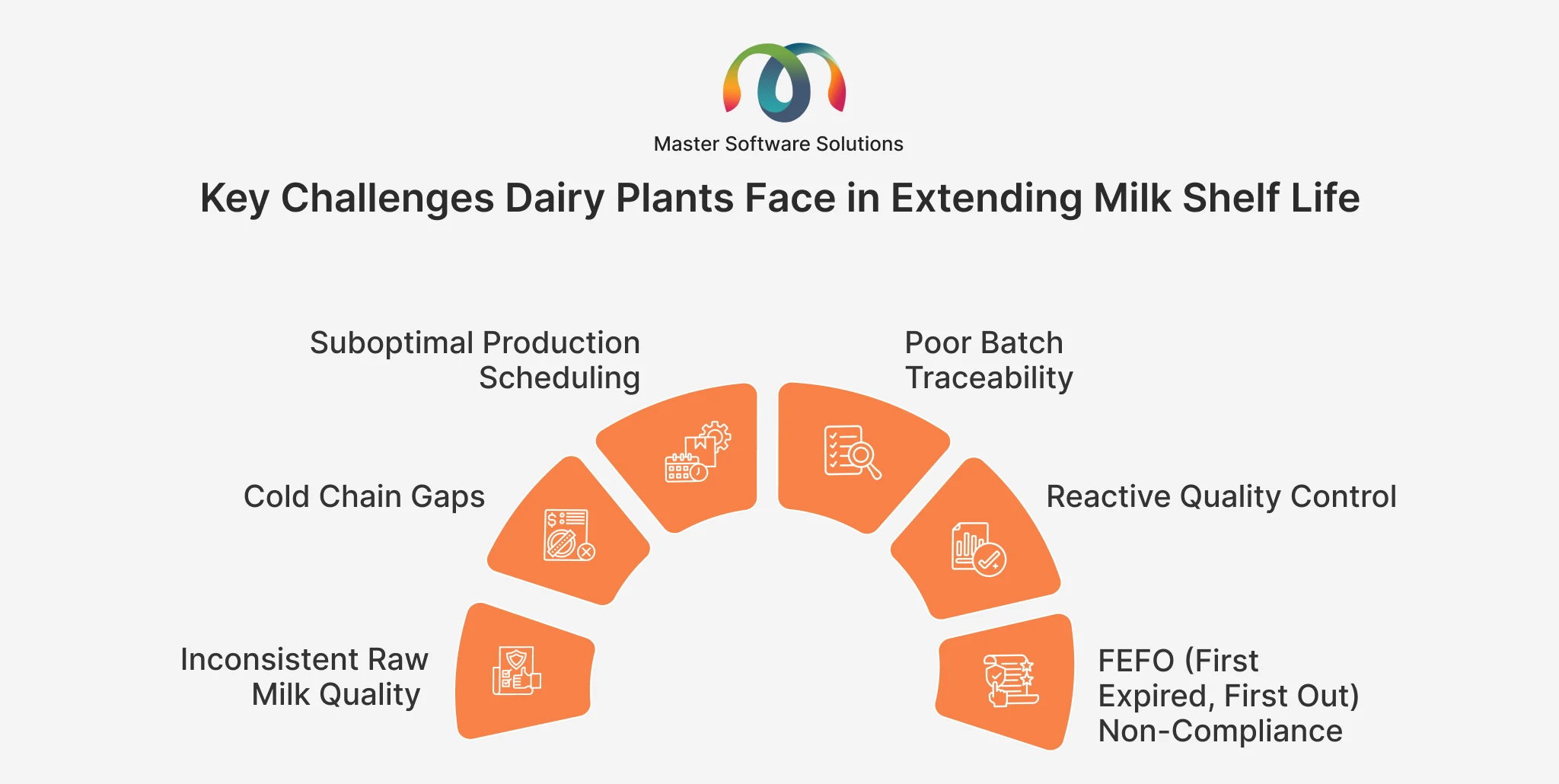
Inconsistent Raw Milk Quality
Milk from different suppliers arrives with varying bacterial counts, somatic cell counts (SCC), and fat/protein compositions. Without systematic supplier quality tracking, one bad batch can contaminate an entire production run.
Cold Chain Gaps
Temperature excursions, even brief ones, during reception, storage, processing, or distribution accelerate spoilage. Manual temperature logs are reactive and prone to gaps.
Suboptimal Production Scheduling
Producing more milk than can be sold within its shelf life leads to waste. Misaligned production and demand forecasts are a leading cause of pre-expiry losses.
Poor Batch Traceability
When a quality issue arises, not knowing which batch is affected forces wide, costly recalls rather than targeted withdrawals.
Reactive Quality Control
Quality tests performed at the end of the process catch problems too late. Without real-time quality data across the production line, corrective action is delayed.
FEFO (First Expired, First Out) Non-Compliance
Warehouses that don’t consistently enforce FEFO ship older stock after newer stock, causing unnecessary near-expiry write-offs.
What Is a Dairy ERP System?
A dairy ERP is an integrated software platform designed specifically for the workflows of dairy manufacturing. Unlike generic ERP tools, dairy-specific ERP modules handle the following:
- Milk reception and raw material grading
- Batch processing with yield tracking
- Quality lab management and compliance reporting
- Cold chain and temperature event tracking
- Production planning aligned with shelf-life windows
- FEFO-driven warehouse management
- Distribution route optimisation
- Regulatory compliance (FSSAI, FDA, EU dairy regulations)
For dairy plants using platforms like Odoo ERP, these capabilities can be implemented as configurable modules and custom extensions tailored to the precise requirements of the dairy operation.
Ready to see what a dairy ERP looks like in practice? Explore Our Food & Beverage ERP Solutions
How Dairy ERP Extends Milk Shelf Life: 7 Core Mechanisms
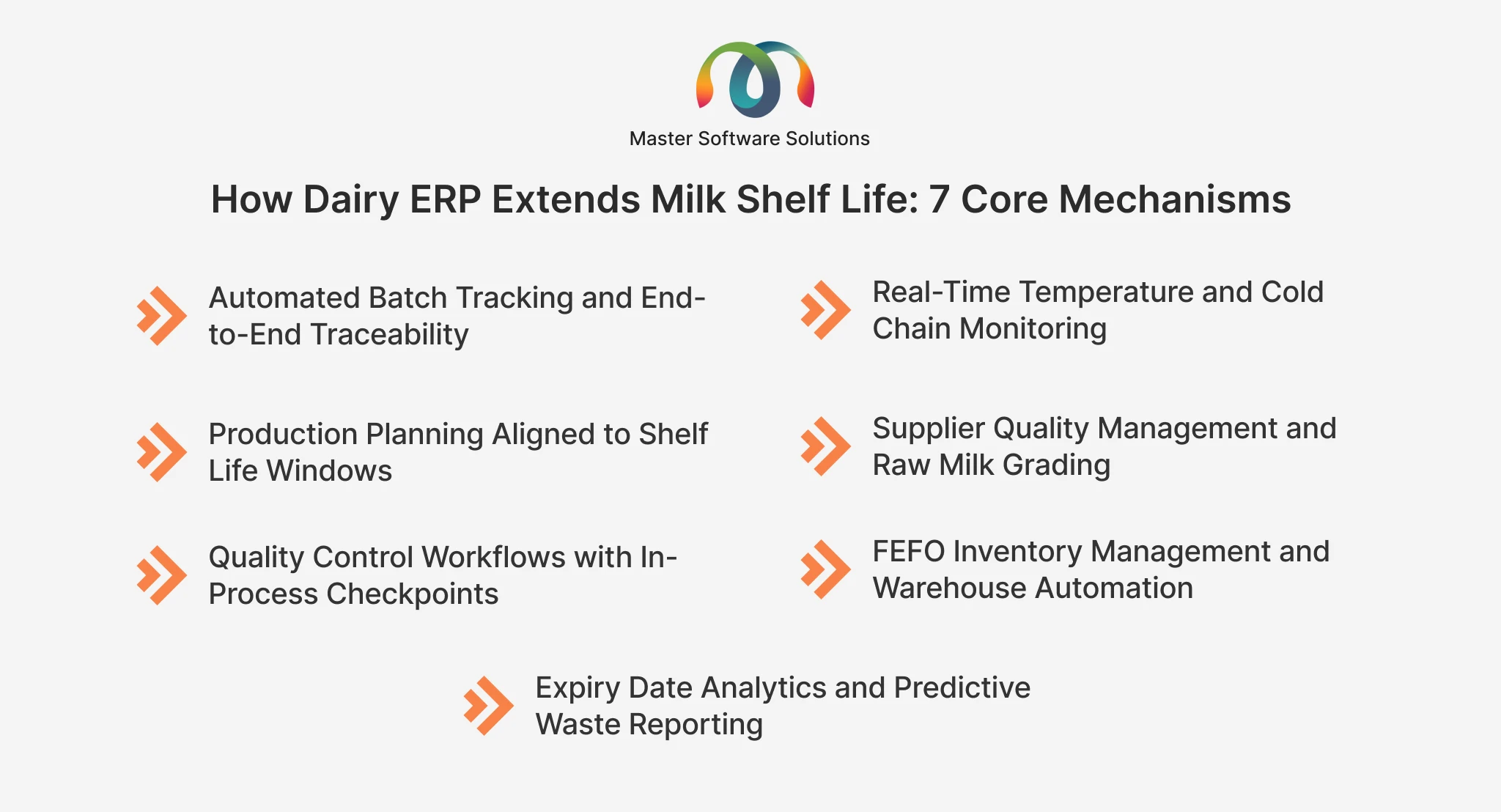
Automated Batch Tracking and End-to-End Traceability
Shelf life management starts with knowing exactly what is in every batch, where it came from, and where it is going.
A dairy ERP assigns a unique batch ID to every production run, linking it to:
- The supplier’s incoming raw milk lot
- Pasteurisation time and temperature records
- Quality test results (microbial, chemical, sensory)
- Packaging line and packaging date
- Distribution channel and delivery destination
This granular traceability means that if a quality anomaly is detected, the system can instantly isolate the specific affected batch, preventing a plant-wide recall and protecting overall inventory. The EU’s General Food Law (Regulation EC 178/2002) mandates full traceability, and ERP makes compliance automatic rather than a manual documentation burden.
Real-Time Temperature and Cold Chain Monitoring
Temperature is the single most critical variable in milk shelf life. A dairy ERP integrated with IoT sensors creates a continuous digital record of
- Incoming raw milk temperature at the reception dock
- Silo and storage tank temperatures
- Processing line temperatures (pasteuriser set points and actuals)
- Cold room and refrigeration unit temperatures
- Dispatch temperatures for each shipment
When a temperature deviation occurs, the ERP triggers an automated alert to the quality manager and production supervisor, and not an hour later when someone checks a paper log, but in real time. The system can also automatically flag the affected batch for quarantine and secondary testing before it progresses to the next production stage.
This shifts cold chain management from reactive to preventive, directly reducing the incidence of temperature-induced shelf life loss.
Production Planning Aligned to Shelf Life Windows
One of the less obvious ways ERP extends shelf life is through smarter production scheduling. Dairy ERP systems integrate demand forecasting with production planning, ensuring that:
- Volumes produced match projected demand within the shelf life window
- Production runs are sequenced to minimise the time between processing and dispatch
- Changeover times are optimised to reduce milk age at the point of packaging
For perishables like fresh milk, which has a shelf life of 10–21 days, saving even 12–24 hours in the production-to-dispatch cycle is meaningful. ERP-driven scheduling makes this possible by connecting sales orders, customer delivery schedules, and production capacity in a single planning view.
Supplier Quality Management and Raw Milk Grading
Shelf life is largely determined at the point of milk reception. The bacterial count in raw milk sets a ceiling on how long the processed product can last; no amount of downstream process excellence can overcome high-SCC or high-TVC raw milk.
A dairy ERP enables systematic supplier quality management through the following:
- Automated grading of every incoming milk lot against pre-set quality parameters (TVC, SCC, temperature, antibiotic residues)
- Supplier scorecards tracking quality trends over time
- Conditional acceptance rules that automatically flag or reject lots that fall below the threshold
Corrective action workflows that notify procurement when a supplier’s quality deteriorates
By enforcing consistent raw material standards, dairy ERP raises the quality floor for every production run, and with it, the achievable shelf life.
Quality Control Workflows with In-Process Checkpoints
Rather than testing only at the end of the production line, dairy ERP embeds quality checkpoints throughout the process:
- Pre-pasteurisation: Raw milk microbial and chemical analysis
- In-process: Pasteurisation temperature and hold-time validation, homogeniser pressure, fill weight checks
- Post-process: Final product microbial testing, pH, fat, and protein verification
- Pre-dispatch: Shelf life verification, packaging integrity checks
Results from each checkpoint are logged in real time. If a reading falls outside specification, the ERP raises a non-conformance record, halts progression of the affected batch, and initiates a root cause investigation workflow, all without waiting for a manual quality review meeting.
This systematic, data-driven approach to quality control is what consistently pushes achievable shelf life toward the upper end of the biological limit.
Losing product to early expiry or quality rejections? Book a Free ERP Consultation with Our Dairy Experts
FEFO Inventory Management and Warehouse Automation
Inventory management discipline is where a significant amount of avoidable shelf life loss occurs. In manually managed warehouses, stock rotation is inconsistent; newer pallets at the front are picked first while older stock at the back ages past its best-before date.
Dairy ERP enforces FEFO (First Expired, First Out) as a system rule, not a guideline. The warehouse management module:
- Assigns each pallet or case a best-before date at production
- Automatically directs picking staff to the oldest available stock first
- Generates alerts when stock reaches a configurable near-expiry threshold (e.g., 30% of shelf life remaining)
- Triggers markdown pricing or redistribution workflows for near-expiry product
For multi-site dairy operations, the ERP also provides cross-site visibility, enabling stock rebalancing between distribution centers to avoid localized expiry build-up.
According to GS1 Global standards for traceability and FEFO management, companies that implement digital FEFO enforcement reduce near-expiry waste by 15–30% compared to manual rotation practices.
Expiry Date Analytics and Predictive Waste Reporting
Finally, dairy ERP turns historical shelf life data into forward-looking intelligence. Analytics dashboards and reports provide:
- Shelf life yield analysis: Average achieved shelf life by product, line, shift, and supplier
- Expiry risk forecasting: Batches projected to expire before their scheduled delivery date
- Root cause correlation: Linking shelf life deviations to specific process variables (supplier, line, operator, equipment)
- Waste trend reporting: Tracking write-off volumes and costs over time
These insights allow dairy plant managers to identify systemic issues, for example, that one particular production line consistently produces shorter shelf life, and make targeted improvements. Over time, this data-driven refinement cycle continuously improves plant shelf life performance.
ERP Integration With IoT and Smart Dairy Equipment
Modern dairy ERP platforms are designed to integrate with the plant’s physical technology. IoT-enabled sensors, SCADA systems, and smart packaging equipment can feed data directly into the ERP without manual entry, including:
- Continuous tank temperature feeds
- Pasteuriser PLC data (temperature, flow rate, hold time)
- Automated filler weight and seal integrity readings
- Refrigeration unit performance data
- GPS and temperature data from cold chain vehicles
This integration creates a fully digital, real-time record of every shelf life-relevant variable from farm gate to retail shelf, the kind of end-to-end visibility that was simply not achievable with paper-based or siloed systems.
Learn how ERP supports dairy and beverage manufacturers at scale. Read Our Beverage Manufacturing ERP Guide
The Business Case: What Dairy Plants Gain From ERP-Driven Shelf Life Management
The return on investment from dairy ERP extends well beyond quality outcomes:
- Reduced write-offs and waste costs from expired or near-expiry products
- Fewer customer returns and complaints due to shorter-than-expected shelf life on delivery
- Lower recall costs and reputational risk through rapid batch isolation
- Stronger retailer relationships: major retailers increasingly audit supplier traceability and shelf life management capabilities
- Regulatory compliance confidence for FDA, EU, FSSAI, and other dairy regulations
- Better margins through optimised production volumes and reduced raw material waste
For a mid-size dairy plant processing 50,000–100,000 liters per day, even a 1–2% reduction in shelf life-related write-offs can represent savings of hundreds of thousands of dollars annually.
Take the Next Step With Master Software Solutions
At Master Software Solutions, we work with dairy and food and beverage manufacturers to implement ERP systems that solve real operational problems, including milk shelf-life management, quality compliance, and cold-chain traceability.
As a trusted Odoo ERP Partner with 14+ years of experience and 800+ clients across 40+ countries, we bring deep industry knowledge and hands-on implementation expertise to every engagement.
Ready to Extend Your Milk Shelf Life and Reduce Waste? Schedule a Free ERP Consultation → Talk to our dairy ERP specialists and get a customized roadmap for your plant. Or explore how we help food and beverage manufacturers: Discover Our Food & Beverage ERP Solutions.