The regulatory landscape for financial services has transformed dramatically over the past decade. Today, compliance is no longer a back-office function—it has become a strategic business imperative. Banks, fintech companies, lenders, and other regulated organizations face mounting pressure to onboard customers quickly while maintaining rigorous compliance standards. Customer due diligence (CDD), identity verification, sanctions screening, and ongoing transaction monitoring have become increasingly complex, costly, and resource-intensive. The stakes are higher than ever: according to recent data, financial crime compliance costs reached $81.87 billion in the United States and Canada, while UK financial institutions spent £38.3 billion on financial crime compliance in 2023—representing a 32% increase since 2021. Regulatory failures can be catastrophic, as illustrated by the $3 billion fine imposed on TD Bank in 2024 for anti-money laundering deficiencies.
For many years, Robotic Process Automation (RPA) has been the preferred technology for automating repetitive compliance workflows. RPA systems execute predefined rules efficiently, handling data entry, form population, and basic verification checks. However, modern compliance environments have evolved beyond what rule-based automation can effectively manage. Regulations change frequently, customer information is often incomplete or inconsistent, and exceptions require contextual judgment. Many organizations are discovering that their RPA investments, while beneficial for routine tasks, cannot adapt quickly to regulatory changes or handle the complexity of real-world KYC scenarios. This operational reality has sparked a critical question: is there a better approach?
Enter agentic AI—a new class of intelligent automation that goes beyond task execution to enable context-aware decision-making and dynamic orchestration. Rather than following static workflows, agentic systems analyze customer information, assess risk in real time, coordinate multiple verification processes, and adapt to changing requirements without manual intervention. Early adopters report remarkable results: organizations implementing agentic KYC solutions have achieved up to 60% reductions in KYC/AML review times, while some have reduced onboarding time by 87%. The question facing many organizations today is no longer whether to automate KYC, but rather whether traditional RPA or modern agentic AI represents the better long-term investment.
The Evolution of KYC Automation
Traditional KYC processes have historically involved collecting documents, verifying identities, screening against watchlists, assessing risk, and maintaining audit records. These tasks require coordination across multiple systems, databases, and regulatory frameworks—a coordination challenge that becomes increasingly complex as organizations scale. Manual processes become costly and difficult to manage; this challenge led many enterprises to adopt RPA for automating repetitive tasks. While RPA has delivered measurable efficiency gains, modern compliance environments require more than workflow automation. They require systems that can understand context, adapt to changing regulations, and support complex decision-making. This is where agentic AI enters the conversation.
Understanding RPA-Based KYC
RPA technology is designed to automate structured and repetitive tasks by following predefined rules. Within KYC operations, RPA can help organizations:
- Transfer data between systems
- Extract information from documents
- Populate forms automatically
- Trigger verification checks
- Generate compliance reports
- Execute predefined workflows
RPA performs exceptionally well when processes remain predictable and standardized. However, challenges emerge when customer information is incomplete, regulations change, exceptions arise, or additional investigation becomes necessary. In such situations, organizations often need to modify workflows manually or involve compliance teams to review edge cases. Research indicates that many financial institutions allocate 10–15% of their full-time workforce solely to KYC/AML tasks, with a significant portion devoted to manual exception handling and workflow modifications.
What Is Agentic KYC?
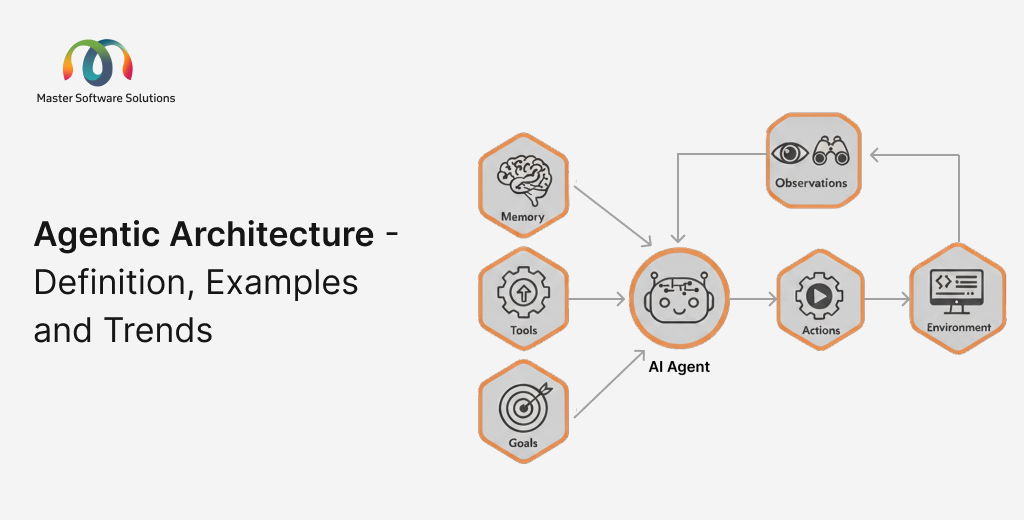
Agentic KYC leverages AI-powered agents that can analyze information, plan actions, interact with multiple systems, and adapt to changing situations. Unlike traditional automation tools that simply execute instructions, agentic systems can evaluate context, determine next steps, and coordinate multiple tasks simultaneously. For example, rather than following a fixed sequence of actions, an agentic system may determine that additional identity verification is required before performing sanctions screening. It can dynamically adjust the workflow based on available information and risk signals. Many modern AI-powered compliance platforms, including emerging agentic solutions such as SimplAI, are designed around this model of intelligent orchestration rather than rule-based execution alone.
Agentic KYC vs RPA-Based KYC: Key Differences
1. Workflow Adaptability
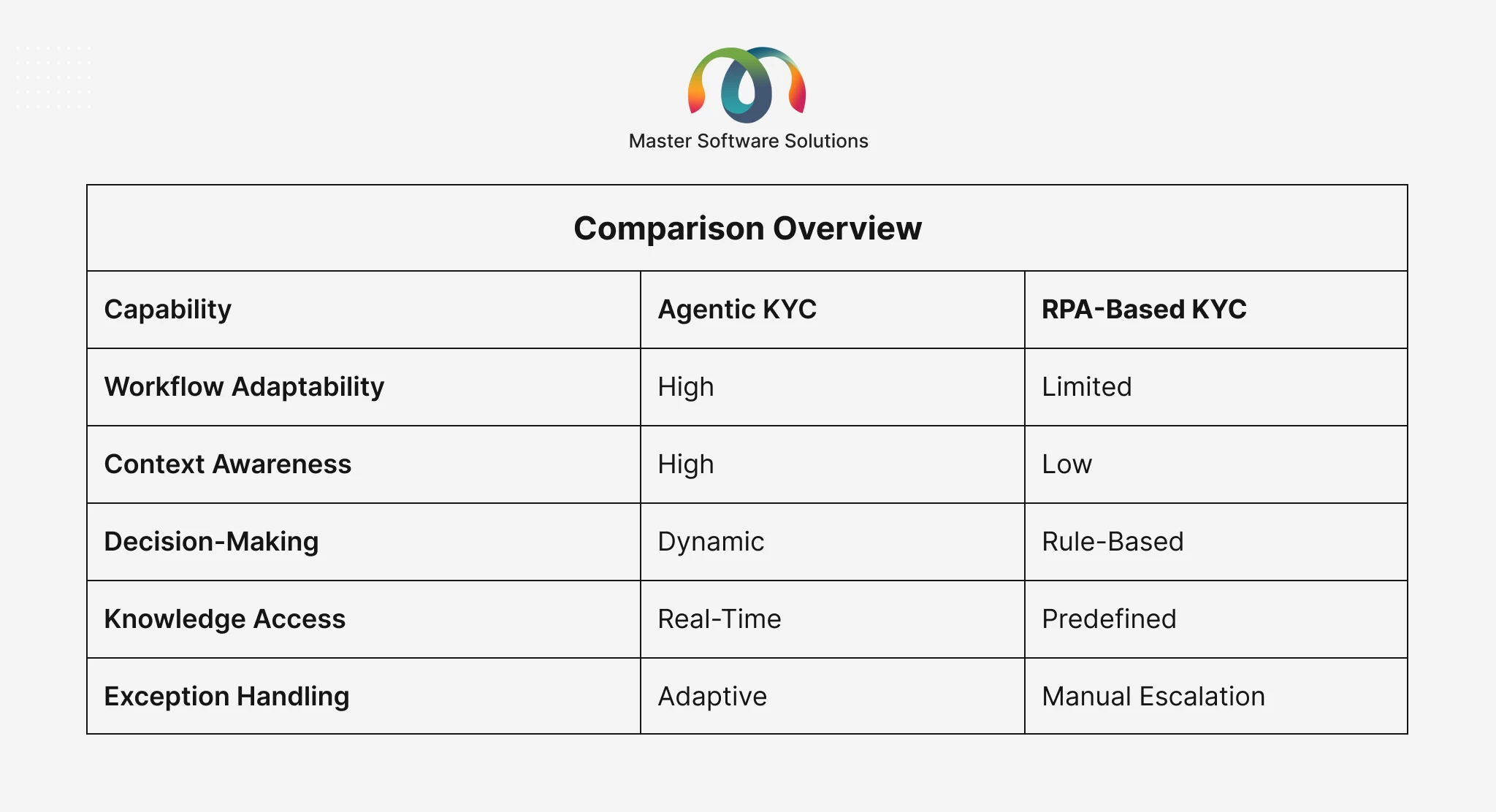
RPA-Based KYC: RPA follows predefined workflows. Any regulatory update or process change typically requires workflow modifications and testing before deployment.
Agentic KYC: Agentic systems can dynamically determine the appropriate sequence of actions based on customer context, risk profiles, and compliance requirements.
2. Decision Intelligence
RPA-Based KYC: Decision-making relies on predefined logic and rule sets.
Agentic KYC: AI agents can analyze multiple data points simultaneously, identify patterns, and provide recommendations supported by contextual reasoning. This allows organizations to handle more complex verification scenarios without excessive manual intervention.
3. Multi-Agent Collaboration
Modern agentic architectures often include specialized agents responsible for different functions such as identity verification, compliance validation, risk assessment, fraud analysis, and document processing. These agents collaborate and share information throughout the verification process. Traditional RPA workflows typically execute tasks sequentially and lack autonomous collaboration capabilities.
4. Access to Regulatory Knowledge
Compliance teams frequently rely on regulatory documentation, internal policies, historical case records, and industry guidelines. Agentic systems can retrieve and analyze information from these sources in real time. RPA solutions generally depend on predefined business rules and static reference databases.
5. Handling Exceptions and Ambiguity
Real-world KYC processes often involve missing documents, inconsistent information, complex ownership structures, and cross-border compliance requirements. RPA workflows typically escalate these cases to human reviewers. Agentic systems can evaluate available evidence, identify information gaps, and recommend appropriate actions while maintaining decision transparency.
6. Customer Experience
Customer onboarding is increasingly becoming a competitive differentiator. Agentic AI can support intelligent onboarding conversations, dynamic follow-up questions, context-aware document requests, and personalized verification journeys. This can help reduce onboarding friction while improving completion rates. Traditional RPA generally requires additional technologies to support interactive customer experiences.
7. Memory and Context Retention
Agentic systems can maintain context across multiple interactions, enabling them to reference previous verification activities and customer histories. RPA workflows typically operate on a transaction-by-transaction basis and require additional integrations to preserve context.
8. Enterprise Scalability
As organizations process larger volumes of customer applications, scalability becomes increasingly important. Agentic AI platforms are often designed to support hybrid cloud deployments, multi-cloud environments, on-premises infrastructure, and enterprise governance frameworks. This flexibility aligns well with broader digital transformation initiatives across regulated industries.
Comparison Overview

How Agentic AI Supports Digital Transformation
Many organizations view KYC modernization as part of a larger digital transformation strategy. Rather than automating isolated tasks, enterprises are increasingly focused on creating intelligent workflows that connect compliance, operations, customer onboarding, and risk management. Agentic AI supports this vision by enabling systems to coordinate activities across multiple business functions while continuously adapting to changing requirements. This shift represents a move from task automation toward decision automation, which many industry leaders consider the next stage of enterprise workflow modernization.
Key Performance Improvements from Agentic KYC
Organizations implementing agentic KYC solutions have demonstrated significant operational improvements:
60% reduction in KYC/AML review times: Organizations deploying agentic systems have achieved up to 60% reductions in KYC/AML review times compared to traditional RPA approaches, according to industry analysis from Banking Dive.
45-60% faster individual customer onboarding: According to Deloitte’s 2025 Digital Identity Report, document verification AI reduces average KYC onboarding time by 45-60% for individual customers and 30-40% for corporate accounts.
Rapid AI adoption: Advanced AI tool adoption in KYC/AML has surged dramatically, increasing from 42% in 2024 to 82% in 2025, with Singaporean firms leading adoption at 92%, followed by the US at 79%, according to Fenergo’s 2025 industry analysis.
Alignment with Regulatory Frameworks
Modern KYC and AML solutions must comply with international standards established by the Financial Action Task Force (FATF) and regional regulators such as FinCEN (Financial Crimes Enforcement Network) in the United States, the Financial Conduct Authority (FCA) in the United Kingdom, and various national jurisdictions. FATF Recommendation 10 establishes comprehensive customer due diligence requirements that form the foundation of effective AML programs. Organizations implementing agentic KYC solutions can better meet these standards by maintaining detailed audit trails, demonstrating consistent risk-based decision-making, and adapting quickly to evolving regulatory guidance. For detailed FATF recommendations and compliance standards, refer to:
- FATF Recommendations on AML/CFT: https://www.fatf-gafi.org/publications/
- FinCEN KYC Guidance: https://www.fincen.gov/
Is RPA Becoming Obsolete?
Not necessarily. RPA continues to provide significant value for structured workflows, data entry tasks, report generation, legacy system integration, and repetitive operational activities. In fact, many organizations are adopting a hybrid strategy. Under this approach, RPA handles predictable and repetitive tasks, while agentic AI manages decision-making, exception handling, and orchestration. This combination allows enterprises to maximize existing automation investments while introducing more intelligent capabilities where they create the greatest impact.
Final Thoughts
Organizations evaluating the future of KYC automation should consider both operational efficiency and long-term adaptability. RPA remains an effective solution for structured and rule-based processes. However, as compliance environments become more dynamic and customer expectations continue to evolve, agentic AI introduces capabilities that extend beyond traditional automation. By combining contextual understanding, intelligent orchestration, and adaptive decision-making, agentic KYC platforms represent a significant step forward in enterprise compliance automation. For organizations pursuing digital transformation initiatives, the conversation is no longer simply about automating KYC workflows. The real challenge is determining how automation can become intelligent enough to adapt, learn, and support increasingly complex business requirements. If your organization is evaluating ways to reduce manual reviews, improve onboarding efficiency, and adapt more quickly to regulatory changes, it may be worth exploring how agentic AI is being applied to modern KYC operations.
See how leading financial institutions are using agentic AI to streamline customer verification and compliance workflows.