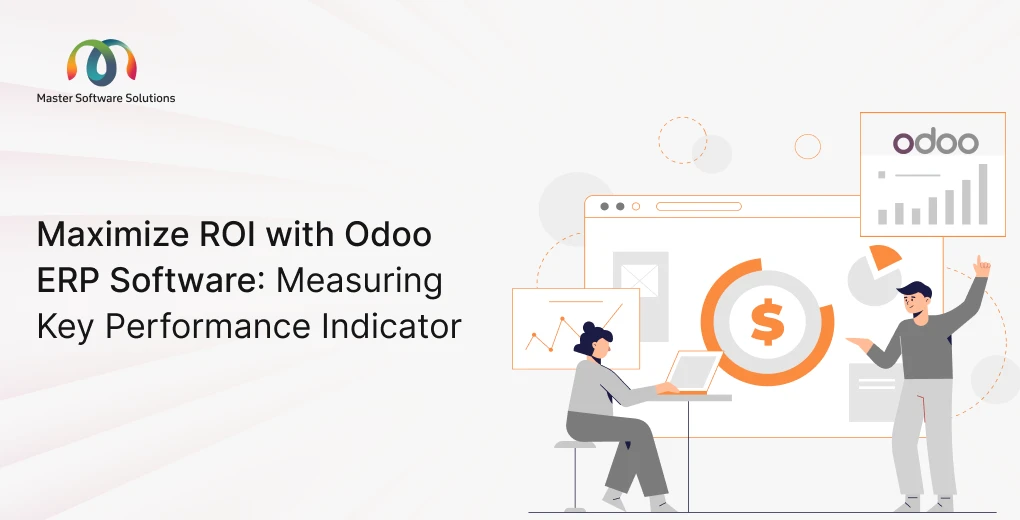
Enterprise Resource Planning (ERP) investments are often justified by the promise of increased efficiency, improved visibility, and long-term cost savings. However, many organizations struggle to quantify the return on investment (ROI) after implementation. Even a powerful platform like Odoo ERP can fall short of its strategic potential without measurable results.
Maximizing ROI with Odoo ERP software requires continuous performance measurement through the right Key Performance Indicators (KPIs). When aligned with business objectives, KPIs transform Odoo from an operational system into a data-driven decision engine.
This blog explores how organizations can identify, measure, and leverage the most critical KPIs to ensure their Odoo ERP investments deliver measurable, sustainable value.
Understanding ROI in the context of Odoo ERP
To evaluate the success of an Odoo ERP implementation, organizations must first establish a clear and practical understanding of return on investment (ROI). In an ERP context, ROI is not limited to cost savings alone; it reflects the overall business value generated by the system to the total cost of ownership.
Defining ROI for ERP systems
ROI in ERP implementation is measured by comparing the financial and operational benefits achieved against the costs incurred, including licensing, implementation, customization, training, and ongoing maintenance. For Odoo ERP software, ROI is expressed through improved efficiency, reduced operational expenses, increased revenue, and enhanced decision-making capabilities. A well-defined ROI framework helps organizations justify their ERP investment and track performance over time rather than treating ERP success as a one-time milestone.
Tangible vs. intangible returns
ERP ROI consists of both tangible and intangible returns:
Tangible : Tangible returns are measurable and directly impact financial performance. Examples include reduced inventory holding costs, lower manual labor expenses due to automation, faster order processing, improved cash flow, and decreased IT maintenance costs from system consolidation.
Intangible : Intangible returns are less quantified but equally important. These include data visibility, improved cross-departmental collaboration, enhanced customer satisfaction, regulatory compliance, and greater organizational agility. While intangible benefits may not appear immediately on financial statements, they often drive long-term competitive advantage.
Understanding both dimensions ensures a realistic and comprehensive assessment of Odoo ERP’s value.
How does Odoo’s modular architecture impact ROI realization?
Odoo’s modular architecture plays a significant role in accelerating and optimizing ROI. Organizations can implement only the modules they need, reducing upfront costs and implementation complexity. As businesses evolve, they can seamlessly add modules without re-platforming or major system disruption.
This phased adoption enables businesses to:
- Achieve quicker time-to-value
- Prioritize the high-impact process first
- Scale functionality in line with growth
- Continuously enhance ROI rather than waiting for a single, large payoff
Aligning module selection with strategic KPIs enables businesses to directly link Odoo functionality to measurable performance improvements, making ROI more transparent, manageable, and sustainable over time.
Why do KPIs matter in Odoo ERP implementations?
Implementing Odoo ERP is a strategic investment designed to enhance visibility, efficiency, and informed decision-making throughout the organization. However, without clearly defined Key Performance Indicators (KPIs), it becomes difficult to determine whether the system is delivering its intended value. KPIs provide the measurable framework that connects ERP functionality to business outcomes.
The role of KPIs in performance management
KPIs serve as objective, data-driven benchmarks for evaluating organizational performance. Within Odoo ERP, tracking how well processes, teams, and departments are performing over time, KPIs transform raw transactional data into actionable insights. They identify trends, inefficiencies, and opportunities, enabling management to move from reactive problem-solving to proactive performance management.
Embedding KPIs into dashboards and reports enables stakeholders to monitor performance in real time, enforce accountability, and support continuous improvement initiatives. Without KPIs, ERP data remains underutilized, and performance assessments become subjective or anecdotal.
Aligning KPIs with business objectives
KPIs are most effective when they directly support an organization’s strategic and operational goals. Tracking metrics that do not align with business priorities creates noise and limits insight. For instance, if improving cash flow is a key objective, relevant KPIs may include days sales outstanding (DSO), inventory turnover, and invoice processing time.
Odoo’s flexibility allows KPIs to be defined at both executive and departmental levels. When aligned with business objectives, these KPIs ensure that Odoo modules consistently drive measurable and meaningful outcomes.
Common mistakes organizations make when tracking ERP success
Many organizations fail to realize the full value of their ERP investment due to poor KPI practices. Common mistakes include:
- Tracking too many KPIs leads to analysis paralysis and a lack of focus
- Focusing solely on system usage metrics rather than business impact metrics
- Using generic KPIs that are not tailored to the organization’s processes or goals
- Failing to establish baselines makes it possible to measure improvement
- Ignoring user adoption and data quality, which undermines KPI accuracy
Key KPI categories for measuring Odoo ERP ROI
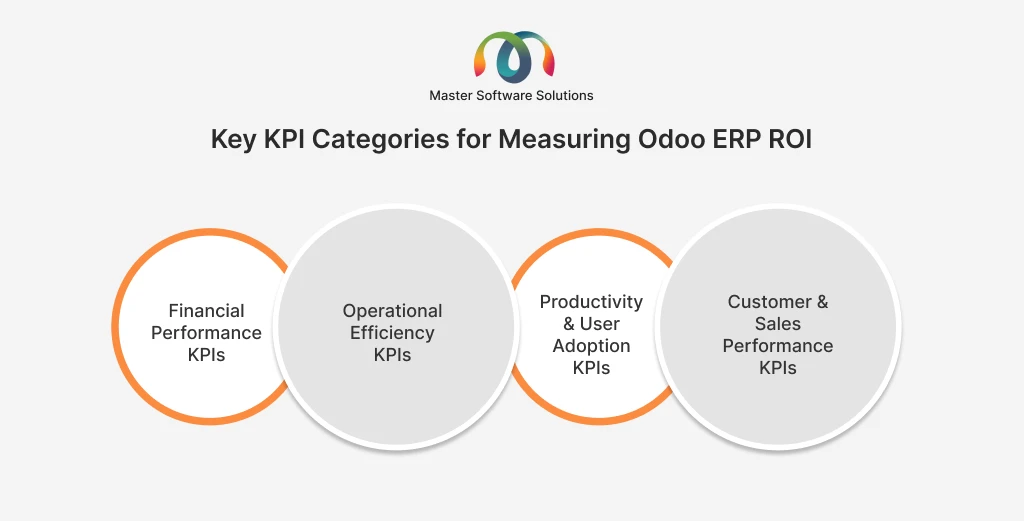
Businesses should track primary KPI categories to evaluate and maximize ROI from Odoo ERP. Each category highlights a distinct facet of business performance and how effectively Odoo supports both operational and strategic goals. Here are the key KPI categories for measuring Odoo ERP ROI.
Financial performance KPIs
Financial KPIs evaluate cost efficiency, profitability, and liquidity improvements, measuring the direct economic impact of Odoo ERP.
- Cost reduction (operational, inventory, labor): Measures savings achieved through process automation, optimized inventory levels, and reduced manual effort.
- Revenue growth and margin improvement: Tracks how Odoo supports higher sales, better pricing control, and improved profit margins.
- Cash flow and working capital efficiency: Assess improvements in receivables, payables, and inventory management that strengthen cash position.
Operational efficiency KPIs
Operational KPIs evaluate how effectively Odoo streamlines and standardizes core business processes.
- Process cycle time reduction: Measures how quickly key processes (procure-to-pay, order-to-cash) are completed after ERP implementation.
- Inventory turnover and stock accuracy: Indicators of how well Odoo optimizes inventory levels and improves demand visibility.
- Order fulfillment and on-time delivery: Tracks the ERP’s impact on delivery reliability and customer satisfaction.
Productivity and user adoption KPIs
These KPIs measure employee adoption of Odoo and its effectiveness in increasing workforce productivity.
- User adoption and system utilization rates: Measures the consistency of the team in using Odoo as their primary system of record.
- Automation ratio and manual effort reduction: Evaluates the extent to which manual tasks are automated in workflows.
- Employee productivity metrics: Tracks output per employee, highlighting efficiency gained from Odoo.
Customer and sales performance KPIs
Customer and sales KPIs measure how Odoo ERP contributes to revenue growth, customer retention, and sales efficiency.
- Customer acquisition cost (CAC): The efficiency of the organization in acquiring new customers using Odoo CRM and sales tools.
- Customer Lifetime Value (CLV): Measures long-term customer profitability supported by improved service and engagement.
- Sales pipeline velocity and conversion rates: Tracks the deal’s progression speed and success rates across the sales funnel.
Mapping KPIs to Odoo modules
Mapping KPIs to specific Odoo modules ensures that performance measurement is grounded in accurate, system-generated data rather than manual reporting. Each module captures operational activities that directly contribute to measurable business outcomes.
Finance and accounting
The finance and accounting module is the primary source for financial KPIs. It supports metrics such as operating costs, profit margins, cash flow, days sales outstanding (DSO), and return on assets. Because transactions are recorded in real-time, finance teams gain immediate visibility into financial health and can track ROI-related improvements with high accuracy.
Sales and CRM
The sales and CRM modules drive customer- and revenue-related KPIs. Common metrics include lead conversion rates, sales pipeline velocity, customer acquisition cost (CAC), average deal value, and revenue growth. Centralizing customer interactions and sales activities enables consistent tracking of sales performance from lead generation through order confirmation.
Inventory and manufacturing
Inventory and manufacturing modules support operational efficiency KPIs, such as inventory turnover, stock accuracy, production cycle time, yield rates, and order fulfillment performance. These KPIs help organizations measure how effectively Odoo reduces waste, improves planning accuracy, and enhances supply chain responsiveness.
HR and project management
The HR and project management modules provide insight into workforce productivity and resource utilization. KPIs such as employee productivity, labor cost per project, billable utilization, project completion rates, and budget variance can be monitored to assess how efficiently human capital is being managed.
How does integrated data improve KPI accuracy?
Odoo’s fully integrated architecture ensures that data flows seamlessly across modules, eliminating silos and duplicate data entry. This integration ensures that financial, operational, sales, and HR metrics are derived from a single source of truth, which is a centralized database. As a result, organizations can rely on their KPIs, identify root causes faster, and make data-driven decisions that directly improve ROI.
How to measure KPIs effectively in Odoo?
Measuring KPIs effectively requires a structured approach that combines native reporting capabilities, customization, and strong data governance. When implemented correctly, Odoo provides real-time, reliable insights that directly support performance management and ROI optimization.
Using Odoo dashboards and reports
Odoo’s built-in dashboards and reporting tools enable organizations to track KPIs in real-time across modules, including Finance, Sales, Inventory, and Manufacturing. Standard reports provide immediate visibility into core metrics, while configurable dashboards enable role-based views for executives, managers, and operational teams. This ensures that stakeholders monitor relevant KPIs without relying on manual reporting or external spreadsheets.
Configuring custom KPIs and alerts
Not all organizations measure success in the same way. Odoo enables the creation of custom KPIs tailored to specific business objectives. Custom reports, calculated fields, and automated alerts can be set up to monitor thresholds, trends, and exceptions, such as overdue receivables or decreasing inventory turnover. Alerts ensure that issues are addressed proactively rather than after performance has already declined.
Leveraging Odoo Studio and third-party BI tools
Odoo Studio is a low-code environment for extending KPI tracking without deep technical expertise. It enables users to create custom fields, views, and reports aligned with internal performance frameworks. For more advanced analytics, Odoo integrates with third-party business intelligence (BI) tools, enabling deeper data visualization, forecasting, and cross-system analysis while maintaining Odoo as the core data source.
Data governance and accuracy considerations
Effective KPI measurement depends on data quality and consistency. Organizations must establish clear data governance practices, including standardized data entry, role-based access controls, validation rules, and regular audits. Poor data quality or low user adoption undermines KPI reliability and ROI analysis. Strong governance ensures that KPIs accurately reflect business performance and support confident decision-making.
Best practices to maximize ROI using KPI insights
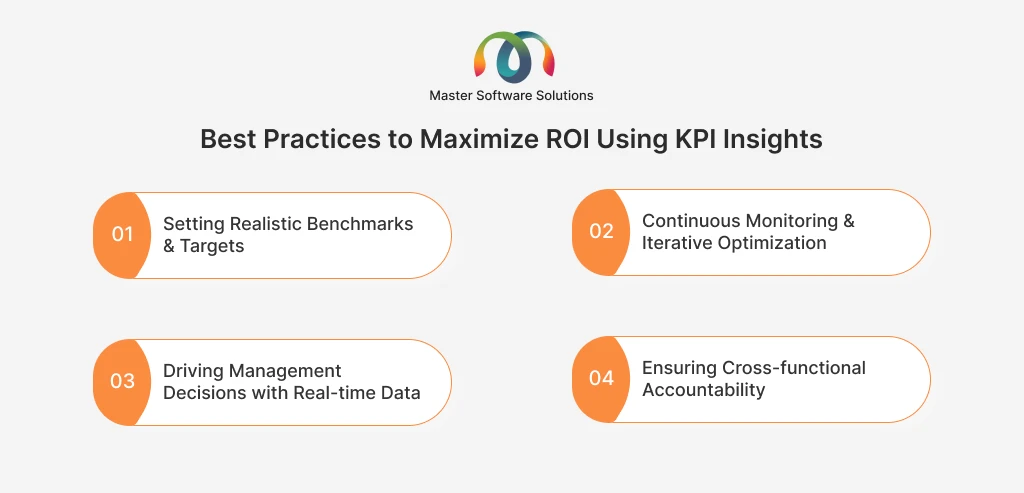
Tracking KPIs is only valuable if the insights generated are actively used to drive improvement. The following best practices help organizations translate Odoo KPI data into measurable ROI gains.
Setting realistic benchmarks and targets
Effective KPI management begins with clear, achievable benchmarks. Organizations should establish baseline performance levels before or shortly after implementing Odoo, then define realistic improvement targets based on business priorities and industry context. Overly aggressive targets can discourage adoption, while unclear benchmarks make ROI impossible to measure. Well-defined targets provide direction and enable meaningful performance comparison over time.
Continuous monitoring and iterative optimization
KPIs should be monitored on an ongoing basis rather than reviewed periodically. Odoo’s real-time reporting allows organizations to identify performance gaps early on and make incremental changes to processes, workflows, or configurations. Continuous monitoring supports iterative optimization, ensuring that ERP-driven improvements compound over time instead of stagnating after migration.
Driving management decisions with real-time data
KPIs are most impactful when they inform day-to-day and strategic decision-making. Real-time visibility into financial, operational, and sales metrics allows leaders to respond quickly to risks and opportunities. Using Odoo KPI dashboards in management reviews shifts decision-making from intuition-based to data-driven, improving accuracy and speed while reducing operational risk.
Ensuring cross-functional accountability
Maximizing ROI requires shared ownership of performance outcomes. KPIs should be clearly assigned to teams or roles across finance, operations, sales, and HR, with transparency into how individual performance contributes to the organizational goals. Odoo’s integrated data model supports cross-functional accountability by aligning departments around common metrics and reducing silos, ensuring that ERP value is realized enterprise-wide.
Conclusion
Maximizing ROI with Odoo ERP software is an ongoing, data-driven process. Defining the right KPIs, aligning them with business objectives, and measuring them consistently across Odoo enables businesses to quantify value, identify performance gaps, and drive continuous improvement. When KPIs are used effectively, Odoo transitions from a transactional system to a strategic performance management platform that enables informed decision-making and long-term growth.
However, realizing this level of ROI requires more than technology alone. It demands the right implementation approach, KPI framework, and governance model. Master Software Solutions, an Odoo implementation partner, helps organizations leverage the Odoo ERP system by aligning the system configuration with business goals, defining meaningful KPIs, and enabling actionable dashboards and reports.
With deep Odoo expertise and a results-focused methodology, we ensure that your ERP investment delivers measurable outcomes. Contact us today for a personalized Odoo assessment or KPI strategy consultation and start turning ERP data into measurable business value.