When businesses evaluate ERP systems, they tend to focus on features such as modules, integrations, reporting, and user interface. What gets far less attention is one of the most operationally critical questions of all: what happens when everything runs at once?
Picture a typical peak hour in your business. Your finance team is pulling month-end reports. Your warehouse team is processing bulk delivery confirmations. Your sales team is creating orders. Your operations manager is refreshing a live dashboard. And your purchasing department is running a vendor reconciliation in the background.
Does the system hold up? Or does it slow to a crawl, freeze, or lock up entirely?
This is one of the most underasked questions in ERP conversations and one of the most important ones you should be pushing your partner on before you sign anything.
The Performance Questions You Must Ask
Before committing to any ERP platform, ask your vendor these specific technical questions:
- What happens when multiple users run heavy reports and live transactions simultaneously, does one affect the other?
- Does the system use separate database tables per module, or is everything running off shared tables that can block each other?
- Does your reporting engine use materialized views to isolate complex queries from live operational data?
- Can you share official benchmark data on concurrent user capacity and transaction volumes?
- How does performance scale as our data volume grows over years of operation?
And here is the critical test: if your partner cannot provide official benchmark numbers or show you a live system under load, that is a red flag. Technical claims without evidence are just sales talk.
What Poor Architecture Actually Costs You
Before getting into how Odoo handles this, it is worth understanding what bad performance architecture looks like in practice, because many businesses only discover it after go-live.
In poorly architected ERP systems, all modules share the same core database tables. When one user runs a large report, it creates a long-running query that locks those shared tables.
Every other user trying to access the same tables, to log a sale, to confirm a delivery, or to raise a purchase order has to wait. In high-concurrency environments, this creates forced slowdowns that can grind operations to a halt during peak hours.
This is not a theoretical risk. It is a well-documented failure mode in legacy ERP platforms, and it is exactly the kind of problem that surfaces only once the system is in production with real data volumes and real user loads.
Our Answer: How Odoo’s Architecture Handles High Volume
Odoo’s architecture is specifically designed to prevent the performance issues described above. Here is how it works technically.
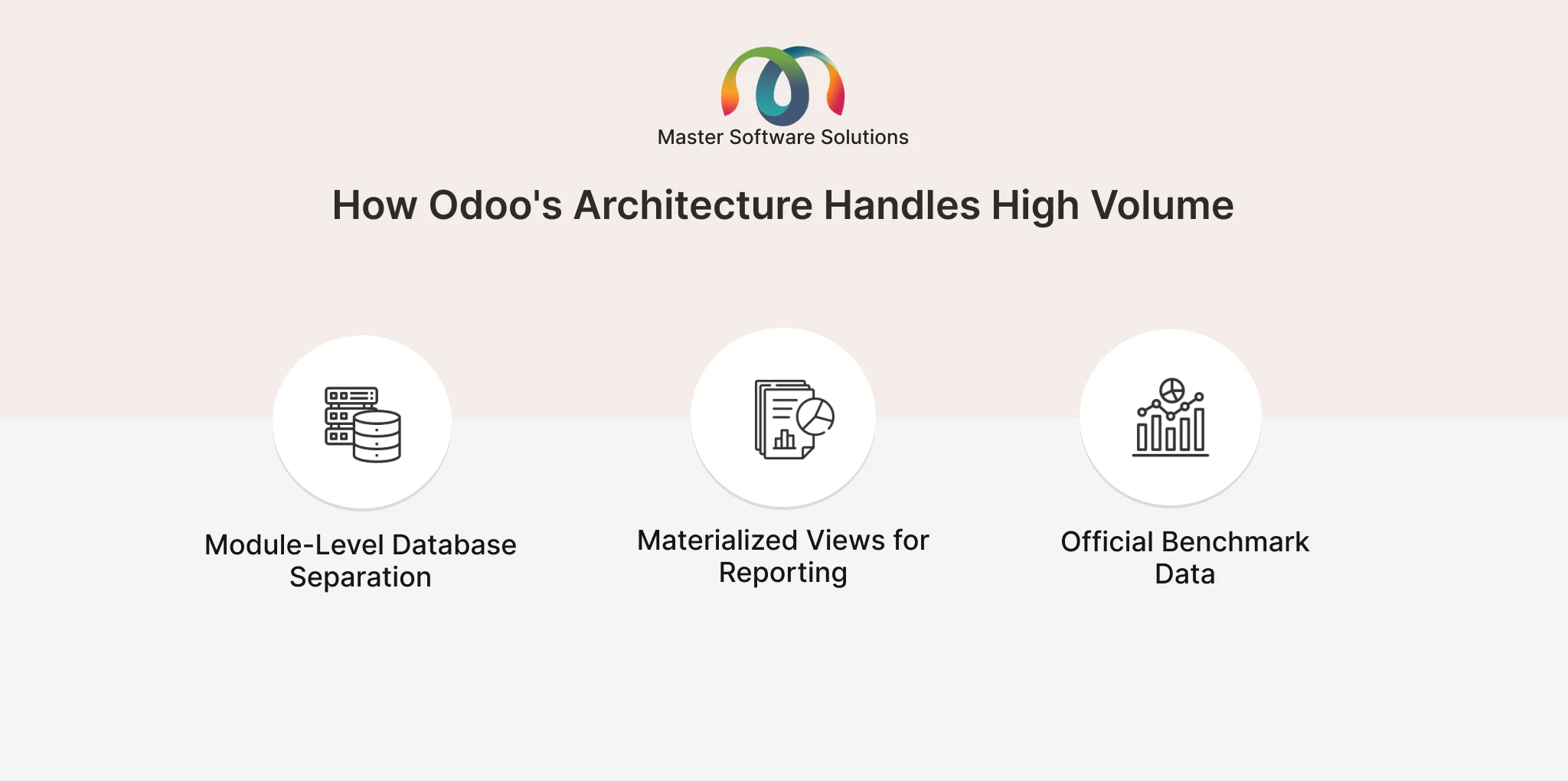
Module-Level Database Separation
Each module in Odoo operates on its own separate set of database tables. There is no single shared source table that spans across modules. Your sales data, manufacturing data, inventory data, and accounting data each live in their own dedicated table structures.
The practical consequence of this is significant: a heavy dashboard report running in your analytics module will not lock the tables used by your sales or manufacturing module. They are completely independent. One team’s intensive reporting activity does not become another team’s performance problem.
Materialized Views for Reporting
For reporting specifically, Odoo creates materialized views, including pre-joined snapshots of data that are computed and stored separately from your live operational tables. When a user runs a complex report, the query runs against this pre-computed snapshot, not against the live transactional data.
This means that no matter how complex or data-intensive your reports are, they never run directly against the tables your operations team is using in real time. Operational performance is never compromised by reporting activity.
Official Benchmark Data
At Master Software Solutions, we include official Odoo performance benchmarks, published by Odoo, as a dedicated section in every proposal we submit. We believe technical explanations are not enough on their own. You deserve to see the actual numbers that back up the claims.
These benchmarks cover concurrent user capacity, transaction throughput, and response times under load. If your current or prospective ERP partner has not shown you these figures, ask for them explicitly. A confident partner with a well-performing product will not hesitate to share it.
Want to see the official Odoo performance benchmarks for your use case? Request a Technical Proposal from Master Software Solutions
What This Means for Your Business in Practice
The architecture decisions described above translate into real-world operational outcomes that your teams will feel every day:
- Your finance team can run month-end reports without your sales team experiencing slowdowns on the order entry screen.
- Your warehouse team can process hundreds of delivery confirmations in bulk without affecting the dashboards your operations managers are monitoring live.
- Your purchasing team can run large vendor reconciliations in the background while procurement continues uninterrupted.
- Your growing data volume, years of transactions, documents, and history, is managed through Odoo’s database architecture in a way that keeps query performance predictable as the system scales.
This is not just about today’s user count. As your business grows and your concurrent user load increases, the architecture that underlies your ERP will determine whether it scales gracefully or starts creating operational friction.
The Benchmark Transparency Test
Here is a simple test you can apply to any ERP partner you are speaking with.
Ask them: “Can you show us official, published benchmark data on concurrent user performance and transaction volumes?”
A partner who responds with vague reassurances, anecdotal customer references, or a promise to “check internally” is not in a position to make credible performance claims. A partner who can immediately share documented benchmarks and walk you through what they mean for your specific environment is one who understands the product deeply and is committed to setting accurate expectations.
At Master Software Solutions, benchmark transparency is a standard part of our process, not something we produce on request after the fact.
Not sure what performance benchmarks you should be looking for? Talk to an Odoo Technical Consultant and we’ll Walk You Through It
About Master Software Solutions
Master Software Solutions is a specialist Odoo consulting and implementation partner with a track record of deploying Odoo for businesses operating at scale across multiple locations, high transaction volumes, and demanding concurrent user environments.
We take a technical-first approach to Odoo ERP consulting. That means we do not just configure software; we design systems with performance, scalability, and long-term reliability built in from day one. When we present Odoo to a prospective client, benchmark data and infrastructure planning are always part of the conversation, not afterthoughts.
Our services include:
- End-to-end Odoo implementation and configuration
- Performance-oriented infrastructure design and hosting setup
- Data migration from legacy ERP systems
- Custom module development and integration
- Ongoing system optimisation and support
- User training and change management
We work with businesses across manufacturing, logistics, distribution, retail, and professional services, including multi-entity and multi-country organizations with complex operational requirements.
Ready to have a technical conversation about Odoo’s performance for your environment? Book a Consultation with Master Software Solutions
Frequently Asked Questions
Q1. How many concurrent users can Odoo handle?
A1. Odoo’s concurrent user capacity depends on your hosting infrastructure and configuration. Odoo publishes official benchmark data covering different deployment sizes and user loads. At Master Software Solutions, we include these benchmarks in our proposals and help you size your infrastructure based on your actual expected usage.
Q2. Will running reports slow down my live operations in Odoo?
A2. No, not when Odoo is correctly configured. Odoo uses materialized views for reporting, which means complex report queries run against pre-computed data snapshots rather than your live operational tables. Your operational users will not experience slowdowns caused by reporting activity.
Q3. What happens if multiple users run heavy processes at the same time?
A3. Because Odoo separates database tables by module, concurrent heavy processes in different modules do not interfere with each other. A bulk import in your inventory module will not block activity in your sales or accounting module.
Q4. How does Odoo perform as our data volume grows over several years?
A4. Odoo’s PostgreSQL database is well-suited to handling large data volumes when properly maintained. Performance management strategies, including database indexing, archiving of historical data, and infrastructure scaling, are part of how a good implementation partner supports your system over the long term.
Q5. Is Odoo performance affected by which hosting option we choose?
A5. Yes, significantly. Odoo is available on Odoo.sh (Odoo’s own cloud platform), third-party cloud hosting, and on-premises infrastructure. Each option has different performance characteristics and cost profiles. Your implementation partner should help you evaluate the right fit based on your user count, transaction volumes, and budget.
Q6. What is a materialized view and why does it matter?
A6. A materialized view is a pre-computed, stored snapshot of a complex database query. Instead of recalculating the query every time a report is run, the system reads from the snapshot. This dramatically reduces the load on your live operational database during reporting, keeping the rest of the system fast and responsive.
Q7. How do I know if an ERP vendor’s performance claims are reliable?
A7. Ask for official, published benchmark data, not just customer testimonials or verbal assurances. Ask your partner to show you the benchmarks and explain what they mean for your specific setup. If they cannot produce documented figures, treat that as a significant concern.
Q8. Does Odoo support horizontal scaling for very large deployments?
A8. Yes. For large enterprise deployments, Odoo supports multi-server configurations and load balancing, allowing the system to scale horizontally as user and transaction volumes increase. This is an infrastructure-level discussion that your implementation partner should guide you through during the scoping process.
Want us to include official Odoo performance benchmarks in a proposal tailored to your business? Get in touch and we will put together a technical proposal, including benchmark data, infrastructure recommendations, and a configuration plan, specific to your user count and transaction volumes.