Enterprise Resource Planning has become a building block for various modern businesses and supply chain operations. ERP Software has become fundamental to streamlining operations through automation and integration of artificial intelligence.
97% of businesses have confirmed that ERP has transformed their business operations. They have also noted 86% better reporting and visibility with increased growth and competitiveness. These numbers are a testament to how ERP has revolutionized business operations and how fast it can help them grow.
High operational costs, poor inventory management, inefficient manual processes, financial & operational discrepancies, limited scalability & growth, and communication & decision-making gaps are common challenges businesses face. These can actually eat up profits and make it difficult for businesses to grow.
This blog explains how ERP software helps businesses optimize and streamline their business operations.
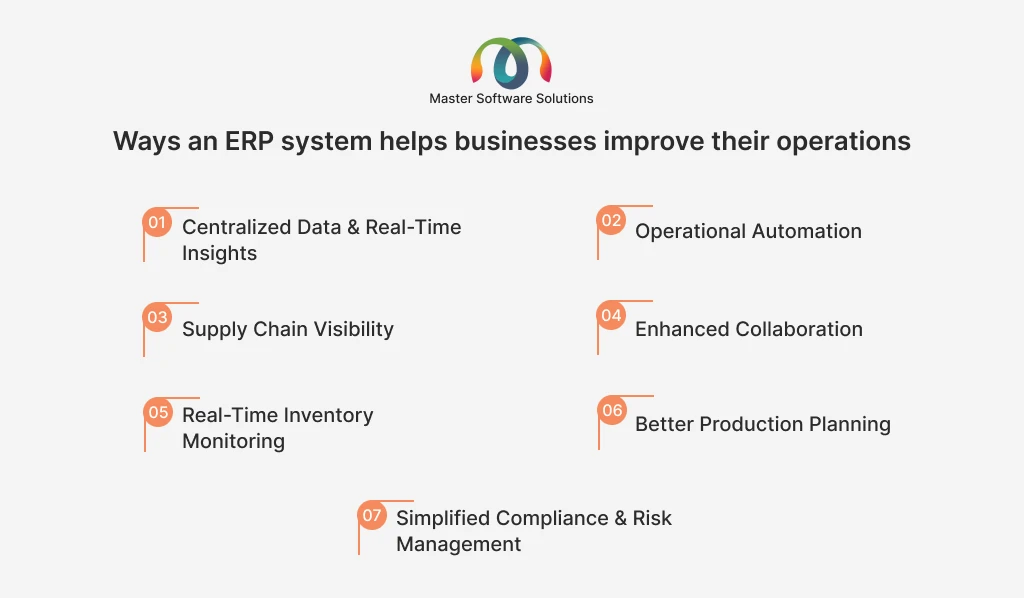
Ways an ERP system helps businesses improve their operations
An Enterprise Resource Planning (ERP) system is a consolidated system that provides interconnected business management applications to operate and track operations from a single screen. This enhances business efficiency, streamlines various departments, boosts productivity, and ensures data accuracy. Here are the ways an ERP system can improve business operations:
Centralized data & real-time insights
ERP software offers a one-stop enterprise-level solution, with all business data stored in a single database, eliminating data silos and connecting all your departments, including HR, finance, manufacturing, etc. Such integrations ensure real-time, actionable insights on the business dashboard and automated, low-error workflows. It boosts your operational productivity and accelerates your decision-making. How do centralized data and real-time insights enhance your business operations?
- Centralized data: The system consolidates all your business data into a single system, eliminating manual data errors and ensuring that your teams work on the same accurate information.
- Real-time visibility: With multiple interconnected business departments, data is updated in real time. This enables businesses to track their operations in real time, allowing proactive responses to the issues rather than reactive or last-minute adjustments.
- Improved efficiency: Routine or daily tasks, such as order processing, inventory updates, or report generation, are automated. This frees up your employees to focus on more strategic tasks.
- Enhanced collaboration: A unified system enables data to flow seamlessly throughout various business departments. This reduces data silos and improves coordination between teams.
- Agility and compliance: Real-time data and insights enable businesses to adjust quickly to issues. It also makes it easy to maintain audit trails with real-time data updates, ensuring regulatory compliance.
Operational automation
The ERP software automates operations by integrating data across all your departments into a single database. This eliminates manual, repetitive tasks and accelerates workflows, increasing productivity, reducing errors, and lowering costs. Here are the key areas that ERP automates.
- Inventory management: Real-time inventory monitoring allows automatic purchasing, reducing overstocking and understocking. This cuts down storage and warehouse operational costs.
- Finance and accounting: The system automation handles tasks such as invoicing, expense management, and reconciliation. All your financial data is consolidated and processed in the finance module, enhancing accuracy and accelerating cash flow.
- Order processing and fulfillment: Automated ERP systems can trigger actions, such as sending order confirmations, generating shipping labels, and updating inventory, based on Service Level Agreements (SLAs).
- Human Resources: Automated resource management streamlines employee onboarding and payroll management. This frees up your HR teams for strategic tasks such as planning for growing teams.
- Production and procurement: Automated replenishment and production scheduling based on demand forecasting to improve efficiency.
Supply chain visibility
The ERP system centralizes data across procurement, manufacturing/processing, logistics, and finance, providing real-time, complete visibility. This end-to-end visibility enables precise tracking of inventory levels and reduces stock issues by upto 60%. This improves agility in handling supply chain disruptions, cuts operational costs, and enhances customer service. Here is how enhanced supply chain visibility improves operations.
- Real-time inventory management: The ERP system enables you to track stock levels in real time. The system allows multi-location and in-transit inventory tracking, preventing both stockouts and overstocking. This reduces your costs due to storage and product wastage.
- Centralized data source: The system consolidates data from suppliers, manufacturing, and logistics, creating a single source of truth. This eliminates data silos and improves collaboration among multiple departments.
- Process automation: The Enterprise Resource Planning (ERP) platform automates operations, including purchasing, order processing, procurement, and inventory updation. This reduces manual data errors and accelerates the process speed, improving overall business productivity.
- Improved supplier & vendor management: A centralized ERP platform enables businesses to track vendor performance, purchase orders, and invoices, fostering better relationships and compliance.
- Enhanced demand forecasting: The system provides predictive analysis that uses historical data to predict future trends, enabling businesses to adjust for demand spikes and optimize stock levels.
- Agility during disruptions: The ERP software provides real-time insights, enabling quick identification of disruptions and making necessary changes.
Enhanced collaboration
ERP systems centralize the database and break down departmental silos, allowing teams to share real-time data, reducing redundant work, and improving cross-functional communication. This unified approach accelerates decision-making, streamlines workflows, and aligns team goals. Here is how enhancing collaboration across multiple departments improves operations.
- Centralized data access: The unified platform enables all your departments, including finance, manufacturing, warehousing, sales, and distribution, to work with the same data. This ensures data accuracy and consistency.
- Breaking silos: Interconnected business departments encourage cross-functional teamwork and prevent communication gaps. Breaking silos fosters open communication, breaks barriers between departments, and aligns teams to a common goal.
- Improved project management: Centralized communication and documentation, defined explicit roles, and using integrated tools align teams towards shared goals. This boosts transparency, reduces task duplication, and builds trust, enabling real-time coordination.
- Streamlined communication: The system removes information silos, reduces misunderstandings, and fosters real-time, transparent data sharing. It synchronizes efforts, boosts team management, and accelerates decision-making by optimizing tools, ensuring that all the teams are on the same page.
- Remote work support: The ERP system fosters real-time communication, streamlines workflows, and builds trust through digital tools, clear documentation, and intentional team-building. Modern cloud-based ERPs enable employees to access critical data from anywhere, enhancing on-the-go collaboration.
Real-time inventory monitoring
The ERP system provides real-time, centralized visibility into stock levels, reducing human error and optimizing inventory control. Automating tracking, barcode scanning, and intelligent reordering prevents stockouts and overstocking, lowering carrying costs and improving customer satisfaction. Key ways in which real-time inventory monitoring improves business operations.
- Real-time tracking & visibility: The system provides instant, accurate data on stock levels and locations using RFID and IoT. This reduces manual errors, eliminates stockouts, optimizes warehouse space, expedites order fulfillment, and improves demand forecasting, cutting costs and enhancing customer satisfaction.
- Workflow automation: ERP replaces manual, error-prone tasks with real-time, technology-driven processes. It provides instant visibility into inventory, automatically triggers reorder alerts, and reduces labor costs, improving accuracy and efficiency. This leads to optimized inventory levels, faster order fulfillment, and increased profitability.
- Optimized stock levels: The ERP software streamlines warehouse workflows, minimizes obsolete stock, and accelerates order fulfillment, which boosts profitability and customer satisfaction. It balances supply with demand, reducing holding costs, preventing stockouts, and enhancing cash flow.
- Enhanced demand planning: ERP aligns stock levels with predicted demand, reducing carrying costs and preventing stockouts. It also streamlines operations such as procurement and production, increases inventory turnover, and enhances customer service through improved availability. This enables a proactive approach, boosting efficiency and profitability.
- Improved supply chain management: Real-time visibility reduces holding costs, minimizes stockouts, and enhances order accuracy. Using data-driven forecasting and advanced technology, you can balance inventory levels, improve supplier relationships, and accelerate order fulfillment.
Better production planning
The ERP system integrates real-time data across departments, allowing for accurate forecasting, reduced inventory costs, and optimized resource allocation. This cloud-based platform automates scheduling, reduces errors, and improves the shop floor processes, streamlining manufacturing operations and ensuring it meets demand faster. Key improvements in production planning that improve business operations include.
- Real-time data & visibility: The ERP system replaces reactive, manual updates with live, actionable insights from the shop floor. This reduces downtime, optimizes resource utilization, and enhances decision-making, leading to lower costs and improved product quality. It converts static planning into an agile, adaptable system.
- Material Requirement Planning (MRP): It ensures that the right materials are available at the right time, minimizing inventory holding costs and optimizing production schedules. It can calculate net requirements based on demand, bills of materials (BOM), and inventory levels. This prevents stockouts, reduces rush orders, and synchronizes purchasing with manufacturing, resulting in higher efficiency and better customer service.
- Optimizing scheduling & routing: The system plays a crucial role in aligning resources with production needs, minimizing machine idle time, reducing bottlenecks, and lowering transportation or material movement costs. This ensures on-time delivery and higher productivity. Optimizing scheduling and routing increases efficiency, reduces costs, and boosts customer satisfaction.
- Better resource allocation: It optimizes the distribution of labor, materials, and equipment, reducing waste, increasing productivity, and lowering operational costs. It eliminates disruptions, ensures timely project completion, and improves workflow efficiency, allowing businesses to adapt quickly to changes in demand.
- Improved forecasting: The system can align production schedules with actual production, reducing excess inventory by 20-30% and minimizing stock-outs. It optimizes resource allocation (labor, materials, machinery), cuts costs, and increases profitability through consistent, data-driven planning that improves efficiency across the entire supply chain.
Simplified compliance & risk management
An Enterprise Resource Planning (ERP) system is a central system that integrates core business departments (finance, HR, supply chain, and more) into a single platform. It provides a single source of truth, reducing the chances of human errors, boosting productivity, and offering real-time insights to improve decision-making. Ways an ERP system simplifies compliance and risk management for improving business operations.
- Automated compliance and reporting: The system replaces manual, error-prone tasks with real-time, accurate, and consistent monitoring, significantly reducing operational costs and human errors. Centralized systems enable proactive risk management, faster audit preparation, and allow staff to focus on strategic tasks rather than repetitive data collection.
- Comprehensive audit trails: ERP provides ground-level visibility into “who, what, when, and why” for every action. This fosters accountability, enhances data integration, and automates compliance with regulations like GDPR and HIPAA. They enable time identification of process bottlenecks, facilitate proactive risk management, and strengthen cybersecurity.
- Built-in risk mitigation controls: The system embeds safety and regulatory requirements directly into daily workflows, transforming compliance from a reactive, manual task into a proactive, automated component of business processes. Integrating these controls enables organizations to reduce manual errors, streamline workflows, and enable faster decision-making.
- Real-time data access and security: The ERP software enables instant threat identification, automates regulatory reporting, and enables rapid decision-making. Leveraging continuous monitoring and AI allows businesses to avoid costly penalties, strengthen cybersecurity postures, and improve operational agility. This reduces compliance reporting time up to 60%.
- Proactive risk management: The ERP software enables businesses to identify, assess, and mitigate threats before they become disruptions, ensuring continuity and efficiency. It lowers incident response costs, improves decision-making with better data, and promotes a compliance culture that protects reputations.
Conclusion
Enterprise Resource Planning systems provide real-time visibility, data-driven insights, and streamlined processes, improving business efficiency, productivity, and profitability while reducing overall operational costs. The functionalities discussed above allow you to adjust your operations in real time, increasing the business’s agility.
Master Software Solutions offers end-to-end ERP implementation services, including consulting, migration, configuration, customization, and ongoing support. We are official partners with Odoo and Microsoft and use their ERP platforms, “Odoo” and “Microsoft Dynamics 365,” respectively, to offer custom enterprise-level solutions. We can help you transform your business landscape with smart AI-powered ERP implementation. Contact us to discuss your business operations and discover your ERP scope.