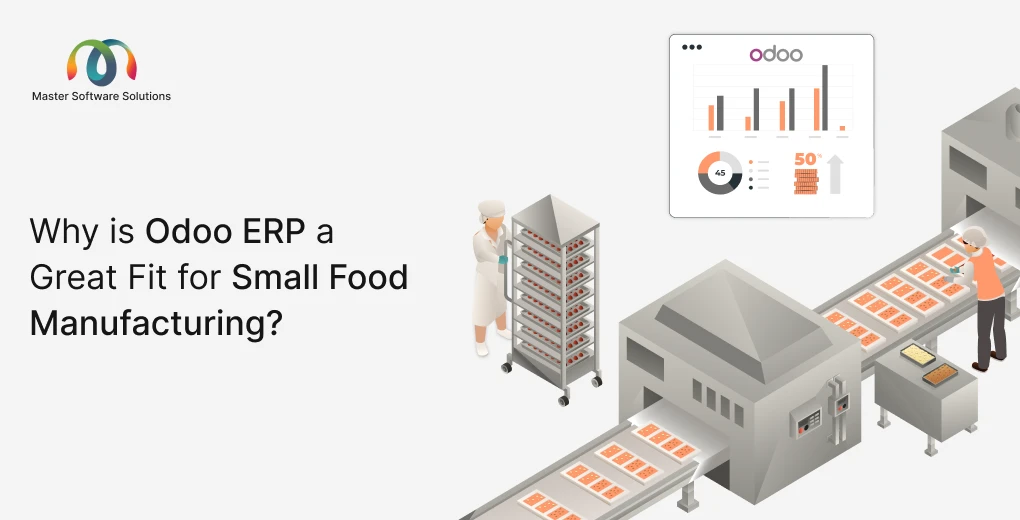
Small food manufacturers sit in an uncomfortable spot in the ERP market. Their operations are genuinely complex, including lot tracking, expiry dates, recipe management, supplier compliance, and food safety regulations, but the ERP platforms built to handle that complexity are priced and sized for companies ten times their revenue.
The result? Most small food manufacturers patch things together with spreadsheets, a standalone inventory tool, QuickBooks, and a lot of tribal knowledge stored in people’s heads. It works until it doesn’t. A recall, a rapid growth phase, or a major retail customer demanding traceability documentation can expose every crack in the system simultaneously.
Odoo changes that equation. It delivers the capabilities a food manufacturer actually needs, like lot tracking, recipe-based production, FEFO enforcement, quality control, supplier management, and compliance-ready traceability at a price point and implementation complexity that makes sense for a business with 10 to 150 employees.
This piece explains why Odoo fits the small food manufacturing world specifically and what that fit actually looks like in practice.
What are the Challenges Faced by Small Food Manufacturers?
The complexity of food manufacturing doesn’t scale with company size. A small bakery producing 50 SKUs faces the same fundamental challenges as a large bread company producing 500. These challenges include perishable ingredients, expiry-driven stock rotation, regulatory traceability, allergen management, and batch-level quality control. The difference is that the large company has a $2M ERP system to manage those challenges. The small bakery has a Google Sheet.
The specific pain points that bring small food manufacturers to ERP conversations almost always come from the same list:
Lot Traceability That Doesn’t Survive a Phone Call
A supplier issues a recall notice. The manufacturer needs to know which finished goods batches used that ingredient lot and which customers received them. Without a system, that investigation can take days of cross-referencing production logs, delivery records, and handwritten batch sheets if the records even exist.
Expiry Management That Relies on Memory
FEFO (First Expired, First Out) rotation is critical for perishable ingredients, but enforcing it manually means relying on warehouse staff to check dates every time they pick stock. One mistake doesn’t just waste an ingredient; it can contaminate a production run.
Recipe Scaling Without a Single Source of Truth
When recipes change, a supplier substitution, a reformulation, or a yield adjustment needs to propagate everywhere: production instructions, cost calculations, labeling, and allergen declarations. Without a central system, changes get missed.
Purchasing That’s Disconnected From Production
The production team knows they’re running low on an ingredient. Purchasing doesn’t find out until someone walks over and mentions it, or worse, until the production line stops.
Compliance Documentation That’s Always Behind
Retailer audits, FSMA requirements, and FDA inspections all require documentation that small manufacturers are often scrambling to reconstruct rather than simply pull up.
Odoo addresses each challenge not with workarounds, but with native functionality built for exactly these workflows.
Why Does Generic Small and Medium Business Software Fail?
QuickBooks, Xero, and basic inventory tools like Fishbowl or inFlow are built for businesses that buy and sell discrete items. They were not designed for manufacturers. The moment you introduce bills of materials, production orders, lot tracking, and expiry-driven rotation, you’re working against the grain of how these tools function.
The gaps show up quickly. QuickBooks can track inventory quantities, but it has no concept of assigning lot numbers, tracking expiration dates, or a bill of materials. Standalone inventory tools can track lots but have no purchasing integration, so purchase orders and inventory receipts live in separate systems. When you want to know the true cost of a finished good, ingredient cost plus labor plus overhead, there’s no way to calculate it without manual assembly from multiple sources.
The other option small food manufacturers sometimes consider is a purpose-built food ERP. These exist, and some are genuinely capable; however, they’re typically priced for mid-market to enterprise customers, require lengthy implementation cycles, and don’t offer the broad business management capabilities (CRM, eCommerce, HR, accounting) that growing food companies increasingly need.
Odoo occupies the gap these options leave open.
What Makes Odoo Different for Small Food Manufacturers?
It’s a complete business platform, not just a manufacturing tool. Odoo’s value isn’t just what it does for the production floor; it’s that the production floor is connected to everything else. Inventory talks to purchasing, which talks to accounting, which talks to sales. When a production order consumes ingredients, inventory updates in real time. When a purchase order is received, it’s automatically matched against the PO and the invoice. When a customer places an order, the system can automatically check the availability of finished goods and generate a delivery. This integration is what eliminates the manual handoffs that cost small teams so much time.
Modular Structure of Odoo
It lets manufacturers start where they need to. A small food manufacturer doesn’t have to implement every Odoo module on day one. Many start with Inventory and Purchasing to solve the most immediate pain points, then add Manufacturing, Quality, and Accounting as they’re ready. This phased approach keeps implementation cost and complexity manageable.
Flexible Pricing Model
Odoo Enterprise is licensed per user, and for small teams, the annual cost is significantly more accessible than most food-specific ERP platforms. Community Edition (free, open-source) is an option for businesses with very limited budgets and some technical capability. However, most food manufacturers benefit from the Enterprise features, particularly lot traceability, quality control, and the full manufacturing module.
Faster and Easy Implementation
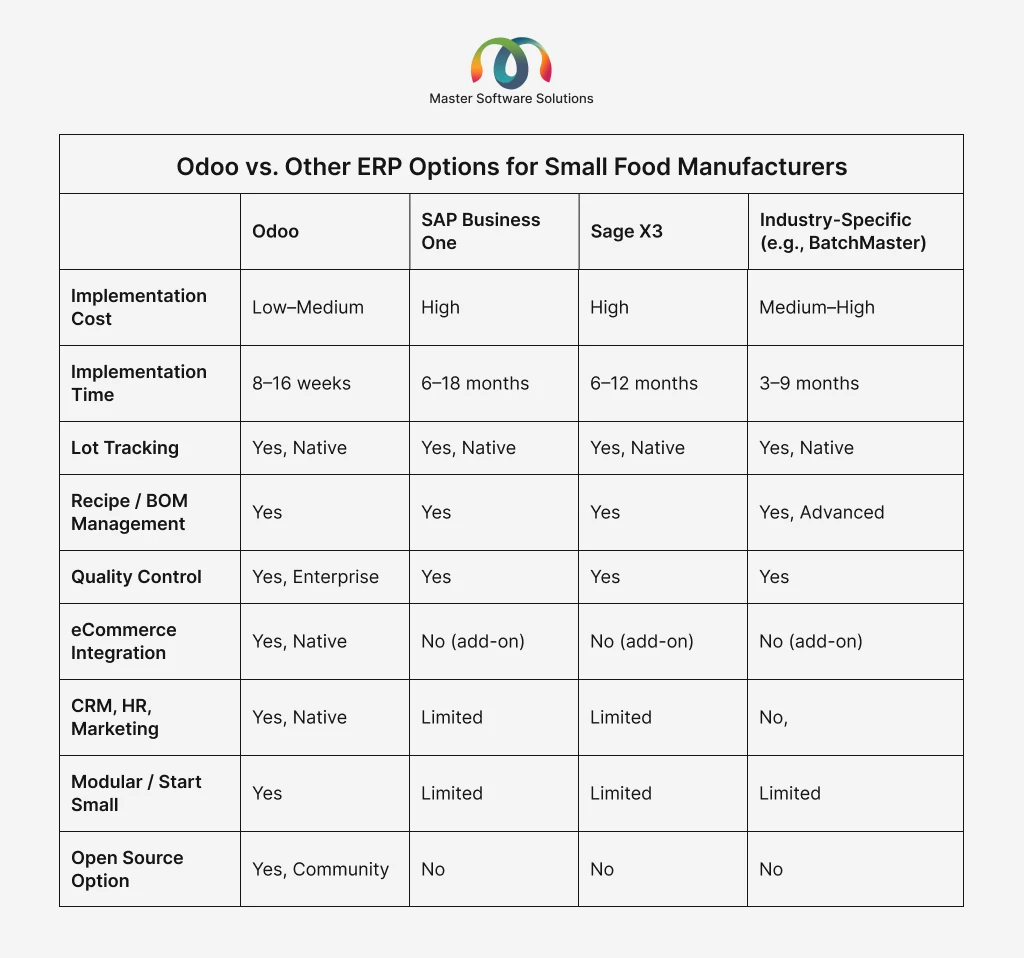
Large ERP implementations are famously long and expensive. A focused Odoo implementation for a small food manufacturer, covering inventory, purchasing, basic manufacturing, and accounting, can go live in 8 to 16 weeks with an experienced partner. That’s a timeline small businesses can actually plan around.
What are the Features of Odoo for Small Food Manufacturers?
The Odoo ERP system offers a complete suite of business applications that help food manufacturers manage and track operations. The key features of Odoo include:
Lot and Batch Tracking
Every ingredient enters Odoo with a lot number, typically tied to the supplier’s lot and the receipt date. Every production batch is assigned a lot that carries forward to finished goods. The result is full forward and backward traceability: if a supplier issues a recall, you can identify every affected finished-goods batch and every customer who received it in minutes, not days.
For small food manufacturers selling to grocery chains, food service distributors, or consumers directly, this level of traceability is increasingly a commercial requirement and not just a regulatory one. Retail customers ask for it at audit time. Having the documentation ready in Odoo is the difference between passing and scrambling.
FEFO Enforcement
Odoo enforces first-expired, first-out rotation automatically. When a warehouse worker picks an ingredient for production, Odoo directs them to the correct lot based on expiry date; the one expiring soonest is consumed first. Alerts fire automatically when lots are approaching expiry and haven’t been reserved. This removes the manual date tracking and rotates correctly every time.
Recipe Management (Bill of Materials)
In Odoo, your recipes are Bills of Materials. Each BOM specifies exactly which ingredients, in what quantities, go into a finished product, and it’s connected to inventory in real-time. Before a production run starts, Odoo checks whether sufficient stock exists for every BOM component. If something is short, you know before you start and not halfway through the run.
BOMs in Odoo also support yield factors, so if your actual output doesn’t match the theoretical yield based on ingredient quality or process conditions, those variances are tracked. This is critical for accurate cost accounting in food manufacturing, where ingredient costs vary and yield consistency directly affects margin.
Quality Control
Odoo’s Quality module lets small food manufacturers configure inspection points at key stages: incoming ingredient inspection, in-process production checks, and finished goods release. Failed quality checks can trigger quarantine; the lot is flagged and blocked from use until the issue is resolved. All quality records are linked to the relevant lots, so your documentation is always traceable to specific batches.
For businesses working toward SQF (Safe Quality Food, a food safety and quality certification system by the Global Food Safety Initiative (GFSI)), BRC (also known as BRCGS – Brand Reputation through Compliance Global Standards), or FSMA compliance, having this documentation native in the ERP rather than in separate spreadsheets or paper records is a significant step toward audit readiness.
Inventory Costing
Small food manufacturers often don’t have a clear picture of the actual costs of their products. Odoo supports standard cost, FIFO, and AVCO (Average Cost inventory valuation method). As ingredients are consumed during production, their costs automatically flow into the valuation of finished goods. You can see actual ingredients, labor costs, and overhead contributions per batch, and not just the purchase price of the raw materials.
Supplier and Purchase Management
Odoo connects purchasing directly to inventory. When stock drops to configured minimum levels, the system automatically generates purchase orders. Goods receipts are matched against purchase orders, and discrepancies are flagged. Supplier performance includes delivery accuracy, lead time, and quality rejection rates, which are tracked over time, giving you the data to negotiate better terms and make informed supplier decisions.
For food manufacturers managing dozens of ingredient suppliers, each with different lead times and MOQs (Minimum Order Quantity), this structured purchasing process is a significant operational improvement over email-based procurement.
Demand Planning and Replenishment
Odoo’s replenishment tools let you set reorder points, safety stock levels, and maximum quantities for every ingredient. The system triggers replenishment automatically when stock drops below the threshold, accounting for supplier lead times so you’re never caught short. As your sales history builds, demand forecasting becomes more accurate. Demand forecasting is based on seasonal patterns, promotional uplifts, and product mix changes, all of which are visible in historical data that informs future purchasing.
Odoo 18 Added Industry Packages Built for Food Businesses
One of the most practical additions in Odoo 18 was the introduction of industry-specific starter packages. For small food businesses specifically, two are immediately relevant:
Bakery Package
A pre-configured setup for bakeries offering baked goods. It includes relevant product categories, BOMs, production workflows, and reporting tailored for bakery operations. For a small bakery looking to implement Odoo without building everything from scratch, this dramatically reduces setup time.
Food Truck Package
A pre-configured setup for mobile food businesses, including ice cream trucks, food carts, and food trucks. It handles the combination of production, on-the-go sales, and inventory management that makes mobile food businesses operationally unusual.
Both packages represent Odoo’s recognition that food businesses have distinct operational patterns and that making it easier to get started reduces one of the main barriers small food manufacturers face with ERP adoption.
If you’re implementing Odoo 18 or later, these packages are worth evaluating as a starting point even if you plan to customize beyond them.
Community vs. Enterprise Odoo Edition: Which is the Right Choice for Small Food Manufacturers?
This is one of the most common questions small food manufacturers ask, and the honest answer is that for most, Enterprise is the right choice.
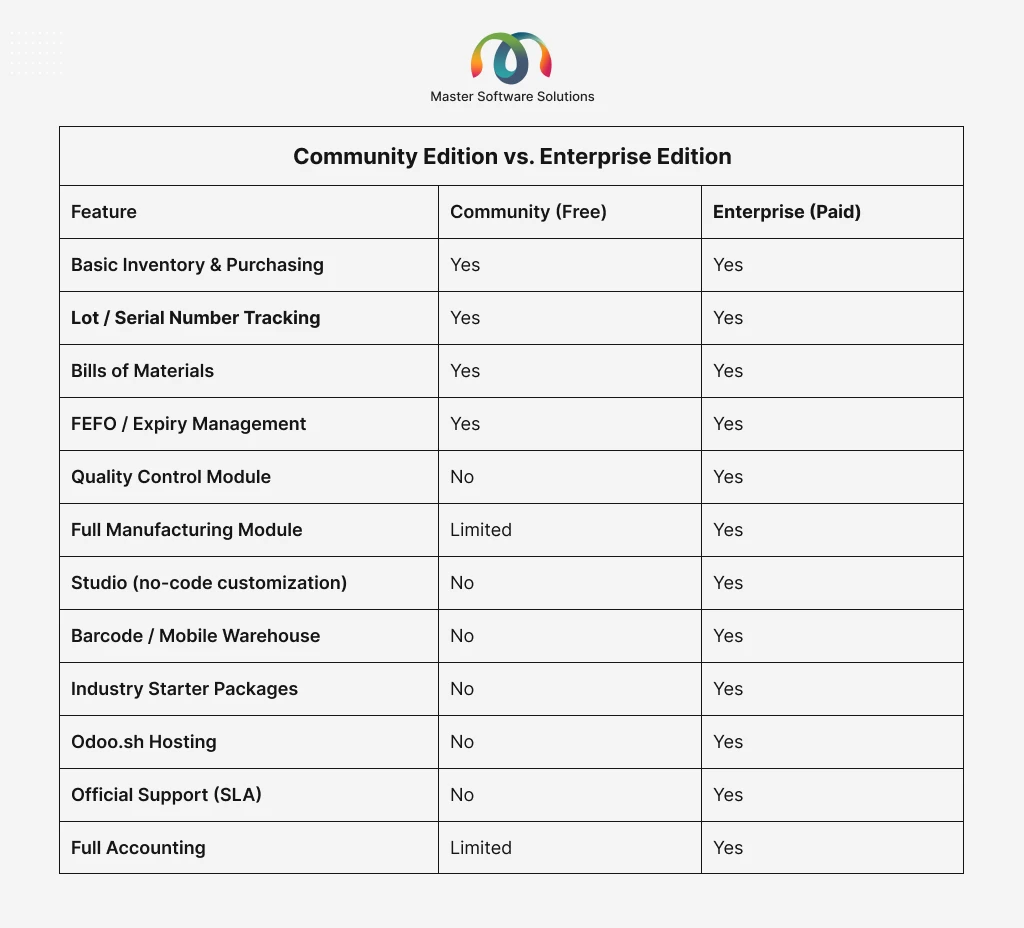
The capabilities that matter most to food manufacturers include Quality Control, full Manufacturing, Barcode-driven receiving and picking, and Studio for customization without developers, which are Enterprise features. For businesses selling to retailers or food service distributors, the Quality and traceability infrastructure in Enterprise is typically a commercial requirement.
Community makes sense if your technical team can self-host, self-support, and work within the module limitations. For most small food manufacturers without a dedicated IT function, the Enterprise subscription is a better value than the hidden cost of working around Community’s gaps.
Odoo vs. Other ERP Options for Small Food Manufacturers
How Does Master Software Solutions Help Implement Odoo in Your Food Manufacturing Operations?
At Master Software Solutions, we work with food manufacturers at every stage, from first ERP evaluation to complex migrations off legacy systems. We’ll tell you honestly whether Odoo is the right fit for your operation, and if it is, what a realistic implementation would look like.
On an Older Odoo Version? You’re Paying a 25% Penalty!
If you’re already using Odoo but stuck on v14, v15, or v16, Odoo’s legacy surcharge is now active, meaning your annual subscription just got 25% more expensive. We can help you upgrade cleanly and stop overpaying. Talk to our Upgrade Team
Master Software Solutions is a certified Odoo implementation partner specializing in manufacturing, distribution, and food production businesses. Our consultants combine deep Odoo expertise with real-world operations knowledge to deliver implementations that work from day one.
Frequently Asked Questions
Q1. Can Odoo handle allergen tracking for food manufacturing?
A1. Yes, with configuration. Ingredient attributes, including allergen declarations, can be captured at the product and BOM level. Allergen-containing products can be flagged, and this information flows through to finished goods declarations. For businesses producing allergen-containing and allergen-free products in the same facility, location-level segregation rules in the Inventory module support physical separation requirements.
Q2. Is Odoo FSMA compliant?
A2. Odoo provides the traceability infrastructure for FSMA compliance, including lot tracking, forward and backward tracing, supplier documentation, and quality records. It doesn’t generate FSMA compliance documentation automatically, but a properly configured Odoo system puts you in a strong position to demonstrate compliance during an audit.
Q3. How much does Odoo Enterprise cost for a small food manufacturer?
A3. Odoo Enterprise is priced per user per month, with pricing varying by region and users. For a small food manufacturer with 10-20 users, annual Enterprise licensing typically runs in the range of $5,000–$20,000, depending on user count and modules. Implementation cost on top of that depends on complexity; a focused implementation with an experienced partner like Master Software Solutions can often be scoped clearly upfront.
Q4. Can Odoo integrate with our existing accounting software?
A4. If you’re currently using QuickBooks or Xero, Odoo has an in-built accounting module that most food manufacturers find preferable to maintaining a separate accounting system. Integrations with external accounting platforms exist as third-party modules, but migrating accounting into Odoo is usually the cleaner long-term approach.
Q5. What version of Odoo should a small food manufacturer implement today?
A5. Odoo 18 is the recommended starting point for a new implementation in 2026 — it’s stable, fully supported through October 2027, and includes the new industry packages (Bakery, Food Truck) that directly benefit food businesses. Odoo 19 is a strong choice if you want AI-assisted features, the manufacturing Gantt view, or forecast-based purchasing from day one.
See our complete Odoo version guide: Odoo Versions Explained: Complete Guide From V14 to the Latest Version V19
Q6. How long does an Odoo implementation take for a small food manufacturer?
A6. A focused implementation covering Inventory, Purchasing, and Manufacturing typically runs 8–14 weeks. Adding Quality, Accounting, and Sales integration extends the timeline. The biggest variables are data migration complexity (how much historical data needs to be migrated), the number of products and BOM records, and whether customization is required.