Enterprise Resource Planning (ERP) systems help businesses manage core operations such as finance, inventory, human resources, procurement, and customer management in a consolidated platform. Traditionally, ERP software has been proprietary (companies must pay a licensing fee and rely on a single vendor for updates, support, and customization).
Open-source ERP software operates differently from this. An open-source ERP system is built on publicly available source code. This means businesses can access, modify, and customize the software to fit their specific workflows. Instead of being locked into a vendor’s roadmap, companies gain greater control over configuration, deployment, and system architecture.
For small and mid-sized businesses, startups, and even enterprises with in-house IT teams, open-source ERP offers cost flexibility, scalability, and customization advantages. However, it also has implementation complexity, maintenance responsibility, and technical requirements that decision-makers must consider carefully.
What is open-source ERP (Enterprise Resource Planning)?
Open-source ERP (Enterprise Resource Planning) is a type of ERP software whose source code is publicly available under an open-source license. This means businesses can access, modify, customize, and distribute the software according to their operational requirements.
Open-source ERP is a business management system that gives companies full control over the software behind their operations. Instead of renting a closed system from a vendor, organizations can adapt the ERP to align their workflows, compliance needs, and growth strategy.
It combines the structured process management of ERP with the flexibility of open-source development.
What makes an ERP open-source?
In a traditional (proprietary) ERP system, the vendor owns the source code. Businesses pay licensing fees and depend on the vendor for updates, customization, and support.
In contrast, an open-source ERP system:
- Provides full access to the source code
- Allows code-level customization
- Can be self-hosted or deployed in the cloud
- It is typically distributed under licenses such as GPL, LGPL, or Apache
- Encourages community-driven development
This model gives organizations greater control over system architecture, integrations, and feature development.
How does an open-source ERP system work?
Open-source ERP systems operate similarly to proprietary ERP systems in terms of functionality. The difference lies in ownership and flexibility. A typical setup involves:
- Installing the ERP on a private server or cloud infrastructure
- Configuring modules based on business requirements
- Customizing workflows and user interfaces
- Integrating third-party tools via APIs
- Managing updates and security internally or through a service partner
Many open-source ERP solutions also offer commercial editions that provide additional features, managed hosting, and professional support.
Who uses an open-source ERP system?
Open-source ERP is commonly adopted by:
- Small and medium-sized businesses (SMBs)
- Manufacturing companies
- Tech startups
- Organizations with in-house IT teams
- Companies seeking high customization without vendor dependency
It is particularly suitable for businesses that need process flexibility, cost control, and system scalability.
Characteristics of open-source ERP
Open-source ERP systems are defined by flexibility, transparency, and control. Unlike proprietary software, they provide access to the source code, allowing businesses to customize and manage the system according to their needs. While this model reduces dependence on licensing and vendor lock-in, it also requires technical oversight. Understanding these core characteristics helps organizations evaluate whether open-source ERP aligns with their operational and IT strategy. Here are the characteristics of an open-source ERP:
No mandatory licensing fees
Open-source ERP software is typically distributed under licenses such as GPL, LGPL, or Apache, which allow users to download and use the software without paying recurring license fees. This means:
- No per-user licensing costs
- No mandatory annual renewal fees
- No usage-based subscription requirements (unless choosing a hosted version)
However, “free” applies only to the software license, not the total cost of ownership (TCO). Businesses still incur costs for:
- Implementation and configuration
- Custom module development
- Server infrastructure or cloud hosting
- Maintenance and upgrades
- Technical support (if outsourced)
This cost structure shifts spending from licensing fees to implementation and operational expenses, giving businesses more financial flexibility.
High customization flexibility
Because the source code is accessible, organizations can modify the ERP at the code level to align precisely with their workflows. The customization may include:
- Adding new modules
- Modifying business logic
- Creating custom dashboards
- Automating unique approval workflows
- Integrating third-party tools via APIs
- Adjusting data models and database schemas
This flexibility is highly crucial for:
- Manufacturing companies with complex production processes
- Businesses with industry-specific compliance requirements
- Organizations with non-standard operational workflows
In proprietary systems, customization is often limited to configuration settings. In open-source ERP, businesses can go beyond configuration into deep system-level customization.
Reduced vendor-in
Vendor lock-in occurs when a company becomes dependent on a single provider for updates, support, hosting, and feature development. This is possible because of:
- The source code is accessible
- Data is typically stored in standard databases
- Multiple service providers can offer implementation and support
- Businesses can self-host if needed
This creates strategic flexibility. If one implementation partner underperforms, the organization can switch providers without losing ownership of the system.
However, vendor lock-in can still occur indirectly if:
- Customizations are poorly documented
- A single development partner controls all system knowledge
Proper documentation and governance are essential to maintain independence.
Community support system
An active developer and user community supports it. This ecosystem includes:
- Online forums
- Community documentation
- GitHub repositories
- Third-party plugins and extensions
- Regular community-driven updates
Benefits of this system
- Faster bug detection and resolution
- Continuous innovation
- Access to shared knowledge
- Large extension marketplaces
Transparent development roadmap
In open-source ERP systems, product development is often publicly visible. This transparency includes:
- Public issue tracking systems
- Open feature requests
- Published release notes
- Contributor discussions
- Roadmap updates
This gives businesses insights into:
- Upcoming features
- Security patches
- Long-term platform direction
- Stability of the project
Business advantages of open-source ERP
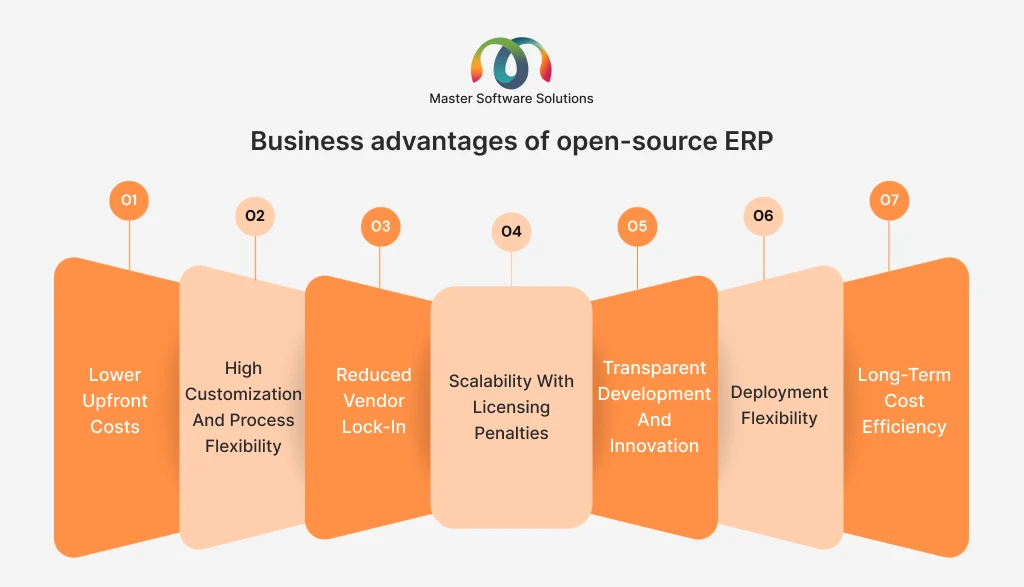
Open-source ERP systems offer several strategic and operational advantages for businesses seeking flexibility, cost control, and long-term scalability. Because the source code is accessible and licensing restrictions are minimal, organizations gain greater control over how the system is implemented, customized, and managed. Below are the business advantages of open-source ERP:
Lower upfront costs
Open-source ERP typically does not require expensive licensing fees. Businesses can deploy the software without paying per-user or recurring subscription charges for the core platform. This enables businesses to:
- Reduce capital expenditure (CapEx)
- Reallocate budget toward customization and process optimization
- Avoid escalating licensing costs as they scale
While implementation and support still require investment, the absence of licensing fees improves cost predictability.
High customization and process flexibility
Open-source ERP allows code-level modifications, enabling businesses to align the system precisely with their operational workflows. The businesses can:
- Build custom modules
- Modify approval workflows
- Integrate industry-specific features
- Adapt reporting structures
This is especially valuable for manufacturing, distribution, healthcare, and other sectors with specialized compliance or operational requirements.
Reduced vendor lock-in
With access to the source code and database, businesses are not dependent on a single vendor for updates, hosting, or support. This provides:
- Greater negotiation power
- Flexibility to switch implementation partners
- Control over upgrade timelines
- Ownership of business data
Long-term, this lowers dependency risks strategically.
Scalability with licensing penalties
Scaling in proprietary ERP systems frequently results in increased licensing fees per module or user. Open-source ERP allows organizations to:
- Add users without a significant licensing impact
- Expand modules as needed
- Scale infrastructure independently
This makes it suitable for growing businesses and startups planning rapid expansion.
Transparent development and innovation
Open-source projects often operate with visible development roadmaps and active community contributions. Benefits include:
- Faster innovation cycles
- Community-reviewed security patches
- Access to third-party plugins
- Transparent issue tracking
This ecosystem encourages continuous improvement.
Deployment flexibility
Businesses can choose how to deploy the ERP system:
- On-premise hosting
- Private cloud
- Public cloud infrastructure
- Hybrid environments
This flexibility supports data governance, compliance requirements, and internal IT strategies.
Long-term cost efficiency
Compared to proprietary systems, open-source ERP may eventually have a lower total cost of ownership (TCO), despite the initial implementation investment. Savings may come from:
- No recurring license fees
- Flexible infrastructure decisions
- Independent upgrade management
When managed properly, this model supports a sustainable long-term IT strategy.
Challenges businesses face with an open-source ERP
While open-source ERP systems offer flexibility and cost advantages, they also introduce operational and technical challenges. Because businesses have greater control over the system, they also assume more responsibility for implementation, maintenance, and governance. Below are the challenges businesses face with an open-source ERP.
High implementation complexity
Implementing an open-source ERP system can be complex and time-consuming. Businesses must configure modules, migrate data, map workflows, and train employees. Without proper planning and project management, implementation delays and budget overruns occur. A clear rollout strategy is essential for success.
Requires technical experts
Open-source ERP often requires strong technical knowledge. Companies may need in-house IT teams or external consultants to manage customization, integrations, and system setup. Without the right expertise, performance issues and system errors can occur. Technical capability plays a major role in long-term stability.
Ongoing maintenance responsibility
Unlike proprietary systems, maintenance is usually the company’s responsibility. This includes applying updates, fixing bugs, and monitoring system performance. If updates are ignored, security risks and compatibility issues may arise. Regular system checks are necessary to keep the ERP running smoothly.
Hidden or indirect costs
Although there are no license fees, other costs can add up. Businesses may spend on customization, hosting, consulting, and long-term support. Without proper budgeting, total expenses may exceed initial expectations. Understanding the total cost of ownership is important before adoption.
Upgrade and version management
Customizations can make system upgrades more difficult. New versions may conflict with modified features, requiring additional testing and adjustments. If upgrades are not managed properly, technical issues can occur. Careful version control helps maintain long-term system stability.
Is open-source ERP the right choice for you?
Choosing the right ERP system is a strategic decision. Open-source ERP offers flexibility and control, but it also requires planning and technical oversight. Below is a simple breakdown to help you decide.
When is it a great fit?
- You need high customization: If your business processes are unique or industry-specific, open-source ERP allows you to modify workflows, modules, and reports to match your exact needs.
- If you want more control: Open-source systems give you ownership of your data and flexibility in hosting. You are not fully dependent on one vendor for updates or changes.
- You have technical support available: If you have an in-house IT team or a reliable implementation partner, managing customization, upgrades, and security becomes much easier.
- You plan to scale: Growing businesses benefit from the ability to add users and modules without increasing licensing fees.
When may it not be the best option?
- You prefer a fully managed system: If you want the vendor to handle hosting, updates, and maintenance with minimal involvement from your team, a SaaS ERP may be more suitable.
- You have limited technical resources: Without proper technical support, managing system updates, integrations, and security can become challenging.
Top open-source ERP provider
Odoo is one of the most widely used open-source ERP systems. It helps businesses manage sales, accounting, inventory, HR, CRM, manufacturing, and more in a single integrated platform. Many small and mid-sized companies choose Odoo because it is flexible, scalable, and easy to expand as the business grows.
Why is it so popular?
Odoo is built with a modular structure. This means businesses can start with only the apps they need, such as sales or inventory, and add more modules later. This makes it cost-effective and suitable for growing companies. It also has a user-friendly interface, making it easier for teams to learn and use compared to many traditional ERP systems.
Odoo Editions
Odoo offers two main versions:
- Community Version: Free and open-source. Best for companies with technical knowledge or developer support.
- Enterprise Version: Paid version with extra features, official support, and cloud hosting options.
Key features of Odoo
Odoo connects core business modules, ensuring that the data flows automatically between departments. The core modules of the Odoo ERP system are
- Sales and CRM management
- Accounting and invoicing
- Inventory and warehouse tracking
- Manufacturing management
- Human resource management
- E-commerce integration
How much does open-source ERP cost?
Even though open-source ERP software itself is usually free to download and use, businesses still need to spend money to make it work well for their operations. Here’s a simple breakdown of the typical costs involved.
Software license
Open-source ERP systems, such as Odoo Community, have no license fee. You can use the software without paying for the core system itself. However, some platforms also offer paid versions with extra features and official support.
Implementation and setup
Setting up an ERP involves installation, module configuration, data migration, and basic training. Many companies work with implementation partners or consultants. Many companies hire ERP consultants or partners to do this. The cost generally depends on the implementation complexity and your partner and can be around $700-$7000.
Factors that influence this cost are
- Size of the business
- Number of modules
- Data complexity
Customizations
If your processes require modifications or custom features, developers will need to build those. The customization cost depends on
- Hours of development
- Complexity of requirements
- The typical cost of customizations ranges from $300 to $3000.
Hosing/infrastructure
You must host the ERP either on cloud servers (AWS or Google Cloud) or on your own infrastructure.
- Cloud hosting: Managed servers with uptime and backups
- On-premise: Your own hardware
The average infrastructure cost is $250 per month for cloud computing and a one-time hardware cost for on-premises.
Support and maintenance
Open-source ERP often relies on community support. For business-critical operations, paid support can ensure faster responses and reliable updates. The average annual cost of support and maintenance is between $150 and $1,500 or more. The support and maintenance include:
- Security patches
- Bug fixes
- Feature updates
- Technical support
Training
Training helps your team get up to speed with the new ERP system. Training can cost $50 – $500 per session or course.
Choosing the right open-source ERP platform
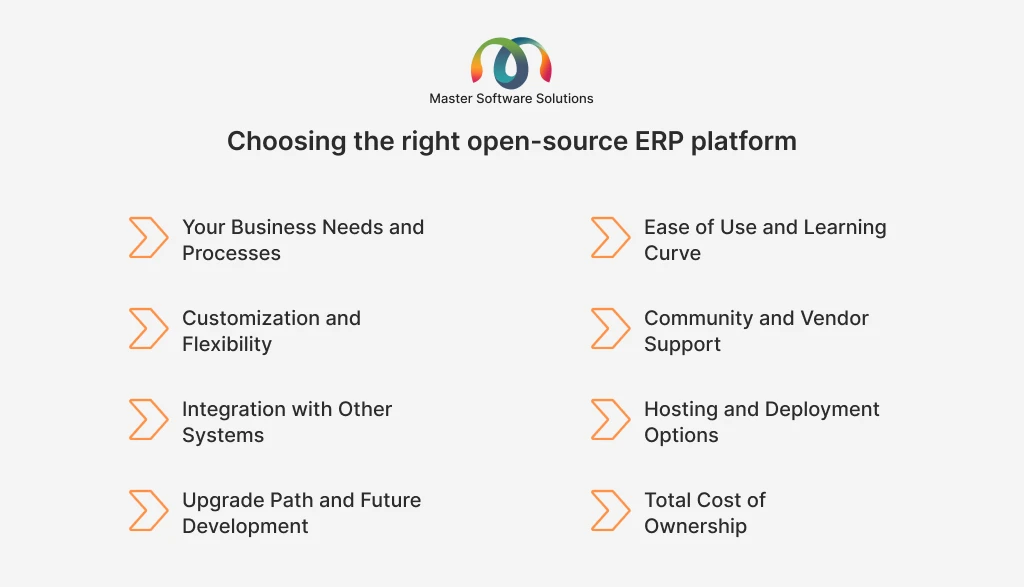
Selecting the right open-source ERP system is an important business decision. The right choice can improve efficiency, reduce costs, and support long-term growth. The wrong choice can lead to delays, higher expenses, and frustration. To make a smart decision, consider the following key factors:
Your business needs and processes
Start by understanding your core business processes. List what you need the ERP to do—such as finance, inventory, manufacturing, HR, or sales. Choose a platform that supports the functions you use now and can grow with you in the future. Avoid systems that require extensive modification just to meet basic requirements.
Ease of use and learning curve
User experience matters. A simple, intuitive interface helps employees adopt the system faster. Ask for demos or try trial versions to see how easily your team can navigate key features. Systems that are easier to use reduce training time and user resistance.
Customization and flexibility
Different businesses have different processes. Open-source ERP should allow you to customize workflows, reports, and modules without high cost or complexity. Evaluate how flexible the platform is and how easily developers can make changes when needed.
Community and vendor support
A strong user community means frequent updates, shared knowledge, and community-built extensions. Also, check whether the ERP provider or third-party partners offer paid support options with guaranteed response times. Good support is especially important for mission-critical operations.
Integration with other systems
Your ERP needs to work with tools you already use—for example, e-commerce platforms, payment gateways, and production systems. Make sure the ERP supports common integrations or has a robust API for custom connections.
Hosting and deployment options
Decide whether you want to host the ERP on your own servers (on-premise) or use cloud hosting. Cloud deployments reduce maintenance load, but on-premise hosting offers greater control. Choose based on your budget, IT capacity, and data security requirements.
Upgrade path and future development
Open-source ERP systems evolve. Check how upgrades are handled—whether they are straightforward or require extensive rework. Also, review the development roadmap to see if future features align with your business plans.
Total cost of ownership
While open-source ERP doesn’t charge license fees, there are other costs—implementation, customization, training, hosting, and support. Calculate the expected TCO over several years to ensure the investment fits your budget.
How does Master Software Solutions help your business?
Choosing the right ERP is only the first step; the real value comes from proper implementation and customization. Master Software Solutions (MSS) helps businesses unlock the full potential of Odoo by delivering tailored ERP solutions that match your exact workflows and goals. From requirement analysis and system setup to customization, integration, and ongoing support, MSS ensures your ERP system runs smoothly and scales with your growth. With the right strategy and expert guidance, your ERP becomes not just software but a strong foundation for operational efficiency and long-term success.
Contact us today to discover our ERP implementation services and see how we can transform your business’s digital landscape.