Two-tier ERP is an approach where a company uses two different ERP systems: one main system for headquarters and another, lighter system for subsidiaries or business units. Both systems are connected and share key data.
Companies are moving away from single, one-size-fits-all ERP systems because they are often expensive, slow to change, and too complex for smaller or regional operations. Two-tier ERP offers flexibility while keeping central control.
This article covers what Two-Tier ERP is, how it works, its key benefits, and when you should use it.
What is Two-Tier ERP?
Two-Tier ERP is an ERP setup where a company uses two ERP systems instead of one. A Tier 1 ERP is used in the headquarters. On the contrary, a Tier 2 ERP is used by subsidiaries, regions, or smaller business units. The systems are connected to share important data.
In a Single-Tier ERP, one larger system is used across the entire organization. While this provides standardization, it is often costly, complex, and slow to adapt, especially for smaller or fast-moving units.
In a Two-Tier ERP model:
- Tier 1 ERP (HQ): Manages core functions like financial consolidation, compliance, and enterprise reporting.
- Tier 2 ERP (Subsidiaries): Handles day-to-day operations, such as local accounting, manufacturing, sales, and distribution, with more flexibility.
This approach allows headquarters to control while giving subsidiaries the freedom to operate efficiently, depending on the local needs.
Why did Two-Tier ERP emerge?
As business grew larger and more complex, traditional systems became harder to manage and more expensive. Two-Tier ERP emerged as a way to balance central control with local flexibility. This section explains why many companies moved away from using a single ERP system for the entire organization. The reasons for the adoption of the Two-Tier ERP are:
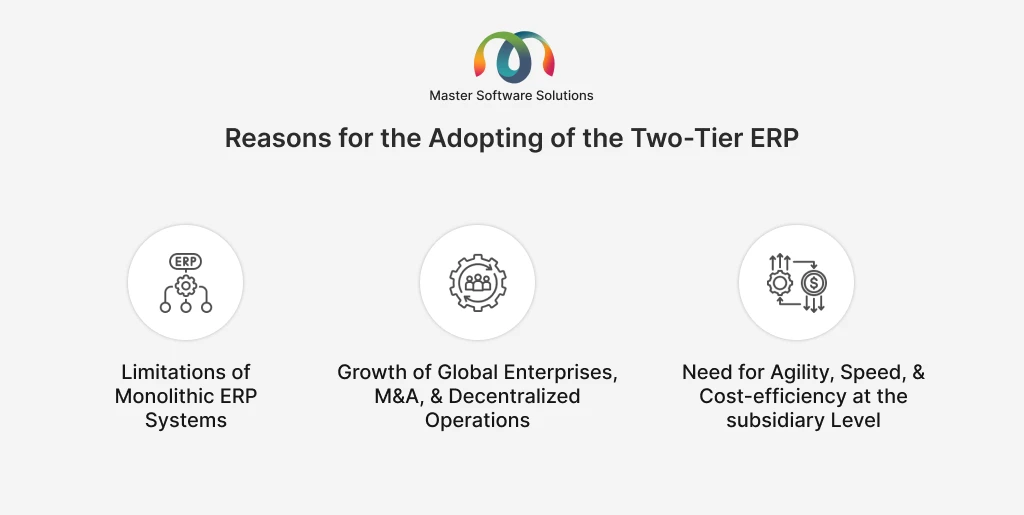
Limitations of monolithic ERP systems
Traditional ERP systems are large and complex. They are expensive to implement, difficult to customize, and slow to change. Smaller business units often struggle to use these systems efficiently.
Growth of global enterprises, M&A, and decentralized operations
Expanding internationally and mergers create diverse business needs across regions. Different countries have different regulations and processes. Two-Tier ERP allows new or regional units to operate independently while staying connected to headquarters.
Need for agility, speed, and cost-efficiency at the subsidiary level
Subsidiaries need systems that are faster to employ and easier to manage. A lighter ERP helps them respond quickly to local market needs. This approach also reduces while still supporting centralized reporting.
How does Two-Tier ERP work?
This section explains how Two-Tier ERP is structured and how the two systems work together. It shows the role of the main ERP at headquarters and smaller ERPs used by subsidiaries. It also explains how data and control are shared between systems. Together, these elements ensure consistency while allowing flexibility.
Core architecture
Two-Tier ERP is built on a layered structure where each ERP system has a clearly defined role. This separation ensures that strategic and operational responsibilities do not overlap or conflict. Tier 1 ERP supports enterprise-wide functions, such as financial control, compliance, and consolidated reporting. Whereas Tier 2 ERP supports operational activities like sales, manufacturing, distribution, and local accounting. Each system is chosen based on the complexity and scale of the business unit it serves.
Data flow and integration
Data sharing is essential in a Two-Tier ERP model to maintain accuracy and visibility across the organization. Controlled data exchange enables independent systems to function as one connected environment. Master data is shared to ensure consistency across both ERP systems. Financial data from subsidiaries is sent to headquarters for consolidation. Integration is handled through APIs or scheduled data transfers, depending on business needs.
Governance and control model
Two-Tier relies on a balanced governance model that clearly defines authority and responsibility. This prevents duplication of effort while maintaining accountability. Headquarters defined global standards, policies, and reporting requirements. Subsidiaries control local workflows and operational decisions. Standardization is applied where needed, while local flexibility is preserved.
Two-Tier vs. Single-Tier ERP
Two-Tier ERP and Single-Tier ERP differ in how ERP systems are deployed across an organization. Single-Tier ERP relies on one system for all business units, while Two-Tier ERP uses separate systems for headquarters and subsidiaries. This difference impacts cost, flexibility, and how well the ERP supports growth.
Side-by-side comparison
The structure of the ERP model determines how easily the system can adapt to different business needs. This also affects:
- Cost: Single-Tier ERP has higher licensing, customization, and maintenance costs. Two-Tier ERP lowers costs by using simpler systems for smaller units.
- Flexibility: Single-Tier ERP enforces uniform processes. Two-Tier ERP allows subsidiaries to adjust processes for local needs.
- Implementation time: Single Tier requires long rollout cycles. Two-Tier ERP enables faster deployment at the subsidiary level.
- Scalability: Single-Tier ERP struggles with rapid expansion. Two-Tier ERP supports growth and acquisitions more easily.
When a Single-Tier approach makes sense
Single-Tier ERP is effective when business operations require tight standardization and minimal variation. Here is when a Single-Tier ERP is effective:
- Business processes are the same across all locations.
- Operations are centralized in one region or market.
- Strong control and uniform reporting are required.
- The organization can support a large, complex ERP system.
Common misconception about complexity
Using multiple ERP systems does not automatically increase complexity. Here is what you should remember:
- Complexity often comes from excessive customization, not system count.
- Integration platforms simplify data exchange.
- Clear ownership and governance reduce risk.
- Two-tier ERP can be easier to manage than a single, overly customized system.
Key benefits of Two-Tier ERP
Two-tier ERP provides a practical way to support both enterprise-level control and local operational needs. Using different ERP systems for headquarters and subsidiaries helps businesses reduce complexity while improving speed, cost efficiency, and adaptability. This model aligns better with how modern, distributed companies operate.
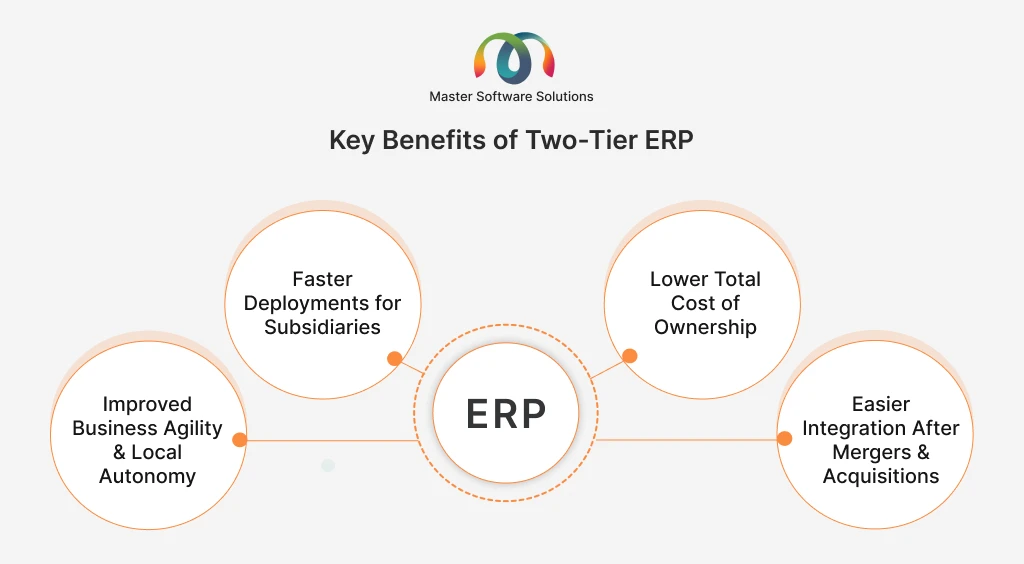
Faster deployments for subsidiaries
Subsidiaries often need ERP systems that can be implemented quickly. Tier 2 systems are simpler and require less configuration, allowing local teams to go live faster. This enables new regions or business units to start operations without waiting for long enterprise-level ERP rollouts.
Lower total cost of ownership
Running a single larger ERP system across all business units increases licensing, customization, and support costs. Two-Tier ERP reduces these expenses by using lighter ERP systems for subsidiaries. Over time, this leads to lower implementation costs, reduced maintenance effort, and better use of IT budgets.
Improved business agility and local autonomy
Local business units face different market conditions and regulatory requirements. Two-Tier ERP allows subsidiaries to adapt their processes without impacting the central ERP system. This gives local teams more control while keeping enterprise reporting and governance intact.
Easier integration after mergers and acquisitions
Mergers and acquisitions require fast system alignment with minimal disruption. Two-Tier ERP allows acquired companies to operate on a separate ERP system while sharing only critical data with headquarters. This simplifies integration and speeds up post-merger operations.
Challenges and risks to consider
While Two-Tier ERP offers flexibility and cost benefits, it also introduces certain challenges that must be managed carefully. These risks are mostly related to integration, data control, governance, and user adoption. Addressing them early helps ensure the ERP strategy remains stable and scalable. Here are the challenges and risks businesses must consider when adopting a Two-Tier ERP system.
Integration complexity
Two-tier ERP requires different systems to exchange data reliably. If integrations are poorly designed, data can be delayed, duplicated, or lost. Managing multiple integrations also increases dependency on middleware, APIs, and integration platforms, which must be monitored and maintained over time.
Data consistency and master data management
When multiple ERP systems are used, keeping data consistent becomes more difficult. Differences in customer, product, or vendor data can lead to reporting errors and operational confusion. Strong master data management is required to ensure that shared data remains accurate and aligned across all systems.
Security and compliance considerations
Using multiple ERP systems increases the number of access and security controls that must be managed. Each system may have different security standards, audit requirements, and compliance rules. Without clear policies, this can increase the risk of data breaches or regulatory violations.
Change management across tiers
Employees across headquarters and subsidiaries may experience ERP changes differently. Inconsistent training, communication gaps, or unclear ownership can lead to resistance and low adoption. A successful Two-Tier ERP requires coordinated change management to ensure all teams understand their roles and responsibilities.
Common use cases of Two-tier ERP
Two-Tier ERP is commonly adopted by organizations that operate across multiple locations, business models, or growth stages. It is beneficial when different parts of the business have different operational needs but still require centralized financial control and reporting. Here are some of the real-world use cases of Two-Tier ERP.
Multinational enterprises with regional subsidiaries
Large multinational companies often operate across countries with different regulations, currencies, and business practices. A Two-Tier ERP model allows headquarters to maintain centralized financial control and reporting, while regional subsidiaries use local ERP systems tailored to their regulatory and operational needs. This approach avoids forcing all regions into one rigid system.
High-growth companies with frequent acquisitions
Companies that grow through mergers and acquisitions need to integrate new businesses quickly. Two-Tier ERP allows acquired companies to continue operating on their own ERP systems or adopt a lighter Tier 2 ERP, while sharing only essential data with the central ERP. This reduces disruption and speeds up post-acquisition integration.
Manufacturing and distribution networks
Manufacturing plants and distribution centers often have specialized operational requirements. Two-Tier ERP enables these units to use systems optimized for production planning, inventory, and logistics, while the headquarters manages financial consolidation and reporting. This separation improves operational efficiency without losing enterprise visibility.
Franchise or multi-brand organizations
Franchise and multi-brand organizations operate many semi-independent units. Two-Tier ERP allows each brand or franchise to manage its own operations, pricing, and processes, while the parent organization retains oversight of financial performance and compliance. This model supports autonomy while maintaining consistency at the corporate level.
Is Two-Tier ERP right for your business?
Two-Tier EROP works best when business units have different operational needs but still require centralized financial oversight. The decision is based on the organization’s structure, growth, and ability to manage multiple systems. Here are some points you should consider when deciding to adopt Two-Tier ERP.
Decision checklist or guiding questions
Organizations should evaluate whether their current ERP setup limits flexibility or slows growth. If subsidiaries struggle with an overly complex system, or if new business units take too long to onboard, two-Tier ERP may be a better fit. The model is most effective when there is a clear need to balance control at headquarters with independence at the local level.
Organizational size, complexity, and growth strategy
Two-tier ERP is well-suited for mid-to-large organizations with multiple regions, business units, or product lines. It is especially valuable for companies expanding globally or growing through acquisitions. When operations vary significantly across units, using a single ERP system often creates inefficiencies that Two-Tier ERP can reduce.
IT maturity and integration capabilities
A successful Two-Tier ERP requires the ability to manage integrations and data governance. Organizations need basic integration, and data consistency issues can outweigh the benefits.
Best practices for implementing Two-Tier ERP
Implementing Two-Tier ERP requires careful planning and coordination to avoid complexity and data issues. Success depends less on the technology itself and more on how clearly the ERP strategy, data standards, integrations, and governance are defined. Following best practices helps organizations realize benefits while minimizing risks.
Define a clear ERP strategy and roadmap
A Two-Tier ERP initiative should start with a clear strategy that defines why the model is being adopted and how it supports business goals. The roadmap should outline which systems are used at headquarters and subsidiaries, how they will interact, and how the rollout will be phased. A well-defined plan prevents ad hoc decisions and ensures alignment across the organization.
Standardize data models early
Data consistency is critical in a Two-Tier ERP setup. Standardizing key data such as customers, products, charts of accounts, and vendors early in the project reduces errors and rework later. Clear data definitions make reporting more accurate and simplify integration between ERP systems.
Invest in integration platforms
Reliable integration is essential for connecting Tier 1 and Tier 2 ERP systems. Using integration platforms or middleware helps manage data flows, monitor failures, and scale integrations as the business grows. This approach is more stable and easier to maintain than building custom point-to-point connections.
Establish governance and ownership
Clear governance ensures that roles and responsibilities are well defined. Headquarters should own global standards, data policies, and reporting requirements, while subsidiaries own local operations. Assigning ownership for data, integrations, and system changes reduces confusion and helps maintain long-term control.
Conclusion
Two-tier ERP is a practical approach for organizations that need centralized control and local flexibility. It helps businesses reduce costs, improve agility, and scale more easily across regions or acquisitions. When designed correctly, it aligns ERP systems with real business needs rather than forcing a one-size-fits-all model.
Master Software Solutions helps organizations plan, design, and implement effective Two-Tier ERP strategies. With expertise in ERP selection, integration, data governance, and rollout planning, Master Software Solutions ensures that Tier 1 and Tier 2 systems work together seamlessly while supporting long-term growth.
Get in touch with us to assess your ERP landscape and build a scalable, future-ready ERP architecture tailored to your business needs.