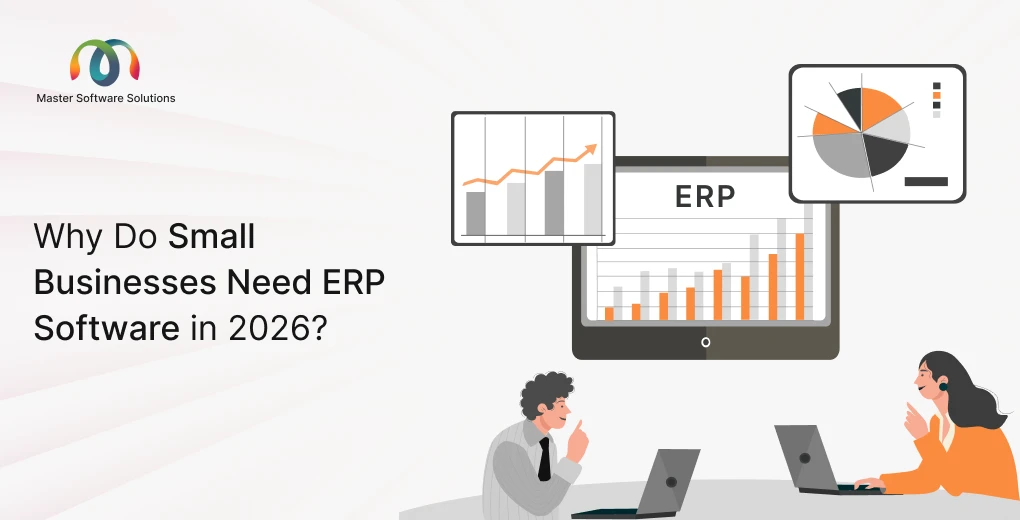
Running a small business in 2026 is more complex than ever. Teams work remotely, customers buy across multiple channels, and AI-powered tools are becoming part of daily operations. At the same time, small businesses are competing with digitally advanced companies that move faster and make smarter decisions using data.
Managing all of this with separate tools, spreadsheets, and manual processes is no longer sustainable. This is where ERP software comes in. Today’s ERP systems are cloud-based, modular, and often AI-assisted. They bring accounting, inventory, sales, operations, and reporting into one connected platform. Unlike legacy systems, modern ERP is affordable, flexible, and designed to grow with small businesses.
In 2026, ERP has become a practical and essential tool for small businesses that want to stay competitive, efficient, and ready for the future.
What does ERP software mean in 2026?
ERP software in 2026 is very different from systems used a decade ago. Earlier ERP tools were expensive, complex, and built mainly for large enterprises. They required heavy hardware, longer setup times, and expert teams to manage them.
Modern ERP is built for flexibility and ease of use. Today’s ERP systems are cloud-native, run in the cloud, and can be accessed from anywhere. Small businesses no longer need to invest in servers or IT teams. Updates, security, and backups are handled automatically.
Key differences in 2026 include:
- Modular & subscription-based: Businesses pay only for the features they need and can add more as they grow.
- Mobile-first and remote-ready: ERP can be used on phones, tablets, and laptops, supporting remote and hybrid work.
- AI-driven insights and automation: ERP systems can forecast demand, flag issues, and automate routine tasks.
For small businesses, the ERP system typically includes accounting, inventory management, sales, purchasing, payroll, reporting, and basic CRM, all in one connected system.
Core challenges small businesses face in 2026
In 2026, small businesses operate in a fast-moving, digital-first environment. While technology offers more tools than ever, it also introduces complexity. Many small businesses struggle to manage operations efficiently, stay compliant, and scale sustainably. Here are the common challenges small businesses are facing in 2026.
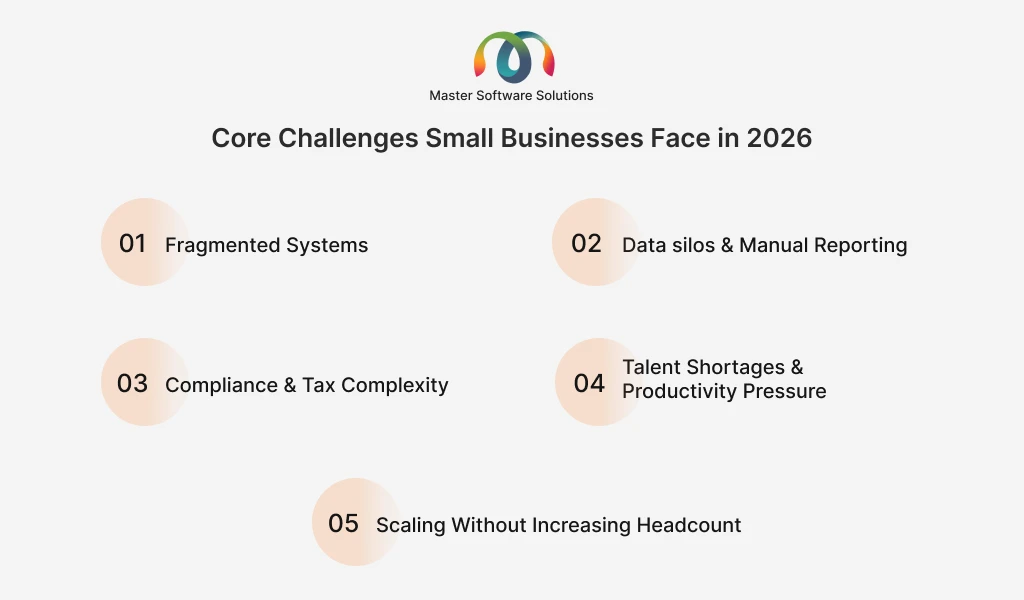
Fragmented systems
Most small businesses use separate tools for accounting, inventory, sales, and customer management. These systems don’t communicate well with each other, leading to duplicate work, errors, and wasted time switching between platforms.
Data silos and manual reporting
When data is spread across multiple systems, it becomes difficult to get a clear view of business performance. Owners often rely on manual reports and spreadsheets, which are slow, error-prone, and outdated by the time decisions are made.
Compliance and tax complexity
Regulations, tax rules, and reporting requirements continue to change. Managing compliance manually increases the risk of errors, penalties, and missed deadlines, especially as businesses operate across regions or online channels.
Talent shortages and productivity pressure
Hiring skilled employees is harder and more expensive. Small teams are expected to do more with less, making efficiency and automation critical to maintaining productivity and avoiding burnout.
Scaling without increasing headcount
Growth means more transactions, customers, and data. Without the right system, scaling operations usually requires hiring more staff, which increases costs and reduces profitability.
How does ERP software help solve these challenges?
Modern ERP software addresses the core problems small businesses face by bringing processes, data, and controls into a single connected system. Instead of managing multiple tools and manual workflows, ERP creates a structured, visible, and automated system that enables businesses to operate efficiently and scale confidently. Ways an ERP system helps small companies overcome their hurdles.
Unified data platform
An ERP system integrates data from accounting, sales, inventory, purchasing, and operations into one system. This ensures everyone works with the same, up-to-date information, reducing confusion, duplicate entries, and data inconsistencies.
Process automation
ERP automation routine tasks such as invoicing, inventory updates, payroll calculations, and order processing. Automation reduces human error, saves time, and allows employees to focus on higher-value work.
Real-time analytics
With built-in dashboards and reports, ERP provides real-time insights into finances, inventory levels, sales performance, and cash flow. Business owners can make quicker, more informed decisions without waiting for manual reports.
Integrated compliance tools
ERP systems include built-in controls for tax calculation, financial reporting, audit trails, and regulatory compliance. This helps small businesses stay compliant, avoid penalties, and reduce the risk of costly mistakes.
Benefits of implementing an ERP system in small businesses
ERP software delivers measurable value to small businesses by improving how they operate, control costs, serve customers, and plan for growth. Instead of reacting to problems, ERP enables businesses to operate proactively by improving visibility, automation, and coordination across all functions. Here are the advantages of implementing an ERP system in your small business.
Operational efficiency
ERP integrates workflows across departments. Tasks like order processing, inventory updates, accounting entries, and reporting are automated and synchronized, reducing delays, duplication, and manual effort.
Cost control and forecasting
With all financial and operational data in one system, ERP helps businesses track expenses accurately and monitor cash flow in real time. It also supports budgeting and forecasting, allowing owners to anticipate costs and plan with confidence.
Better customer experience
ERP connects sales, inventory, and customer data, enabling faster order fulfillment, accurate billing, and consistent communication. This leads to fewer errors, quicker responses, and improved customer satisfaction.
Scalability and business agility
ERP systems are designed to grow with business. As transaction volumes increase or new locations, products, or channels are added without major system changes, small companies can scale smoothly and respond quickly to market changes.
Data-driven decision-making
ERP provides real-time dashboards and reports that give clear insights into performance, trends, and risks. Business owners can make informed decisions based on accurate data rather than assumptions or outdated spreadsheets.
ERP and emerging trends in 2026
In 2026, ERP systems have become strategic platforms built to support innovation and long-term growth. Modern ERP solutions are designed to adapt to new technologies, market shifts, and customer expectations, helping small businesses stay competitive in a rapidly changing digital landscape. Here are some emerging ERP trends in 2026.
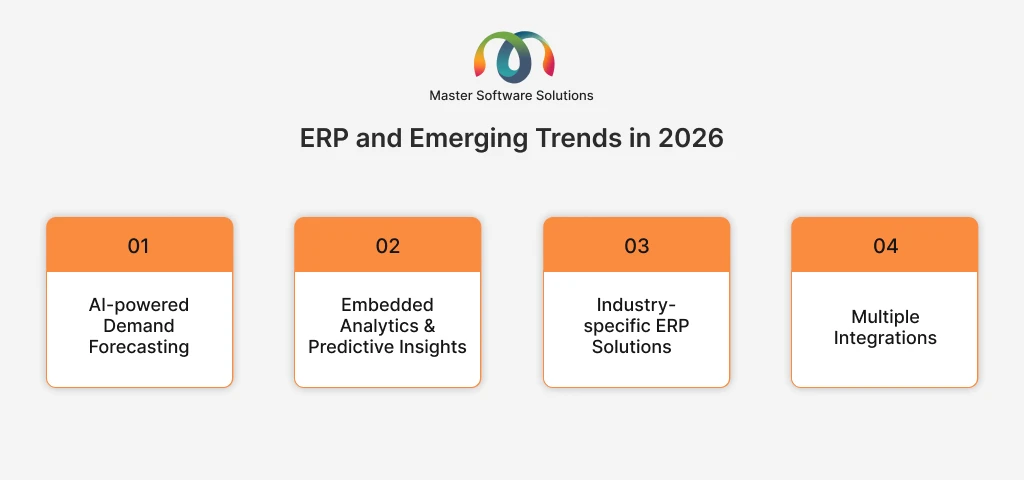
AI-powered demand forecasting
ERP software uses artificial intelligence to analyze sales history, seasonality, and market patterns. This helps small businesses predict demand more accurately, avoid overstocking or shortages, and plan purchasing and production with greater confidence.
Embedded analytics and predictive insights
Modern ERP includes built-in analytics that provide real-time dashboards and automated insights. Instead of analyzing past data, ERP can highlight trends, flag potential risks, and suggest actions before problems occur.
Industry-specific ERP solutions
ERP vendors now offer solutions tailored to specific industries such as retail, manufacturing, healthcare, or professional services. These systems include pre-configured workflows, reports, and compliance features, reducing customization time and improving relevance for small businesses.
Integrating e-commerce, fintech, and marketing automation tools
ERP systems easily connect with online stores, payment platforms, banks, and marketing tools. This creates seamless data flow across sales, finance, and marketing, enabling better visibility, faster transactions, and more coordinated customer engagement.
Common myths about ERP for small businesses
In 2026, ERP technology has evolved significantly, making it more accessible, affordable, and practical for small teams. Addressing these common myths helps clarify why ERP is now a suitable solution for small businesses. Here are some myths about ERP systems that are stopping small businesses from adopting them.
Myth 1: ERP is too expensive
This belief comes from legacy ERP systems that required large upfront investments. In 2026, most ERP solutions use SaaS pricing models with monthly or annual subscriptions. Small businesses can start with essential modules and control costs over time.
Myth 2: Implementation is too complex
Older ERP implementations took months or even years. Modern ERP systems offer faster deployments, pre-built templates, and guided onboarding. Many businesses can go live in weeks, not months, with minimal disruption.
Myth 3: We’re too small for ERP
ERP is no longer designed only for large enterprises. In 2026, ERP platforms will be built specifically for small and growing businesses, supporting lean teams and simpler processes while still enabling growth.
Myth 4: Spreadsheets still work fine
Spreadsheets may work at an early stage, but they don’t scale well. As data grows, spreadsheets become error-prone, time-consuming, and disconnected. ERP replaces manual tracking with real-time, accurate, and automated data management.
When is the right time for small businesses to adopt ERP software?
The decision to adopt ERP is often driven by operational pressure rather than business size. In 2026, ERP becomes necessary when existing tools can no longer support growth, accuracy, or visibility. These common triggers signal that a small business has outgrown manual processes and disconnected systems.
Rapid growth or multi-location expansion
As a business grows, transaction volumes, customers, and locations increase. Managing operations across multiple branches or channels with separate tools becomes inefficient. ERP provides centralized control and consistency across the organization.
Increasing operational errors
Frequent mistakes in invoicing, inventory counts, payroll, or order fulfillment indicate process breakdowns. These errors often result from manual data entry and disconnected systems. ERP reduces errors by automating workflows and synchronizing data.
Lack of visibility into finance or inventory
When business owners cannot see real-time cash flow, stock levels, or profitability, decision-making suffers. ERP delivers real-time dashboards and reports that provide clear visibility into financial and operational performance.
Difficulty scaling current tools
If existing software requires constant workarounds, manual reporting, or additional staff to manage growth, it is no longer scalable. ERP replaces patchwork systems with a single platform designed to grow with the business.
How to choose the right ERP system for small businesses?
Choosing the right ERP system can impact daily operations, costs, and future growth. In 2026, small businesses should focus on flexibility and long-term value rather than features. The right ERP should fit current needs while supporting future expansion without adding complexity. Factors to consider while choosing the right ERP system for small businesses.
Must-have features vs. nice-to-have
Small businesses should clearly identify essential features such as accounting, inventory management, reporting, and integrations. Nice-to-have features can be added later. Prioritizing core needs prevents overpaying and keeps the system simple and effective.
Cloud vs. hybrid ERP
Cloud ERP offers lower upfront costs, faster deployment, and remote access, making it ideal for most small businesses. Hybrid ERP may suit businesses with specific data control or compliance needs, which usually involve higher complexity and maintenance.
Industry-specific vs generic ERP
Industry-specific ERP solutions come with pre-built workflows, reports, and compliance tools tailored to particular sectors. Generic ERP offers broader flexibility but may require more customization. The choice depends on how specialized the business operations are.
Total cost of ownership (TCO)
Beyond subscription fees, businesses should consider implementation, customization, training, integrations, and ongoing support costs. Understanding TCO helps avoid unexpected expenses and ensures the ERP delivers long-term value.
Vendor support and ecosystem
Strong vendor support is critical for successful ERP adoption. Businesses should evaluate onboarding assistance, customer support quality, update frequency, and the availability of third-party integrations and partners that can extend ERP functionality.
Conclusion
In 2026, ERP software has become critical, as operations become more complex and competition increases, and relying on disconnected tools and manual processes can limit growth. A modern ERP system helps small businesses gain control, improve efficiency, and make smarter, data-driven decisions.
This is where Master Software Solutions (MSS) plays a key role. We help small businesses plan, implement, and customize ERP systems that fit their specific needs. Our technical and functional team ensures a smooth and practical ERP adoption journey, from ERP consulting and implementation to customization, integration, and ongoing support.
MSS works with leading ERP platforms, like Odoo and Microsoft Dynamics 365, to deliver flexible, scalable, and cost-effective ERP solutions for small businesses. Whether you need an all-in-one ERP like Odoo or a powerful, Microsoft-backed ERP solution like Dynamics 365, MSS tailors the system to match your business processes and growth goals.
Contact us to explore the right ERP solution for your small business and take the next step towards sustainable growth.