Managing dairy products is never easy. Milk, cheese, and yogurt spoil quickly, and even a short delay can result in significant losses. For the dairy businesses, every hour matters.
Many dairies still rely on manual tracking or basic software. This makes it hard to control expiry dates, stock movement, and storage conditions. As a result, waste and errors become common.
Dairy ERP software helps bring everything together in one system. It gives real-time visibility into inventory, production, and quality. This makes it easier to handle perishable products with confidence.
This guide explains how dairy ERP software enables you to manage perishables. You’ll learn practical ways to reduce waste, stay compliant, and maintain end-to-end product freshness.
Understanding perishability in the dairy industry
Not all dairy products behave in the same way. Milk spoils much faster than butter, while cheese and yogurt have different shelf lives depending on their processing methods. This makes planning and storage more complicated.
Temperature plays a crucial role in maintaining the freshness of dairy products. Poor quality or spoiling can result from even small breaches in the cold chain during storage or transit. Once this happens, the product may no longer be safe to sell.
The dairy industry follows strict food safety regulations. Businesses must track batches, expiry dates, and the movement of products at every stage. If an issue arises, timely traceability is critical for managing recalls and protecting consumers.
Key challenges in managing perishable dairy inventory
Managing dairy inventory is difficult because products spoil quickly and must meet strict quality standards. Businesses must balance production, storage, and demand while avoiding waste and compliance risks. Without the right systems, even small gaps can lead to losses and customer issues.
Short shelf life
Dairy products have a limited selling window. Milk, cream, and fresh products can expire within days. If stock is not sold or moved promptly, it leads to spoilage and direct financial loss. This puts constant pressure on planning and execution.
High spoilage risk
The dairy industry is sensitive to temperature and handling. Poor storage, transportation delays, or equipment failure can quickly spoil products. Often, spoilage is discovered too late, when the product is already unsellable.
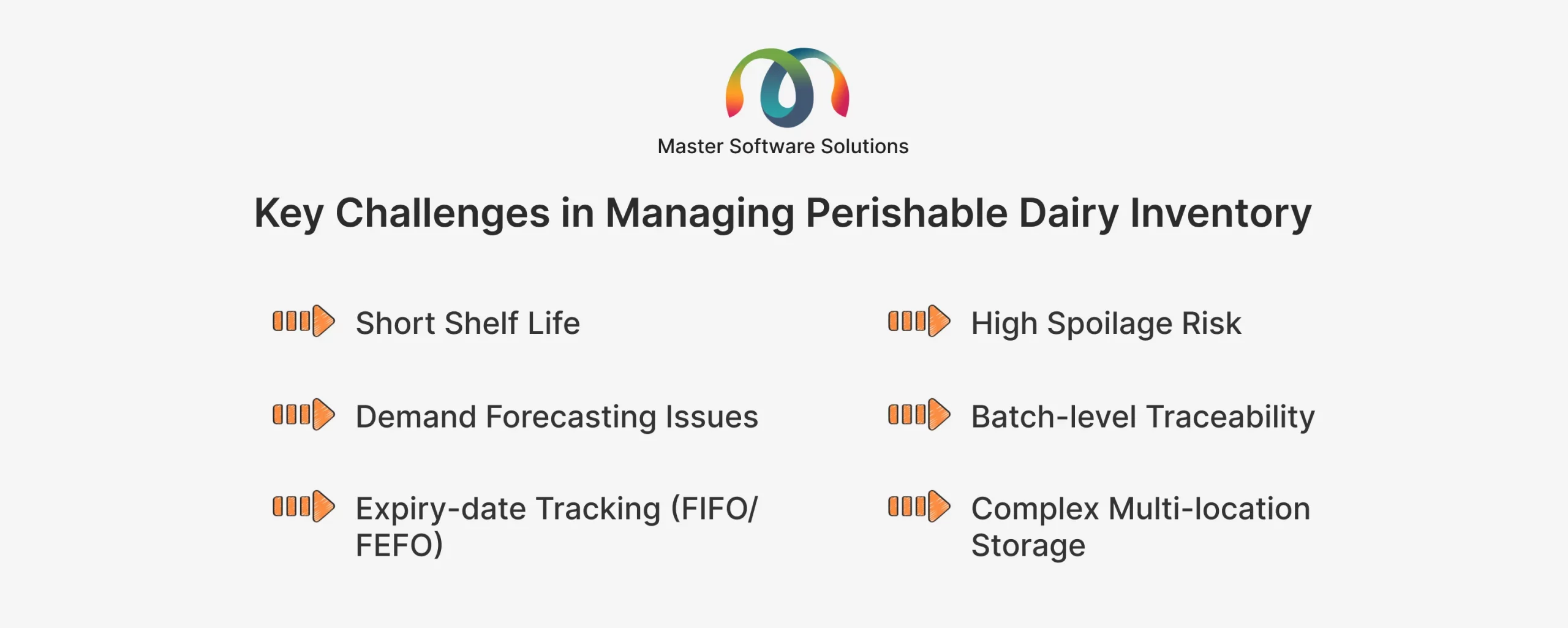
Demand forecasting issues
Customer demand for dairy products can change depending on the season, weather, and promotional offers. Inaccurate forecasts lead to overproduction or stock shortage. Overproduction increases waste, while underproduction affects customer reliability and trust.
Batch-level traceability
Every dairy batch must be traceable from source to sale. Manual tracking makes this slow and prone to errors. During quality issues or recalls, a lack of clear batch data can increase risk and response time.
Expiry-date tracking (FIFO/FEFO)
Managing expiry dates across many SKUs is complex. Without automation, older stock stays in storage while newer stock is shipped. This results in expired inventory and missed sales opportunities.
Complex multi-location storage
Maintaining visibility between various plants, cold stores, and distribution centers is a challenge for many dairy businesses. Poor coordination can cause excess stock in one location and shortages in another.
What is dairy ERP software?
Dairy ERP software is a business management system designed specifically for dairy operations. It helps manage dairy activities, including production, inventory, quality, and distribution, from one platform. The focus is on handling perishable products efficiently and safely.
Dairy ERP software is designed to manage the entire dairy process. It connects data from milk procurement, processing, storage, and sales. Core components usually include inventory management, production planning, quality control, finance, and reporting. All departments work using the same real-time data.
How does dairy ERP software differ from generic ERP?
Generic ERP systems are designed for multiple industries and lack dairy-specific features. Dairy ERP systems understand shelf life, batch tracking, and cold chain needs. It supports dairy regulations and quality checks by default. This makes it more practical for dairy businesses.
Dairy ERP modules relevant to dairy perishability
The ERP for the dairy industry includes multiple business management applications (also known as modules) that work together to ensure improved yield, profits, and customer satisfaction while reducing overheads. Here are the dairy ERP modules.
Inventory: The inventory module tracks stock by batch, lot, and expiry date. It helps follow FIFO or FEFO rules automatically. Users can identify which products are at risk of expiring and act early. This reduces waste and improves stock rotation.
Quality and compliance: The quality modules record test results, inspections, and approvals. They ensure products meet safety and regulatory standards before release. If an issue occurs, the affected batches can be quickly identified, supporting audits and recall management.
Production and planning control: The production module helps plan output based on demand and shelf life. They manage raw milk consumption, yields, and processing schedules. This avoids overproduction and aligns supply with actual demand. It also improves resource usage.
Logistics and distribution: Logistics modules manage storage, dispatch, and transportation. They ensure the right products are shipped at the right time. Integration with cold storage and delivery planning helps maintain product quality, supporting timely and safe delivery.
Core dairy ERP system features for managing perishable dairy products
Managing perishable dairy products requires tight control over inventory, quality, production, and distribution. A dairy ERP system integrates these functions, enabling businesses to operate in real time. The following features play a key role in reducing spoilage, ensuring safety, and improving efficiency.
Real-time inventory tracking
This feature shows current stock levels across all locations. Products are tracked by batch, lot number, and expiry date. Teams can track what is available, moving, and about to expire. This helps prevent overstocking and last-minute losses.
Expiry and shelf-life management
The system can record the shelf life for each product type. It automatically tracks expiry dates from production to dispatch. Alerts notify users when products are nearing expiry. This allows timely action, such as priority sales or distribution.
FEFO and FIFO automation
Dairy ERP enforces FIFO or FEFO rules during picking and dispatch. Older or earlier-expiring stock is selected by default. This reduces the risk of expired products reaching customers. It also improves stock rotation without manual effort.
Batch and lot traceability
Every production batch is recorded and linked to raw materials and finished goods. The movement of each batch is tracked across processing, storage, and sales. In the case of quality issues, affected batches can be identified quickly. This supports fast recalls and compliance.
Quality control management
Quality checks are built into the workflow. Test results, inspections, and approvals are recorded in the system. Products cannot move forward unless quality standards are met. This helps maintain consistency and food safety.
Cold chain monitoring support
Dairy ERP can integrate with temperature logs or monitoring systems. Storage and transport conditions are recorded against each batch. Alerts can be triggered if temperature limits are crossed. This helps protect product quality throughout the supply chain.
Demand forecasting and planning
The system uses historical data and sales trends to predict demand. Production plans are aligned with shelf life and market needs. This reduces overproduction and stock shortages. Better planning leads to lower waste and higher profitability.
Reporting and alerts
ERP dashboards provide visibility into stock status, expiry risks, and waste levels. Automated alerts highlight issues that need quick attention. Managers can make faster, informed decisions using accurate data, which can help improve overall control and accountability.
Managing dairy products with an ERP system: A practical workflow
A dairy ERP system does more than just track movement. It measures performance at every stage using clear KPIs. These metrics enable teams to identify issues early, reduce waste, and improve decision-making. Step-by-step example from raw milk collection to retail distribution.
Raw milk procurement
Milk is received and recorded in the ERP with supplier and quantity details. The ERP records supplier details, quantity, quality test results, and receipt time. Only approved milk is processed, which ensures quality from the start. The KPIs evaluated in this stage help you measure supplier quality and procurement efficiency. The tracked KPIs are
- Milk intake volume (per supplier/per day)
- Supplier acceptance rate
- Rejection percentage
- Cost per litre
- Collection-to-receipt time
Quality testing and approval
Milk is tested and approved or rejected before processing. Test results are entered directly into the ERP system. If the milk fails quality checks, it is blocked automatically. This prevents unsafe material from entering production. The key performance indicators involved in this stage ensure that the safety standards are consistently met. The KPIs included are
- Quality pass/fail rate
- Average testing turnaround time
- Number of blocked batches
- Compliance deviation count
Production and processing
Approved milk is processed into finished products. The ERP tracks processing details, such as product type, yield, and processing time. Shelf life and expiry dates are generated automatically. This creates full batch-level visibility. Measuring KPIs during production and processing helps businesses identify production losses and efficiency gaps. The KPIs involved are
- Yield variance
- Production efficiency
- Batch completion time
- Raw material wastage
- Downtime due to quality or process issues
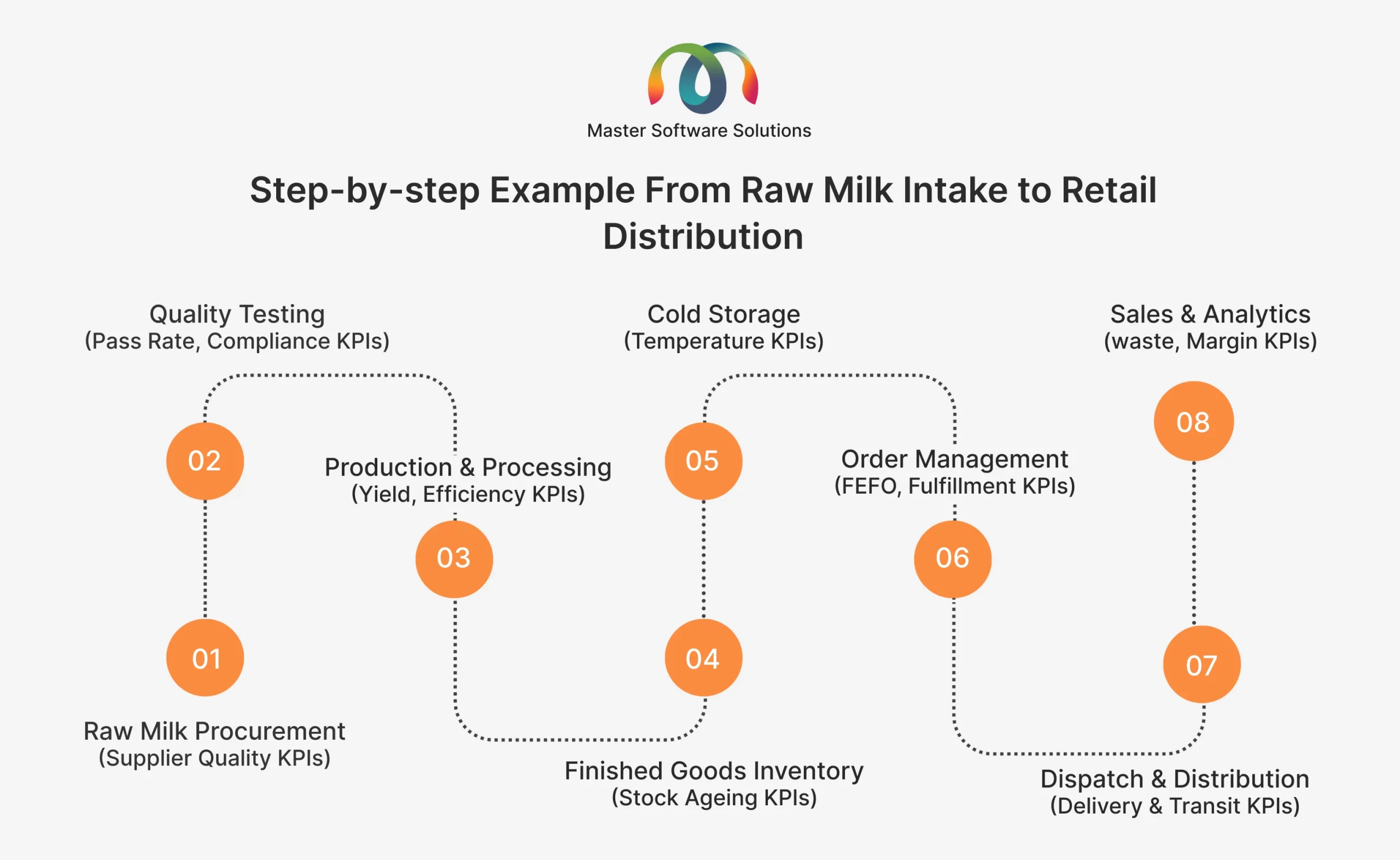
Finished goods inventory
Products move into cold storage as finished goods. The ERP system tracks location, batch number, and expiry date. Stock levels are updated in real-time. This helps teams monitor available and at-risk inventory. Tracking key performance indicators related to inventory enables businesses to control slow-moving and at-risk stock. The associated KPIs are
- Inventory turnover rate
- Stock ageing by expiry date
- Near-expiry inventory value
- Overstock and understock levels
Storage and cold chain control
Products are stored under controlled conditions. The system can capture temperature data manually or through IoT integrations. Alerts are triggered if limits are exceeded. This protects product quality during storage. Evaluating KPIs related to storage and cold chain control helps product quality and shelf life. These KPIs are
- Temperature compliance rate
- Number of temperature deviations
- Time to resolve deviations
- Spoilage due to storage issues
Order management and allocation
Orders are created, and stock is allocated using FIFO/FEFO. The ERP system allocates stock using FIFO or FEFO rules. Products nearing expiry are prioritized for dispatch. This reduces waste and improves stock rotation. Evaluating key performance indicators related to order management and allocation efficiency ensures timely delivery and proper stock rotation. The KPIs involved are
Order fulfillment rate
- FIFO/FEFO compliance rate
- Order allocation time
- Backorder percentage
Dispatch and distribution
Products are shipped to customers or distributors. The ERP maintains traceability through delivery. If any issue arises, affected products can be traced quickly. This supports compliance and customer trust. The related KPIs measure logistics performance and customer satisfaction. These KPIs include
- On-time delivery rate
- Transit temperature compliance
- Dispatch accuracy
- Returns due to quality issues
Sales, reporting, and feedback
Sales data feeds back into planning and analysis. ERP reports show wastage, expiry losses, and demand trends. This data feeds into forecasting and planning. Continuous improvement becomes easier. The KPIs and reporting support continuous improvement and strategic planning. These KPIs include
- Expiry-related wastage percentage
- Sales forecast accuracy
- Gross margin by product
- Waste reduction over time
How do ERP systems help reduce waste and improve profitability?
Waste can directly affect margins in the dairy industry. Products that expire or spoil represent lost revenue and added disposal costs. The ERP systems help prevent this by providing visibility, timely insights, and data-driven actions that protect both inventory value and profitability.
Spot slow-moving stock
ERP systems track the timeframe each product batch stays in inventory. They highlight items that are not moving as expected or are about to expire. This early warning helps teams act before products become unsellable. It reduces last-minute losses and panic decisions.
Flag at-risk inventory
The system continuously monitors expiry dates and storage conditions. Products nearing expiry or exposed to temperature issues are flagged automatically. Managers get alerts instead of discovering problems too late, allowing quick corrective action.
Support smart markdowns
ERP data reveals which products require immediate movement. Based on shelf life and demand, teams can apply controlled price reduction. This helps sell products faster while recovering part of the cost. It is better than full write-offs.
Enable stock redistribution
ERP systems provide visibility across all locations. Excess stock in one warehouse can be moved to another with high demand. This balances inventory and avoids unnecessary waste. Decisions are made using real-time data, not assumptions.
Guide reprocessing decisions
Some dairy products can be reprocessed before their expiry. ERP systems help identify eligible batches and track the costs for reprocessing. This ensures reprocessing is profitable and compliant, turning potential waste into usable inventory.
Track waste through reports
ERP reports show where and why waste occurs. They break down losses by product, batch, location, or reason. This helps management find root causes. Corrective actions become more focused and effective.
Measure improvement with KPIs
Key KPIs such as expiry loss percentage and inventory turnover are tracked over time. Trends show whether waste reduction efforts are working. Improvements directly reflect in lower costs and higher margins. This links operational control to profitability.
Best practices for implementing dairy ERP for perishables
Implementing a dairy ERP system requires clean data, trained people, and well-connected systems to manage perishable products effectively. Following these best practices helps ensure the ERP delivers real value, reduces waste, and supports daily operations smoothly.
Accurate master data setup
Master data is the foundation of a dairy ERP system. This includes correct shelf life, expiry rules, batch parameters, and SKU definitions. If shelf life or product details are incorrect, the system will give incorrect alerts and reports. Accurate master data ensures reliable tracking, planning, and decision-making.
Consistent shelf-life rules
The shelf life of each dairy product varies depending on its processing and storage. These rules must be clearly defined in the ERP. Consistency ensures expiry dates are calculated correctly across all locations. This helps enforce FIFO or FEFO without manual intervention.
Proper batch and lot configuration
Batch tracking must be enabled and standardized across procurement, production, and sales. Every movement should carry batch information. This ensures complete traceability and prompt response to quality issues. Poor batch setup limits the system’s ability to manage perishables.
Staff training and daily usage
Employees must understand how to use the ERP in daily tasks. This includes data entry, scanning, approvals, and exception handling. If staff bypass the system, data accuracy suffers. Training builds confidence and improves adoption.
Process alignment before automation
Existing processes should be reviewed before ERP implementation. Manual steps that cause delays or errors must be corrected first. The ERP should support clean, standardized workflows. Automating poor processes only increases problems.
Integration with warehouse systems
ERP should be integrated with a warehouse management system (WMS) for real-time stock movement. This ensures accurate inventory levels and location tracking. Integration reduces manual updates and mismatches. It is critical for managing cold storage and dispatch accuracy.
Integration with IoTs and temperature monitoring
Connecting ERP with temperature monitoring systems improves cold-chain visibility. Storage and transit data can be linked to specific batches. Alerts can be triggered automatically, protecting product quality and supporting compliance.
Accounting and cost integration
The ERP system must be linked with the accounting system to track costs accurately. Waste, reprocessing, and markdowns should be reflected in finances. This provides a true picture of profitability. Finance and operations stay aligned.
Phased and controlled rollout
ERP should be implemented in phases rather than all at once. Critical perishability features should go live first. This reduces the risk and allows teams to adapt. Issues can be resolved early without disrupting operations.
Conclusion
Managing perishable dairy products is a challenge, and the right ERP system makes it far more manageable. Real-time visibility, expiry control, and data-driven planning help businesses reduce waste, stay compliant, and protect their margins. The key to seamless management is not just having software but implementing it in the right way.
Master Software Solutions (MSS) helps dairy businesses do exactly that. We work closely with dairy processors, distributors, and cooperatives to design and implement ERP systems that fit real operational needs. Our ERP implementation services cover everything from requirement analysis and system configuration to integration, training, and ongoing support.
We develop custom dairy ERP solutions utilizing trusted ERP platforms, such as Odoo and Microsoft Dynamics 365. These platforms are adaptable, scalable, and ideal for managing batch tracking, shelf life, quality control, and cold-chain requirements. Tailoring these systems to dairy-specific workflows, Master Software Solutions ensures businesses get maximum value from their ERP investment.
If you are looking to reduce spoilage, improve profitability, and gain better control over your dairy operations, now is the time to act. Contact us to explore custom dairy ERP solutions built around your business needs.