In this technology-driven world, businesses continuously adopt AI, automation, and cloud-based operations to manage operations, optimize resources, and scale effectively. With so many ERP solutions available, selecting the right one can make the difference between surviving in the market and growing.
Choosing the right ERP among players like Odoo, SAP, NetSuite, and Dynamics 365, who compete for dominance, has become more about aligning with your business than just features.
If you want to implement an ERP system in your business but are confused about which one to choose, you are in the right place. After reading this blog, you will know which is best for your business.
The blog includes:
What is an “ERP software system?”
ERP stands for Enterprise Resource Planning. An ERP system is a platform that enables you to streamline and optimize your entire business operations. It is an all-in-one solution for managing your operations, from procurement and manufacturing to retail, inventory management, and payments.
An ERP system can automate the processes to improve overall efficiency, productivity, cost reduction, and enhanced customer satisfaction, ultimately improving the ROI. The types of ERP systems available are:
- On-premise ERP system: The on-premise ERP system requires you to install and host your own servers. It requires up-front investments, maintenance, and customization costs.
- Cloud-based ERP system: Cloud-based ERP systems are hosted and managed by a third-party cloud service provider (Azure, AWS, and Google Cloud). They are more flexible, scalable, and affordable.
Too Many Choices, Too Little Clarity
With many ERP systems promising robust functionalities, flexibility, and value, you need help identifying solutions that fit your unique needs. Small and medium enterprises (SMEs) look for cost-effective, scalable solutions, while big enterprises look for complex, industry-specific integrations. Your ERP choice should be about affordability and the long-term impact on productivity and growth. Popular ERP software systems available are:
Introduction to Odoo ERP
Odoo ERP is an open-source enterprise resource planning platform with a modular architecture. It offers various applications to manage business operations, including manufacturing, finance, sales, inventory, HR, purchasing, warehousing, retail, e-commerce, POS, etc. Odoo offers two editions to cater to your businesses regardless of their types or sizes. The two Odoo editions offered are the following:
Odoo Community
The Odoo Community Edition is a completely open-source platform that doesn’t require licensing fees. You can download the Odoo Community edition directly and start working.
Odoo Enterprise
The Odoo Enterprise edition is an advanced version of the community edition, which requires licensing. The edition enables you to perform high-level customizations and integrations to cater to your specific business needs for big enterprises. Odoo Enterprise offers three pricing plans:
- One App Free: The plan offers one free application. You can access other apps from the Odoo store and make a tailored solution for your business.
- Standard: You can access all the applications from the Odoo store and host them on Odoo Online. The cost depends on the number of users, the region, and the country.
- Custom: This plan is perfect for businesses looking for heavy customizations. The plan enables you to manage multiple companies with a single database.
Odoo vs. other ERPs (SAP, NetSuite, and Dynamics 365)
Now that you know Odoo and other ERPs, we’ll explore how Odoo differs from others. You can refer to your checklist while studying the comparison.
Other popular ERPs available in the market are:
- SAP: Systems, Applications, and Products, or SAP, is an ERP system owned by SAP AG. It is designed for large enterprises with complex operations to manage large-scale operations and complex project management, such as manufacturing, retail, and finance. SAP offers a variety of ERP solutions, including SAP Business One, SAP Business ByDesign, SAP S/HANA, etc.
- NetSuite: NetSuite is a cloud-based ERP platform that helps businesses manage operations, including accounting, CRM, inventory, and others.
- Microsoft Dynamics 365: Microsoft Dynamics 365 is an integrated CRM and ERP suite. It is an all-in-one solution that streamlines and optimizes your business processes. It offers multiple ERP solutions, including Microsoft 365 Finance and Operations, Microsoft GP, and Microsoft Dynamics 365 Business Central.
Comparison between Odoo, SAP, NetSuite, and Dynamics 365
We’ll dive deep into the difference between Odoo and other ERP platforms. This will give you a clear idea of what ERP will suit your business. We’ll compare these ERPs based on some parameters:
Target audience
Odoo ERP suits all types of small and mid-sized businesses. It is highly flexible and scalable, well-suited for startups and small and medium-sized enterprises. On the other hand, SAP, NetSuite, and Microsoft Dynamics offer solutions for small and large enterprises. Unlike SAP or NetSuite, Odoo offers paid products, whose cost depends on the number of users and requirements. Microsoft Dynamics delivers on-premises ERP solutions with competitive pricing for businesses looking to host their own ERP.
Odoo Costing
Odoo offers two editions: Odoo Community and Odoo Enterprise. The Community Edition is an open-source platform, and the Odoo Enterprise edition provides optimal product pricing, making it best-suited for your business. Conversely, SAP, NetSuite, and Microsoft Dynamics are highly advanced and expensive.
Customizability
Odoo offers modular architecture, making it a highly flexible platform. The platform offers multiple modules that can be integrated to perform different business operations. On the contrary, NetSuite, SAP, and Microsoft Dynamics 365 offer limited customizations that require technical expertise.
Functionality
Odoo offers advanced features to help you manage your business processes, including CRM, accounting, reports, and analytics. It also has additional features such as a website builder, Odoo Studio, email marketing, and social media. On the other hand, SAP, NetSuite, and Microsoft Dynamics offer similar features. They specialize in supply chain management, HR management, and e-commerce.
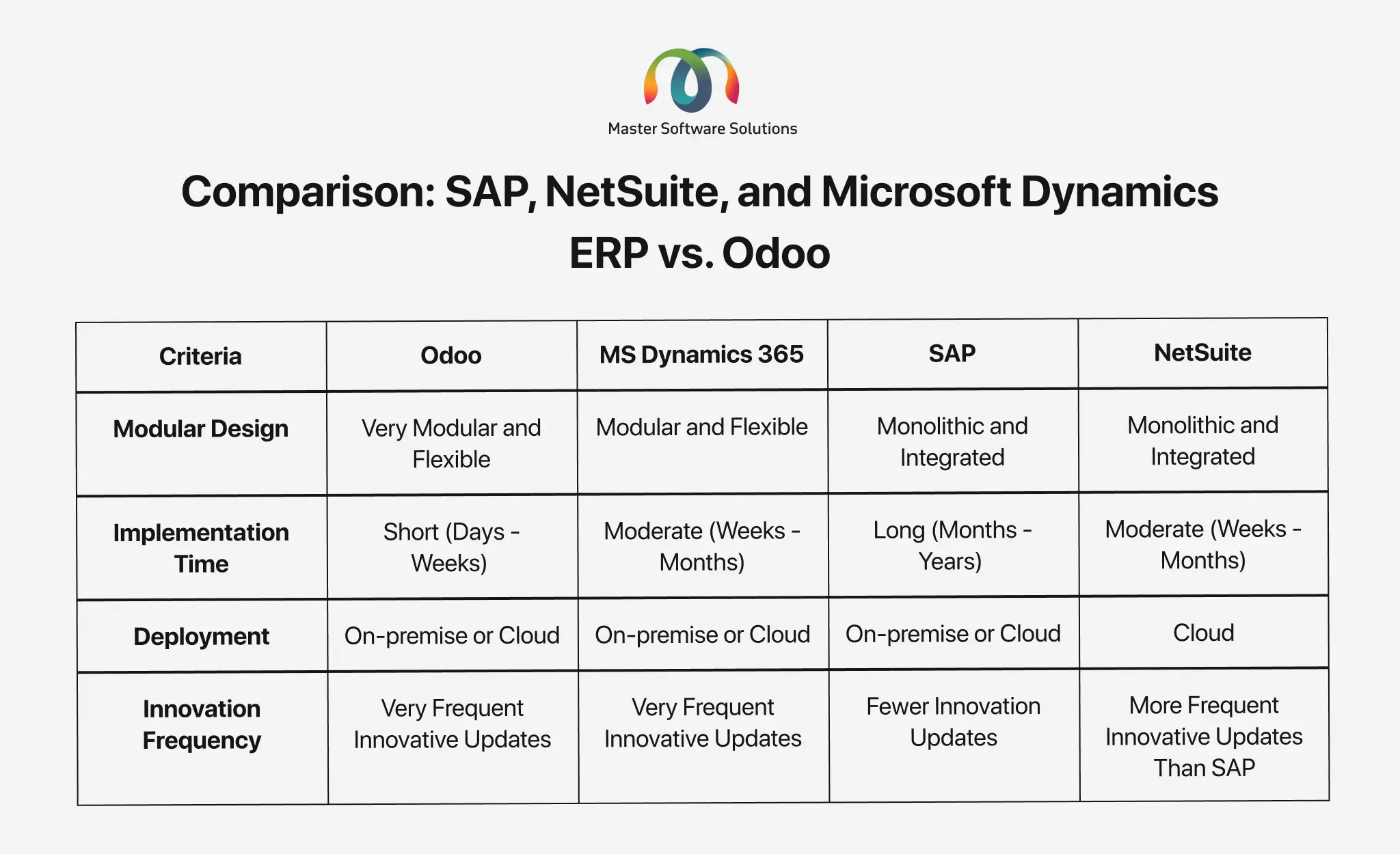
Comparison: SAP, NetSuite, and Microsoft Dynamics ERP vs. Odoo
Benefits of Odoo for SMEs
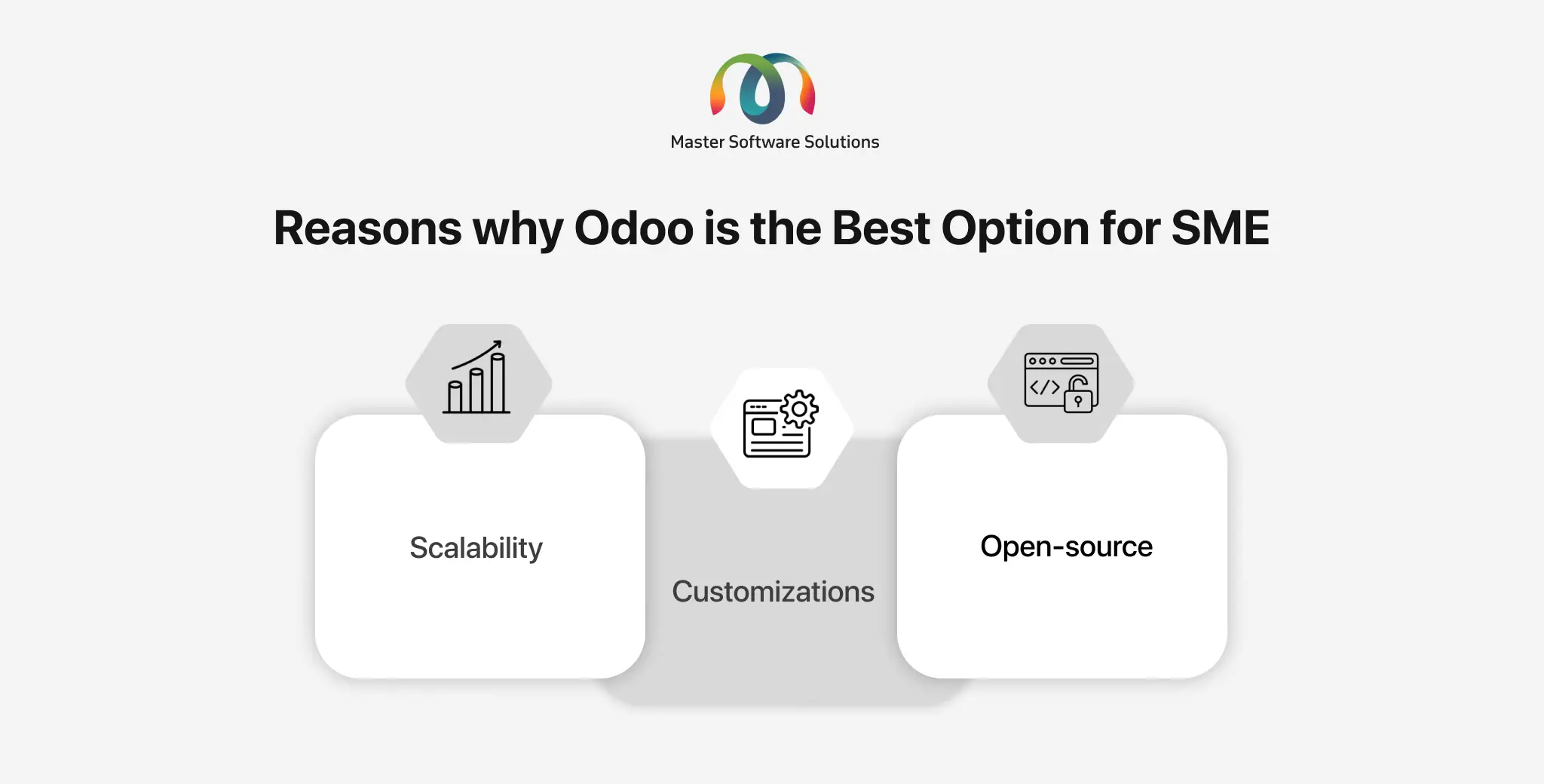
The overhead section gives clarity on the difference between Odoo and other ERP systems. Now, let’s check out the benefits of implementing Odoo for your SME business. Odoo is popular among small and medium enterprises due to its flexibility, modular structure, user-friendly interface, and affordable pricing. Reasons why Odoo is the best option for SMEs:
Scalability
Odoo is a highly scalable platform. Its modular structure enables you to add as many modules as you need to fulfill your business requirements. You can only choose the modules you need to run the business and pay for them. You can upscale or downscale your business as per your requirements.
Customizations
The platform is flexible enough to be customized to your business needs. It allows you to perform simple to complex customizations to meet business demands. Customizations are needed for complex operations in manufacturing, warehousing, etc.
Odoo offers an integrated platform that enables you to manage and track your business operations from a single screen. It also provides a single database that allows you to share data among different departments, such as sales, marketing, inventory, warehouse, and manufacturing.
Open-source
Odoo is an open-source, free platform that doesn’t require you to pay licensing fees. It allows for complex customizations and large community development, providing a wide range of add-on support. The platform also offers a licensed platform that is more advanced than the Odoo community.
Bottom Line
When comparing Odoo with other ERP solutions like SAP, NetSuite, and Dynamics 365, Odoo stands out as a cost-effective, scalable, and highly customizable solution. The platform can be tailored to the unique needs of small and medium-sized enterprises (SMEs). If you are an SME looking for Odoo implementation, discuss your business with us to see how we can help you.
Master Software Solutions is an Odoo ERP implementation company that can help you implement, customize, integrate, and migrate Odoo into your business.
Frequently Asked Questions
Q1. What are the main types of ERP systems?
A1. There are two types of ERP systems:
- On-premise ERP: Installed and managed on the company’s own servers. It requires upfront infrastructure investment and ongoing maintenance.
- Cloud-based ERP: Hosted on cloud platforms such as AWS, Azure, or Google Cloud and assessed through the internet. These systems are more scalable, flexible, and cost-effective.
Q2. How does Odoo compare with other ERP systems such as SAP, NetSuite, and Microsoft Dynamics 365?
A2. Odoo is known for its affordability, modular architecture, and flexibility, making it ideal for small and medium-sized businesses. In contrast, ERP platforms like SAP, NetSuite, and Microsoft Dynamics 365 are often designed for larger enterprises with complex operations and typically require higher implementation and licencing costs.
Q3. Is Odoo ERP scalable for growing businesses?
A3. Yes, Odoo is highly scalable and allows businesses to add new features, users, and integrations as their operations expand. This makes it suitable for startups, SMEs, and even large enterprises.
Q4. What are the key benefits of using Odoo ERP for SMEs?
A4. Some of the major benefits of using Odoo ERP for SMEs include:
- Affordable implementation and licensing
- Modular and scalable architecture
- Easy customization
- Integrated business applications
- Real-time reporting and analytics
- Improved collaboration across departments
Q5. Can Odoo ERP integrate with other business systems?
A5. Yes. Odoo can integrate with various third-party tools and technologies such as payment gateways, e-commerce platforms, CRM systems, shipping providers, IoT devices, and business intelligence tools.
Q6. How much does Odoo ERP cost compared to SAP, NetSuite, or Dynamics 365?
A6. Odoo is generally more cost-effective than SAP, NetSuite, or Microsoft Dynamics 365. While Odoo Community is free, the Enterprise version charges based on the number of users and applications. Other ERP platforms usually involve higher licensing, customization, and implementation costs.
Q7. Why is Odoo becoming popular among modern businesses?
A7. Odoo is gaining popularity because it offers a modern user interface, affordable pricing, cloud flexibility, and extensive customization options. Its all-in-one platform helps businesses manage multiple operations from a single system.