With operational costs surging across industries, labor expenses, inventory waste, manual processes, and disconnected systems can quietly drain profits every day. According to industry research, businesses can lose up to 20% to 30% of revenue due to inefficiencies caused by poor process integration and a lack of real-time visibility. Many companies still rely on spreadsheets or multiple software tools that do not communicate with each other, leading to delays, errors, and duplicated work.
This is where Enterprise Resource Planning (ERP) systems make a difference. An ERP system integrates finance, inventory, procurement, sales, and operations into a single unified platform. Studies show that companies implementing ERP solutions report improved productivity, reduced inventory costs, and measurable operational savings within the first 12 to 24 months.
What is ERP? Why does it matter?
Enterprise Resource Planning (ERP) is a centralized software system that integrates and manages a company’s core business processes on a single unified platform. Instead of using separate tools for finance, inventory, HR, and sales, ERP connects all departments through a shared database. This ensures data consistency, process transparency, and real-time visibility across the organization.
Core ERP Modules
Most ERP systems include the following key modules:
- Finance: Manages accounting, budgeting, invoicing, cash flow, and financial reporting.
- Inventory: Tracks stock levels, warehouse movements, and demand forecasting.
- Procurement: Automates purchasing, vendor management, and approval workflows.
- HR (Human Resources): Handles payroll, recruitment, attendance, and employee records.
- Manufacturing: Supports production planning, material requirements planning (MRP), and quality control.
- Sales & CRM: Manages customer data, order processing, and sales performance.
How does ERP centralize business processes?
ERP operates on a single integrated database. When one department updates information, such as a sales order, it automatically reflects in inventory, finance, and procurement. This eliminates duplicate data entry, reduces errors, and improves coordination. This centralization minimizes inefficiencies, reduces administrative workload, improves resource allocation, and provides real-time insights for better financial control.
Ways ERP implementation can minimize operational costs
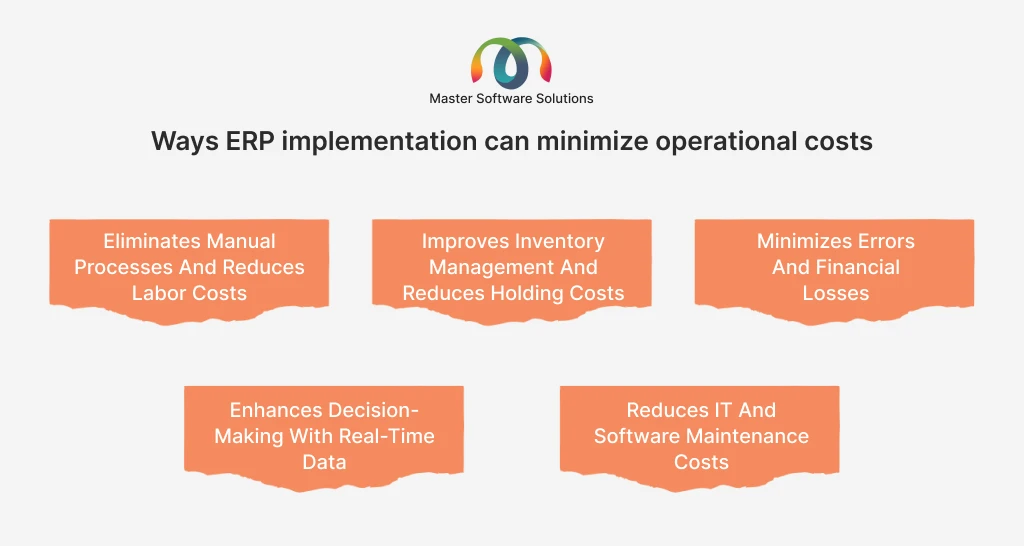
Implementing an Enterprise Resource Planning (ERP) system reduces operational costs by addressing inefficiencies at their source. Instead of treating cost overruns as isolated problems, ERP improves the underlying processes that drive daily operations. Here are the ways ERP implementation minimizes operational costs:
Eliminates manual processes and reduces labor costs
Many businesses rely on manual data entry, spreadsheets, and repetitive administrative work to manage daily operations. These processes consume time, increase payroll expenses, and often result in costly errors. ERP systems automate critical functions such as invoicing, payroll, reporting, and order processing. Automation reduces dependency on manual intervention, shortens processing cycles, and minimizes rework caused by human error. As a result, organizations can operate with leaner administrative teams while improving productivity and accuracy.
Improves inventory management and reduces holding costs
Procurement inefficiencies often stem from poor vendor management, inconsistent pricing, and unauthorized spending. ERP centralizes purchasing activities by automating purchase orders, approval workflows, and supplier tracking. With access to consolidated spend data, businesses can negotiate better contracts, standardize purchasing policies, and eliminate maverick spending. This structured procurement process improves transparency and ensures cost-effective sourcing decisions.
Minimizes errors and financial losses
Manual systems are prone to duplicate entries, calculation mistakes, and compliance risks. Even small errors in billing, accounting, or reporting can lead to financial losses and regulatory penalties. ERP systems enforce standardized workflows and automated validations, reducing inaccuracies. By ensuring consistent data entry and generating accurate financial statements, ERP minimizes costly mistakes and enhances financial control.
Enhances decision-making with real-time data
Delayed or incomplete information often results in poor financial decisions. ERP systems provide real-time dashboards and performance analytics, allowing managers to monitor expenses, track KPIs, and instantly identify inefficiencies. With timely insights, leadership can take corrective action before minor issues escalate into significant financial problems. Improved forecasting and budgeting capabilities further support long-term cost control.
Reduces IT and software maintenance costs
Many organizations operate multiple disconnected software solutions, increasing licensing fees, integration expenses, and IT maintenance burdens. ERP consolidates core business functions into a single integrated platform, reducing system complexity. This consolidation lowers software subscription costs, simplifies infrastructure management, and reduces reliance on multiple vendors. Over time, businesses benefit from a lower total cost of ownership and more predictable IT expenditures.
Challenges and initial investments vs long-term savings
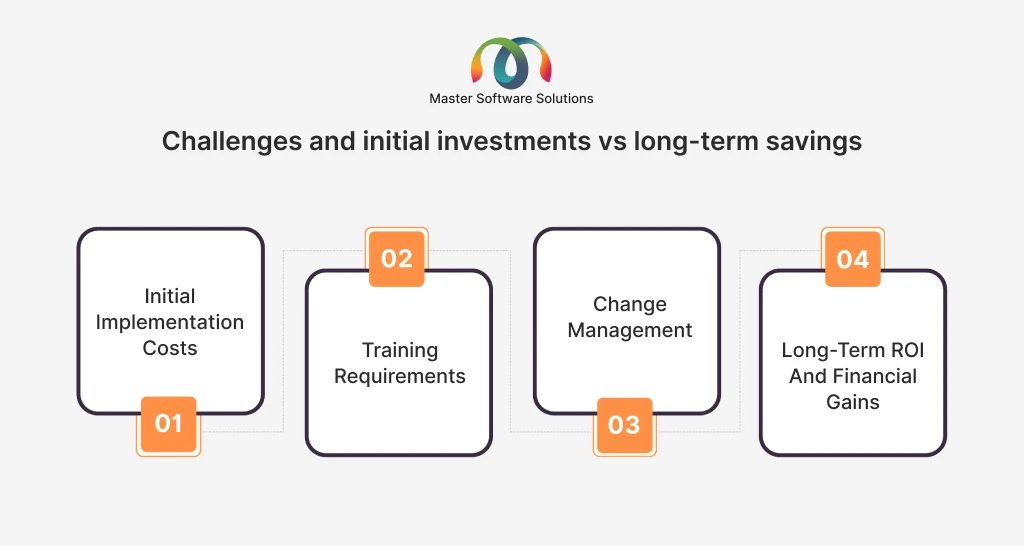
While ERP implementation delivers significant cost savings, it is important to understand that the journey requires upfront investment and organizational commitment. A balanced evaluation of both short-term challenges and long-term returns helps businesses set realistic expectations and maximize success:
Initial implementation costs
ERP implementation involves software licensing or subscription fees, system customization, data migration, infrastructure upgrades (if on-premise), and consulting services. Depending on the organization’s size and complexity, the initial investment can be substantial. However, this cost should be viewed as a strategic capital investment rather than an operational expense, as the system replaces multiple disconnected tools and manual processes.
Training requirements
Employees must be trained to use the new system effectively. This includes time spent on workshops, onboarding sessions, and adapting to new workflows. During the transition period, productivity may temporarily slow as teams adjust. Proper training, however, ensures higher user adoption, fewer errors, and faster realization of cost benefits.
Change management
ERP implementation often requires process standardization and cultural shifts within the organization. Resistance to change can create delays and inefficiencies if not managed carefully. Strong leadership support, clear communication, and phased implementation strategies are critical to overcoming these challenges.
Long-term ROI and financial gains
Despite the initial investment, most organizations achieve measurable returns within 12 to 24 months. Cost reductions from automation, improved inventory control, streamlined procurement, and enhanced productivity gradually offset implementation expenses. Over time, ERP delivers sustained operational efficiency, improved cash flow, and a lower total cost of ownership.
Also Read: Cost for Odoo ERP Migration – Pricing and Estimation
Tips for successful ERP implementation to improve cost savings
Implementing an ERP system is a strategic initiative that directly impacts operational efficiency and financial performance. However, cost savings are not automatic. They depend on proper planning, execution, and continuous optimization. The following best practices help organizations maximize the financial benefits of ERP implementation.
Choose the right ERP vendor
Selecting the right ERP vendor is critical to achieving long-term cost efficiency. Businesses should evaluate vendors based on industry expertise, scalability, customization capabilities, integration flexibility, and total cost of ownership. A system that aligns with your operational requirements reduces the need for expensive customizations and minimizes future upgrade costs. Conducting thorough requirement analysis and vendor comparison prevents costly implementation mistakes.
Define clear goals and KPIs
Before implementation, organizations must establish measurable objectives such as reducing inventory holding costs, improving order processing time, or lowering procurement expenses. Clear goals ensure the ERP system is configured to support cost-reduction priorities. Defining key performance indicators (KPIs) enables leadership to track progress and accurately measure return on investment.
Train employees properly
User adoption directly influences ERP success. Without proper training, employees may resist the system or use it inefficiently, reducing potential savings. Structured training programs, role-based access guidance, and continuous support improve system utilization. Well-trained employees make fewer errors, follow standardized workflows, and contribute to operational efficiency.
Implement in phases
A phased implementation approach reduces operational disruption and financial risk. Instead of deploying all modules at once, businesses can roll out high-impact areas first, such as finance or inventory management. This approach allows teams to adapt gradually, identify issues early, and optimize processes before full-scale deployment, protecting both productivity and budget.
Monitor performance and optimize continuously
ERP implementation does not end at go-live. Continuous monitoring of performance metrics such as processing time, cost per transaction, inventory turnover, and procurement savings ensures the system delivers expected value. Regular system audits and process refinements help identify new efficiency opportunities and sustain long-term cost reductions.
Conclusion
ERP implementation is more than a technology upgrade—it is a strategic investment in operational efficiency and financial control. By automating manual processes, integrating departments, improving inventory accuracy, and providing real-time data visibility, ERP systems significantly reduce operational costs. They eliminate inefficiencies, minimize errors, streamline procurement, and support faster, data-driven decision-making. Over time, these improvements translate into measurable cost savings, improved cash flow, and stronger long-term profitability.
Master Software Solutions helps businesses design, customize, and deploy ERP solutions aligned with their operational goals. With expertise in process optimization, system integration, and scalable ERP development, their team ensures smooth implementation and maximum return on investment.
Contact us today and take the first step toward a smarter, more efficient business.