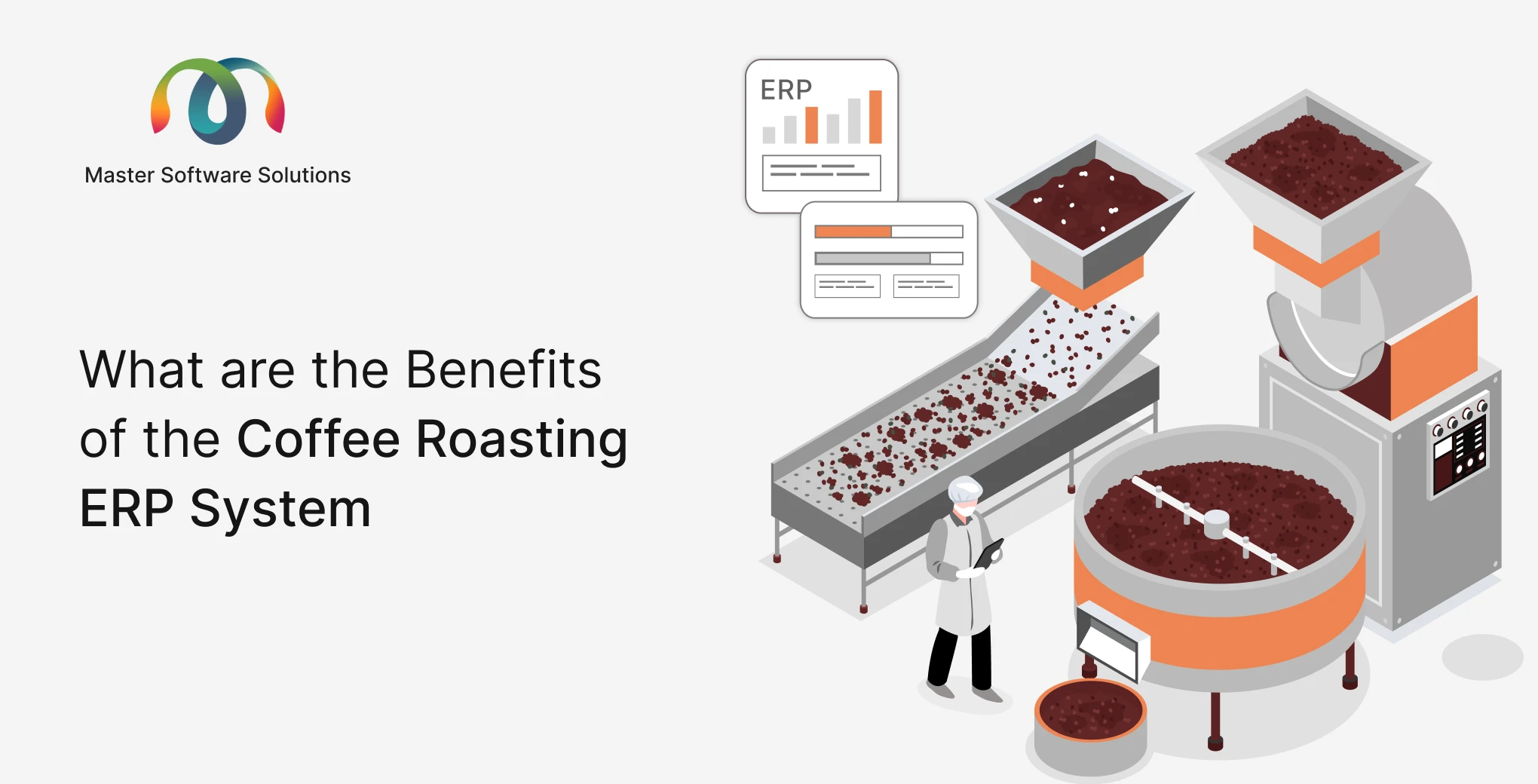
A perfect roast can turn into a wasted batch in seconds. That’s how fragile growth can be for coffee businesses. Production, quality control, maintenance, and demand planning all get harder to manage together. Manual processes and disconnected systems lead to errors, delays, and unhappy customers. An ERP brings everything into a unified platform, with real-time data guiding every decision.
Fortune Business Insights shows that the global coffee roaster market size was valued at USD 1.96 billion in 2025 and is expected to grow from USD 2.06 billion in 2026 to USD 3.41 billion by 2034. As roasters are scaling towards growth, an efficient coffee roasting ERP system manages that expansion & streamlines every process from sourcing, production, to inventory & delivery. Here’s how that shift pays off, from bean intake to final delivery.
Benefits of the Coffee Roasting ERP System
Manual coffee production processes without a unified system result in inaccurate data for inventory & production. The key advantages of the coffee roasting ERP system are as follows:
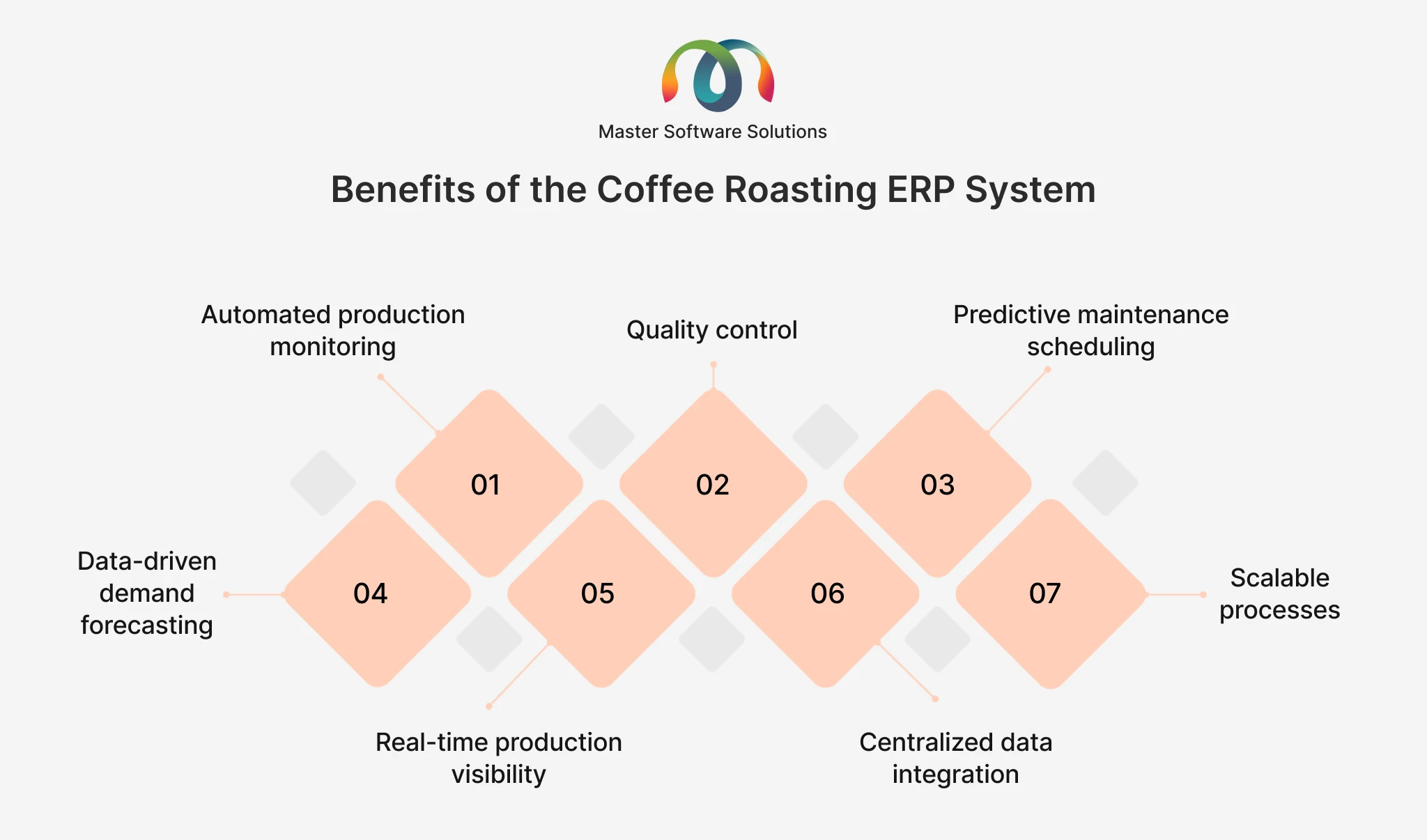
Automated production monitoring ensures consistent roasting profiles, strengthening flavor quality and customer satisfaction
When production monitoring is done manually, there is a high risk of human errors in recording roasting time, temperature, and bean quality. Automated production monitoring is a significant shift that tracks the production data automatically. When roasting data is captured continuously and accurately, deviations from established profiles are identified immediately rather than after a batch has already shipped.
- Consistent flavor profiles across batches strengthen customer trust and improve CSAT scores over time.
- Automated data reduces human data-entry mistakes and makes it faster to pinpoint the root cause of problems.
- Standardized roasting parameters support scalability & allow production volumes to increase without compromising product quality.
- Reduced rework and fewer wasted batches support long-term profitability.
Real-time quality control reduces defects, recalls, and strengthens regulatory compliance
Manual inspection creates quality issues, particularly when production volume grows & inspection fatigue sets in across long shifts. Timely system-driven quality checks at every stage of production close this gap by flagging defects & analyzing contamination risks.
- Early defect detection lowers the risk of product recalls, protecting businesses from the financial losses from wasted stock and reverse logistics.
- Consistent quality standards reduce customer complaints and returns, supporting stronger repeat purchase rates and retailer relationships.
- Documented quality control records make it easier to demonstrate compliance during audits or certifications, reducing regulatory exposure.
Predictive maintenance scheduling optimizes equipment performance and reduces operational costs
Roasters, grinders, brewers, and packaging machines wear down over time & the team misses the early warning signs before a breakdown hits. Predictive maintenance scheduling driven by real-time equipment usage & performance generates early signs of equipment maintenance.
- Timely maintenance keeps equipment running at optimal efficiency, reducing unnecessary energy consumption and utility costs.
- Fewer unexpected breakdowns minimize production stoppages, protecting output targets and delivery timelines.
- Extending equipment lifespan through consistent servicing delays the need for premature capital investment in new machinery.
- Well-maintained equipment preserves packaging quality, which supports consistent product output and long-term operational efficiency.
Data-driven demand forecasting balances production and inventory, minimizing spoilage and missed sales
Spreadsheet-based forecasting struggles to keep up with seasonal demand shifts, changing customer buying patterns, and market fluctuations. Businesses are turning to AI and analytics to predict demand more accurately. This is pushing the global market to grow at a CAGR of 10.7% through 2033, according to Growth Market Reports.
Data-driven demand forecasting in production & sales enables businesses to align procurement, roasting schedules, & distribution planning. As forecasting accuracy improves, planning will be more accurate & consistent.
- Accurate forecasting keeps inventory in check, lowering storage costs and cutting the risk of beans or finished products going stale.
- Better-aligned production results in fewer stockouts, missed sales, and customers turning to competitors instead.
- Streamlined procurement planning builds stronger supplier relationships & more consistent ordering patterns.
- Balanced supply and demand protect profitability & build customer trust in product availability.
Real-time production visibility accelerates issue detection, protecting brand reputation and reducing recall costs
Without real-time visibility into production, various errors are encountered, such as incorrect roasting temperatures, contamination risks, or packaging defects. Continuous monitoring across every stage of the production cycle tracks issues earlier and resolves them before they turn into bigger quality or safety incidents.
- Faster error detection means fewer contaminated or defective products reach customers, lowering recall risk.
- Clear traceability across production stages makes it easier to pinpoint root causes & cuts down the time and cost of uncertainties.
- Fewer quality failures lead to lower operational costs of recalls, logistics reversals, and wasted stock.
- Stronger production oversight protects brand reputation and builds customer trust for long-term business growth.
Centralized data integration improves cross-functional decision-making and reduces costly miscommunication
When production, inventory, procurement, and sales data are settled in different systems, it’s difficult to coordinate roasting schedules or to line up purchasing decisions with actual inventory levels. A centralized data structure removes these gaps & circulates consistent data in every department to fix miscommunication & delays.
- Shared visibility across departments leads to fewer planning conflicts & enables production and sales teams to work from a unified platform.
- Faster, better-informed decisions bring down the operational costs due to miscommunication, delays, and duplication.
- Better traceability from bean intake to finished product makes certification, like organic or fair-trade compliance, much simpler.
- Stronger cross-functional alignment supports more consistent execution & maintains profitability even as the business gets more complex.
Standardized, scalable processes support consistent growth across new locations and expanding product lines
As coffee businesses open new roasting facilities, add product lines, or expand into new markets, maintaining established quality and process standards by hand gets harder and harder. Standardized digital workflows make it possible to apply the same roasting parameters, quality checks, and maintenance protocols across every facility and team, no matter the location.
- Standardized processes provide direction to the new facilities and teams, getting them to full production capacity.
- Consistent standards across locations protect brand identity, so customers get the same product quality no matter where it was made.
- Scalable, repeatable processes lower the operational risks that usually come with expansion.
- Reliable execution at scale builds confidence among investors, partners, and retail buyers, supporting sustained long-term business growth.
Turn Every Batch Into a Consistent Success! Get the ERP solution that brings production, quality control, and demand planning together on a single platform.
Conclusion
As coffee businesses shift toward ERP-driven operations, the takeaway is simple: real-time data & automated oversight. Businesses that close these gaps see fewer quality failures, lower operational costs, and stronger customer trust. As coffee businesses scale, real-time visibility becomes the baseline for staying competitive. The ones who get there first — winning on quality, reliability, and profitability — will be successful in the long run.
Master Software Solutions provides custom ERP systems for coffee businesses handling production, rentals, inventory, quality control, and sales and distribution. The team works across platforms like Odoo, Microsoft Dynamics 365 Business Central, and TrakOp, tailoring each implementation to the specific workflows of the coffee supply chain. With offices in North America and Asia, Master Software Solutions supports coffee businesses through every stage of ERP adoption, from the initial discovery meeting to ongoing support and maintenance.
Take a step towards coffee ERP solutions. Get connected with our experts in Master Software Solutions & get a free consultation about your coffee business requirements.