In dairy distribution, returns are inevitable. A retailer receives damaged pouches. A distributor returns unsold products near their expiration date. A supplier delivers substandard packaging material. Each of these events triggers a chain of actions, including inspection, credit, stock correction, and documentation, that most dairy businesses handle manually, inconsistently, and long after the damage has compounded.
Dairy ERP software changes this entirely by making returns and damage tracking structured, automated, and visible across the entire supply chain.
How Returns and Damage Losses Impact Dairy Businesses
Returns and damage management are the most underestimated cost centers in dairy operations. Unlike production inefficiencies that are visible on the plant floor, return losses accumulate quietly. They include mislogged credits, unenforced supplier claims, and uninspected damaged stock that slips back into usable inventory.
- 6-12% of dairy products returned due to damage, quality failure, or expiry in distribution
- 40% of returned goods go uninspected before being restocked in manually managed operations
- $10k to $14k average annual write-off from unrecovered damage claims in mid-sized dairy businesses
- 3x faster return resolution time reported by dairies using ERP-driven return workflows
What is Return Management in Dairy Operations?
Returns management is the structured process of handling goods returned by customers or distributors to the dairy, whether because of product quality issues, packaging defects, excess stock, or delivery errors. In dairy specifically, returns can include returnables, such as crates and bottles that require reconciliation and credit processing.
Without a system, each return is handled ad hoc: a phone call to the driver, a manual entry in a register, a credit note raised days later by someone who wasn’t present at the inspection. The result is inventory inaccuracies, disputed credits, and unenforceable supplier claims.
Why are Dairy Returns More Complex Than General FMCG?
Dairy products have short shelf lives, are temperature sensitive, and have a high return rate. A batch of milk pouches returned two days before expiry requires a different resolution than a crate of damaged glass bottles. ERP systems designed for dairy understand these distinctions and automatically route each return type through the appropriate workflow.
Are Returns and Damage Write-offs Quietly Draining Your Dairy’s Margins?
Most dairy businesses discover the true scale of their return losses during a year-end audit, by which point months of write-offs are unrecoverable.
Master Software Solutions offers a free 30-minute returns management review: we’ll map your current return process, identify the highest-cost gaps, and show you exactly how a dairy ERP system would close them. Book a Free Return Audit
What is Return Management in Dairy ERP?
Returns management in dairy ERP is the end-to-end process of authorizing, receiving, inspecting, and reconciling returned goods from retailers, distributors, or suppliers within a centralized software system. It includes damage classification, reason coding, inventory updates, and credit or replacement workflows, all tracked in real time.
What are the Key Aspects of Return Handling in Dairy ERP?
A robust dairy ERP system addresses every stage of the return journey, from the initial authorization request through to inventory correction and financial settlement. Here are the core capabilities that distinguish structured ERP-driven returns from manual handling.
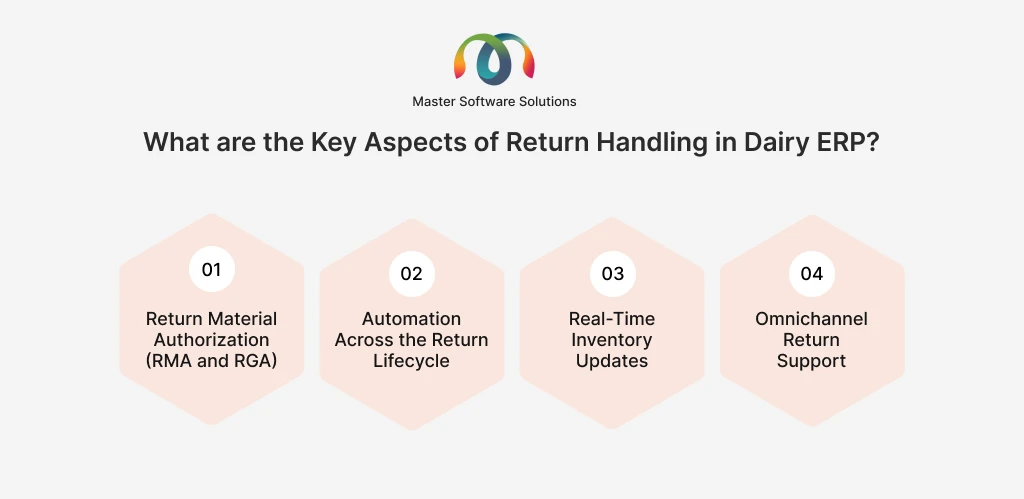
Return Material Authorization (RMA and RGA)
Before a return is physically accepted, it needs to be authorized. ERP systems enforce this with Return Material Authorization (RMA) for customer returns and Return Goods Authorization (RGA) for supplier-side returns. RMA is a customer-side return request with product, quantity, and resolution type recorded before physical receipt.
Automation Across the Return Lifecycle
The most time-consuming part of returns management is not the physical handling; it is the paperwork. In a dairy ERP, automation eliminates manual steps at every stage: return receipts are auto-generated from the original sales order, credit notes are triggered on inspection completion, stock is automatically rerouted to quarantine or back to usable inventory based on inspection outcome, and supplier claims are raised as purchase credit notes without additional data entry.
Real-Time Inventory Updates
Real-time inventory updates play a pivotal role in checking stock capacity, overstocking, and overstock. Everything is monitored via software; there is no manual intervention or double-checking.
Omnichannel Return Support
Modern dairy distribution involves multiple customer touchpoints, including direct retailers, sub-distributors, institutional clients, and online channels. A dairy ERP consolidates return handling across all these channels into a single system. Whether a return originates from a field driver’s mobile app, a distributor portal, or an internal warehouse scan, it flows into the same workflow with the same tracking, inspection, and resolution process.
Is Your Return Process Costing More Than You Think?
Every dairy operation has a different return profile; some struggle with high-frequency small returns from retailers, while others struggle with bulk supplier returns on packaging materials. The right ERP configuration depends on understanding your specific volume, product mix, and distribution model. Talk to a Dairy ERP Specialist
Damage Tracking and Quality Management With Dairy ERP
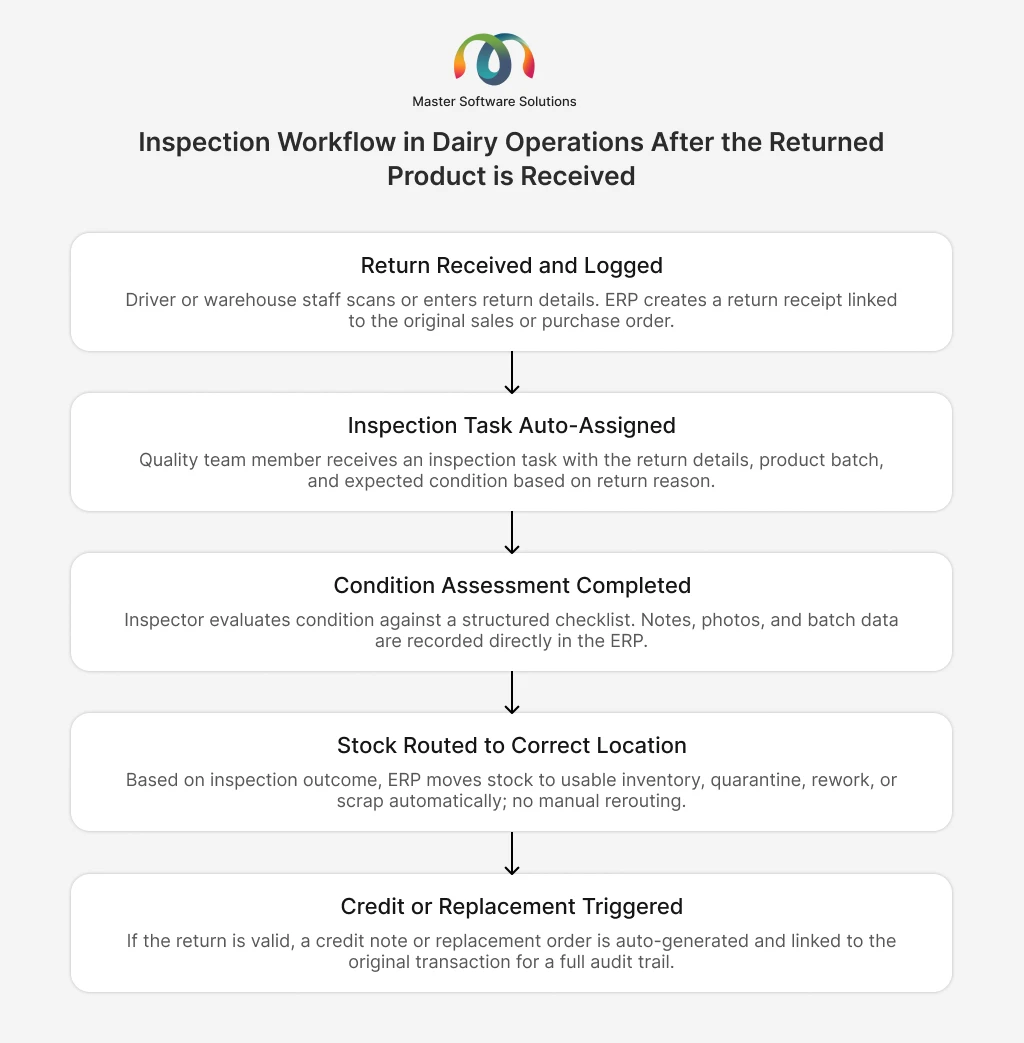
As we know, milk is a perishable product whose quality is the major concern. Quality concerns are very common, as there are a lot of parameters included in it. Dairy ERP follows the proper inspection workflow and creates documentation of every detail to maintain the records.
The ERP follows an inspection workflow that includes:
- When a return is received
- Inspection task is triggered
- Create a structured Checklist (product condition, packaging, temperature & expiry verification)
- Quarantine for Rework
Reason Codes For Structured Damaged Classification
Every return is tagged with a reason code at entry. The dairy configures codes to reflect their specific return patterns, and over time, they become a powerful dataset for identifying systemic issues. Common reason codes in the dairy include:
- Packaging Damage: Pouch tear, bottle crack, or carton crush during transit or handling
- Expiry / Near Expiry: Product returned before or at expiry date by retailer or distributor
- Cold Chain Breach: Temperature deviation detected during storage or transport
- Overstocking: Customer ordered excess and is returning unsold units
- Wrong Product Delivered: Delivery errors, such as wrong SKUs, flavors, or fat percentages, were dispatched
- Quality Complaint: Taste, smell, or appearance issue reported by the end customer
Documentation and Digital Paper Trail
Every return event in a dairy ERP creates a complete digital record, including who initiated the return, when it was received, who inspected it, its condition, where it was routed, and the financial resolution used. This documentation is retrievable in seconds and critical for resolving customer disputes, supporting insurance claims, defending against supplier liability disputes, and passing food safety audits.
Dairy businesses using ERP-driven damage documentation report a 70% reduction in unresolved customer disputes because every return event has a timestamped, photographic, and financial record that both parties can access.
Also Read: ERP Software for Dairy Manufacturers – Everything You Need to Know
Supplier Returns and Upstream Reconciliation in Return Handling
Returns management in dairy is not only downstream, from customers back to the dairy. It is also upstream, from the dairy back to suppliers of raw materials, packaging, and ingredients. Supplier returns are often the most financially significant, and the least systematically managed.
Initiating Supplier Returns From Purchase Orders
When a batch of milk pouches arrives with defective sealing or a delivery of packaging film is off-specification, the dairy needs to return these materials and claim credit or replacement from the supplier. In a dairy ERP, supplier returns are initiated directly from the original purchase order, creating a purchase return with the correct quantities, unit prices, and vendor details populated automatically.
Vendor Debit Notes and Claim Tracking
Once a supplier return is validated, the ERP generates a vendor debit note, a formal document requesting credit from the supplier. The debit note is linked to the original purchase, the return receipt, and any inspection notes or photographic documentation. This creates a complete, enforceable claim that suppliers cannot easily dispute. Outstanding supplier claims are tracked in a dedicated aging report, so your procurement team always knows what is owed and for how long.
See Dairy Return Handling and Damage Tracking Live, Inside a Real Odoo Environment
Book a meeting, and we will walk you through the complete return lifecycle in a configured Odoo instance: initiating an RMA from a sales order, running an inspection workflow, classifying damage with reason codes, routing stock to quarantine, generating a credit note, and raising a supplier debit note, all within a single system.
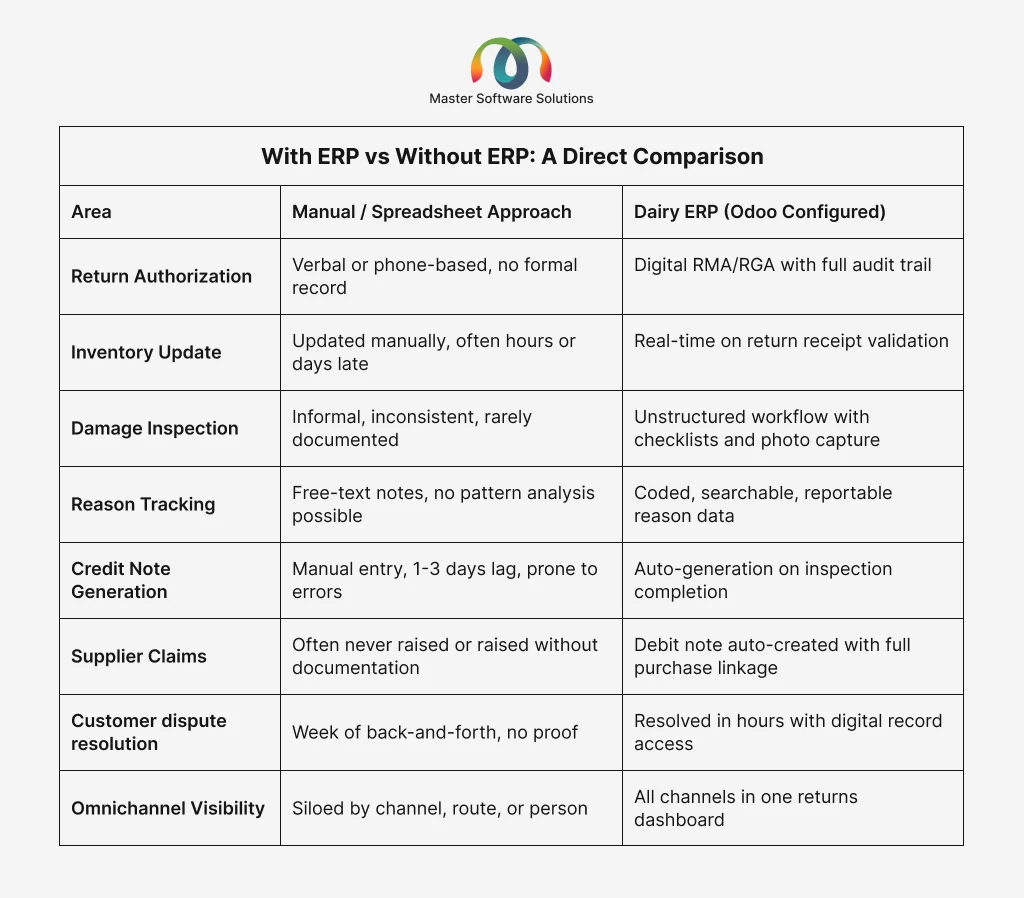
With ERP vs Without ERP: A Direct Comparison
The difference between manual return handling and ERP-driven returns management is not just speed; it also includes visibility, accuracy, and recoverability. Here is how the two approaches compare across the dimensions that matter most in dairy operations.
What are the Benefits of Using ERP for Return and Damage Management?
The operational and financial case for ERP-driven returns management in dairy is compelling. Here is what dairy businesses consistently report after implementing structured returns workflows.
Increased Operational Efficiency Across the Return Cycle
Return processing time drops from days to hours. Staff who previously spent time chasing return paperwork can focus on exception handling and customer service.
Significant Cost Reduction Through Claim Recovery and Waste Prevention
ERP-driven returns management recovers costs that manual systems leave on the table:
- Supplier credits that were never claimed
- Customer deposits on unreturned packaging
- Insurance claims that lacked documentation
- And damaged stock that was restocked instead of being scrapped
They generate downstream complaints and further returns. Each of these represents real money that structured returns management puts back into the business.
Enhanced Customer Experience Through Faster, Transparent Resolution
When a retailer returns 50 packets of damaged milk, they expect a fast, clear resolution, not a week of follow-up calls. ERP-driven returns mean the credit note is raised within hours, the customer can track the status through a portal, and there is no ambiguity about what was returned, when, and what credit is due. This transparency builds retailers’ trust and reduces churn, particularly for high-frequency delivery accounts.
Odoo ERP Capabilities for Handling Dairy Returns
- Auto-Created Return Receipts: These receipts are generated from the original sales order without needing the product’s re-entry or customer data.
- Quality Inspection Triggers: The system auto-assigns inspection tasks on return receipt, with configurable checklists per product category.
- Reason Code Tagging: Every return is tagged with a configurable reason code at entry. This enables pattern analysis across routes, customers, and SKUs.
- Smart Stock Routing: Inspection outcomes in Odoo automatically route stock to usable inventory, quarantine, rework, or scrap locations.
- Auto Credit Notes: The system automatically generates credit notes when the return is validated. It is linked to the original invoice and the customer’s account.
- Supplier debit notes: The purchase return generates vendor debit notes that are fully linked to the purchase order and attached documentation.
- Customer Portal Access: Retailers and distributors can track their return status, view credit notes, and download statements from a self-service portal.
- Return Dashboard: The Odoo ERP system provides a real-time view of all open returns by status, reason, customer, and financial value across all channels and locations.
Conclusion
Returns and damage management in dairy are not peripheral concerns; they are direct drivers of margin, customer satisfaction, and supply chain integrity. Every untracked return is a write-off. Every uninspected damaged product is a future complaint. Every unclaimed supplier debit is permanent money left on the table.
Dairy ERP software and Odoo in particular transform returns from a chaotic, reactive process into a structured, automated, and fully visible workflow. The result is faster resolution, better data, recovered costs, and a supply chain that gets smarter with every return it processes.
Master Software Solutions is an end-to-end Odoo implementation company with deep specialization in dairy ERP. From returns management and damage tracking to route scheduling, crate reconciliation, and milk billing, we configure Odoo to fit the specific workflows of dairy operations, not the other way around.
Get a Free Dairy ERP Returns Management Review.
We’ll assess your current return process, identify where losses are occurring, and show you how Odoo can close those gaps in a single focused session, no commitment needed. Book Your Free Review