If you are in the food manufacturing business, this might sound similar. You walk through any food manufacturing facility, and you’ll find the same crisis playing out
- Spreadsheet
- Sticky notes
- And frantic phone calls
Between the warehouse and the production floor.
- A batch of flour expired last week because nobody flagged it.
- A shipment of packaging materials arrived early
- There’s nowhere to put it
And the purchasing manager just placed a duplicate order for an ingredient that was already sitting in aisle seven.
Inventory management in food manufacturing isn’t just a logistics challenge: it’s a food safety issue, a profitability issue, and increasingly, a compliance issue. The margin for error is razor-thin, and the cost of getting it wrong is measured not just in wasted product but in regulatory fines, customer complaints, and, in the worst cases, recalls.
This is where Enterprise Resource Planning (ERP) software earns its place in a food manufacturer’s tech stack. A well-implemented ERP doesn’t just digitize your inventory records; it transforms how your operation tracks, manages, and optimizes every ingredient, packing material, and finished product that moves through your facility.
Let’s break down exactly how.
Why Is Inventory Management Uniquely Challenging for Food Manufacturers?
Before we get into what ERP solves, it’s worth understanding why food manufacturing inventory… is more complex than most industries.
Perishability changes everything
Unlike electronics or automotive parts, food ingredients expire. First-in, first-out (FIFO) and first-expired, first-out (FEFO) rotation rules aren’t optional; they’re necessary. Even a single expired batch that makes it into production can trigger a recall that costs orders of magnitude more than the ingredients themselves.
Regulatory requirements add layers of complexity
FDA regulations, FSMA (Food Safety Modernization Act), HACCP requirements, and increasingly strict retailer standards demand traceability at a level that most manual systems simply can’t deliver. Knowing exactly which lot of an ingredient went into which batch of which product and being able to prove it is no longer optional.
Demand variability is extreme
Seasonal products, promotional spikes, and retailer promotions can swing demand 200-300% in a matter of weeks. Ordering the wrong amount of a perishable ingredient in either direction is expensive.
Supplier complexity is real
Food manufacturers often work with dozens or hundreds of ingredient suppliers, many of whom have their own variability in lead times, quality, and pricing.
Waste directly impacts margins
In an industry where margins are already thin, ingredient waste, from spoilage, overproduction, or poor yield management, makes a difference between profitability and loss.
None of these challenges is new. What’s changed is the availability of ERP systems sophisticated enough to address all of them on an integrated platform for mid-size food manufacturers to implement.
How ERP Transforms Inventory Management: Feature by Feature
ERP offers advanced inventory management features that enable food manufacturers to manage their raw materials and produced products. The system ensures that manufacturers have the right quantity of raw materials and products to fulfill customer demand. Here are the features of ERP for inventory management:
Real-Time Inventory Visibility
The most fundamental thing an ERP provides is a single source of truth for inventory. Every receipt, every consumption, every transfer between locations, and every adjustment is recorded in real time and visible to anyone with access. For food manufacturers, this means:
- Knowing exactly how much of every ingredient you have on hand, by location, at any given moment
- Seeing inventory across multiple warehouses, cold storage areas, and production lines from a single dashboard
- Eliminating the lag between physical movements and system updates that creates discrepancies and errors in manual processes
When a production planner asks, “Do we have enough semolina to run tomorrow’s pasta line?” the answer should be available in seconds, not after a warehouse walk or a call to the storeroom. ERP makes that possible.
Lot and Batch Tracking
This is where ERP is crucial in food manufacturing, specifically. Every ingredient that enters your facility should be tagged with a lot number, typically tied to the supplier’s lot number and your internal receipt date. Every batch of finished goods should carry a reference to every ingredient lot that went into it. An ERP with robust lot tracking allows you to:
- Assign lot numbers at goods receipt and track them through every stage of production
- Know instantly which lots are in which locations, and which lots have already been consumed
- Run a forward trace: “Which finished goods batches contain ingredient lot X?” — critical during a supplier recall
- Run a backward trace: “Which ingredient lots went into finished product batch Y?” — essential for a product recall investigation
- Set expiry dates at the lot level and get automated alerts when lots are approaching expiry
Without ERP, this traceability exists only if someone has been diligently filling out paper records and a recall investigation can take up to two days; that can be done in two hours using an ERP system. With ERP, a full forward or backward trace takes minutes.
FEFO and FIFO Rotation Enforcement
ERP systems enforce stock rotation rules automatically, removing human error from one of the most critical processes in food inventory management.
FIFO (First In, First Out) ensures that the stock received earliest is consumed first. FEFO (First Expired, First Out) ensures that the stock with the earliest expiry date is consumed first, which is often more appropriate for perishable ingredients where lot expiry dates don’t always align with receipt dates.
In practice, this means:
- When a production operator scans or picks an ingredient, the ERP directs them to the correct lot based on the configured rotation rule
- Putaway strategies in the warehouse can be configured for efficient stock rotation
- Alerts fire automatically when stock is approaching expiry and hasn’t been reserved for production
The alternative, relying on warehouse staff to manually check dates and rotate correctly every time, is a system that will eventually fail.
Automated Reorder Points and Replenishment
Running out of a critical ingredient mid-production is expensive. Overstocking perishable ingredients is equally expensive. ERP systems find balance by automating reorder logic based on the real-time consumption data.
With ERP-driven replenishment, you can configure:
- Minimum stock levels (reorder points): When inventory drops below a defined threshold, the ERP automatically generates a purchase requisition or purchase order
- Safety stock: A buffer quantity that accounts for variability in supplier lead times and production demand
- Maximum stock levels: Ceiling quantities that prevent over-ordering, especially important for cold storage with limited capacity
- Lead time awareness: Reorder triggers that account for how long it takes for a supplier to deliver, so you’re never caught short
Over time, ERP systems with demand forecasting capabilities learn from historical consumption patterns, seasonal peaks, promotional uplifts, and product mix changes and adjust reorder recommendations accordingly. This moves food manufacturers from reactive purchasing (“we just ran out”) to proactive supply management.
Bill of Materials (BOM) Integration
In food manufacturing, recipes are your bill of materials. An ERP connects your inventory directly to your production recipes, so every time a production order is confirmed, the system knows exactly what ingredients and quantities will be consumed.
This integration enables:
- Accurate raw material planning: Before committing to a production schedule, the ERP checks whether sufficient inventory exists for every BOM component
- Automatic inventory reservations: Ingredients are reserved against specific production orders, preventing the same stock from being double-allocated
- Yield management: If your actual yield varies from the theoretical recipe yield, those variances are tracked and reported, giving you visibility into true consumption costs
- Allergen and nutritional tracking: Ingredient attributes at the BOM level can trigger warnings when recipe changes introduce allergens or alter nutritional profiles
The result is a production planning process that’s grounded in actual inventory reality and not assumptions.
Warehouse Management and Location Tracking
Food manufacturing facilities are rarely simple. You might have ambient storage, refrigerated zones, freezer storage, a packaging-materials warehouse, and a finished-goods area; each with its own management requirements.
ERP warehouse management features allow you to:
- Define storage locations down to the bin or pallet position level
- Configure putaway rules that direct received goods to the correct zone based on product category, temperature requirements, or lot characteristics
- Track inventory by location so you always know not just how much you have, but exactly where it is
- Manage warehouse transfers between locations with full inventory impact
For food manufacturers with regulatory requirements around segregation (allergens, organic vs. conventional, raw vs. processed), location-level tracking is essential for compliance.
Supplier and Purchase Order Management
Inventory management doesn’t start when goods arrive at your dock — it starts when you place the purchase order. ERP systems connect procurement to inventory so you can see the full picture: on-hand inventory plus incoming inventory.
Key capabilities include:
Goods receipt matching: When a delivery arrives, the ERP matches it against the original purchase order. Quantity or quality discrepancies are flagged immediately rather than discovered at month-end
Supplier performance tracking: Delivery accuracy, lead time consistency, and quality rejection rates are tracked over time, giving you the data to make better supplier decisions
Certificate of analysis management: For regulated ingredients, ERP can store and track supplier COAs (certificates of analysis) alongside lot records
Three-way matching: Purchase order, goods receipt, and supplier invoice are matched automatically, reducing administrative overhead and preventing payment errors
Inventory Costing and Waste Tracking
Food manufacturing profitability depends on understanding the true cost of your inventory, not just the purchase price, but the landed cost, including freight, duties, and handling, and the actual cost accounting for yield losses and waste.
ERP inventory costing provides
Standard vs. actual cost variance analysis: Compare what you expected to spend on ingredients vs. what you actually spent
Waste and scrap recording: Production waste, quality rejections, and expired stock are recorded and attributed to the correct cost center
Lot-level costing: Know the cost of every lot in inventory, which matters for accurate finished goods costing when ingredient prices fluctuate
Inventory valuation reporting: FIFO, weighted average, or standard cost valuation methods supported, with audit-ready reporting
The Real Cost of Managing Inventory Without ERP
Many food manufacturers still rely on a patchwork of spreadsheets, standalone warehouse systems, and manual records. The hidden costs of this approach are significant.
The spreadsheet approach works until it doesn’t. And in food manufacturing, when it fails, the consequences are serious.
Key ERP Modules That Drive Inventory Performance in Food Manufacturing
Not all ERP modules are created equal for food manufacturing. These are the ones that deliver the most direct impact on inventory management:
Inventory / Stock Management
The core module manages on-hand quantities, lot tracking, location management, and stock movements. This is non-negotiable.
Purchase Management
Connects procurement to inventory, enabling goods receipt, supplier management, and three-way matching.
Manufacturing / Production
Connects BOMs and production orders to inventory, driving reservations, consumption tracking, and yield management.
Quality Control
manages incoming ingredient inspections, production quality checks, and non-conformance records. Link quality control to inventory so quarantined stock can’t be accidentally used.
Warehouse Management
extends basic inventory with location-level control, putaway strategies, and picking/packing workflows.
Traceability / Lot Tracking
the feature set that enables forward and backward traceability. Essential for food manufacturers and often a key requirement for major retailer certifications.
Demand Forecasting
Uses historical sales and production data to predict future demand and feed that into replenishment planning.
What to Look for in an ERP for Food Manufacturing Inventory
If you’re evaluating ERP systems for your food manufacturing operation, here’s what to prioritize from an inventory management perspective:
Native lot and serial number tracking
This should be a core capability, not an add-on. Verify that tracking works across all transactions: goods receipts, transfers, production consumption, and customer shipments.
FEFO support
Not all ERP systems support first-expiry, first-out as a native rotation strategy. For food manufacturers, this is essential.
Configurable BOMs with yield factors
Your recipes have variable yields based on ingredient quality and process conditions. The ERP should accommodate this, not force you to use fixed consumption quantities.
Quality control integration
QC and inventory must be tightly linked. A quality lot that should be automatically quarantined from production use without a manual workaround.
Regulatory reporting readiness
Check whether the ERP can generate the reports that regulators and retailers actually ask for: lot traceability reports, allergen declarations, and inventory disposition records.
Multi-warehouse and multi-location support
If you operate more than one facility or have complex storage zones within a facility, make sure the ERP handles this natively.
Mobile warehouse operations
Barcode scanning and mobile receiving make inventory data more accurate and reduce the lag between physical movements and system records.
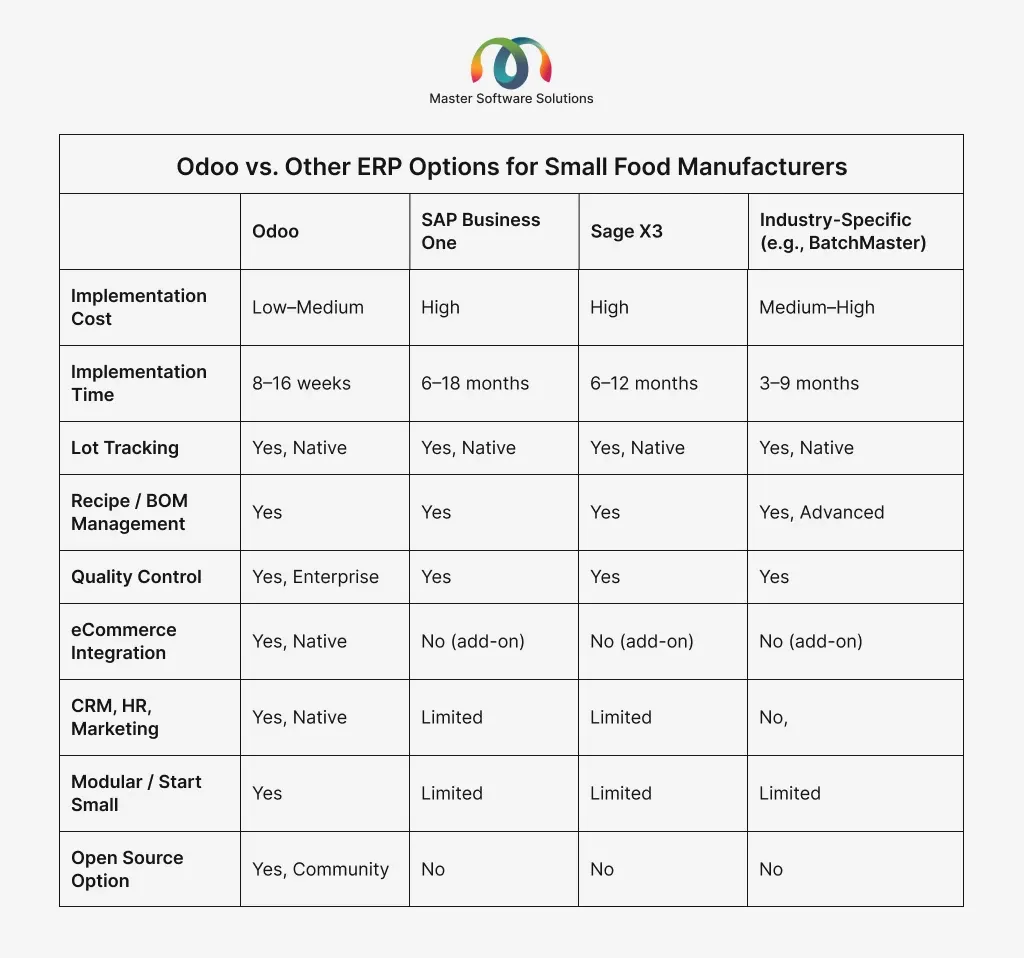
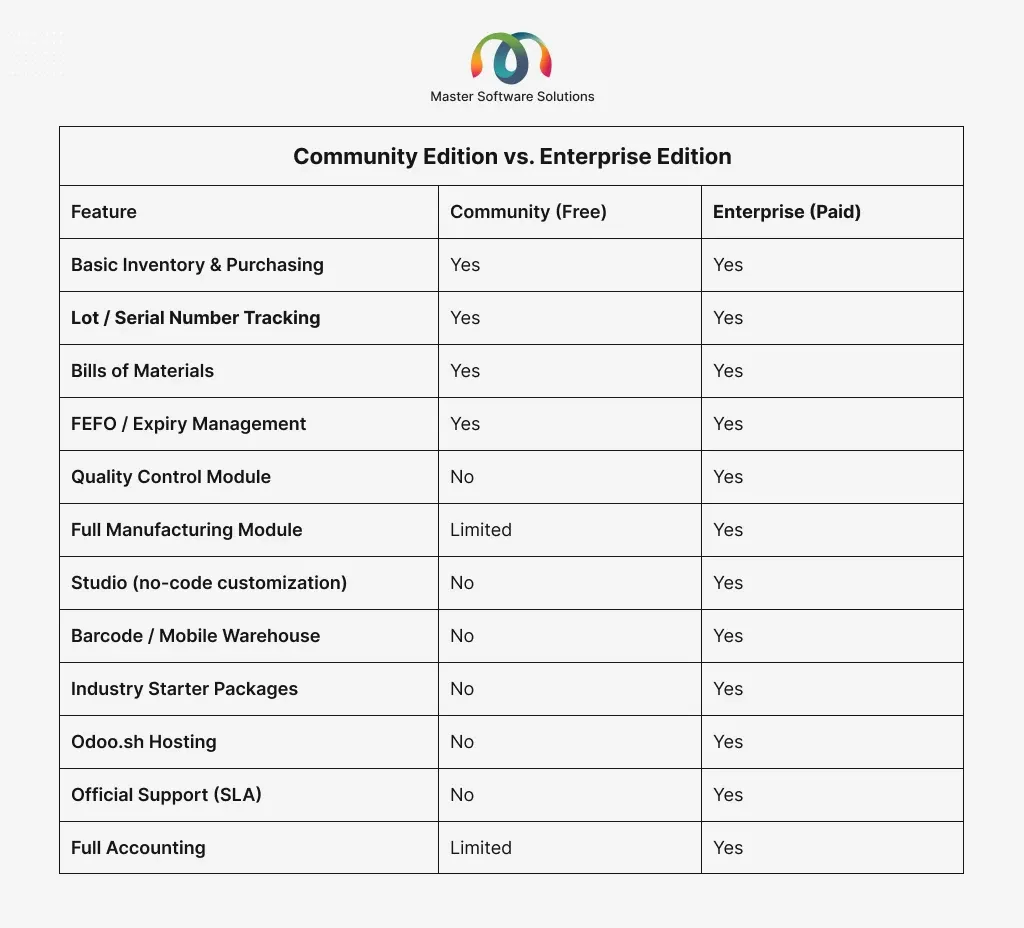
Why is Odoo ERP a great fit for Food Manufacturing Inventory?
Among the ERP platforms available to food manufacturers today, Odoo ERP stands out for the combination of capability, flexibility, and total cost of ownership it delivers, particularly for mid-size manufacturers who need enterprise-grade features without enterprise-grade licensing fees.
Odoo’s inventory management capabilities include native lot and serial number tracking, FEFO and FIFO rotation strategies, multi-location warehouse management with configurable putaway rules, barcode-driven receiving and picking, and deep integration with the Manufacturing module for BOM-driven consumption tracking.
The Quality module in Odoo allows manufacturers to configure incoming inspection checkpoints, production quality control points, and finished goods release workflows — all tied to lot records for full traceability.
And because Odoo is a unified platform, every module, such as Inventory, Manufacturing, Purchase, Sales, Accounting, and Quality, shares a single database. There’s no integration tax. Data flows naturally between departments, and reporting draws from the same source of truth.
For food manufacturers considering Odoo, versions 18 and 19 represent the most mature implementations of these capabilities, with improved AI-assisted replenishment, better multi-warehouse performance, and enhanced traceability reporting.
Exploring Odoo for your food manufacturing operation? Read our complete breakdown of Odoo versions from v14 to the latest to understand which release is right for your implementation.
Real-World Impact: What Food Manufacturers Gain
Food manufacturers who implement ERP-driven inventory management consistently report improvements across these metrics:
Ranges based on industry benchmarks and implementation experience across food manufacturing clients.
These aren’t theoretical numbers. They reflect what happens when a food manufacturer moves from managing inventory reactively, responding to problems after they occur, to managing it proactively, with real-time visibility and automated controls in place.
What a Food Manufacturing ERP Implementation Looks Like
Implementing ERP for inventory management in food manufacturing isn’t a plug-and-play exercise. The most successful implementations share a few common characteristics:
They start with a process audit
Before configuring any software, the best implementations document current inventory processes, including where the gaps are, where the data currently lives, and the biggest pain points. This informs both the configuration decisions and the data migration strategy.
They invest in master data quality
An ERP is only as good as the data it runs on. Ingredient master data, BOMs, supplier records, and opening inventory balances need to be accurate before go-live, or the system will compound existing problems rather than solve them.
They train warehouse staff properly
The fanciest ERP configuration fails if warehouse staff don’t trust the system or revert to workarounds. Change management and hands-on training are as important as the software itself.
They go live in phases
Trying to implement every module simultaneously is a recipe for chaos. Most successful food manufacturing implementations start with core inventory and purchasing, then layer in manufacturing, quality, and forecasting.
They partner with specialists
Food manufacturing has nuances that general ERP consultants often miss: lot tracking requirements, quality workflows, and the regulatory context. Working with a partner who understands the industry makes a measurable difference in outcomes.
The Bottom Line
Inventory management in food manufacturing sits at the intersection of operational efficiency, food safety, and regulatory compliance. Getting it right requires more than spreadsheets and good intentions — it requires real-time visibility, automated controls, and the traceability infrastructure to respond when something goes wrong.
ERP software provides all of this in a single, integrated platform. This results in reduced waste, fewer stockouts, faster recall response times, leaner purchasing, and audit-ready compliance.
The question for most food manufacturers isn’t whether ERP is worth it; the data on that is clear. The question is which platform, which version, and which partner will deliver an implementation that actually sticks.
Ready to Transform Your Food Manufacturing Inventory Operations?
At Master Software Solutions, we’ve helped food manufacturers move from spreadsheet chaos to ERP-driven inventory control with traceability, compliance, and operational efficiency built in from day one.
Whether you’re evaluating ERP for the first time or looking to upgrade a legacy system that’s no longer keeping up, our team will help you build the right roadmap.
Get a Free Inventory Management Assessment
Tell us about your current setup, the gaps, the pain points, and the compliance pressures, and we’ll map out what an ERP solution would actually look like for your operation.
Schedule Your Free Consultation
Already Using an ERP? Let’s Make Sure It’s Working Harder for You
A poorly configured ERP can feel worse than no ERP at all. Our team works on optimization projects, identifying and addressing gaps that undermine accuracy, efficiency, and compliance.
Talk to an ERP Specialist
Frequently Asked Questions
Q1. Can an ERP help with allergen management in inventory?
A1. Yes. ERP systems can flag allergen attributes at the ingredient and BOM level, enforce segregation rules in the warehouse, and generate allergen declarations for finished goods. This is a significant compliance capability for manufacturers producing allergen-containing and allergen-free products in the same facility.
Q2. How long does it take to implement ERP inventory management for a food manufacturer?
A2. For a focused inventory and purchasing implementation, 3-6 months is typical. Adding manufacturing, quality, and forecasting modules extends the timeline. Complexity factors include the number of products, the number of locations, the volume of historical data to migrate, and the degree of process customization required.
Q3. Does ERP replace our warehouse management system (WMS)?
A3. It depends on the scale and complexity of your warehouse operations. For most mid-size food manufacturers, the warehouse management capabilities built into platforms like Odoo are sufficient. Very large-scale operations with complex pick-and-pack workflows, conveyors, or advanced automation may still benefit from a dedicated WMS integrated with the ERP.
Q4. Can ERP handle catch-weight inventory? (e.g., meat, fish, cheese sold by variable weight)
A4. Yes — leading ERP platforms support catch-weight management, which tracks inventory in both nominal units (pieces, cases) and actual weight simultaneously. This is essential for protein processors and other manufacturers dealing with variable-weight products.
Q5. We have multiple production sites. Can one ERP instance manage inventory across all of them?
A5. Yes. Multi-site inventory management — with visibility and control across all locations, inter-site transfer workflows, and consolidated reporting — is a core capability of enterprise ERP platforms. This is one of the significant advantages of ERP over standalone or site-specific inventory tools.
Master Software Solutions is a certified Odoo implementation partner specializing in ERP for manufacturing, distribution, and food production businesses. Our consultants combine deep Odoo expertise with real-world manufacturing operations knowledge to deliver implementations that work on the floor, not just in demos.
Questions about ERP for your food manufacturing operation? Contact us — we respond within one business day.